
Documented Genetic Merit Drives Premiums
Maximizing premiums for cattle with documented genetic potential is putting money in producers’ pockets and ensuring quality beef on shelves.
September 27, 2026
by Maddy Rohr
The genetic decisions cow-calf producers make at breeding determine the potential for profit of every sector of the beef industry. Deciding what bull to turn out with a group of cows or what bull to breed heifers to by artificial insemination (AI) affects performance and acceptability throughout a calf’s lifetime. New tools that document those genetics are helping cow-calf producers reap the benefits of mating decisions that add value for segments further down the supply chain.
Milliken Land & Cattle raises commercial Angus near Lebanon, Mo. The family has seen firsthand how improving the genetic merit of their herd results in increased revenue. For their operation, relying on the AngusLink® Genetic Merit Scorecard® (GMS) makes the difference in calf premiums.
 The premiums don’t lie
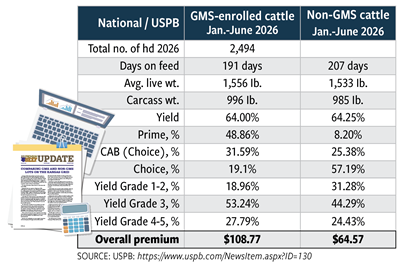
With data from the last six months, U.S. Premium Beef (USPB) reports that GMS lots saw $44.19 more in overall premiums per head than non-GMS lots and had $155.30 more per head in value than non-GMS lots.
Since the beginning of the USPB program, nearly 14,000 head with GMS have been processed. On average, those cattle have received a $178.79 premium per head.
“I think of the Genetic Merit Scorecard as a report card for every calf crop,” owner Marta Milliken says. “It gives you objective feedback on the genetics and management decisions you’re making — and, just as importantly, it gives you that information early enough to do something with it.”
Feedback is important to Milliken, and having a “report card” on each calf crop provides key insights when planning future genetic decisions. The GMS showcases a numeric value for genetic potential by generating scores for feedlot, grid, carcass and maternal genetic merit.
“As producers, we invest in quality genetics and management, so it is imperative that we are both reflective and proactive in our decision-making,” she says. “Having a scorecard on every calf crop — for us, that means receiving feedback twice a year— provides an opportunity to make timely decisions. This is essential as we strive to produce cattle that are maternal, efficient and demonstrate quality carcass merit.”
Using the breeding history of the herd and drawing from the expected progeny differences (EPDs) of the sires used, the GMS assigns to groups of calves a score indicating how well they are expected to perform in the feedlot and on the rail.
Enrolling in AngusLink GMS is simple. The ranch of origin enrolls the cattle using the sire’s American Angus Association registration number and a description of the cow herd, including birth records (see “How to Enroll”).
“This is not an individual animal-by-animal deal,” says Brian Bertelsen, vice president of field operations at U.S. Premium Beef (USPB). “You don’t have to know the sire and the dam of each calf. You need to know what bulls produced this group of calves. Then the Association is going to use updated EPDs. The whole calf crop gets the same score.”
Bertelsen has a vested interest in the GMS scores. In August 2024, National Beef Packing Co. LLC began offering a $5-per-head premium for groups of cattle with a GMS Beef Score of 100 or greater marketed on the USPB grid at its Liberal and Dodge City, Kan., plants. Later that year, it added a $10-per-head premium for groups with a Beef Score of 150 or greater. He sees the closeouts that validate calves are performing on the rail as predicted.
Every calf enrolled in the GMS program is required to have an electronic identification (eID) button. IMI Global, a division of Where Food Comes From, a third-party verification program, enrolls the calves for the rancher. At the time of harvest, these buttons are scanned and connected to the calf’s GMS scores and eID tags shared from IMI.
A Beef Score of 100 represents industry average, Bertelsen explains, so National is paying a premium for cattle with the genetics to be above average. And the predictions are proving out (see “The premiums don’t lie”).
Marketing genetic merit
Earning premiums on the USPB grid is an advantage for Milliken, but the data received through GMS scores also assist in marketing their replacement females, capitalizing on whole-herd success.
“Enrolling calves in the Genetic Merit Scorecard has allowed us to analyze the $Beef, $Grid, and $Feedlot scores in a more concise manner,” she says. “Prior to this, I was only able to analyze data on our steer calves after harvest. Having this information prior to harvest has proven beneficial when marketing replacement heifers from the same calf crop.”
Building a résumé for their herd shows continued genetic improvement and builds industry credibility.
“We analyze our most current data to identify areas where we want to see growth and improvement. That information determines the traits we leverage when choosing sires,” Milliken adds. “There is always value in being able to produce tangible evidence rather than relying on assumptions based solely on breed. Breed assumptions can give you a starting point, but genetic merit gives you a measurement.
“We live by the philosophy that pounds pay, but quality pounds pay more,” Milliken continues. “Investing in quality Angus genetics supports this philosophy. Angus genetics have consistently returned more quality-grade premiums than any other genetics we have seen.”
Increasing predictability
For Sam Hands of Triangle H, Garden City, Kan., the biggest advantage from a feedyard perspective is predictability.
“If I see a scorecard come in and the cattle are scored at 155, I know then that, as we near the finish point, we can expect very good results,” Hands says. “If they’re saying 125, we know we may have to work a little harder to get all we can out of them.”
In addition to feeding cattle, Triangle H has a cow-calf operation. They crossbreed many of their cows to Angus bulls. Those progeny receive a score through GMS.
Hands says the incentive for him is having another tool to ensure he is producing cattle that meet the quality consumers demand.
“It’s just a matter of giving more credibility to what you’re producing,” Hands says. “It gives a benchmark to know where they’re at, and [it] gives us a better idea of what we expect out of them, and hopefully do a better job of helping them reach their potential.”
While Hands appreciates GMS scores for making his job easier when feeding cattle for other producers, he notes that measuring genetic merit ultimately affects the future acceptability of beef for the consumer, too.
“We’ve been very fortunate these last couple years here with the price of beef, and certainly they could go buy other protein sources cheaper, but they keep coming back for beef, and we just don’t want to lose that.”

Herd impact
The GMS program primarily draws from the EPDs of the producer’s bull battery, but there is a more advanced option for those wanting to include data from the cow herd. Testing the breeding females with GeneMax® Advantage™ helps add genetic information on the cow herd to provide a more accurate GMS score.
“It’s not a requirement to DNA test,” Bertelsen says, “but you can really get an even more accurate value. That’s going to start to have a pretty big impact on your calf scores because you’re taking into account both the cow herd and the bull battery.”
Milliken prefers a full-circle approach, and GeneMax helps make the best decisions.
“GeneMax is used not only to select replacement heifers to retain in our program, but also to ensure that the females we offer for sale are quality females for someone else’s program,” she says. “GMS scores and the USPB data are tied back to individual calving records to determine which cows and sires remain in our herd.”
By using the most current data available, Milliken can identify areas where improvement is needed. She uses that information to determine what traits are leveraged when choosing sires.
“You can’t measure what you don’t know. Every management decision has an economic impact, and genetic evaluation gives you information you can actually use to make those decisions,” she concludes. “For us, the combination of genotype, phenotype and actual performance has helped us improve quality grade and, ultimately, our return on investment.”
Editor’s note: Maddy Rohr is a freelance writer and cattlewoman from Weatherford, Texas.
Angus Beef Bulletin EXTRA, Vol. 18, No. 10-A
Topics: EPDs , Management , Marketing , Record Keeping , Success Stories
Publication: Angus Beef Bulletin
Issue: November 2026
Related Content


Current Angus Beef Bulletin
Our September issue focuses on the females of the herd and the records that validate them.