



Feeder-Calf Marketing Guide
National Beef, USPB Reflect on Genetic Premiums
Stakeholders review first-of-their-kind grid premiums based on genetic merit data.
August 2, 2025
There’s a first for everything. In August 2024, the first producers earned premiums on the U.S. Premium Beef LLC (USPB) Kansas grid based on the genetic merit of their cattle. A year later, the Genetic Merit ScorecardSM (GMS) remains the measuring stick for premiums offered by National Beef Packing Co. LLC (NBP).
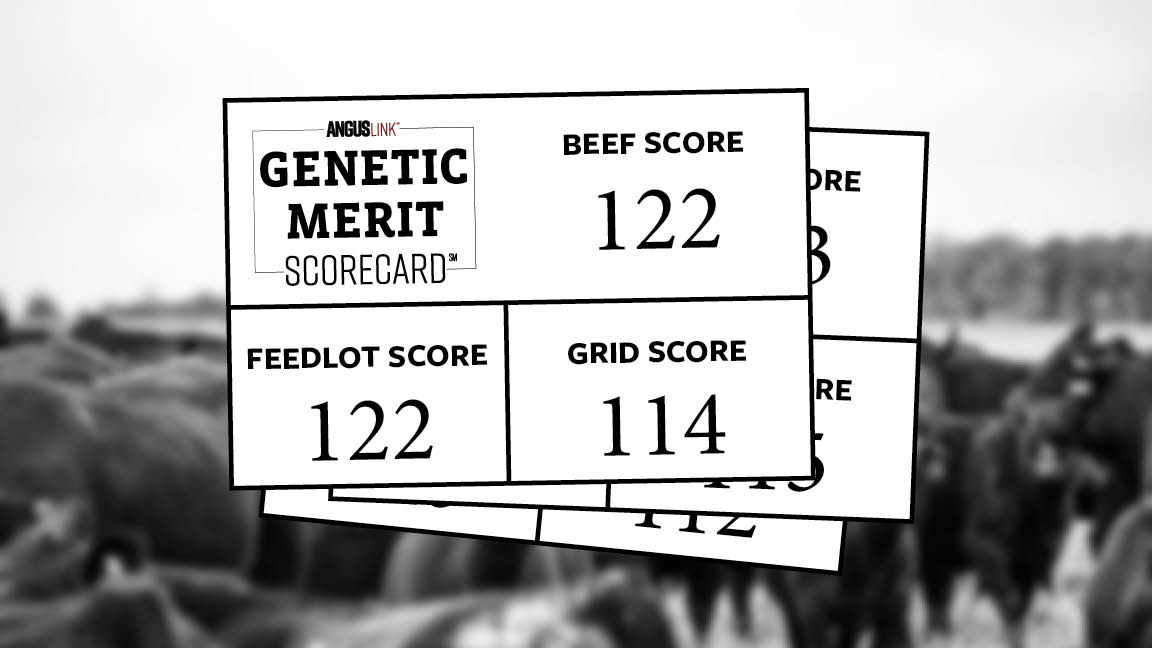

“It’s predictable, consistent quality,” says Chad Barker, vice president of cattle procurement with NBP. He adds that the GMS allows them to forecast and sell that quality with some confidence, because of the predictive power of the tool.
The GMS is one of the AngusLinkSM value-added programs administered by the American Angus Association in partnership with IMI Global and Where Food Comes From. It objectively describes performance potential across four areas using a range from 0 to 200, with the industry average being 100.
The GMS Beef Score specifically predicts genetic potential for feedlot performance and carcass value and is calculated using the Association database and genetic information on sires and the cow herd. For producers and feeders, cattle harvested Aug. 5, 2024, and later with a Beef Score of 100 or greater on the AngusLink GMS can earn a grid premium of $5 per head. In December 2024, a second grid premium — $10 per head for cattle with a GMS Beef Score of 150 or greater — took effect, while those scoring 100-149 continued to receive the $5-per-head premium.
These premiums have been in addition to all other premiums and discounts available based on grading and carcass performance, and they are exclusively available for cattle marketed through USPB and delivered to NBP plant locations in Liberal and Dodge City, Kan.
Predictable performance
Barker says NBP has been pleased with the quality of qualifying cattle.
“I think all but maybe four pens have been really high Prime,” he says. “That’s something we would not be able to sort out or find without the scorecard.”
Troy Marshall, director of commercial industry relations for the Association, says the cattle going into the program have been extremely good, averaging close to 150 for their GMS Beef Score.
Brian Bertelsen, USPB vice president of field operations, agrees the cattle with a GMS going through the USPB grid have been well-above average. Looking at data from August 2024 through mid-February 2025, greater than 44% have been Prime. The average for the industry is 11% Prime.
These qualifying cattle have averaged more than $200 per head premium over selling in the cash market, Bertelsen says. As a reference, the non-GMS or USPB average premium during the same period was a little over $100 more than if those cattle were marketed on the average cash, live market in Kansas.

“Moving forward, we sure hope that more cattle feeders and feedlots will step out and buy AngusLink GMS-enrolled feeder cattle to really boost the volume of cattle,” says Brian Bertelsen.

Bertelsen says, overall, these cattle have excelled in all areas except for Yield Grade 4s and 5s. Their average live weight was close to 100 pounds (lb.) heavier than all other USPB cattle.
“The better your genetics are for marbling, the longer you probably ought to feed them to let them do what you designed them to do,” he says.
Barker says the traceability component of this is something they like, but it’s also something that has not fully developed yet.
“We like being able to share and make progress and make improvements,” Barker says. “We just have to find out what’s an effective mechanism for sharing and communicating it.”
Room to grow
At the one-year mark, Barker says the main challenge is getting enough volume consistently.
“As long as we can continue to show a little incremental margin, we’re going to be committed to growing it, and we know most good things take time,” Barker says.
To qualify for the GMS, calves’ sires must be predominantly registered Angus, and 75% of the bull battery must be registered.
“I know the guys that feed them like them,” Barker says about AngusLink cattle. “Then they bring a pretty big grid return.”
Marisa Kleysteuber, managing partner of Triangle H near Garden City, Kan., estimates between one-half to two-thirds of the cattle at their feedyard are enrolled in AngusLink, and 50% of those are customer cattle. The rest are owned by Triangle H and K Ranch. Most of the cattle fed at their yard are marketed on the USPB grid.
“The GMS AngusLink program definitely rewards producers for producing high-quality beef,” she says. “Our focus is the consumer and producing what the consumer wants; and they’ve clearly said they want high-quality beef. I think it’s exciting that there’s another program out there that is rewarding the cow-calf producers for their willingness to focus on high-performance, quality cattle.”
Tracking cattle with the GMS to earn grid premiums “makes it a little more challenging, and we’ve had to adjust our management some with how we’d typically sort our cattle,” she says. Other adaptations have included making sure all AngusLink certificate numbers are listed on the show list for NBP and providing that list two weeks ahead of harvest instead of one.
Who’s participating?
Before these grid premiums were added, people retaining ownership of their cattle through the feeding phase did not have much incentive to enroll in the GMS program outside of benchmarking their genetic progress.
“They now have a financial incentive,” says Doug Stanton, senior vice president of sales and business development at IMI Global. “They can see in the U.S. Premium Beef grid that they can earn an additional $5 or $10 a head based on their Genetic Merit Scorecard on the Beef Score specifically. In most cases it’s been eye-opening for them from the standpoint that cattle were maybe better than they thought they were.”
Many of those who earned premiums this past year have been those already comfortable with marketing cattle on the USPB grid or retained ownership.
“It’s really nice that those people can get a little bit more premium, a little bit more recognition,” Bertelsen says. “We can even better identify them in our data and recognize them with the higher premiums for the cattle that are truly genetically designed for our system.”
Stanton says he anticipates new participation coming through USPB members buying cattle with the GMS, placing them in a USPB yard and then delivering them to NBP.
Digital EXTRAs
- Listen to “How Bull Selection Affects Your Feeder-Calf Prices” with Brian Bertelsen
- First Grid Premiums Offered for Genetic Merit
More will participate the second year because they will have heard more about it, Bertelsen says.
“Moving forward, we sure hope that more cattle feeders and feedlots will step out and buy AngusLink GMS-enrolled feeder cattle to really boost the volume of cattle,” Bertelsen says. He recognizes it is a challenging time to ask feeders to do that, given the current cattle supply.
“They certainly know and appreciate that genetics make a difference,” he says. “If the record-high prices of feeder cattle postpone their stepping out and buying these cattle, that’ll change. This cattle cycle will come around eventually.”
For those ready to take the next step, he reminds producers the process of enrolling and getting a GMS for cattle is pretty easy.
“You don’t have to have an on-site audit,” he says. “You just need to send the birth dates, the registration numbers (for sires), and a description of the cow herd.”
There is no additional cost associated with the GMS program, aside from IMI Global’s Age and Source verification enrollment, which includes an electronic identification (eID) tag. Plus, for cattle marketed on the USPB grid, a $1-per-head premium is paid for each low-frequency eID tag that is read and assigned to a carcass ID number within each lot.
When available, feeders can lease USPB delivery rights to market cattle through USPB on the Kansas grid. Those interested should call USPB at 866-877-2525 or visit www.uspb.com for more information.
“As we see more and more acceptance of the scorecard as a valuable tool for describing cattle’s genetic merit in the marketplace, I know we’ll see this program progress,” Marshall says. “There’s tremendous value in better understanding the genetics of cattle in our industry, and this has just added to the momentum we see for rewarding the good work producers are already doing.”
For questions about the GMS or the grid premium, call 816-383-5100 or email anguslink@angus.org. To enroll, call IMI Global at 303-895-3002, or complete the contact form at www.imiglobal.com/contact.
Editor’s note: Sarah Kocher is senior communications specialist for the American Angus Association.
Angus Beef Bulletin EXTRA, Vol. 17, No. 8-A
Topics: Feeder-Calf Marketing Guide , Marketing , Industry News , News
Publication: Angus Beef Bulletin
Related Content


Current Angus Beef Bulletin
Our September issue focuses on the females of the herd and the records that validate them.