




Consider Leaving Some Corn Standing
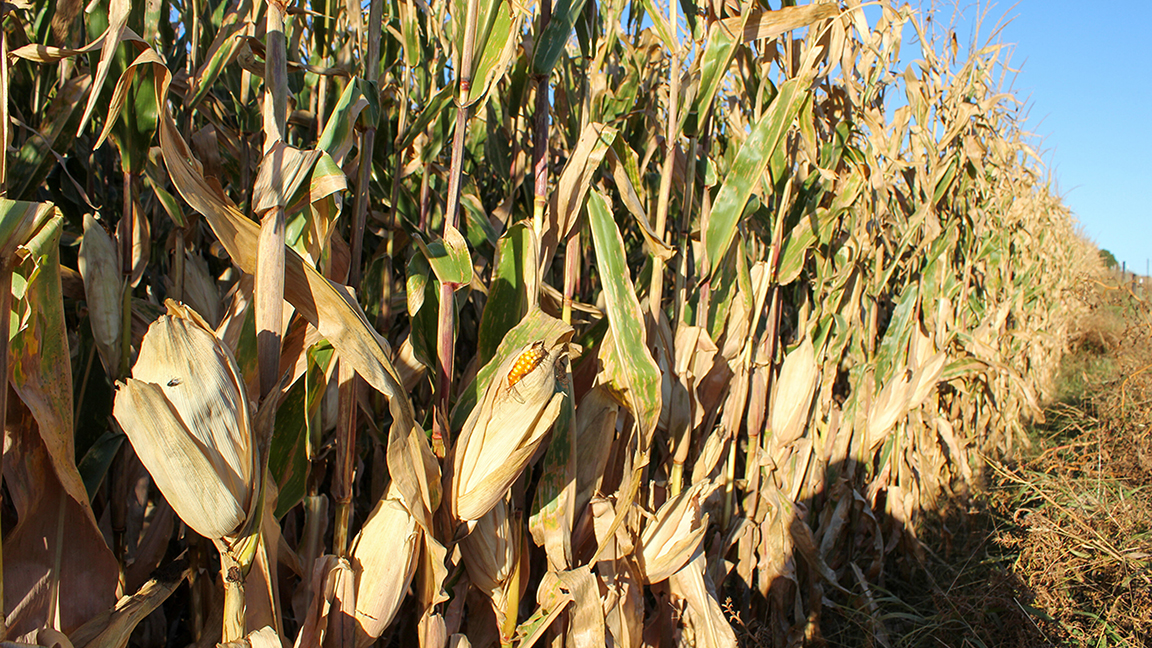
Leaving some corn in the field can add grazing days for grazing cornstalks.
October 7, 2026

by Aaron Berger, University of Nebraska
With severe drought conditions affecting large portions of the state of Nebraska and other areas, forage production on rangeland and pasture has been significantly reduced. Hay production has also been affected by the drought, leading to yields that in many places are only one-third to one-half of the long-term average. In some places farther west, they are even less.
For many cow-calf producers, this means there will be very little fall and winter grazing available, and hay will be in short supply. Corn-residue grazing, especially on irrigated pivots, is going to be in high demand. In fact, demand for corn-residue grazing will exceed supply in many locations.
While forage prices are high, corn prices are near the cost of production. When both forage and other feed options are considered, corn in many cases is the most economical energy source available for feeding the cow herd. This sets up a scenario where purposefully leaving some corn standing in the field to be gleaned directly by the cows while also grazing residue could be a way to significantly increase the number of grazing days a field could provide.
A rule of thumb is that for every 100 bushels (bu.) of corn yield from a field, there are approximately 25-30 grazing days available of husks and leaves for 1,300-pound (lb.) cows. However, if with corn residue cows are given 11 lb. of corn per day of standing grain through strip-grazing, the number of days of feed available could be increased by 1.5 to 2 times.
In this situation, the harvested area of residue needed could be allocated along with a daily delivered strip of standing corn. In addition, a supplement could be provided daily in a pound or more of a feed that contains the ionophore monensin along with vitamins, minerals and additional protein. Under these conditions, supplementing non-protein nitrogen in the form of urea would be an option to meet rumen degradable protein needs of the cows, as the microbes in the rumen could effectively utilize the nitrogen with the readily available energy from the corn.
Cows coming out of drought-stressed pastures are likely going to be thin and would benefit greatly from this type of feeding scenario to gain weight going into the fall and winter and put on body condition prior to calving. Having corn standing in the field also provides a readily available feed resource that will stick out above the snow should the winter bring much needed precipitation. Cow owners could calculate how much corn will be needed and buy bushels of standing corn by the acre from the farmer from whom they rent cornstalks.
The economics of leaving strips of standing corn
When considering the economics of grazing strips of standing corn with residue, there are several questions that need to be asked:
- What is the cost of the next alternative feed option of comparable quality delivered to the cow compared to grazing standing corn and residue in the fall or winter?
- What are the benefits of reduced expenses by harvesting standing strips of the crop with cattle vs. combining and hauling the grain? For example, the 2026 Nebraska Agricultural Custom Rates report states harvesting irrigated corn is $0.32 per bushel (bu.) and hauling is $0.15 per bu., for a total of $0.47 per bu. or $94 per acre for harvesting costs if the crop yields 200 bu. per acre.
- What is the value of grazing and recycling nutrients being consumed from grain and stover back on the field as fertilizer (manure and urine) at today’s prices? Around 0.70 lb. of nitrogen, 0.31 lb. of phosphate, 0.27 lb. of potassium, and 0.6 lb. of sulphur are in 1 bu. (56 lb.) of corn grain.
Quick math for an irrigated corn crop grazed in the fall and winter with dry cows:
A 200-bu. corn crop at $5 per bu. and corn-residue grazing at $35 per acre generates a gross value of $1,035 per acre.
| Gross value per acre of grain harvest and grazing residue | = $1,035 |
| Reduced harvest expense of not combining and hauling corn | = ($94) |
| Estimated value of corn grain nutrients retained [30% of nitrogen (N), 80% of phosphorus, potassium and sulpher (P,K,S)] | = ($110) |
| Value per acre of standing corn to equal the value of crop after credits | = $831 |
| $831 per acre ÷ 200-bu. corn | = $4.16/bu., or about $0.07/lb. of corn |
Cow costs per day
| 11 lb. of corn at $0.07 per lb. |
= $0.77 |
| 20 lb. of residue at $0.02 per lb. | = $0.40 |
| 2 lb. per day of protein/mineral/ionophore | = $0.50 |
| Total feed per day per cow | = $1.67 |
Spring-calving cows with calves weaned off would likely gain around 1.5 lb. per head per day on this feeding plan. The old saying, “The eye of the master fattens the ox” applies here. The amount of area needed will vary depending on cow body condition, residue in the field and weather as grazing progresses.
For comparison, providing cows an average grass hay at $200 per ton, having a total digestible nutrients (TDN) energy value of 55% and crude protein at 8%, along with 3 lb. per head per day of a dried distillers’ grain (DDG) cube at $375 per ton, would have similar performance and cost about $3.75 per head per day.
What are the logistics?
How could this work? Let’s assume an irrigated cornfield with a 200-bu. yield. If the farmer harvests all the corn on an acre, there are approximately 50-60 days of grazing per acre of husks and leaves for one 1,300-lb. cow.
If, in addition to residue, 11 lb. of standing corn were targeted to be allocated per day per cow, 1/1,000 of an acre of 200-bu. corn yield would provide the desired amount of grain. If corn is planted on 30-inch rows, 17 feet, 5 inches is 1/1000th of an acre. For 100 cows, being allocated 11 lb. per day of 200-bu. corn, 0.1 acres of standing corn is needed.
If the 100 cows are provided with 20 lb. of leaves and husk to go along with the corn, approximately 1 acre of harvested corn residue should meet this need along with the corn husk and leaf available from the grazed standing corn. Because of the corn being supplied, cows can be expected to eat a greater percentage of the corn residue in the field, utilizing more of the cobs and corn plant tops and still achieve acceptable performance.
This level of residue utilization is greater than what would be targeted if only corn residue without grain were being grazed. Cows should be worked up to 11 lb. of corn over a 7- to 10-day period, increasing the amount of corn the cows are consuming daily to reduce the risk of acidosis.
Strategic planning of where standing corn strips are to be left in the field in relation to the water source and prevailing wind can help make the most of this opportunity. After harvest, when standing corn strips are left, calculate the area needed daily for the allocation of standing corn and use a tractor with a front-end loader or a UTV to lay down alleys. This allows for building temporary fence across standing corn rows, so cows can see the wire and keep standing corn from being knocked down into the temporary electric fence.
In terms of fencing for strip-grazing, quality geared reels with polywire or braid, step-in posts and solar chargers are tools that are beneficial to make this practice effective. This scenario is also one that would lend itself well to the use of virtual fence technology. The outside traditional boundary electric fence would still be needed, but cows could be moved internally with virtual fence collars, being given the desired amount of standing corn and harvested corn residue daily.
The thought of purposefully leaving strips of standing corn in the field for cows to graze directly may be a bit of a mental stretch for both the farmer and cow owner. However, with current prices for corn and the market value of limited hay and other forages, it looks to be one of the most cost-effective options available for putting weight on cows, stretching corn residue resources and getting cows fed through this fall and winter.
Editor’s note: Aaron Berger is an extension educator for the University of Nebraska. [Lead photo by Troy Walz.]
Angus Beef Bulletin EXTRA, Vol. 18, No. 10-A
Topics: Feedstuffs , Management , Nutrition
Publication: Angus Beef Bulletin
Related Content


Current Angus Beef Bulletin
Our September issue focuses on the females of the herd and the records that validate them.