



How Much Is Enough?
University of Nebraska researchers consider how much vitamin A supplementation is enough for beef cows.
October 7, 2026

by Mary Drewnoski & Marissa Eekhoff, University of Nebraska
Vitamin A is important for immune function, reproduction, vision and growth. In cow-calf production, the young calf is particularly vulnerable to vitamin A deficiency, which can impair immune function and increase susceptibility to scours and respiratory disease.
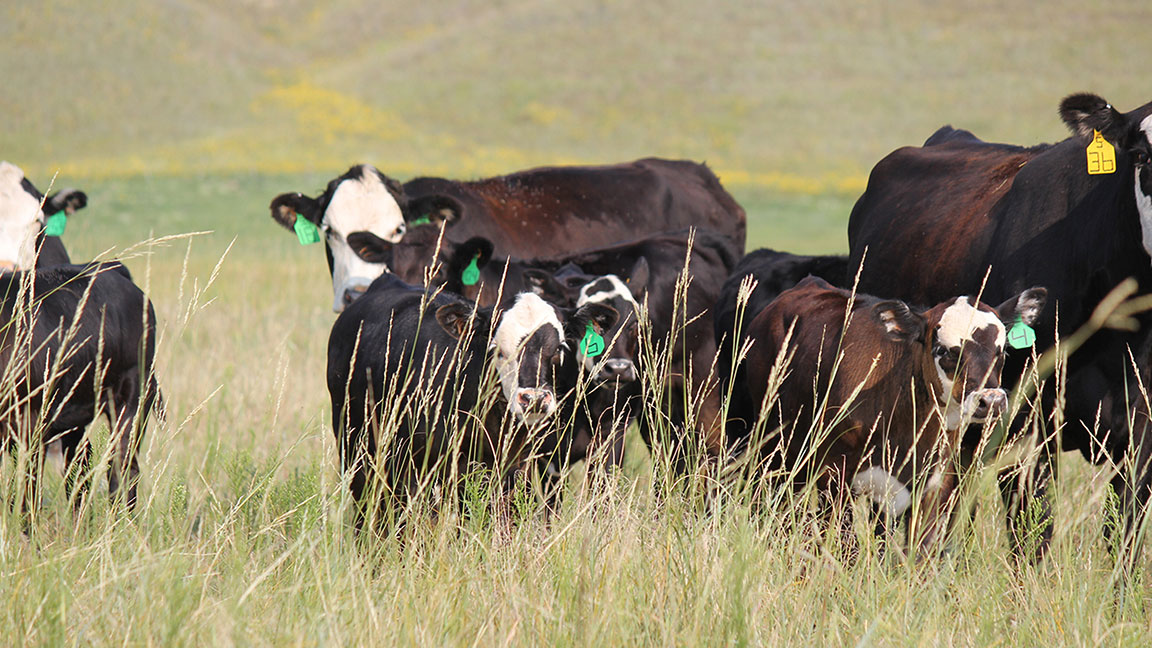
Fresh, green forage is an excellent source of vitamin A; however, dormant, weathered or long-stored forage may contain very little. That means even in a normal year, spring-calving cows may not consume enough vitamin A during late gestation before green grass is available. This year, drought may increase that concern for many herds because cows may have spent more time consuming brown forage and are entering winter with lower vitamin A stores.
Calves are born with very little vitamin A and depend on colostrum to build their stores. Vitamin A in colostrum comes from both the cow’s liver reserves (where she stores vitamin A) and what she is consuming during late gestation. However, one of our recent studies illustrates that liver stores alone are not enough.
The take-home message is that good vitamin A stores in the cow do not guarantee adequate vitamin A for her calf.
Cows entered the study after grazing green pasture and had very high liver vitamin A stores. They were then fed alfalfa hay and corn silage with relatively little supplemental vitamin A. At approximately one month after calving, the cows still had adequate liver vitamin A stores, but their calves did not. The take-home message is that good vitamin A stores in the cow do not guarantee adequate vitamin A for her calf.
Her vitamin A intake during late gestation matters, too. It has been shown that the late-gestation diet contributes around 60% of the vitamin A in the colostrum, with the liver only contributing 40%.
How much vitamin A is enough?
Current recommendations would suggest providing approximately 31,000 IU of supplemental vitamin A per day to a 1,200-pound (lb.) gestating cow. However, recent Nebraska research suggests that may not be enough when cows are consuming stored or dormant forages.
In our study, cows had been fed stored feeds for a year or more and were receiving approximately 31,000 IU of supplemental vitamin A per day before the study began. Despite that supplementation, their average liver vitamin A stores were below the range considered adequate. Cows that continued to receive 31,000 IU per day remained below the adequate range, while cows receiving 93,000 IU per day reached adequate liver vitamin A concentrations after 81 days. Calves from cows receiving 31,000 IU per day also had inadequate liver vitamin A concentrations at about 1 month of age, while the average concentrations of calves from cows receiving 93,000 IU per day were adequate.
These cows represented a relatively high-risk situation: They had been fed stored feeds for a year or more and began the study with low liver vitamin A stores. Thus, 93,000 IU per day should not necessarily be interpreted as the minimum needed by every cow. Cows entering winter with greater stores or consuming hay that retains some green color will likely receive more vitamin A from their diet.
For most spring-calving cows consuming dormant or stored forage, targeting at least 75,000 IU of supplemental vitamin A per cow daily during late gestation is a reasonable approach. That may sound like a lot, but it is still below the 93,000 IU per day that was needed to bring cows with low vitamin A stores into the adequate range in our research. In herds that have experienced prolonged drought, have been consuming low-quality or weathered forage for an extended period, or are otherwise likely to have low vitamin A stores, targeting closer to 90,000 IU per day may be warranted. This number aligns well with the total vitamin A intake recommendations suggested by other countries.
How can you supplement vitamin A?
Vitamin A can be supplied through free-choice mineral, cake, cubes or another supplement. The table below shows the concentration needed in supplements fed at several common intake levels to provide either 75,000 or 90,000 IU of supplemental vitamin A per cow daily.
|
Supplement fed per cow daily |
Amount needed in supplement to provide 75,000 IU/day |
Amount needed in supplement to provide 90,000 IU/day |
|
4 oz. |
300,000 IU/lb. |
360,000 IU/lb. |
|
1 lb. |
75,000 IU/lb. |
90,000 IU/lb. |
|
2 lb. |
37,500 IU/lb. |
45,000 IU/lb. |
Vitamin A degrades during storage, particularly when supplements are stored for long periods or in hot, humid conditions. Avoid carrying excessive mineral inventory and store vitamin-containing supplements in a cool, dry location whenever possible.
Using free-choice mineral to supply vitamin A?
If you cannot find a mineral containing enough vitamin A, or you have mineral that has been stored for an extended period and are concerned about vitamin A degradation, adding fresh vitamin A premix may be an option. Contact your local feed mill and ask whether they can obtain a vitamin A premix for you to add to your mineral.
Vitamin A premixes are highly concentrated. A common premix contains approximately 30,000 IU of vitamin A per gram. The table below shows approximately how much additional vitamin A would be supplied by adding different amounts of a 30,000 IU-per-gram premix to a 50-lb. bag of mineral. The vitamin A supplied by the premix is in addition to the vitamin A already present in the mineral. For example, adding ¾ lb. of a 30,000 IU-per-gram vitamin A premix to a 50-lb. bag of mineral containing 150,000 IU per lb. would add 200,000 IU per lb. and result in a final mixture containing approximately 350,000 IU per lb. At a 4-ounce (oz.) daily intake, that would provide about 87,000 IU of vitamin A per cow per day. Adding a full pound would increase the final concentration to approximately 414,000 IU per lb. and provide about 103,000 IU per cow per day.
|
Vitamin A premix added to 50-lb. bag of mineral mix |
Vitamin A concentration added to mineral |
Vitamin A supplied at 4-oz. mineral intake |
|
¼ lb. |
68,000 IU/lb. |
17,000 IU/cow/day |
|
½ lb. |
135,000 IU/lb. |
34,000 IU/cow/day |
|
¾ lb. |
201,000 IU/lb. |
50,000 IU/cow/day |
|
1 lb. |
267,000 IU/lb. |
67,000 IU/cow/day |
However, the concentration on the tag only helps if cows are consuming the expected amount. Check mineral disappearance and determine whether actual intake is close to the target. If a mineral is formulated for 4 oz. per day, but cows are only consuming 2 oz., they are receiving only half of the vitamin A you expect.
What about feeding alfalfa?
Good-quality, green alfalfa can be a useful source of vitamin A activity, but the amount varies considerably with maturity, harvest conditions, storage time and how much green color remains. Feeding a few pounds of alfalfa as a protein supplement can contribute some vitamin A but generally will not provide the 75,000 to 90,000 IU per day we are targeting. If good-quality alfalfa makes up a substantial portion of the cow's diet, its contribution can be much greater. However, because vitamin A activity declines during storage and is difficult to predict based on appearance alone, we would not suggest relying on supplemental alfalfa to replace vitamin A supplementation during late gestation.
|
Alfalfa fed |
Avg. alfalfa, some green |
Very green alfalfa |
|
2 lb./day |
~8,000–13,000 IU |
~16,000–22,000 IU |
|
5 lb./day |
~20,000–31,000 IU |
~40,000–56,000 IU |
|
10 lb./day |
~40,000–63,000 IU |
~81,000–111,000 IU |
The bottom line
Do not assume that cows are receiving enough vitamin A simply because they do not show signs of deficiency or because they entered the winter with adequate liver stores. For spring-calving cows consuming dormant or stored forage, pay particular attention to vitamin A during late gestation. Target at least 75,000 IU of supplemental vitamin A per cow daily and consider closer to 90,000 IU per day when cows may have lower stores because of prolonged drought or extended periods on brown forage.
Editor’s note: Mary Drewnoski is a Nebraska Extension beef systems specialist and Marissa Eekhoff is a virtual fence program field specialist. Source: Speer et al, 2024. Vitamin A in Cow-Calf Production: Impacts of Maternal Supplementation and Status on Offspring. Nebraska Beef Report. p 25-27. [Lead photo by Troy Walz.]
Angus Beef Bulletin EXTRA, Vol. 18, No. 10-A
Topics: Feedstuffs , Nutrition , Pasture and Forage
Publication: Angus Beef Bulletin
Related Content


Current Angus Beef Bulletin
Our September issue focuses on the females of the herd and the records that validate them.