

Policy Matters
While OBBBA may have taken some big spending questions off the table, there is still plenty at stake for cattle producers.
September 28, 2026
The last Farm Bill passed into law in December 2018. The five-year legislation was set to expire Sept. 30, 2023, and has since been kept active through multiple temporary extensions.
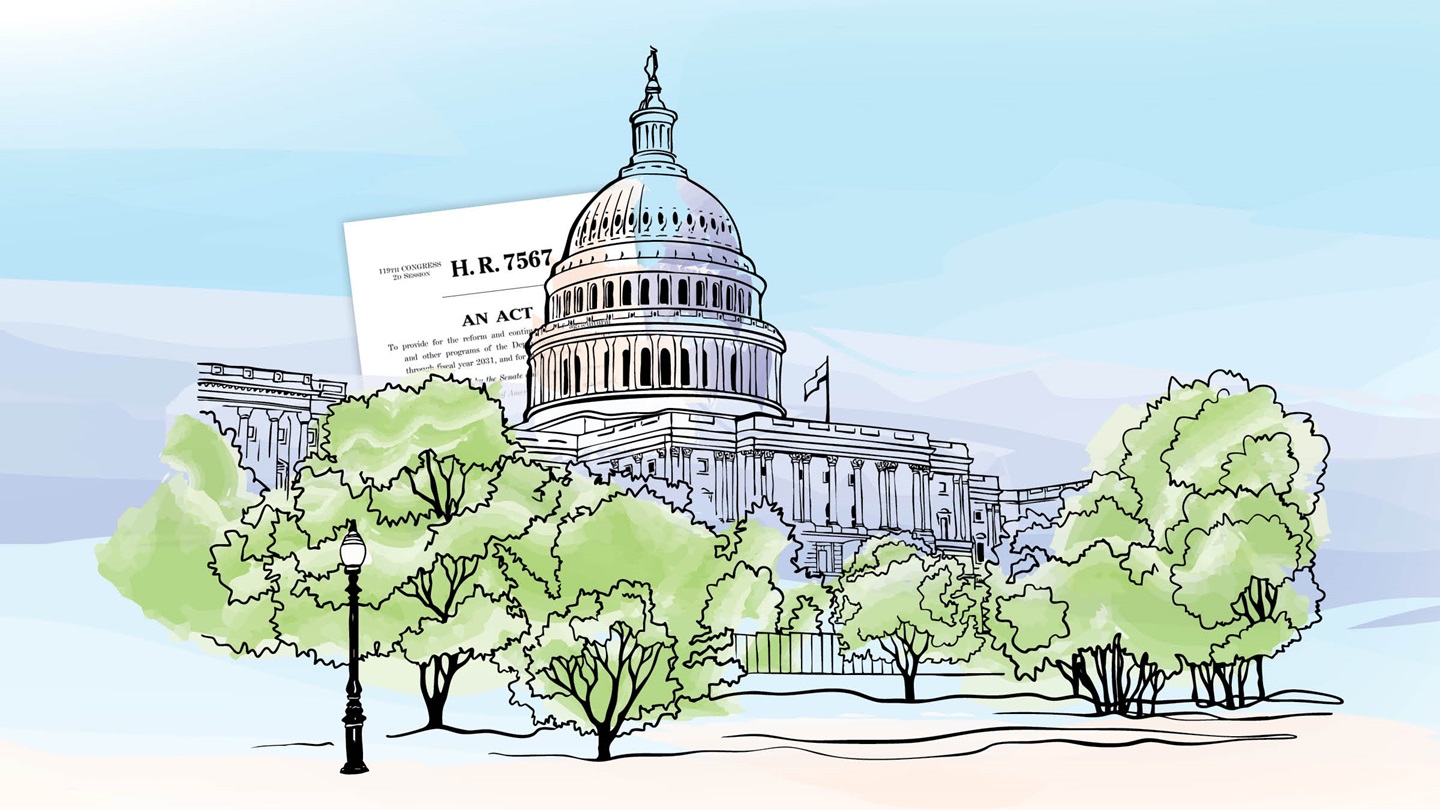
On April 30, 2026, the House of Representatives passed the Farm, Food and National Security Act of 2026 (H.R. 7567) on a 224-200 vote. However, a path forward in the Senate is less certain.
On Aug. 6, the Senate Committee on Agriculture, Nutrition and Forestry convened a hearing to consider its version of a 2026 farm bill. With Senators Mitch McConnell (R-KY) and Tommy Tuberville (R-AL) not in attendance, the bill failed to advance out of committee on a party line vote of 11-10. However, Chairman John Boozman (R-AR) opted to recess and reconvene the committee when members returned from legislative recess in September. With all senators present the bill passed out of committee, again on a party line vote. Whether the full Senate will vote on the bill is in question, with 60 senators needed for a cloture vote to end debate and allow a bill to be voted on and just 53 Republican senators.
Building on OBBBA
Passing a farm bill is always a major legislative lift. This time, Congress has an additional wrinkle as many issues typically addressed in a farm bill were handled through the One Big Beautiful Bill Act (OBBBA), signed into law July 4, 2025. While it did not replace the Farm Bill, Congress used the budget reconciliation process to address many of the programs with the biggest price tags, effectively settling several major farm bill debates before consideration of a new farm bill. For this reason, the current bill under consideration is being called “Farm Bill 2.0.”
Much of the work already completed focused on the farm safety net. OBBBA extended the Agriculture Risk Coverage (ARC) and Price Loss Coverage (PLC) programs through the 2031 crop year and increased statutory reference prices for major commodities. It also authorized up to 30 million additional base acres, increased Marketing Assistance Loan rates, and raised payment limits for ARC and PLC. These are traditionally some of the most consequential and heavily negotiated provisions in the commodity title of a farm bill.
OBBBA also made changes affecting livestock and dairy producers. It strengthened several livestock disaster programs, including expanding assistance for certain unborn livestock losses and adjusting coverage for predation and forage losses. Dairy Margin Coverage was updated, including an increase in the amount of production eligible for Tier I coverage. OBBBA also made changes to the sugar program.
Crop insurance received additional investment and policy changes, including increased premium assistance and additional support for beginning farmers. Conservation programs were another major beneficiary. The law moved substantial funding originally provided through the Inflation Reduction Act into programs such as the Environmental Quality Incentives Program (EQIP), Conservation Stewardship Program, Agricultural Conservation Easement Program and Regional Conservation Partnership Program. That funding was incorporated into the long-term Farm Bill baseline, giving future farm bills a larger pool of conservation dollars from which to work.
OBBBA also addressed agricultural trade promotion and made substantial changes to the Supplemental Nutrition Assistance Program (SNAP). Nutrition programs traditionally account for the largest share of farm bill spending, so addressing SNAP through reconciliation removed another major budgetary issue from the upcoming farm bill debate. However, tensions on SNAP remain, and it was a major reason Senate Democrats did not support the bill in committee in August.
OBBBA requires states with SNAP error rates above 6% to pay part of the cost of food stamp benefits beginning in fiscal 2028, but gives states with the highest error rates, including Alaska, an additional year before the cost-sharing requirement kicks in. While Chairman Boozman offered a one-year delay in the Farm Bill, Democrats wanted to see a two-year delay and no preferential treatment given to specific high-error-rate states.
Farm Bill 2.0
The result is an unusual situation for Congress. A new farm bill is still needed, but many of the most expensive and politically difficult decisions normally associated with it have already been made. Because the reconciliation process generally requires provisions to have a budgetary effect, OBBBA could not simply serve as a replacement farm bill. Numerous programs and policy authorities were left untouched.
Continuing farm bill debate has focused heavily on programs and policies that did not fit within reconciliation, including research, rural development, specialty crops, forestry, credit, energy and various miscellaneous programs. In effect, OBBBA took care of much of the farm bill’s financial heavy lifting, while leaving Congress with the task of assembling the broader ag policy framework around it.

Some remaining topics pertinent to cattle producers that could be addressed include:
- improving the implementation of conservation programs;
- expanding access to credit and increasing outdated ag loan limits;
- amending veterinary grant programs to relieve ongoing rural veterinary shortages;
- clarifying animal disease traceability eligibility under the National Animal Disease Preparedness and Response Program (NADPRP);
- reviewing the cattle fever tick program;
- allowing livestock auction owners to own a small or mid-sized processing facility;
- requiring a report on federal programs to assist producers affected by a foreign animal disease outbreak; and
- possibly other livestock policy issues discussed below.
Key differences
There are some key differences in the House and Senate versions of the bill currently under consideration.
In particular, the House bill included Section 12006, mirroring concepts from the Save Our Bacon Act. This provision blocks state and local governments from regulating livestock production outside their own borders. This language is aimed at stopping California’s Proposition 12, which requires minimum space standards for breeding pigs whose meat is sold in the state, from dictating how farmers must build and operate barns in other states.
While Proposition 12 directly targets pork production, the broader debate over whether one state can effectively dictate livestock production practices in other states has implications across animal agriculture.
While the fix is heavily supported by the National Pork Producers Council and other mainstream agriculture groups, it has become a politically contentious issue with opposition from animal welfare groups. Ultimately, Chairman Boozman did not include the language. With just 53 Republicans in the Senate and no Democrats prepared to support the measure, including the provision could jeopardize passage of the Farm Bill, which would need 60 votes to overcome a filibuster in the Senate.
On the Senate side, Senator Boozman included year-round E15 in the Farm Bill. This would allow gasoline blended with 15% ethanol (E15) to be sold throughout the entire year, including during the summer driving season. While the House passed a separate bill supporting year-round E15, it was decoupled from the Farm Bill. This was due in part to jurisdictional questions over which committee has authority over the issue, but also to disagreements between E15 supporters and oil-state interests. The measures handle refinery exemptions (SREs) under the Renewable Fuel Standard differently. While the House bill would allow gallons exempted for small refiners to be reallocated to other obligated refiners, the Senate Farm Bill does not.
While both bills expand the ability for certain processing facilities to sell meat, the House version applies to custom-slaughter facilities, and the Senate version focuses on state-inspected facilities. The House bill included a pilot program for the Processing Revival and Intrastate Meat Exemption (PRIME) Act, which would let states allow the sale of custom-slaughtered meat directly to local buyers, restaurants and stores. Currently, these facilities process animals only for the personal use of the animal’s owner, household, guests or employees. This is not in the Senate version. Alternatively, the Senate but not the House included language from the Direct Interstate Retail Exemption for Certain Transactions (DIRECT) Act, which would permit the interstate online sale of state-inspected meat.
The Senate bill calls for a report to analyze production trends and marketing practices used in the livestock and meat industries, including the extent to which different marketing practices are used and the possible effects of the use of those marketing practices on industry participants, including consumers. This is not included in the House.
A Senate Farm Bill markup vote to reinstate mandatory country-of-origin labeling (sometimes referred to as mCOOL) for beef drew significant attention in cattle country. The amendment by Senate Majority Leader John Thune (R-SD) would incorporate the American Beef Labeling Act into the Senate’s draft Farm Bill text. This amendment passed 17–6 with support from all committee Democrats and six Republicans, Senators John Thune, Chuck Grassley, Joni Ernst, Deb Fischer, John Hoeven and Cindy Hyde-Smith.
The amendment directs trade and agriculture officials to devise a World Trade Organization (WTO)-compliant system to reinstate mandatory country-of-origin labeling for beef.
Mandatory country-of-origin labeling for beef was included in previous farm bills and implemented in March 2009. However, mandatory country-of-origin labeling for beef and pork was repealed by Congress in December 2015 to avoid more than $1 billion in annual retaliatory tariffs from Canada and Mexico authorized by the WTO.
The House bill does not address mandatory country-of-origin labeling.
Path forward
If the Senate is able to pass its version of the farm bill, significant work remains before a new farm bill can become law. Because of substantial differences in the bills, a conference committee process would likely be necessary to resolve those differences before a final bill is passed into law. Under this process, House and Senate leadership appoint conferees, generally drawn heavily from the Agriculture Committees, but sometimes including members from other committees with jurisdiction over pieces of the bill.
Conferees negotiate differences between the House and Senate bills. In practice, much of the real negotiating occurs among the House and Senate Agriculture Committee chairs and ranking members and their staffs. Once negotiators reach agreement, the conference committee issues a single compromise legislative text. The conference report then returns to both chambers for approval. A conference agreement cannot be amended on the floor. The House votes yes or no on the conference report, and the Senate does the same. If both approve identical text, the bill goes to the President.

For now, however, the first hurdle is getting a Farm Bill through the Senate. If that happens, the focus will quickly shift to resolving significant differences with the House.
While OBBBA may have taken some of the biggest spending questions off the table, there is still plenty at stake for cattle producers. From animal health and conservation to meat processing, Proposition 12, and mandatory country-of-origin labeling, decisions made in the final stages of this Farm Bill debate could have lasting implications for the cattle industry. As Congress returns this fall, cattle producers will have good reason to keep watching what makes it into the final bill — and what gets left behind.
Editor’s note: Chelsea Good is an advocate, strategist and attorney with deep roots in the cattle industry and a proven record of shaping ag policy at the state and federal levels. She founded Good & Associates to help ag clients navigate complex issues, strengthen stakeholder relationships and turn challenges into strategic wins. Prior to launching the firm, she served as vice president of government and industry affairs and legal at the Livestock Marketing Association (LMA), where she successfully led policy efforts resulting in major legislative wins. She is also a former Angus Journal® intern.
Topics: Business , Management , Record Keeping
Publication: Angus Beef Bulletin
Issue: November 2026
Related Content


Current Angus Beef Bulletin
Our September issue focuses on the females of the herd and the records that validate them.