


Policy Matters
How USDA is rebuilding America’s defense against New World screwworm.
August 10, 2026
For decades, New World screwworm (NWS) was something many U.S. cattle producers only read about in history books.
NWS is a destructive parasitic fly whose larvae infest warm-blooded animals and particularly cattle. Female flies seek out open wounds — including branding sites, castration wounds, dehorning sites, navels on newborn calves, tick bites or even small scratches — and lay clusters of eggs.
Once the eggs hatch, the larvae burrow deeper into healthy tissue, enlarging the wound as they feed. Left untreated, infestations can become severe and even fatal.
During the mid-1900s, NWS was a costly reality across much of the southern United States. Ranchers routinely dealt with infestations, livestock losses and expensive treatments.
Beginning in the 1950s, the USDA and its partners launched one of the most successful animal health campaigns in history. Through decades of cooperation with states, Mexico and countries across Central America, the pest was steadily pushed farther south until it was eliminated from the United States and much of North America (see map above).
However, the long-standing containment line unraveled, with NWS cases breaching the Darién Gap and spreading through Panama. In November 2024, after a positive detection of NWS in southern Mexico, USDA closed the border for live cattle imports from Mexico.
The border briefly reopened in early 2025, after new protocols were developed for import, but additional cases in Mexico have caused imports to be effectively suspended since May 2025.
One concern has been illegal movements of cattle north into Mexico that bypass inspection and carry false paperwork. Wildlife can also carry NWS north.
Staging a response
While much of the public attention focused on border closures and the spread of NWS through Mexico, USDA spent much of 2025 preparing for the possibility that the parasite could reach the United States.
USDA developed a NWS Response Playbook to coordinate the federal response alongside state animal health officials, industry groups, and other federal agencies. The agency also expanded surveillance and trapping.
The Food and Drug Administration (FDA) issued emergency use authorizations for several products to aid producers should screwworm be detected in U.S. livestock, including ivermectin and Dectomax®. Producers were encouraged to closely monitor their animals and report suspicious wounds. This surveillance worked, with a producer report leading to the first confirmed case.
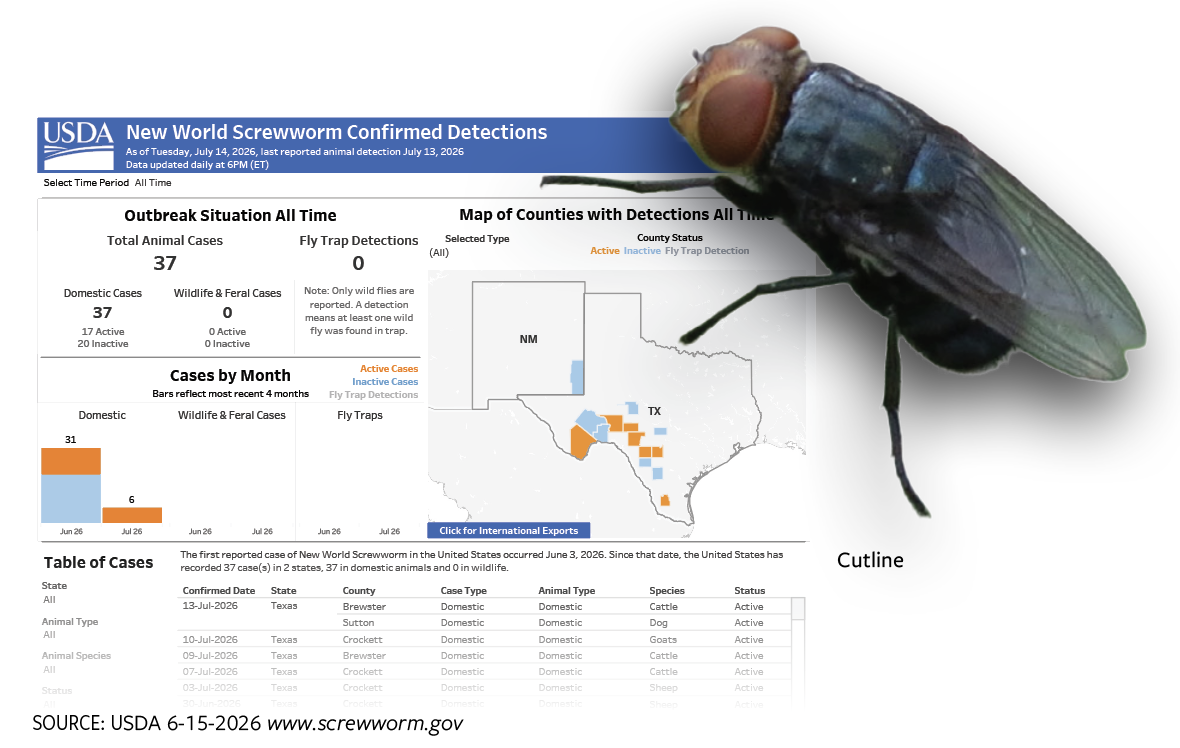
On June 4, USDA confirmed the detection of NWS in the navel of a 3-week-old calf in Zavala County, Texas. By the end of the month, cases had climbed to 31.
USDA and Texas officials took immediate action by forming an incident command team. Officials established a 20-kilometer (km, 12.4-mile) infested zone around the detections and implemented quarantines, movement controls and surveillance in this area. They also increased targeted release of sterile NWS flies and increased trapping of flies along the border. Officials also expanded surveillance and management efforts in wildlife populations.
USDA’s goal is not simply to slow its spread or reduce losses. The goal is eradication. That might sound ambitious, but it has been done before. The United States was declared officially free of indigenous screwworms in 1966. The same tool that led to eradication decades ago is once again at the center of USDA’s strategy.

Fly away
Sterile insect technique (SIT) is a proven and effective tool for controlling and eradicating NWS. Female NWS flies only mate once in their lives, so if they mate with a sterile male, they lay unfertilized eggs that don’t hatch. Releasing sterile flies just outside of affected areas helps ensure flies traveling to new areas will only encounter sterile mates and will not be able to reproduce.
In recent decades, the backbone of the North American NWS eradication effort has been the binational COPEG sterile fly production facility in Panama, operated jointly by the United States and Panama. This was the only production facility operating in the Western Hemisphere through 2024. It currently produces approximately 100 million sterile flies per week.
In May 2025, USDA announced a $21 million investment to renovate an existing fruit fly production facility in Metapa, Mexico, to further the long-term goal of eradicating this insect. When operational, this facility will produce 60-100 million additional sterile NWS flies weekly.
USDA also broke ground on a $750 million sterile fly production facility in Edinburg, Texas, at Moore Air Force Base in April 2026. An initial operational capability is targeted for November 2027, producing 100 million sterile flies per week. Construction will continue beyond the initial operations to scale full production capacity to 300 million sterile flies per week.
In addition to ongoing efforts to expand production, two new fly dispersal facilities have opened. In November 2025, USDA announced the opening of a sterile fly dispersal facility in Tampico, Mexico. The Tampico facility allows USDA to disperse sterile flies aerially across northeastern Mexico, including in Nuevo Leon.
Until this opening, aerial dispersal of flies had been limited to southern Mexico. Aerial dispersal allows USDA to quickly release millions of sterile flies over large areas that would be difficult or impossible to reach from the ground. It also provides the flexibility to rapidly shift release locations as new detections occur or screwworm populations move.
In February 2026, USDA opened an $8.5 million sterile NWS fly dispersal facility in South Texas at Moore Air Base with the capability to disperse sterile flies in Northern Mexico.
Grand challenge
USDA is also looking beyond today’s response through its NWS Grand Challenge, a competitive grant initiative launched in 2026 to accelerate new tools for detection, control and eradication. The program awarded approximately $105 million to 40 projects focused on expanding sterile fly production, developing better traps and attractants, improving treatments that could be used or stockpiled for NWS in the United States, and creating other innovations to strengthen preparedness and response.
Together, the projects are intended to build on today’s response and move promising ideas out of the laboratory and into the field.
Border, market woes
While USDA, states and industry work together on eradication efforts, the consequences of the border closure continue to strain U.S. cattle production. The loss of roughly 1.2 million head of annual feeder-cattle imports from Mexico occurred during an already tight U.S. supply environment. This affects not only feeders of those cattle, but the entire system.
“As those feeders of imported cattle go to competing with everyone else without margin, it affects the ability of cattle feeders everywhere,” says Chad Clift of Hansford County Feeders, Spearman, Texas. “While temporary high prices benefit cow-calf producers, they are artificial, and I worry about price and product demand destruction, which will hurt everyone.”
Some argue that since the pest was able to enter the United States not on cattle, USDA should begin to allow limited movements under strict animal health and monitoring protocols, especially through the western ports farther from where the pest has been detected.
“If we allow Mexico time to build their feeding and processing infrastructure, those could be cattle we’ll never get back in the U.S.,” Clift says.
This could be forcing a shift that had already begun.
“The Mexican industry has evolved a lot the last 25 years or so in their infrastructure,” says Derrell Peel, professor of ag economics and extension specialist for livestock marketing at Oklahoma State University. “A number of new processing facilities were built or expanded by meat companies, many of whom were historically in the cattle feeding business.”
For example, when SuKarne began operation of a new packing facility in the State of Durango, just south of Chihuahua, it also included an affiliated 300,000-head feedlot.
According to Peel, Mexico was exporting mostly steers to the United States and already feeding and processing the heifer mates in the north. They then backfilled much of the domestic market needs with cattle from Central America. During the course of just a few months of the border shutting, Mexico was able to make room for those steers in their feedlots.
Digital EXTRAs
Resources
Listen
Read
- The Lowdown on New World Screwworm
- New World Screwworm Fact Sheet Announced
- A Tool in the Fight Against New World Screwworm
- Existing Product Receives Conditional Approval for New World Screwworm
- What is New World Screwworm, and Why Does It Matter?
- What to Know and How to Protect Against This Deadly Pest
“If the border stays closed long enough, there may be some permanent changes. It is possible we could see them not export at the same level they have historically,” Peel says.
Whether the current border closure lasts months or longer, the decisions made today will shape the cattle industry for years to come. USDA’s investments in surveillance, sterile fly production, research and emergency response are intended to do more than address today’s outbreak. They are rebuilding the nation’s ability to keep one of the livestock industry’s most destructive pests from becoming established in the United States again.
The United States has accomplished that goal before. Through decades of science, cooperation and persistence, New World screwworm was eliminated from the country in 1966. Today’s response builds on that same foundation. Success will require continued investment, strong partnerships with Mexico, and vigilance from producers who are often the first to notice when something isn’t right.
If those efforts succeed, future generations of cattle producers may know New World screwworm only as a chapter in history rather than a challenge on the ranch.
Editor’s note: Chelsea Good is an advocate, strategist and attorney with deep roots in the cattle industry and a proven record of shaping ag policy at the state and federal levels. She founded Good & Associates to help ag clients navigate complex issues, strengthen stakeholder relationships and turn challenges into strategic wins. Prior to launching the firm, she served as vice president of government and industry affairs and legal at the Livestock Marketing Association (LMA), where she successfully led policy efforts resulting in major legislative wins. She is also a former Angus Journal® intern.
Related Content


Current Angus Beef Bulletin
Our September issue focuses on the females of the herd and the records that validate them.