




Extend Fall & Winter Grazing
Stockpiled forage and cover crops offer options.
March 20, 2026
Winter feed costs are usually the largest expense to raising cattle. Planning ahead to extend grazing through late fall and much of winter can save costs and labor.
Some ranchers stockpile forage, saving certain pastures for later. This works well on native rangeland. Other types of forage can be grazed lightly in the spring and regrowth saved for fall and winter grazing.
Tim DelCurto, head of the Department of Animal & Ranch Sciences at Montana State University (MSU), says some range operations graze well into winter. The benefits of being able to graze longer are substantial.
“At our research center at Havre and with our MSU herd, much of our research efforts focus on extending grazing,” says DelCurto, a professor of range beef cattle nutrition and management. “Some winters we only feed hay for about a month at our MSU Red Bluff Research Center.”
Ranchers are trying to reduce costs, with less reliance on harvested feed and fossil fuels. Growing cover crops requires farming equipment and fuel, but if producers are doing some farming anyway, it can be cost-effective to grow triticale, forage barley or other annual forages for fall grazing.
“No two farms or ranches are alike. What might work for one may not work for another,” says DelCurto. “It depends on climate, resources, labor, et cetera.”
In the West, ranches with native bunch grasses for summer grazing are most vulnerable to grazing damage during the growing season.
“If we can graze some of these pastures in fall and winter and reduce the time we graze while they are actively growing, this may be better management,” he says.
Many native pastures thrive and improve if rested during the growing season to be grazed in fall and winter, when plants are mature and dormant. Cattle can graze heavily then, and trample seeds into the ground.
“Research on dormant-season grazing suggests that grazing late has minimal impact on the plant community,” he says. “Cattle use the decadent plant material and process it to where it is more readily incorporated into the soil as organic matter.”
Grazing it completely off in the fall also reduces fuel loads and reduces risk for serious wildfires the next year, he adds. When feasible, winter grazing on rangelands, utilizing protein supplements when needed, saves money during those grazing days.
The key
“Strategic supplementation makes this work, but there is no magic protein or best kind,” says DelCurto.
Consider cow nutrient requirements, he advises. If cows need 2 pounds (lb.) of protein per day, the forage is 6% protein and the cows eat about 20 lb. per day, they will get only 1.2 lb. of protein from the forage. They need an additional 0.8 lb. of supplemental protein.
With optimal supplementation, a 1,200-lb. cow would consume 2% of her body weight (24 lb. of dry matter) from the forage itself, DelCurto says.
Delivery of supplements can be a challenge.
Studies evaluating salt-limiting supplements (e.g., blocks or tubs) and cake have dispelled earlier concerns, says DelCurto. At the Northern Agricultural Research Center near Havre, feeding up to 300 head of all ages — yearlings up to 13-year-old cows — researchers saw, for the most part, uniform consumption. The young animals (1- to 4-year-olds) actually ate the most; the middle-aged and older cows consumed less.
“We have a lot of data with salt-limited supplements that show they work,” he says.
He cautions that, in multiple studies, young cows didn’t eat molasses blocks very well.
“It’s foreign to them; they have to learn to eat it. Once they get a little older they generally eat it, but yearlings are not used to this form of supplement and often eat less than the label amount,” says DelCurto.
Winter challenges
Winter environment affects nutrient needs. At higher elevations there may be challenges to grazing stockpiled forage or native rangelands, DelCurto cautions. When grass gets covered with snow or temperatures drop dramatically, cows require more feed.
“In the past nine years that I’ve been in Montana, we’ve had some winters that were really hard on cattle,” he says, sharing a call from a producer in the Glasgow area. “We’d had a week of –30° F with wind chill equivalent of –50° or colder, and he asked how he should feed his cows. This is a tough question. Hopefully cattle go into winter with extra body condition so they have some reserve. During weather like that, with wind, cows hunker down and don’t eat or drink much because it’s just too cold.”
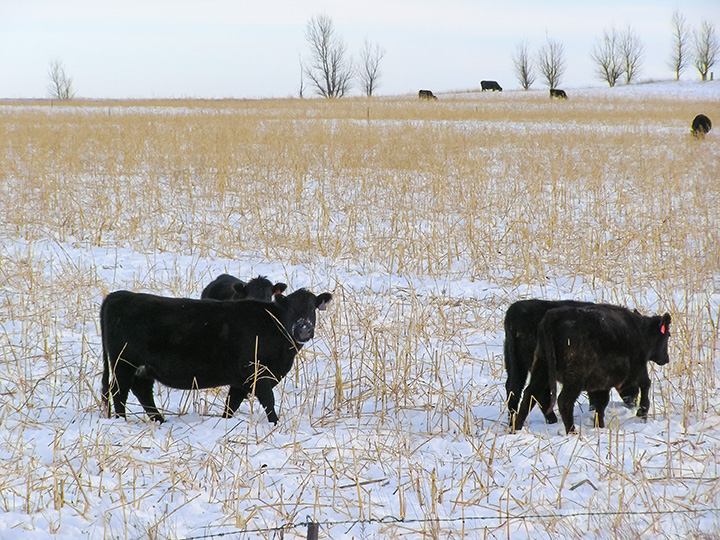
When grass gets covered with snow or temperatures drop dramatically, cows require more feed.

These are things to be prepared for, and try to manage around. But, as a general rule, cattle can do well on an extended grazing program — only fed hay when conditions make grazing impossible. Most ranchers want cattle that can harvest their own feed.
“As the saying goes — you want cows that work for you, rather than you working for them. But, you have to provide the right nutrition and tailor your program to your environment and your cattle,” says DelCurto.
Annual crops
On dry years, native pastures and hay aftermath don’t produce as much forage unless you can irrigate. One strategy is to grow annual crops, which can include cereals and brassicas.
In dry climates ranchers may be short on late summer and fall pasture, as productivity of cool-season perennials is limited during the heat of summer. Mark Hayek, assistant state conservationist with the Natural Resources Conservation Service (NRCS) at Bismarck, N.D., says some of the traditional cover crops work well for extending grazing periods. If you want to do a full-season cover crop, he recommends a mix containing both cool- and warm-season species. Diversity is the key to a season-long cover crop.
“We’ve found that sorghum-sudangrass (a warm-season species that provides a lot of tonnage) can be the centerpiece of a season-long crop, adding some legumes,” says Hayek, noting the goal is to produce a lot of tonnage. “Any of the vetches or clovers will work. We also add a warm-season legume, such as cowpeas or any of the pea options.”
Warm-season cover crops can be planted June 15-Aug. 15 in North Dakota, he says. “The earlier you get a warm-season plant in the ground, the better possibility for more tonnage produced by the end of the year for grazing.” Options include any of the millets, and warm-season legumes including soybeans and cowpeas.
The important thing for a season-long crop is diversity. This provides a better diet for cattle, as there is always something nutritious growing, providing a high-quality forage throughout the grazing season.
Legumes also help with nitrogen fixation, which is beneficial to soil health and growth of other plants.
“We target soil health, as well as cattle nutrition; we’re increasing soil fertility and organic matter,” says Hayek. “The root system of sorghum-sudangrass can do that, and reduce erosion from wind or water. It helps capture and recycle/redistribute nutrients in the soil profile.
“Deeper-rooted plants,” he continues, “like sunflowers, can reach farther down. They might be a poor forage source, but [they] add to diversity and help pull up nutrients and maybe break some of the compaction that occurs. They also provide benefits for pollinator insects.”
To get good tonnage for fall grazing in North Dakota, a cool-season mix could be planted Aug. 15-Sept. 20, Hayek suggests. You could plant a little earlier in optimum moisture and weather conditions, to get the crop going earlier in case winter comes early.
Plant something frost-tolerant, that stays green and holds its nutrients and that won’t kill out at 27°, Hayek advises. “We may get an early frost and then it warms up again with more growing weather. Brassicas are good for this. Mustards, rape, canola, radish, kale and turnips are very winter-hardy. They don’t stop growing until air temperature drops below 25°.”
Targeting that fall window, Hayek says he centers a mix around brassicas, then includes a cool-season grass such as winter rye, triticale, oats or spring wheat to provide extra tonnage.
“Brassicas tend to be high in moisture (and go through the animal swiftly), so adding a grass species makes a better mix nutritionally, and helps slow the material as it goes through the cow,” he says. If you just do a brassica mix, make sure there is enough dry-matter supplemental feed.
“The Menoken Demonstration Farm in North Dakota did some work with Jay Fuhrer, soil health specialist for NRCS, sampling top and bottom halves of various plants to see where the nutrients are. As we graze cover crops, if we leave stubble (rather than eating them down to the ground), this helps feed the soil and aid soil health. About three-fourths of the plant nutrients are in the top half. The bottom half is where the nutrients really drop off. If you want high performance — with weaned calves or yearlings, or heifers prior to breeding — you don’t want them to get down into the bottom half of the plants. Keep them moving to new plants,” Hayek says.
Editor’s note: Heather Smith Thomas is a freelance writer and cattlewoman from Salmon, Idaho.
Advantages of windrowed forage
University of Nebraska studies found grazing windrowed forage can save money on feeding costs and enable cows to more efficiently graze fall and winter pastures. Jerry Volesky, range and forage specialist at the University of Nebraska–Lincoln’s West Central Research and Extension Center, says this works well for producers using annual forages that have a lot of growth and can be cut at the peak of forage quality.
The advantage of cutting and leaving feed in windrows rather than letting cattle harvest it on the stem as stockpiled forage is you can cut it at optimum maturity, locking in nutrients at a higher quality stage. If left on the stem, it becomes overly mature and dry, losing quality.
“Stage of maturity is important when harvesting hay or creating windrows for winter grazing,” says Volesky.
He did a study about 25 years ago comparing leaving the crop in windrows to baling, hauling bales to a stackyard and then hauling them back to feed cows.
The researchers grazed windrows November-February with weaned calves weighing about 500 pounds (lb.) to start.
“We looked at how well the forage quality was maintained through winter and found it kept just as well as hay that was harvested in big round bales. Calf weight gain on windrow grazing was equal to that of the calves fed hay. Windrow grazing was a cheaper alternative; we saved the cost of baling, hauling the bales and hauling them back,” he explains.
“Another advantage: You are leaving the nutrients in the field rather than hauling them off,” he explains. Any organic matter left, plus manure from the cattle, serves as good fertilizer for the next few years.
Large windrows keep better than small ones, Volesky says, adding: “It depends partly on the type of forage and equipment you use. If it’s a productive sudangrass or sudangrass mix, producing 3 to 4 tons per acre, those will be fairly large windrows. You need a properly formed windrow that settles,” he says. If it is too large and fluffy, a strong wind may scatter it all over the field.
A fairly large windrow, even though it settles a bit, is easy for cattle to find under deep snow.
“Once they learn about windrow grazing, they root down through the snow and find the forage,” says Volesky.
It helps to cut it at higher stubble height than cutting hay, so the windrows are not lying directly on the ground. On a perennial pasture or hay field, there is minimal damage to plants under the windrow, since they are cut after most of their growth cycle.
“The feed lies in the windrow several months and there is some potential for mold, but once the hay is cured and dry in the windrow, it doesn’t spoil much — other than some discoloring of the top surface from rain or snow in the fall. Underneath, we didn’t have any mold or spoilage. This may depend on the amount of rain you get in the fall. Here in Nebraska, or on the Great Plains — Dakotas, Montana, Wyoming, et cetera — fall weather is usually relatively dry,” he says.
If snow gets deep, cattle may still be able to graze big windrows unless snow drifts over them too deep for cattle to dig through. Sometimes fields are so covered you can’t tell there’s a windrowed crop, but experienced cows root down and find the windrows. If cattle haven’t done this before, you might put a few experienced cows with them to show them where the windrows are. Otherwise they don’t realize there’s feed under the snow. Cattle learn from experience and from following the example of herd members. Calves learn from their mothers. Heifers grazing with their mothers through winter learn what they need to know.
“Our cattle have to rough it and graze year-round,” says John Griffin, a rancher in Saskatchewan, adding he selects cows that are efficient and stay in good body condition. “We have some irrigated fields and windrow sorghum to graze in winter. This year we have Italian ryegrass we windrowed with the barley straw after barley harvest, and that mix provides a high-quality forage.”
Griffin verifies cattle will find a windrow in fairly deep snow.
“It’s amazing what they can do, even going through 2 inches of ice to get to the forage. They find a windrow, push it down and pound through the ice, grazing down into the windrow,” he says. “Our cattle can handle some really tough conditions.”
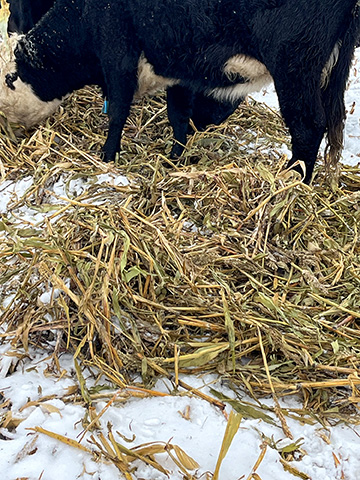
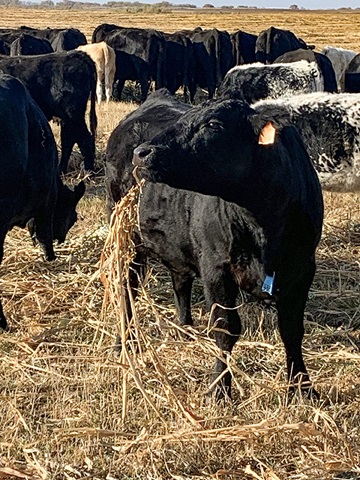
A fairly large windrow is easy for cattle to find under deep snow.
Topics: Feedstuffs , Management , Nutrition , Pasture and Forage
Publication: Angus Beef Bulletin
Issue: April 2026
Related Content


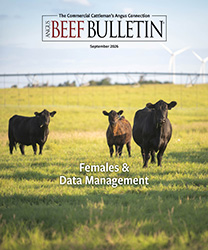
Current Angus Beef Bulletin
Our September issue focuses on the females of the herd and the records that validate them.