



Market Update with Paul Dykstra | Fall 2026
Season: 5 — Episode: 20
October 15, 2026
The cattle industry has seen its fair share of ups and downs of late, but the quality and pounds producers are bringing to the table of the U.S. consumer is one thing that can be counted on.
On this episode, our host Miranda Reiman is joined by Paul Dykstra, director of supply management and analysis with Certified Angus Beef. Take a listen as Paul and Miranda chat about recent data on CAB cattle harvested, improvements in the quality of cattle over the last decade and the incredible job U.S. cattle producers are doing at bringing high-quality cattle to market.
Additional Resources:
- Commercial Programs at the American Angus Association
- AngusLink program information
- Subscribe to the Angus Beef Bulletin EXTRA
Find more information to make Angus work for you in the Angus Beef Bulletin and the Angus Beef Bulletin EXTRA. Make sure you’re subscribed! Have questions or comments? We’d love to hear from you! Contact our team at abbeditorial@angus.org.
Host Lynsey McAnally (00:04):
Angus at Work, a podcast for the profit-minded cattlemen. Brought to you by the Angus Beef Bulletin, we have news and information on health, nutrition, marketing, genetics and management. So let's get to work, shall we?
Miranda Reiman (00:28):
Welcome to Angus at Work! I'm your host for the day, Miranda Reiman, and I'm here with Paul Dykstra with the Certified Angus Beef ® brand. Thanks for joining us today, Paul!
Paul Dykstra (00:37):
My pleasure. Glad to be here.
Miranda Reiman (00:39):
Paul, you are no stranger to this podcast. You've been on here before, and those who've been around the brand for a while are probably no stranger to your name. For any new listeners we might have, just give us a little background on what you do at the brand and a little bit of your story.
Paul Dykstra (00:54):
Yeah, I work in supply development, and as you said, [I'm] Director of Supply Management and Analysis. But to boil that down, really, my primary purpose and function here is to work essentially from the packer backward or I call it upstream through the production sector. The entire goal there being to encourage more supply of carcasses that meet our brand specs. So that ends up being quite a number of activities and functions throughout the year. Of course, interacting with cattlemen in each of the supply chain sectors and doing that in many fashions, whether it be in-person visits, fielding phone calls, writing the biweekly CAB insider, providing market analysis and keeping folks up to date on trends in the high quality beef world and the fed cattle world and all of the metrics that affect the supply of our brand and really beef trends in the entire country.
Miranda Reiman (02:03):
Sure. Well, with that vantage point, it probably gives you great perspective to answer the question. We've heard from lots of places for lots of years now, it feels like the same story, not enough cattle. So how is Certified Angus Beef supply holding up in these times of tight supplies?
Paul Dykstra (02:19):
Well, that theme is very real for the brand as well. Not enough cattle is an overriding theme at this point in time. But as far as the outcome, we just finished up our fiscal year, so it's an important time to document how we've been doing. We actually came out quite good with the backdrop of these tight supplies of cattle, and we did certainly face a market where we had far fewer carcasses to look at for eligibility for our brand, and that was down about 6.5% this year. That's pretty close to what fed cattle supplies are down as well. And of course, the fiscal year being different than the calendar year, but it's pretty much on trend with overall fed cattle supplies here in the country. That's been a tight spot for us. But in the end, we came out very close to a year ago when it comes to sales.
And of course, that's the bottom line. And that's all kind of been underpinned a bit on a very strong acceptance rate. So we nearly matched, but we actually bested last year's brand acceptance rate by a couple of tenths of a point. So we came in this year at 37.8% of those black-hided brand-eligible cattle that were harvested at our brand partner packing plants, actually meeting all 10 specs and receiving our branded mark.
Miranda Reiman (03:53):
So really a story of doing more with less in many ways. How about your things like carcass weights or carcass utilization, the amount of the carcass that's branded as CAB? How are some of those things figured into it?
Paul Dykstra (04:07):
Yeah, those items provided a great deal of help as well. Carcass weight's been helping all of us from a fed cattle perspective in terms of supply to our end users, supply to consumers. That's been, I think, the number one theme throughout this last few years where we've had a dwindling cattle head count. Carcass weights are clearly much, much heavier. Hand-over-fist heavier. And that was the case again this year. And I think if I recall correctly, about 28 pounds heavier on our carcasses specific for the year. So another big leap. And when it comes to sales, we measure those in pounds just like everybody else in the business. So more pounds gave us more opportunities on certain items, of course. Didn't give us any larger supply of briskets and certainly didn't help as much when it comes to some of those steak cuts where it's more of a piece item than a straight weight item.
But pounds help pay the bills. As well, you talked about carcass utilization, and some folks might not understand what that term really means, but when we look at any carcass, how many pounds did we sell into our branded channel essentially? How many pounds went to a licensed retailer or food service customer in a package in a licensed sale format? We don't get to use every pound of every carcass. Some of it gets substituted out if it doesn't have a customer. And our job at the brand primarily is to make sure we have a customer for all those pounds produced or as many as we possibly can get. And we did see a very nice bump this year of carcass utilization up about, let's see, that would be about 12 pounds I think that we had an increase in pounds per carcass utilized in a branded channel.
Miranda Reiman (06:19):
Yeah. All those little things kind of add up when you're trying to eke out just a little bit more out of every carcass. One thing that I want to go back to is you talked about those heavier carcass weights, and I think that it's important to note with the brand that bigger isn't always better or then you've also faced maybe some challenges that probably 10, 15 years ago weren't really a huge challenge for the brand, but in terms of reasons that cattle maybe don't meet CAB, talk a little bit about how the trends in increasing carcass weights have maybe caused a new challenge for you guys.
Paul Dykstra (06:57):
Yeah, that's a very key element as well. As a matter of fact, you said 10 years ago. Well, about 10 years ago is when we first started to have to face some of these challenges of heavier weights, particularly when we began to evaluate the landscape and the future of fed cattle weights and the fact that they weren't getting any smaller and would only continue to increase. And that kind of began the era about a decade ago where
Miranda Reiman (07:26):
I'm glad it was a decade ago, I guessed. I guessed at that, Paul. I'm glad it was a decade ago.
Paul Dykstra (07:34):
Yes. Coincidentally, that's about right. When we saw our first surge in carcass weights up to that 2015 period, and we made a couple of changes in the years since to increase our maximum limit carcass weight. And we did so very reluctantly because we know that consumers like their state cuts to be smaller than they are, but we have to remain relevant to the industry and cattle were not getting smaller. So our current maximum weight of 1100 pounds is a couple of jumps above what it was more than 10 years ago. But even so, even though we've made that adjustment to increase that upper limit, we still have in 2026 a pretty large percentage of carcasses that would otherwise be acceptable, very richly marbled, high quality carcasses that are over 1100 and they therefore do not make it into the brand. And so the leakage there or the lost opportunity there, particularly on those heavy steers in the spring is when we saw it the most.
When we set the new record high steer weights last March, we saw also record high marbling percentage of Prime carcasses, premium Choice and Choice were collectively all time high, but our acceptance rate did not respond favorably to those increased marbling achievements because we set the all time high weights and therefore we lost more of the right side of the bell curve of carcasses that fell over 1100 pounds. So that's not a great help, but it was a short term impact at that point. But the theme throughout the year has been, yes, we continue to lose more than we like to excess weight. That's just the reality of the business today. At the same time, we see ribeye sizes similarly increasing and we've moved our upper limit to 17 inches (in.) on the same theme of remaining relevant. And that was only a 1 in. move that you may recall.
And not very many carcasses actually fit in that 16 to 17 in. window, which is kind of the new expanded max, but we are losing some over 17 in. ribeye areas today. So between those two and a smaller share, we're losing to excess back fat over an inch. Not a huge problem there, but certainly in this era with days on feed reaching all time record lengths as well, that's increased back fat, increased total body fat composition. And so we're losing some to excess back fat as well. And none of those factors are things that we think are especially good. And potentially I would think that possibly cattle feeders would say, "Boy, this is kind of going overboard." But let's face it, the economics of cattle feeding and the entire market on a steeply increasing fed cattle price trend and a very low cost of gain environment that we've been enjoying in that sector for many, many months, it has incentivized the system to make cattle bigger and feed them longer.
And when head counts have been low, it's no secret that essentially packers and feed yards and everybody in the supply chain has said, "Well, what we need to do is maximize pounds on the hook." And so that's where we've been and it's where we're going to be for a bit more because we haven't turned around these head counts at all. And that may wane in the future if we can build the cow herd. But that's a long answer to the question, but it's a multifactorial situation that's gotten us to where we are today.
Miranda Reiman (12:02):
Sure. I was just going to ask if you saw it moderating at all or any factors that would change it, but really you're saying either something like high feed cost or more cattle is really the only thing that's going to maybe put the brakes on that a little bit in your opinion?
Paul Dykstra (12:21):
I think that's the relatively easy answer and feed costs would need to escalate a great deal more than they have. We've seen corn come up in the recent few months here up to, let's call it $5 a bushel corn in that realm. So that's a dollar higher, but that's not a high enough cost to push back hard enough in my view, because your cost of gain is still well below fed cattle price, even though the two numbers have narrowed the gap a bit between them, but there's still plenty of feeding margin to add weight to these cattle. You mentioned greater head count, and that's really the big stick I think in the future, but I don't think there's anyone out here making predictions for massive increases in the cow herd anytime soon. We do have optimism about some increases and some recovery in the nation's cow herd numbers, but nothing that'll turn this trend around immediately.
So I suppose if I were to make a guess, I would say we're kind of getting there when it comes to how much can this system handle from an individual live weight basis and what is really an acceptable carcass weight and cut sizes. I want to say we're getting there in terms of maybe we'll level off a bit and at least moderate the increases. Now, historically, it's never been a good bet to suggest that carcass weights are going to come down because they don't do that for more than a year.
But given the extreme circumstances in the cattle supply, I would say packers are probably going to begin pushing back. We've seen just a little bit of that as far as what they've pinned their upper limits on for carcass weight and where they have begun those discounts for heavies. There's been a little bit of a reduction in those upper limit weights that have kind of cropped up here this season. So far be it for me to make a strong prediction, but it seems logical we kind of level this thing off just a little bit.
Miranda Reiman (14:49):
Sure. You mentioned in there the idea that we've got some projections for maybe a slight increase in the cow herd or a slight increase in the fed cattle harvest mix for next year. Nothing wild, nothing big, but it feels like we've said that for a few years now like, oh, this'll be the year that we'll see an increase. What makes us a little bit optimistic that that'll actually materialize in the coming year?
Paul Dykstra (15:15):
Well, the fed supply is really only going to be bolstered on the Mexican border opening in 2027, according to those that have studied those numbers. And it seems that we'll actually be pretty tight still on our domestic fed steers and heifers, but we'll get a little bit of injection as that border has systematically or phased in opening here this fall. There'll be a little bit of injection of headcount there, but our own calf crop isn't helping that cause very much. Well, there's of course several factors holding ranchers from expanding to the degree that maybe economics that are front and center would suggest that they might. And of course the prevalence of drought around particularly the western half of the country, but including the Southeast. Florida's a very important state that continues to be impacted and those in that region. Lingering drought has slowed what otherwise would be a more rapid turnaround in cow numbers.
So we're going to have to be a bit more patient and wait for this thing to develop, hoping that some changes in precipitation and important cow produce in the states will energize and incentivize producers to keep more cows. I think we're seeing the bred heifer retention in the second half of 26 look a little brighter. I think one percentage point decline in the heifers that are sold at auctions has been noted. So cautiously optimistic on that particular point.
Miranda Reiman (17:03):
Well, from your vantage point where you sit at the brand and of course looking at quality beef supplies, let's talk just a little bit about the quality of the cow herd. That's something that obviously when you have fewer of them, you need more of them to qualify for the brand. So the quality grade trends have also been on an increasing plane for decades now. And at some point I think people thought, "Oh, are we going to get to a point where we level off there?" But we really haven't done that either.
Paul Dykstra (17:31):
No, that's another multifactorial result over many, many years. And gosh, the story stems back to the early 2000s, right? So we don't need to document every element that's helped along the way, but certainly changes in feed technology and feeds themselves. Heck, we can harken back to the introduction of distillers byproducts in the early 2000s to feedlot rations as one of the things that's really improved the quality grade outcomes that we're seeing. But it's been a longer story than that with many more features. And I really lean on the genetic aspect of it, and particularly as we speak about Angus cattle and what we've collectively done as a producer group from Angus seedstock producers on down to their customers. And overall, the entire US fed cattle supply has just continually made very strong increases in marbling achievement. A lot of that's been driven on not just the genetics, but we continue to increase in weights to the feed yard.
We increased days on feed, and of course we have those heavier carcass weights. And what's come along with that is more total body fat. So we can't ignore some of the feedlot management or supply chain management pieces that are really impactful, but we sure wouldn't have gotten here without genetic improvement and some focus on the part of the seedstock sector to embrace, at least to a degree, the fact carcass traits are important and there is more value in these cattle if we add some marbling. Some have done so very strongly and others have come along as basically the average Angus marbling EPD has increased. So even your average bull, when he steps in the pasture, probably has a better marbling potential to give that off into his offspring than the one before. So it's been a success story. It's really helped. If I take the story further, Miranda, as we talk about beef demand and consumers and how they respond to beef in this modern era, it's an amazing and very gratifying trend because of what's come up here in carcass quality and eating satisfaction as a result.
Miranda Reiman (20:18):
Yeah, I think that it's amazing to me when you think about how much change has happened that we used to talk about just getting above 50% Choice, 60% Choice. Now we're not even worried about that. We're looking at the upper two-thirds Choice and Prime. And I know some data I saw recently in some CAB slides said that upper two-thirds Choice had increased 89% in the last two decades and Prime had increased 477%. That seems like impossible numbers here, but talk about that, I guess, as we move on to those higher quality grades or you think about Prime specifically, have you been able to, as we've had supply increase so dramatically, has demand been able to keep up with that?
Paul Dykstra (21:04):
Yes, and that's been an unsteady increase in demand, but it's also demand is responding to supply, and that happens unevenly because the entire marketplace, if you want to call it that, has to adjust to greater supply and greater availability. This initially became a factor back in, let's say that period from 2015 to 19 when we saw strong increases in particularly USDA Prime, of course CAV Prime came along for that ride as well. But the net tonnage of Prime product that was available in the system really ratcheted up quickly in that period. And that's the time when retailers finally were able to take notice and say, "Hey, this Prime category is actually more than two or 3% like it used to be. And there's enough supply here that we can plan on a weekly supply of Prime product." And that's when we saw some spikes in the Prime over Choice premium.
But then again, as Prime supplies increase again, say last spring when we had record high shares of Prime carcasses in the mix, the Prime premium fell back rapidly. At that time, the Choice-Select spread also fell back to zero, and for a few days it was inverted. It was kind of the talk of the business. Oh my gosh, these spreads are topsy-turvy and they'll never be right again. It was simply a period when the market saw a supply shock to the increased side, and that righted itself as the seasons changed and the grade kind of fell back modestly. We've seen those spreads widen right back out again here into this fall and more normalcy return to that where your Prime premium over the Choice cutout in my latest data is $38 per hundredweight (cwt.). Now that's not record high, but it's awfully healthy and a good signal of continued demand, as you said, in a supply situation that's seeing robust volumes of Prime relative to the other grades.
Miranda Reiman (23:28):
And if you're the one receiving that premium, it means a lot to your pocketbook, too.
Paul Dykstra (23:34):
Absolutely. And I would add that, of course, traditional is nothing to sneeze at. We've got a $22 per cwt. premium there on CAB traditional over commodity Choice. So as we just ratchet up through the quality spectrum, including our brand through Prime, it's a healthy environment. And this is all essentially producers responding to the price signals and collectively getting in line and paying attention. So as I said, it's gratifying that this is all culminated into where we're at today.
Miranda Reiman (24:11):
So now that we've talked everything that we wanted to talk about on supply, or maybe did I cover everything you wanted to talk about on supply, Paul, before I switch a little bit more into the demand side and talking about CAB sales and how you're going to finish up this fiscal year?
Paul Dykstra (24:27):
That's a big piece of the supply, so let's go ahead and move on.
Miranda Reiman (24:30):
All right, perfect. Well, I guess that is the question. How is CAB going to finish up this fiscal year when it comes to sales and where's the growth coming from? Where are the challenges coming from?
Paul Dykstra (24:42):
Yeah, the ink's barely dry on those year-end sales numbers as that just wrapped up our books at the end of September, but we'll be down less than 1%. That's 0.9% decline in tonnage. So we never like a decline, but it's a sign of the times that we just talked about and covered. So we're going to come in at 1.224 billion pounds of sales, and that's really, really good in this supply situation that we've been dealing with. And I believe that's the 11th year that we've surpassed one billion pounds of sales. So by any measure, that's big success, and it's not very far off of our all time one and a quarter billion sales. I believe that was back in 2019, our record high sales volume year. So really, really good. I think most anyone would quickly be able to see that the downfall for all US beef sales this year in terms of our product that we're producing domestically has been in exports.
No doubt about it. That was the Achilles heel for us. We exported to a very large market in 55 countries that are export destinations for Certified Angus Beef products. So when we have a year like this where it's kind of been embattled through tariffs and price, and price is still an issue, not just political topics, but global price for beef is still a thing. And that kind of hindered that particular category especially this year. And so our export numbers are down unsurprisingly, but we saw some nice increases in value added product sales up about 4%. So that's a category that was a highlight for us. As I mentioned, in terms of trends, that Certified Angus Beef brand Prime category was up a massive 10% in terms of volume this year. So those are two areas that I would highlight. And we'll hope that the international marketplace and the trends come back to our favor again there, but I think we all can understand that's a matter of time and some changes in the political wins, etc.
Miranda Reiman (27:09):
And so when you think about domestic sales about even or just slightly up on retail and then up on food service maybe in some ways you didn't expect?
Paul Dykstra (27:21):
Yeah. And those changes were not dramatic. And I can tell you that we eked out every pound that we could get sold, and kudos to our sales team and our licensed partners downstream. I mean, they're the ones that make it happen. It's about getting those sales into more licensed accounts, helping those customers understand how they can continue to get carcass utilization from cuts where let's say if ribeyes are like they are now, ribeyes are a record high in the wholesale market, what cuts can they identify that are possibly providing nearly the same eating experience at a lower dollar cost per pound, those kinds of things. But to your point, retail actually will end up to the positive at half of a percentage point increase. So that was a very narrowly higher number that I'm happy to see on the page as we wrap up the books.
And food service was up 1.7% in volume. So narrowly higher really on both of those, but I call it a success given all that we know when we're facing the tightest supplies in carcasses that were eligible for the brand since 2018.
Miranda Reiman (28:38):
Absolutely. And those tightest supplies, and you've kind of already mentioned it about the global trade and that, but the question seems to be around beef prices, both among producers and consumers maybe too. It's been in the news a little bit, but Paul, are beef prices too high? Are consumers pushing back? Is that going to be our Achilles heel?
Paul Dykstra (29:02):
I don't think beef prices are too high. I like to think about beef prices are higher. That doesn't mean they're too high. Now, I suppose if we were to talk to a certain consumer, they would say, "Well, ribeye prices are too high." And that's, I think, understandable. Folks may not be eating particular cuts of beef as often as they were. But in total, as we look at the grocery store and all the prices they're in, beef prices are higher, but they need to be higher. And I think it's just going to be something that needs to be normalized for consumers. And there may be a little bit of swapping around within the beef category in terms of products and that cost per pound or per meal. That's, I think, very, very real and normal. But when our cutout values remain high That means that we're just simply shuffling prices throughout those cuts across the carcass and getting greater utilization of chuck and round items, et cetera.
And that's the beauty of beef is we've got something for everybody and it's great experiences all the way across that carcass, but just some different items that come at a different price point. But beef demand's very, very good. I think we are seeing a little pushback if we look at a possible negative, but gosh, keeping this in perspective of history, the last few years even, but going back two decades, beef demand has been growing at a very rapid pace. And in the last two years in the midst of a price adjustment that consumers have had to face, their demand for our product is robust and it's exciting to see.
Miranda Reiman (30:58):
Yeah, absolutely. And I guess if they keep coming back to the table for more, the answer is no, it's not too high because they're still eating it.
Paul Dykstra (31:06):
That's correct.
Miranda Reiman (31:08):
So in all of this that we've talked about, supply and demand, there's probably a message for producers in there. I guess, what's your take home if you're looking at how you're going to breed your cattle, the kind of bulls you're buying, maybe the management, those types of things? What's the message in all this for the commercial producers that are listening? Well,
Paul Dykstra (31:29):
I try to offer very little advice to producers on how to raise cattle for their operation because that is a very sensitive issue and they all have their own factors to deal with at the ranch and at the farm, but you get that.
Miranda Reiman (31:44):
They know better.
Paul Dykstra (31:47):
And they know best. We know better than to try to guide too much there. So first of all, I say balanced trait selection's a pretty good place to start, but specific to carcass traits and what we need to focus on for the consumer and what the future trends will be, it's really easy for me to sit here in my seat at Certified Angus Beef and say, stay the course. And not just because we need more supply for our brand and for our partners and for our success, but the financial incentives and disincentives that are being handed back up the supply chain indicate to do nothing else. Now, will we see some adjustments? We talked some, well, a great deal, I think industry-wide about red meat yield and how that evolution might happen in the near future with technology. We'll need to focus on red meat yield possibly in a different way as those changes are brought to the forefront.
But in terms of what consumers want on their plate, they continue to vote for higher quality, richly marbled beef that brings all of those eating attributes that we're so familiar with to their table. So in the dollars and cents that are passed through on grid marketing agreements, et cetera, indicate as much as well.
Miranda Reiman (33:12):
Sure. Yeah, I guess maybe that's the thing that I always worry gets a little bit lost the more we say record high quality, record high quality that people say, "Ah, okay, we can go pick up a different thing to focus on." And really market says, "You better keep that as part of your factors that you're considering."
Paul Dykstra (33:31):
Quality is job one, and really it's the only way that beef remains, I think in the major proteins remains on top. If we were to happen to lose any of our taste, flavor, juiciness profile in our product, we would be cooked because we know that our other friends in those other protein sectors, they can do the job cheaper. And that doesn't need to be our goal. We need to be the most satisfying protein out there. And I'm just happy to see that we've gotten to that position that we're in today.
Miranda Reiman (34:07):
Yeah, absolutely. So I guess the message of today's conversation really is that we've had tighter cattle supplies, done more with it, really strong demand. That's kind of the whole message from today. Is there anything else that you'd like to add to that?
Paul Dykstra (34:23):
I think I would be in error to try to add anything to detract from those messages because that very much is a good summation of where we're at.
Miranda Reiman (34:32):
Excellent. Well, you've been on this podcast before, so you maybe already have anticipated the question that comes next, Paul, but in today's news, in today's world, there's plenty of negative out there, so we want to add some positive to it. Just tell me something good, whether it's personal or professional. Well,
Paul Dykstra (34:48):
I'm going to keep it to our friends in ag and say that I'm tickled to see that we've had some moisture across lots of areas that were direly in need of such. And in this particular season of the year, it's not really helping the folks that are harvesting beans and corn. So that I understand, but in the major grazing areas, particularly south, southcentral U.S., lots of rain and it's going to be a shot in the arm for the feeder calf market as folks are looking to now increase the headcount perhaps that they're going to turn out for winter grazing and those kinds of things. And even in a larger swath of area, there are some spotty increases in precipitation and that tends to move the needle quite a bit in ag. So I'm also happy just to see the change of seasons because I think a lot of us are tired of the 90 plus degree temperatures that we've dealt with for, seems like a long time.
Miranda Reiman (35:46):
Absolutely. Yeah, a little cooler weather and some rain will keep spirits high heading into the fall.
Paul Dykstra (35:52):
It'll provide a boost anyway.
Miranda Reiman (35:54):
Excellent. Well, thank you for taking the time to visit with us today and for all of your work at the brand.
Paul Dykstra (35:58):
My pleasure. It's been a lot of fun. Thanks, Miranda.
Host Lynsey McAnally (36:05):
Listeners, for more information on making Angus work for you, check out the Angus Beef Bulletin and the Angus Beef Bulletin EXTRA. You can subscribe to both publications in the show notes. If you have questions or comments, let us know at abbeditorial@angus.org, and we would appreciate it if you would leave us a review on Apple Podcast and share this episode with any other profit-minded cattleman. Thanks for listening. This has been Angus at Work!
Topics: Business , Consumer , Marketing
Publication: Angus Beef Bulletin
Related Content


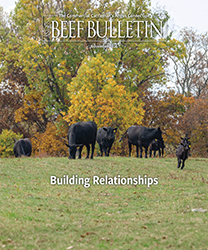
Current Angus Beef Bulletin
Our November issue focuses on the females of the herd and the records that validate them.