


The Road to Rural Veterinary Medicine with Richard Prather
Season: 5 — Episode: 17
September 2, 2026
We’ve all been there: the wee hours of a morning where your breath fogs the air, watching over a cow struggling to calve or a calf that isn’t sure it wants to remain in the land of the living.
Those moments can feel pretty isolating, but if you’ve got a rural large-animal veterinarian a phone call away, they are masters at putting fears to rest and offering a knowledgeable hand in often less-than-ideal situations.
Our November print edition of the Angus Beef Bulletin focuses on relationships and we would be remiss if we didn’t acknowledge the relationships cattlemen maintain with their large-animal veterinarians. On this episode, we’re joined by longtime rural veterinarian and Dean of the Oklahoma State University College of Veterinary Medicine Richard Prather to discuss how cattlemen can build a relationship grounded in trust with their veterinarian, the challenges associated with increasing the number of large-animal practitioners, and more.
Additional Resources:
- Managing the Effects of Wildlife on Livestock with Rosslyn Biggs
- Rancher's Thursday Lunchtime Series
- Oklahoma State University Names New Dean of the College of Veterinary Medicine
- OSU Receives Historic $250 Million Investment to Build World Class Veterinary Teaching Hospital
- Subscribe to the Angus Beef Bulletin EXTRA
Host Lynsey McAnally (00:19):
Angus at Work, a podcast for the profit-minded cattleman. Brought to you by the Angus Beef Bulletin, we have news and information on health, nutrition, marketing, genetics and management. So let’s get to work, shall we?
Hello and welcome back to Angus at Work! We’ve all been there: the wee hours of a morning where your breath fogs the air, watching over a cow struggling to calve or a calf that isn’t sure it wants to remain in the land of the living. Those moments can feel pretty isolating, but if you’ve got a rural large-animal veterinarian a phone call away, they are masters at putting fears to rest and offering a knowledgeable hand in often less-than-ideal situations.
Our November print edition of the Angus Beef Bulletin focuses on relationships, and we would be remiss if we didn’t acknowledge the relationships cattlemen have with their large-animal veterinarians. On this episode, we’re joined by longtime rural veterinarian and Dean of the Oklahoma State University College of Veterinary Medicine Richard Prather to discuss how cattlemen can build a relationship grounded in trust with their veterinarian, the challenges associated with increasing the number of large-animal practitioners, and more. So, let’s dive in!
Welcome to Angus at Work. I'm your host, Lynsey McAnally, and today we have a treat for our audience. Welcome, Dr. Prather! Do you mind telling the audience what your preferred title would be? Then we'll dive a little bit into what your background is in the industry.
Richard Prather (01:52):
Thank you, Lynsey. It's great to be here and appreciate the opportunity to be a part of your program. To answer your question, official title is I'm the Dean of the College of Veterinary Medicine here at Oklahoma State University. My preferred title is Richard, and feel free to call me as such anytime.
Host Lynsey McAnally (02:12):
Awesome. No, that's great. So I know that you have had some exciting things happen here just recently, but can we dive into what your background was prior to pursuing veterinary medicine, and then maybe talk a little bit about how you actually got into practice?
Richard Prather (02:30):
Trying to think back to when my first thought about veterinary school or being a veterinarian came to my mind. For as long as I can remember, I didn't have any other desire. I never considered anything else. I couldn't be talked into considering anything else. Even when I was a freshman here at Oklahoma State and they had career think-tank opportunities for us, veterinary medicine was the only one that I wanted to pursue, and there were no other options, and failure in that pursuit was not an option.
I am a second-generation veterinarian. My father was a veterinarian, and he was the first generation in his family to ever go to college. And the reason he had that opportunity was primarily because of the land-grant college in Texas, and it was probably his primary influence. And my earliest thoughts and memories that I can recall are standing next to him in his pickup riding around on dirt roads in Cotton County, Okla.
That was a lifelong memory that inspired during all kinds of challenges that you'll face along the way. Grew up in rural western Oklahoma, was here in Stillwater for eight years, pursuing an undergrad degree and then a veterinary degree, and then moved back to rural Northwest Oklahoma. Stayed in rural northwest Oklahoma until a month ago. So I guess that's about 60 years bouncing around in western Oklahoma, except for an eight-year stint here.
Host Lynsey McAnally (04:05):
Now tell our audience real quick, why are you back in Stillwater these days?
Richard Prather (04:11):
Probably because students over the years planted the seeds. Really was nothing that I pursued or contemplated. I always wanted to be a rural veterinarian in a town where I could make a difference, helping the people that were in the livestock industry, helping them with their horses, their cattle, their pets, whatever they needed. I wanted to be there to be that go-to person for them. I wanted to be a part of that community and see what I could do to help make that community encourage their children and their grandchildren to come back. And that's what Angie and I have done for the past 40 years. It's who we've been, and it's what led us to be where we are.
After the students would compliment and give platitudes about the experiences they had in our practice. Then over time, different practitioners, colleagues that I respect encouraged us to head back this way and then had opportunities to work with several different aspects of extension here in Oklahoma State. Those opportunities led to this opportunity. When this opportunity came open, we threw our hat in the ring, and here we are.
Host Lynsey McAnally (05:23):
And now you're in a position to shape further young veterinarians.
Richard Prather (05:28):
That's kind of where we are in our stage of life. It's time for us to turn around and help the next one in line enjoy a great career like we have had.
Host Lynsey McAnally (05:38):
So talk to me a little bit. We've begun to cover the importance of large-animal veterinarians and the relationships that they have with their clients and rural producers, but how important are those veterinarians in your eyes, particularly large-animal veterinarians, to rural America and farming and ranching?
Richard Prather (05:58):
We have the ability because of our relationship with the producers that we work with, whether it be a commercial operator or a seedstock operator, we have the skills and we have the background from what we learned in our agricultural degrees, what we learned in our veterinary degree that will help with the wellbeing and the profitability of their cattle operations.
Whether it be caring for the reproduction, the nutrition, the animal health programs in that aspect of their life to the point of caring for their horses that they gather their cattle with on working days, whether it be branding or weaning or just daily checks to areas that even their lives after work when they're sitting around in the evening trying to relax, watch the weather forecast with that working dog or their pet sitting on their lap, our influence touches numerous points in their life. It's just great to have those open doors and those relationships that let us in.
Host Lynsey McAnally (07:00):
I want to break this next part down into two sections, but what do you think is the biggest barrier to young people considering veterinary medicine
Richard Prather (07:09):
Probably just understanding and getting the word out that there's so much more than just someone who vaccinates or cares for their animal when it's having trouble delivering. The veterinary profession is so vast. Most people don't understand that veterinarians are highly involved in their food safety and being able to have and live in a country where we have the safest, most wholesome, most enjoyable food product anywhere in the world, that's all touched by a veterinarian somewhere along the way.
The safety of those products, the wholesomeness, the confidence that we have in our food supply to education, to people back into that profession and to be able to support the research that goes on. Research from veterinary medicine is touching lives through metabolic diseases like diabetes, through aging disorders such as dementia. The careers in veterinary medicine are just so vast and helping young people understand or even experience the opportunities that a veterinary curriculum could get to them. That's probably the biggest barrier.
Host Lynsey McAnally (08:25):
The second part of that question is what do you think the biggest barrier is to those young people being successful in pursuing their veterinary career?
Richard Prather (08:33):
A lot of them are understanding how they need to prepare. It's not an easy curriculum. It's a competitive curriculum. So helping young people understand early on that it's going to require discipline, it's going to require them to have done a fair amount of preparation through their junior high and high school years in the math and the sciences and be able to problem solve rather than just sheer memorize in their curriculum. They have to learn how to study and that's not often emphasized in most curriculums. The curriculum itself is the emphasis rather than the preparation of how to deal with that curriculum as a student once they reach college and they have to have the self-discipline to pursue and move on. And then financial barriers, it's a long journey. Eight years is a lot of time that you're not generating a salary and you're accumulating debt and we're working on all those issues to try to mitigate those debt service needs coming out of veterinary school.
Host Lynsey McAnally (09:43):
So we have an upcoming edition of the Angus Beef Bulletin that's focused on building relationships, and I would love to get your thoughts on why building relationships. Whether that is the relationship between a vet student and their instructors, other veterinarians or the relationships that they have with their peers and why that's important to the long-term success of future veterinarians.
Richard Prather (10:05):
Being a veterinarian really boils down to trust in the community where you're at. I can only speak to my particular career in a small rural community, and I'm sure it's the same even in an urban community and it's more of a companion animals setting where people get comfortable with the person that they see on the other side of the animals. Those relationships are not unlike family. In a small community, everybody pretty well knows everybody. The biggest issue in that kind of a relationship, if you know someone, then you're more apt to be reliable when they need you. And to know someone on the other side of the equation, it's also more likely that you'll be able to reach out to the right person that you need when you're in one of those moments. The relationship's a two-way thing and knowing who you're going to call and knowing who is calling you is terribly important in that relationship and the confidence and the trust and helping young people understand that this is a service-related industry and without service, we fail.
Host Lynsey McAnally (11:16):
We were talking before we started recording today. I think our listeners are well aware I'm a chatterbox, but we were talking before we started recording just about the compassion aspect as well and how important I think that personality trait is, whether that is something that comes natural to young veterinarians or something that they have to learn. That compassion goes a long way toward building that trust with clientele too.
Richard Prather (11:42):
Exactly. The old saying that it's not so much important what you know, it's to knowing that you care.
Host Lynsey McAnally (11:50):
And that builds that trust too. But let's talk a little bit about you as a young veterinarian. Do you have any stories that you can recall about those relationships and how they shaped you earlier in your career?
Richard Prather (12:05):
Again, I had the very good fortune of people that knew I was from a veterinary heritage and were very willing to help me expand on that and to become a veterinarian. I had two really great mentors along the way, a veterinarian that was primarily a cow-calf -riented veterinarian and a dairy veterinarian. That veterinarian taught me a lot about working and how to work and just what the definition of a work ethic was. There would be days that we would work at his office and out in the rural areas around his office until late in the evenings, and then he would ask me over for dinner. What that meant was after we left work, we would go home and we would work on his corrals or we would work on his fence. And, finally after dark, we would go eat the hamburger that he promised.
So he taught me how to work. Then the other veterinarian, both of them were extremely intelligent and extremely hardworking. The other veterinarian in his practice taught me what was a difficult lesson for a late teenager, early 20s young man.That was how to think. It wasn't a lesson that I really wanted to learn at that point in my life, but he was very clear in what we needed to do and how we would learn to think. That's kind of a lost art. More often than not now, people want to see things in quick images that they've seen before. Veterinary medicine is about problem solving and being able to take a situation in front of you that you've never seen before, you may never see again, but you can think your way through how to come up with a solution that's good for that animal and good for that producer. I owe a great deal to those two veterinarians.
Host Lynsey McAnally (13:52):
Going back to the idea of cultivating the art of thinking, when was the first time that you recall inviting vet students to rotate through your clinic
Richard Prather (14:04):
That's pretty easy. We've always had vet students through our practice. The veterinarian that we broke out under, one, he was a super great people person. He really understood and grasped the big picture and taught us the value that when people came to us with what they needed, they needed to feel welcome. And when they left, they needed to feel valued. When we first arrived, he was already accepting what was then called preceptors. Now they call them interns or they call them clerkships. They have varied names for them, but bottom line is students are coming out of just a pure academic, well-controlled, under the best of circumstances with some of the most skilled people possible at their disposal to being in a less than optimum situation and trying to determine how to still carry out good science. Still carry out good medicine, good surgery. That was ongoing in the practice where we started and he had built such a solid foundation based on that, that as he retired out and Angie and I took over responsibility for veterinary care, we realized how important those students were to our own vitality and our own desire to keep up.
Staying ahead of those students was one of our goals. When they came out, we didn't necessarily want to be behind the curve and we sure enough wanted to be good resources for them. It's just always been a part of who we were and what we do.
Host Lynsey McAnally (15:38):
Are there any standout stories that you have from mentoring and teaching vet students? I feel like this one might be kind of an entertaining question.
Richard Prather (15:49):
One of those days when we had students like what you were talking in. Some of the really, really busy times of the year, we'll be at the clinic 'til way, way late at night oftentimes. During tough seasons when it's either brutal cold, or extremely hot. We had a student with us one year and it was one of those weeks when we'd gone daylight 'til dark for several days in a row. Nearing the weekend, well after dark and one of our large animal helpers had gone out to set the gates so that the animal could return to its pen safely. The student walked around the corner in the dark and that assistant jumped out and said, "Boo!" Didn't scare the student at all. And the hired man looked at him and said, "Well, you're not very easy to scare." And [the student]said, "The only thing that would scare me right now is the sound of another trailer pulling up."
Host Lynsey McAnally (16:40):
There you go. That's not hard to picture, honestly. It's always a joy to come into the practice. I know probably I talk too much at times, but it's because everytime I step foot on property, I feel like I learned something. Whether good or bad, right?
Richard Prather (16:59):
That's one thing I learned a long time ago. It's so fulfilling to see those students have all these pieces. A may be over here and D may be over there and C is there. And they're trying to figure out how do I get A, B, C, and D to all line up in the right order. When you see those light bulbs come on and all those pieces have lined up in the right order and led them down the right path where they want to go, there's nothing more fulfilling than that. Just to see that development and see the self-fulfillment that it gives them.
Host Lynsey McAnally (17:39):
I love that. So what - from your perspective - would be the single most important piece of advice for young veterinarians?
Richard Prather (17:46):
To be the best version of themselves that they can be. And these aren't my thoughts, these are thoughts that I've learned from very wise and sage mentors along the way. Along the way, they're going to have people that might influence them one way or the other, and they've got to make good choices and good decisions about [whether] this person is influencing me to be the best that I can be or is this person not influencing me in that direction? If they're not, gravitate towards the ones that are.
Host Lynsey McAnally (18:19):
That's a good piece of advice in general, right? You are who you surround yourself with is something that my dad always said. I think that the older I get, the more true that statement is.
Richard Prather (18:30):
Absolutely.
Host Lynsey McAnally (18:32):
So how open ... I guess this is a different way of thinking, but we've talked about building relationships with clients and building relationships with your fellow veterinarians or instructors if those are veterinary students we're talking about. How open do veterinarians need to be earlier in their career to building their network and knowledge base into other sectors? So what I mean by that is how willing do they need to be to reach out into the nutrition side of things or looking into new technologies that might be available that could help their customers? Do they need to have that desire to continue looking out there in the industry to find those things that might be beneficial?
Richard Prather (19:15):
Early. Early in their career is the time to do that. I was very fortunate to have an Angus breeder of all people back in the day. His name was Dale Minnick. He ran a really forward thinking operation out of a little community called Fargo, Okla. Dale was way ahead of his generation working on tenderness and quality of the protein product that we were putting on people's plates. Dale, when I stepped onto his place, I knew every time I was there he wanted everything that my degree in animal science and agriculture had to offer as well as all the discipline that veterinary science could bring to the table. He knew that using all of those tools together meant that he was more likely to succeed. In those days, Dale would offer at his sale that he would buy any cattle back that were bred out of his bulls for $2 per cwt. above what the market was that season. He would then buy those cattle back and put them on feed himself. He knew that the genetics that he had in the Angus breed would be profitable. He was probably the single greatest client influence in shaping the direction that my career would go. It was a really big loss to the state of Oklahoma and a big loss to the Angus Association when Dale passed well before his time. He was an icon.
Host Lynsey McAnally (20:40):
What's the flip side of that? If a veterinarian doesn't have those answers and they have a client that's asking about nutrition or health protocols or what drug would be best in this situation ... What is the scenario if that veterinarian doesn't have that answer? What effect does that have on client success?
Richard Prather (21:00):
Just be honest. Most of the time a person doesn't realize what their blind spot is. They don't know what they don't know. If you're honest with that individual and say, "This is something that I really, really need and I don't have any other resource except you, and I'm looking to you to be that resource." And if they know that, I can't imagine a veterinarian not engaging and saying he or she will do their very best to get back with you and start finding you answers to whatever problem it is on your operation that you need their resource for. Don't be shy about giving constructive criticism both ways. Honesty between the producer. Honesty from the veterinarian back to the producer is invaluable. Sometimes those answers aren't easy to hear. I learned early on in this career that two things you have to be very delicate in because they're very difficult situations to handle in giving a client constructive, sure enough criticism about their operation and then listening to the client who's trying to tell you constructive criticism about the service that you're offering.
Once you learn how to work and have those kind of honest and open dialogue between the veterinarian and the producer, that's when you forge some really great relationships that have the highest opportunity for success.
Host Lynsey McAnally (22:27):
I'm sure those clients that ask those questions, the clients that hear that input and put it into practice in their operation, that has got to make you feel pretty good. But also, like you said, forge that relationship and that trust between client and their provider too.
Richard Prather (22:47):
The old axiom that iron sharpens iron. Difficulties and challenges can be the greatest teachers.
Host Lynsey McAnally (22:57):
Sure. We talked a little bit earlier about the importance of that relationship between young veterinarians and their clients, but what advice would you give to cattle producers on communicating with and supporting their local veterinarian? I know we talked a little bit about this just a second ago, but I'd love to dive a little bit deeper into it.
Richard Prather (23:15):
Main thing would be to just reach out to that veterinarian and let them know what your needs are, and then give them some time to work on what those needs are. If they don't already have that skillset, look to them in the first place. A lot of times producers don't really understand that veterinarian can be that kind of a resource. Don't hesitate to reach out to a veterinarian and say, "I need this advice on nutrition. I need this advice on how I should or shouldn't implement antibiotic use. Or, "I don't understand how to decide when and what type of vaccine to give." A lot of those decisions veterinarians already have a knowledge base on, but the veterinarians a lot of times don't know how to help if the producers don't ask for help.
Host Lynsey McAnally (24:06):
How much importance is Oklahoma State University placing on students building a network while in school and after graduation?
Richard Prather (24:13):
Right now they're working really hard on student services to be able to incorporate wellness as well as education. Teaching the students that relying on their peers, relying on their classmates, building relationships among themselves that will last a lifetime. That is a significant part of what we're trying to work on. Relationships with 4-H and FFA organizations, with the science, technology, education, engineering and mathematics programs, and working through those relationships. Those networks help building students that have the highest opportunity for success.
Host Lynsey McAnally (24:59):
Are there any continuing education opportunities that OSU has put in place for vet students? Whether that's students currently in vet school or maybe recent grads?
Richard Prather (25:10):
Yes, there are. We're very fortunate that the College of Veterinary Medicine and the College of Agriculture are working collaboratively together on the Rancher's Lunch Thursday [Series]. That's an excellent continuing education program for producers and for veterinarians. And then Dr. [Rosslyn] Biggs with our Extension service is a part-time veterinary college Extension, part-time College of Agriculture Extension, and her program that's called the Integrated Beef Cattle Program. It's working with students and pairing them up in the same classroom with graduate veterinarians to continue education with a focus on the producer and on the producer's viability, on the producer's sustainability and the producer's profitability. Those are just great networks that are ongoing right now.
Host Lynsey McAnally (26:00):
Awesome. We had the fortune to interview Dr. Biggs last year about the interaction between wildlife and livestock. We might do a call back in this podcast to that episode from Dr. Biggs last year too. I think it's probably a good time to revisit those interactions. One more question for you on that, but are there any exciting things happening within Oklahoma State Vet Med?
Richard Prather (26:25):
Probably right now is the most exciting thing happening within the College of Veterinary Medicine is we're currently in the design phase of an entirely new teaching hospital that'll be coming out on the west side of town as you're coming in on the north side of the road. We will soon - in the next several years - have a brand new $300 million veterinary teaching hospital that will be serving the needs of small animal, companion animal, equine and food animal clients [as well as] their animals. That process is involving stakeholders from all over the state that are practicing veterinarians, engineers, architects, and our faculty and staff here at the College of Veterinary Medicine. That is a huge collaborative effort to get that off of the ground, and we're very grateful to the taxpayers of Oklahoma. We're grateful to the legislature. We're grateful to the administration and the regents of Oklahoma State.
And it's just an exciting time to be in the College of Veterinary Medicine with that on the horizon.
Host Lynsey McAnally (27:29):
I can't wait to hopefully one day be able to attend an open house and come see everything too. It sounds like an incredible, incredible opportunity for the state of Oklahoma and potential vet students coming through Stillwater. So very, very excited to see that. What would you say to young people considering attending vet school?
Richard Prather (27:49):
Be passionate. That's the single most motivating emphasis for me in the early portion of my career, in the middle of my career, and now as I'm in the autumn of my career. That total dedication and consuming passion to what you want to do. That's what will make you great at whatever profession you decide to be in.
Host Lynsey McAnally (28:11):
Is there anything that we've forgotten? Anything that you think is important to this episode that I've neglected to mention?
Richard Prather (28:19):
I don't think so. There's a tremendous amount of momentum in our industry right now. We're fortunate to be in a time when cattle prices are good and things happen in the government. Things happen around the world that affect us, but the momentum that I feel from cattle producers and horse owners and companion animal clientele across the state? It's just a great time to be involved with Oklahoma State University and be a part of this effort. I'm just excited and as fortunate as I can be to be a part of it.
Host Lynsey McAnally (28:52):
Alright. This is the last question, but we always like to end Angus at Work on a positive note. Not that your previous statement wasn't positive, but what is one thing happening personally or professionally that you're thankful for?
Richard Prather (29:05):
I would have to say it'd be the support. There are so many people from so many different industries and areas around the state that want this school, that want our graduates, that want this profession to be successful. They're really looking forward to what is on the horizon. It's just very, very important that everybody understands we'll be doing our very level best to produce practice-ready, successful veterinarians that are ready to be part of their communities, part of their families, and part of the whole process of the success of the state of Oklahoma.
Host Lynsey McAnally (29:42):
I love that. Well, thank you so much for joining us today.
Richard Prather (29:46):
My pleasure. Thank you for the opportunity. Greatly appreciate it and wonderful job.
Host Lynsey McAnally (29:52):
Well, I think that our audience is going to really appreciate this conversation and I can't think of a better way to end it.
Richard Prather (29:59):
Alright.
Host Lynsey McAnally (30:06):
Listeners, for more information on making Angus work for you, check out the Angus Beef Bulletin and the Angus Beef Bulletin EXTRA. You can subscribe to both publications in the show notes. If you have questions or comments, let us know at abbeditorial@angus.org and we would appreciate it if you would leave us a review on Apple Podcasts and share this episode with any other profit-minded cattlemen. Thanks for listening. This has been Angus at Work!
Topics: Health , Management , Sustainability
Publication: Angus Beef Bulletin
Related Content


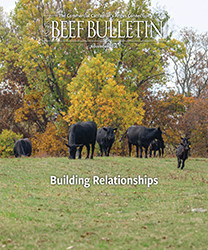
Current Angus Beef Bulletin
Our November issue focuses on the females of the herd and the records that validate them.