


Managing the Effects of Wildlife on Livestock with Rosslyn Biggs
Season: 4 — Episode: 18
September 25, 2025
There isn’t a much better place to spend time than in the great outdoors. One of the beautiful things about farming and ranching — whether you work primarily on or off-farm — is that our workplace involves spending time amongst this beautiful creation and the wildlife that call it home.
While it’s never a bad thing to appreciate the beauty of our wild creatures, they do sometimes throw a curveball when it comes to managing our own cattle.
On this episode of Angus at Work, we welcome you to listen in as we visit with veterinarian Rosslyn Biggs of Oklahoma State University regarding:
- diseases we should be on the lookout for when livestock and wildlife commingle;
- methods for managing risk;
- steps for preparedness; and
- why a happy medium is crucial when it comes to coexisting with wildlife.
Additional Resources:
- The Buzz on Flies of Importance with Sonja Swiger
- New World Screwworm Information | Oklahoma State University
- Producers Needed for Asian Longhorned Tick Study
- Livestock Biosecurity Can Prevent Disease
- Veterinary Viewpoints: Disease Testing New Additions to a Herd
- Subscribe to the Angus Beef Bulletin EXTRA
A huge thank you to Purina for their sponsorship of this episode.
Find more information to make Angus work for you in the Angus Beef Bulletin and the Angus Beef Bulletin EXTRA. Make sure you’re subscribed! Have questions or comments? We’d love to hear from you! Contact our team at abbeditorial@angus.org.
Intro (00:04):
Angus at Work, a podcast for the profit-minded cattleman. Brought to you by the Angus Beef Bulletin, we have news and information on health, nutrition, marketing, genetics and management. So let’s get to work, shall we?
Host (00:29):
I don't know about you but, in my opinion, there isn't a much better place to spend time than the great outdoors. One of the beautiful things about farming and ranching – whether you work primarily on or off-farm – is that our workplace involves spending time amongst this beautiful creation and the wildlife that call it home.
While it's never a bad thing to appreciate the beauty of our wild creatures, they do sometimes throw a curveball when it comes to managing our own beef cattle.
On this episode of Angus at Work, we welcome you to listen in as we visit with veterinarian Rosslyn Biggs of Oklahoma State University regarding diseases we should be on the lookout for when wildlife and livestock commingle, methods for managing risk, steps for preparedness and why a happy medium is crucial when it comes to coexisting with wildlife. So, let's dive in!
Purina ad (01:23):
Raising cattle demands, grit, determination and the right nutrition. That's why cattle producers have turned to Purina Animal Nutrition for over 130 years. From starters that help set calves up for success to protein that fuels cattle growth to minerals to help keep herds performing, Purina has the products and expertise that work as hard as you do. Get rewarded for your work with proven nutrition from Purina. Learn more at purinamills.com/cattlecare. That's purinamills.com/cattlecare.
Host (01:54):
Welcome to Angus at Work. I'm your host, Lynsey McAnally, and while our team always tries to bring you exciting topics today we're discussing one that I am more than ready to dive into. Dr. Biggs, before we jump in, would you mind sharing a little bit about your background and your role with both OSU Extension and the Oklahoma State University (OSU) School of Veterinary Medicine?
Rosslyn Biggs (02:14):
Absolutely. So I am a fourth generation farmer-rancher from Chickasha, Okla. I am an Okie through and through and I love western Oklahoma. I came to Oklahoma State as an undergrad and got an undergrad degree in Ag [Economics] and then went on to veterinary school. My mother was also a veterinarian and so I'm a second generation veterinarian.
After graduating, I worked in private practice. I went back home. People tell you to go somewhere else and make your mistakes. I went home and made all my mistakes. Thankfully had a lot of grace from a lot of producers in that area. I then later worked for the USDA APHIS for Veterinary Services and joined OSU just a little over six years ago. My current role is I am the Director for the Center for Rural Veterinary Medicine, which is a new program - a new center - I'm super excited about. I'm also the Director of Continuing Education and I do beef cattle Extension [work] as well.
Host (03:18):
Awesome. I know I've leaned on you and some of your colleagues quite a bit, both personally and professionally, in the past.
This one is a pretty broad topic. I'm sure our listeners have already read the summary for the episode, but there are a lot of different rabbit trails that we can go down and probably will go down at some point. But I'd love to visit with you a little bit about why producers should be concerned about wildlife commingling with livestock. Before we jump into some of that, would you mind telling us about some of the diseases we need to be on the lookout for and how those transmission pathways work?
Rosslyn Biggs (03:54):
Yeah, absolutely. So let's talk about that transmission piece. First and foremost, we're always concerned about direct contact. Meaning our cattle are picking up the pathogen directly. It can also potentially be carried by a vector. So when we think about vectors, most commonly we think about insects. Biting flies, ticks, that kind of thing.
We certainly can have contaminated environments as well. Meaning an infected animal comes across and defecates for instance. That feces is there and then an unexposed animal comes in to interface with that contaminated environment and picks up the pathogen.
As far as diseases of concern, we've got some here in Oklahoma. I will tell you my laundry list of diseases of concern. We've had a lot of discussion here about rabies in multiple species - particularly livestock. Rabies, of course, is going to be one of those direct contacts where we have wildlife ... typically wildlife vectors. Here in Oklahoma, that's going to be skunks. In other parts of the U.S., our wildlife vector may be raccoons.
But we are looking at how that is transmitted. It's going to be a bite in most, if not all cases and symptoms can be highly variable. They can be ... we think classically of that 'Where the Red Fern Grows' kind of rabid dog: aggressive. But we can also see what's called a dumb and or paralytic form. So think neurologic diseases, rabies always has to be on our list.
Of course, with rabies - once infected - there's no treatment and so we want to make sure that any time we're dealing with a neurologic animal, rabies is top of mind and we're taking appropriate precautions. Particularly if we are an individual or have individuals handling those animals.
It depends upon where you sit in years of cattle production, but brucellosis ... When I was a kid on up into and just past veterinary school, brucellosis was a big deal to the cattle industry. In particular, brucella abortus is what we were concerned about.
People may be familiar with brucellosis more by the term Bangs. I still do a lot of Bangs vaccination as well with heifers, for instance. Brucellosis is a bacterial agent and again, its a direct contact. Typically, we're going to see brucellosis transmitted at the time of birth. We had a lot of people infected with brucellosis because they were helped with calving or things like that.
Are wildlife factors for brucellosis? I think it's important to note with brucellosis that we've got different species of brucella that we're concerned with. Typically those are specific to their species of choice, but it is also something that can cross species and is zoonotic too. I may need to step back on zoonotic ... [That is] any disease that can be transmitted from animals to humans or the reverse.
So we've got brucellosis in our feral hog population. That is typically brucella suis and so that's a wildlife vector that we're concerned about. Our friends in the Greater Yellowstone area are very familiar with brucellosis populations in wild cervids (the deer family) as well as the bison in that area.
Lepto - leptospirosis - is one we routinely vaccinate for in the cattle herd. Lepto is going to be transmitted by contact with urine. Think wildlife carry it, they urinate in particular in bodies of water, cattle drink that and can be exposed in that way.
Crypto - cryptosporidium - is one that is concerning as well. We kind of classically think with any diarrhea calf, crypto has got to be high on our list. We stress to our veterinary students here to take appropriate precautions. If you've ever had crypto, you're going to remember that. I can assure you.
And then we also want to talk about things that are maybe a little bit newer on the scene, so to speak. Highly pathogenic avian influenza that's been predominantly identified in dairy herds. We've had Asian longhorn tick and the agent that it carries theileria orientalis or one of the agents it can carry Ikeda. We're seeing that kind of march westward.
And then notably high on everybody's list is New World screwworm and we can have some interface. Maybe we'll talk about our concerns for wildlife as well as our domestic livestock populations.
A variety of others too that we could talk about. But then that may be all we talk about today! Those are ones that I kind of go to. And people, with many of these - particularly brucellosis and tuberculosis - we can also see in our wildlife populations as well. We've had eradication efforts of those diseases with that. Not all that many producers, particularly on those two diseases, are that familiar and so that's a concern of mine too as we move forward. Things like New World screwworm is just the lack of familiarity and so it doesn't get on the radar screen so to speak. Or on the differential list as early as sometimes I might like it.
Host (09:43):
Starting off, how do we control the issues of wildlife meeting livestock, whether that's through direct contact or through shared resources?
Rosslyn Biggs (09:52):
Yeah, any time we're concerned about disease introductions, and I think this applies in the wildlife setting, we've really got to do an evaluation on what the risks are, right? Different producers are going to have different levels of risk they can tolerate or - in some cases - have to tolerate because that's where they operate. I cannot control where the whitetail deer enter and exit my place. I suppose I could, but my financial capability to build high fence around our operations, that's not realistic. And so we want to think about what are the things we can do to keep separation while still maintaining wildlife populations. Certainly many of our operations have financial incentive to maintain their wildlife populations, whether that's through hunting or biodiversity on the operations themselves. Nobody cares for land more than the farmer or rancher in my mind. And that wildlife piece is a component of it.
And so now there are things that we need to think about, right? Can we influence where those animals are or are not? Can we make sure that we have biosecurity practices to limit exposure? Is that vaccinations? Is it making sure that access to feed and hay is more controlled? Is it fencing frankly? And so there are ... Again, back to the risk piece of it: we see higher numbers of whitetail deer than we did even 20 to 30 years ago. That's for a variety of reasons, but we want to make sure we're managing things, at least in my mind, in balance and keeping our goals in mind as we do those things.
Host (11:50):
All of that can sound a little bit ominous. I think we talked about that. How heavy this conversation can get when we're talking about the diseases. In particular, a little bit later in the conversation when we get into New World screwworm. For those diseases that we listed above, most of them have an existing vaccination on the market. I know with avian influenza there's been conversation about potentially getting a vaccination on the market. Can we talk a little bit about how effective those vaccines are as well as the importance of developing a strong herd health plan with your local veterinarian?
Rosslyn Biggs (12:29):
Yeah, Lynsey, I am a big proponent of making sure you have a great relationship with your veterinarian. I know you personally have a tremendous veterinarian that works with your own herd. First and foremost, I think that's where it starts. I joke the time to develop a relationship with your veterinarian is not at 2:00 a.m. when the cow decides to calve and it's a train wreck. In fact, one of my big focus areas - particularly with the Center for Rural Veterinary Medicine - is our efforts to get more graduates at least from Oklahoma State and really more broadly into rural areas and give them the tools to be successful there. But as it stands right now, there are many veterinary practices that won't see your emergency unless you have an existing valid veterinarian-client-patient relationship (VCPR). There's no requirement for them to see that. And so this is a great discussion as to evaluating the risks. What the risks are from other cattle, from wildlife and getting things down of what's our vaccination plan going to look like when it comes to vaccine efficacy?
Our vaccines do a really good job. Let's take rabies for instance. Rabies is one where the risk is low, right? But if you have an animal that contracts rabies, it was a 100% for you. And so I am a big supporter, a big proponent of rabies vaccinations for high value animals. Two categories of high value. Either they were expensive to purchase - so think bulls, think show stock, think donor females - or they have high value sentimentally or emotionally for the owner. Or both. For me, it's usually both. And we're talking ones that have names. Is it practical to rabies vaccinate a set of stockers that's going on to wheat? No and that's not a recommendation I would make as a veterinarian. This is not out of the bounds, right? You got a $50,000 or $75,000 or $100,000 animal? Let's plug a rabies vaccination in there. Those vaccines are effective.
Particularly show animals. We've had incidences in Texas, in Oklahoma, where show animals have contracted rabies. Even going so far as being at the show. Not in Oklahoma, that was in another state. But with that, we've got kids that interact with these animals and it makes sense.
Why were these higher risk animals? Well, think about how we manage show animals. We've put them into more confined settings. We're feeding them, right? What do wildlife like, right? It's that separation from wildlife. And so not intentionally, but it's not uncommon for ... I've had skunks in my barn. I will tell you from a personal standpoint in veterinary practice and afterwards, every single skunk I have ever submitted for rabies testing has been positive.
Host (15:30):
Not a good look for the skunks.
Rosslyn Biggs (15:32):
It's not a good look for skunks, I'm afraid. So I may get in trouble from the skunk supporters. Particularly those that are out in the middle of the day, we need to have some concerns. But when it gets back to vaccines, we've got great efficacy on things like lepto. Making sure we have appropriate VCPRs in our vaccination plans. Brucellosis? We've vaccinated ourselves largely into eradication here in the [United States] and so we're pretty proud of that. And so thinking about the steps we can take through biosecurity measures to include vaccinations, to include treatment protocols. How, where and what we're going to test new purchases for before we get them on the place. All of that needs to be top of mind.
I'm a little biased. I'm a veterinarian. I think you want to establish that [VCPR], have your veterinarian out. Let's talk through these things and let's look at what our biosecurity practices are. Let's look at what our vaccination protocols are as part of that. Let's look at what treatment protocols are. And what you may find, too, is those recommendations may save you some funds. Again, I'm not unrealistic. Not every vaccination is for every animal. It's highly operational and goal dependent, but that's a conversation for owners to have with their veterinarians and figure out what works for them.
Host (17:01):
And it's going to depend on your location, like you mentioned, your goals.
Rosslyn Biggs (17:05):
Absolutely.
Host (17:06):
And potentially either experiences that you yourself have had or your veterinarian has had with other operations. Which just drives home the point of finding a good veterinarian that you get along with really well and that you can have these conversations with. Because I think they're not easy conversations to have sometimes, right? No one ever wants to find out that they need to implement several new vaccinations, but if it potentially is going to save you heartache down the road? That can be said for many things, but it might be worthwhile.
Speaking of things that might cause some producers heartache - whether it comes to New World screwworm or more just management in general - I feel like facilities are often a barrier to effective herd health management. What advice do you have for producers who are on the fence about investing in working facilities or potentially a portable system?
Rosslyn Biggs (18:03):
That includes myself. I'm reflective of that statement.
Host (18:05):
Well, me too.
Rosslyn Biggs (18:10):
Depending upon the location, we have animals ... So, actually, that's one of my biggest concerns frankly with New World screwworm and its threat here in the U.S. Access to facilities. Access to be able to treat, right? Facilities as far as that investment are ... It's got to be something that, of course, makes sense. At a very minimum, we've got to be able to get those animals caught, get them handled in the way based on what we could potentially face.
Actually, my two biggest concerns with New World Screwworm are facilities, which I've already mentioned, and then I have concern that the vast majority of producers don't remember it, what it was like. And that includes me, right? I'm getting back to having to listen to my father and others that had to deal with New World screwworm. Literally on a daily basis.
And so folks being unfamiliar with certain diseases, emerging diseases. Those two big categories: lack of facilities and just being unfamiliar with the implications of these. Those are my top two concerns, but back to facilities. I think people, especially with looming New World screwworm. We had the announcement - I saw it in the middle of the night - that it's 70 miles from the border. Again, we're still really happy that it's not in the U.S., hope that continues. Unfortunately, it looks like it's inching closer and with that, if there's any time to invest in facilities its probably now. What you may find is that handling facilities will improve your cattle experience. If you get good ones, right? I don't know how many times we've been just dealing with something, dealing with something, dealing with something, and we finally make the investment. Its like, 'Why did we wait so long to do that?' That's another component, too, that you can have your veterinarian out with as well. It's a new fresh set of eyes to it, but maybe you're new to the game. Facility consults I think [are] a great approach. Again, now's the time to invest.
Host (20:39):
I don't think anybody wants to be in the position where this does cross into the United States, becomes an issue and you aren't able to get those cattle up to get a closer look at them. I think for me, that's probably my biggest concern with New World screwworm. Just not having ... It's just my husband and I. Even though we have just a handful of cattle, that still can be a lot to manage when you both have off-farm professional roles that you're also trying to take care of. So I think just taking a good look at ... Obviously, these facilities need to be safe for both cattle and those handling them. Maybe it's not going to make it on the cover of a magazine, but it's safe and it gets the job done. We can look at investing in something a little flashier down the line.
Rosslyn Biggs (21:30):
It just needs to be safe and functional, right? Safe and functional. And it does not have to be, it doesn't have to be super fancy. It doesn't. It just needs to get the job done, as you said. Making sure we've got personnel and animal handling in mind, I suppose too. Maybe now's the time with cattle prices, if you've got that one cow that is ... I just put together an article on culling decisions. Now's the time. If she's hard to catch and you get her captured, maybe she needs to go to the sale barn. Those are some decisions that I think are worth considering.
Host (22:13):
With all of that said - many of our viewers will have seen the news - and you mentioned earlier the Asian Longhorn tick being found in, I believe, it was southeast Iowa? As well as New World screwworm, which we've talked about quite a bit. Do you mind sharing the relationship between those insects/arachnids as well as the role of biting flies in potentially transmitting disease?
Rosslyn Biggs (22:40):
Let's talk about Asian longhorned tick first. We've had it for a number of years in the U.S. This is the thing that's interesting about Asian longhorned tick and maybe most worrisome: it is a tick that does not require a male and a female to set up a population. It just requires ...
Host (22:58):
I did not know that.
Rosslyn Biggs (23:01):
It just requires a single female, and so you can have thousands and thousands and thousands of ticks with one single [tick]. So as we think about where and how we can move disease, wildlife is part of the conversation. That's what we're talking about today. Asian longhorned ticks do not necessarily care if it is a cow or if it is a deer or a dog. It is one of those that we are seeing. We've had some introductions. It's continuing to march its way westward. The thing about Asian longhorned tick is it is notably ... It can carry a variety of pathogens, but notably the one that we're most concerned is theileria orientalis with the genotype Ikeda. Now, most producers are not going to be terribly familiar unless, unfortunately, they have had to deal with theileria. Those on the East Coast are in even farther, farther west than that are experiencing.
Unfortunately, theileria orientalis itself, theileria is going to look like anaplasmosis. We're really familiar with anaplasmosis in this part of the country. The thing that's notable with it, in my mind, is first of all, there's no labeled treatment for theileria here in the U.S. So if we see, we think it's [anaplasmosis], we treat for it, and it's not responsive to the antibiotics that we would typically reach for in that instance? Additionally, if it is [anaplasmosis] we usually think of it as more of an adult animal thing. Theileria is less discriminant than that and it can impact younger animals. And so we also have a largely naive herd. We'll put a plug in. We've got an ongoing research project here at Oklahoma State - so if Oklahoma producers or those in surrounding states, bordering states to Oklahoma are interested - we've got an ongoing research project looking for these ticks as well as looking for theileria orientalis.
They can contact me and I'll get them set up with the information if they're interested in that. But in particular, Asian longhorned tick is a concern. Now, of course, that's an arachnid.
As we move to more fly issues, let's just talk about biting flies in general. Our historic concerns with biting flies is they take large blood meals. So if we have bloodborne pathogens, they can feed similar to a tick, right? Meaning they take a blood meal and then they go feed on another animal and the pathogen is then transmitted to the second animal. So when it comes to biting flies, those are concerning.
So let's talk about the one that is on everybody's mind or should be: New World screwworm. We had it here in the U.S. We have eradicated it, well, it was eradicated here in the U.S.
Many producers, as I mentioned before, don't remember having to ... I think it was Smear 62? As my dad describes it, this nasty tar-like black stuff. Putting it on every newborn's navel, getting wounds addressed immediately. This is the thing about New World screwworm. First of all, it's not like a worm, like a fishing worm. It is going to be ... The female fly comes in and lays her eggs in open wounds or around mucus membranes. So think in nasal passages, on the edges of eyes. New needs an opening to the body. Now, we've talked a little bit about ticks. These new World screwworm flies will lay their eggs in an opening as small as a tick bite. And so this is the concern: as that egg matures, it develops into a maggot. We've all probably seen maggots. Here's the thing that's unique about New World screwworm: is it feeds on live tissue.
Host (27:14):
They're the thing of nightmares.
Rosslyn Biggs (27:16):
They are, they absolutely are, right? It's effectively eating that animal alive. So if left untreated, within about two weeks, it can lead to death of these animals. And so, Lynsey, you mentioned you guys both have off-farm jobs. It's the same at my house too. We joke sometimes we don't see our animals except under the cover of darkness. It'd be pretty easy to miss these things. It's also like having to go out and treat navels and treat every other wounds during calving season. My goodness gracious. I mean, it has the potential to drastically change how we operate in so many ways. New World screwworm, those maggots burrow in, they eat life tissue. They are what nightmares are made of. And when we think about our ability to deal with this ... This is the good thing if you can have a good situation in dealing with a pest like this: we eradicated New World screw worm in the U.S. and down into Mexico with what is called the sterile insect technique.
This is what's unique about female New World screwworms. They only mate once. So if we're able to sterilize the male flies, which has been done at a facility in Panama historically, then once that female mates with a sterile fly then that's the end of the life cycle effectively, right? Because we don't have fertilization that occurs. My livestock entomologist friends? They would probably be upset with me. I keep it super basic in my brain. You could have a whole multiple podcasts on New World screwworm and the life cycle and that kind of thing. So keep that in mind. I'm keeping it pretty basic. We did have the notification as we mentioned, that it was in Nueva Leon about 70 miles from the border. That's absolutely a concern. I will tell you that animal health officials, certainly within Texas, within Oklahoma - those are the two I'm the most familiar with.
I have no doubt our other border states are taking this with the utmost concern and being very aggressive about their approach. Secretary Rollins was actually in Oklahoma week before last, and this is what she talked about. She's not backing down on this deal and so that I am encouraged with. It's been taken very seriously. We certainly want producers to understand though what the risk is. We don't want to scare folks. We don't want to create hysteria, but we want people to be aware. We want them to understand if they see something, we want them to report it. Again, one more plug for having that VCPR. The other thing that I haven't mentioned is in order to eradicate this? The financial investment, should we get it here in the U.S., is exorbitant. And so thinking about personnel needs, thinking about the financial resources in order to get this done? I am hopeful with what the USDA and Secretary Rollins - under her guidance - has said. The commitment to new facilities in Texas to deal with distribution areas as well as potentially creating a new sterile fly facility. So folks need to be on point and need to be aware and stay in tune because it's definitely a concern.
Host (30:58):
I think the key message there is be aware of what is going on. Be educated as to steps that you can take and then take that knowledge and prepare the best that we can, whether that be making sure that we have a good VCPR. Whether that be facilities, whether that just be taking this winter - which hopefully is a little bit of a breather for all of us. Taking this winter and making a plan moving into the spring or using this time to maybe get some of that preparedness done. If you don't have facilities before we get too many hard freezes, this might be the time to do it. It can be a lot for all of us to take in. I understand no one wants to read these reports, but it's going to be a lot more of a headache and cause a lot more heartache down the road if we don't take the opportunity to at least try to get ready for it.
I think at the end of the day, if it doesn't cross into the United States, if we are fortunate enough for it to stay south of the border, then all of that preparedness that we have already done can be put to use in other ways. It won't have been for a waste in my opinion.
I'm really excited to share all of this information with our listeners. I did want to point out, I'm going to link back to a podcast that we did where we focused on biting flies and New World screwworm in particular. It might be a little bit older information as far as where the New World screwworm is as of now, but still had some really great info. So for our listeners, I'll link back to that in the show notes. Can we talk a little bit about maybe the effect of wildlife, whatever kind of creature that is. On hay pastures and mineral feeders, and then maybe talk a little bit about fences and water sources as well?
Rosslyn Biggs (32:53):
Yeah, absolutely. Briefly mentioned earlier in the discussion, our ability to keep the things we feed our animals safe, so to speak. Or as isolated as much as possible from wildlife. We have a big feral hog issue here in Oklahoma, particularly where I'm from. You want to see something that can destroy pastures, in particular wheat pasture? My family has some small operations along the Washita River. I mean, those feral hogs can just destroy it. So we want to think about what are the ways that we can still get our hay and feed out to our animals without inviting wildlife? In order to do that, in many cases, that's going to be fencing options most of the time or how we store those things, meaning hay and feed water sources. But if there are, it gets back to how do we manage the wildlife populations and creating that separation as much as possible. That's where I like to start.
Host (34:12):
I find it really interesting. We have game cameras on water sources and on our mineral feeders because that's always a great place to capture those animals coming up and a good way for us to check on them if we can't be there in the light of day. Just being able to read tags or seeing if somebody comes up and doesn't look quite right. Or maybe they didn't bring their calf up. Any of those things. But it's been interesting to me this year. Last year, we caught no deer on game cameras, a few coyotes, but I saw no deer. And this year the number of deer that we've caught on game cameras has been pretty surprising, but it's also been interesting to me. They're not going to the water sources. They've been going to our mineral feeders. They ought to be very well-managed deer at this point.
Rosslyn Biggs (35:03):
Yeah, I have some well-managed turkeys at my house too. They're going to go where the opportunity exists, right? They are going to go after where it's easy to eat, where it's easy to drink, if they're seeking out that salt. Well, my goodness, there's a buffet at the mineral feeder right there! And so how we separate that sometimes is easier said than done. Please, I want listeners to realize that I'm not naive in recognizing that. But I love the concept of the game cameras too. You're evaluating risk at the end of the day with the data and the knowledge you have. Wildlife sometimes too, they are not going to always hang out where we're going to see. So we want to evaluate what you think is going on there too, and what actually is maybe two separate things,
Host (35:59):
And we're going to jump over into another conversation about the effect that some wildlife can have on your herd as far as harassment and predation. But one thing that I wanted to mention that I thought was really interesting was they were not going to one side of that stock tank for several days. Over the course of the next few days going over to check them, we found out that we had had apparently a very large female prairie rattler that had ... had babies? Gave birth? I understand they give live birth. I don't know what you call a group of ... is it a litter of snakes? Who knows!
Rosslyn Biggs (36:36):
I fortunately work with people who like snakes and so I leave that expertise up to them.
Host (36:44):
But it was interesting that they avoided that side of the stock tank and the area closest to the gate. I would assume the snakes were there. So I just wanted to talk about the effect that some of our larger carnivores can have on our beef cattle herds, as well as things like, I know in parts of the country we have producers who deal with vultures and then maybe venomous snakes and the concerns that they bring about?
Rosslyn Biggs (37:09):
Well, we've talked a lot about disease transmission. Think of those large carnivores. Safety and protection of our animals is a concern. And again, it's [finding] the right balance with the wildlife populations. Black vultures here in this part of the world are a big concern. I think it's always good to have a good relationship with your game warden because of these kind of things. Again, it gets back down to knowing what the risks are with predation and the snake issue? Are there ways to manage them so that we don't have that interface between - or even tempt the interface frankly - between wildlife and others when it comes to predation.
Host (38:01):
And I think just kind of keeping in mind, again, going back to that relationship with your veterinarian. For me, myself and I, I find a lot of peace in being able to take an image of something that comes up. Last year, we ran into the snakes. We were a little bit drier later in the summer, and so I'm sure a lot of people were dealing with very similar things, but we were a little bit drier. Those snakes were looking for water, and at that time, our calves were just tall enough that they could get their heads into the stock tanks. They were a week or two old at that point, but they couldn't see over into the stock tank. And so we ran into several of them that got bitten right under the jaw as they were reaching over into those stock tanks. That's not something that you can really manage, but it is something that you can be aware of and have medications on hand if you have the ability to catch those calves up to help them through that. In our case, a painkiller, an antibiotic and an anti-inflammatory went a long way for those little calves getting back on their feet.
Rosslyn Biggs (39:08):
We want to be prepared for what we might face, whether that's disease or whether that is wildlife interfaces. I'm a big preparedness person. I'm like the biosecurity and preparedness geek, and so ...
Host (39:24):
I love that.
Rosslyn Biggs (39:24):
What you said too is worth noting. It's hard sometimes to do this, but letting our animals tell us what's going on. Why are they not going to that side of the tank? Oh, okay. Sometimes my husband gets on me, he's like, 'Why are you just sitting there watching?' I'm like, 'Well, I'm trying to ... just leave me alone.'
Host (39:47):
They can't tell us, they can't speak.
Rosslyn Biggs (39:49):
I'm trying to see what the keys are. What are the subtle things that may give me some indication of what's going on. It never hurts to take a moment and enjoy the view, so to speak.
Host (40:03):
We have had the conversation multiple times within our own team. How relaxing it is just to sit, whether they're at a bunk or they're out on grass, just sit and listen to them, chew and eat. I don't feel like there's anything more peaceful than a happy group of cattle. Just watch your feet when you do that.
Rosslyn Biggs (40:22):
That's right. That's right.
Host (40:23):
So we've talked a lot about wildlife and cattle. Some of the things that can go on that maybe are unfortunate when they come into contact with one another. I also want to go back to a statement that you made earlier. There's no one that cares more about the health of their land and the health of the wildlife populations than cattlemen. We're stewards of the resources that we have been blessed enough to be tasked with. And so with that in mind, how do we go about developing that mutually beneficial relationship when it comes to cattle and wildlife on both private and public lands? What are the benefits of doing that?
Rosslyn Biggs (41:01):
Yeah, I think sometimes we have to change our mindset. For most of us, we're in this for the long game. And with the long game, that means we've got to take care of our resources that we have in hand. Now, we understand that many times we've also got to cashflow this deal, too. And so I think thinking what the right measures are to be able to achieve both, not one at the expense of the other? I think that's where we start. I like wildlife on my operations. I like cattle on my operations. I like a handful of horses on my operations. So I'm a proponent of multi-species grazing, I guess. But with that, as producers, we're given the opportunity to be good stewards of our stock. We're given the opportunity to be good stewards of the land, the water and really all of our resources that are in front of us.
And keeping in mind that for most of us, we don't want this to end with us, right? We want this to be a multi-generational thing. And I think too, having the mindset that just because it's the way we've always done it doesn't mean we don't need to consider change taking in the knowledge that we have in front of us. And that's where I would start think about mindset, think about what goals are and where we can be mutually beneficial. And for some, as I mentioned before, having both a more agriculturally focused operation right alongside wildlife as well and making sure that they're managed in appropriate way. The economics of that will be in many cases, sometimes that may keep our agricultural operation afloat if we're able to do that. But for the long run too. Hopefully, it keeps it in balance and we can continue these operations in this style for years and years to come.
Host (43:04):
I think one of the best indications, in my humble opinion, that you're doing a good job managing your operation is when you have created a space that the wildlife also want to inhabit. We're as much stewards of them as we are of our own livestock.
We always like to end Angus at Work on a positive note. So with that, what is one thing happening in your life - personally or professionally - that you are thankful for?
Rosslyn Biggs (43:37):
I'm going to pick both, if that's okay? Professionally, I'm super excited about the investment that Oklahoma, specifically the Legislature and the Governor have made in veterinary medicine. We got a significant appropriation to build a new veterinary teaching hospital, so I'm super stoked about that. I'm excited for our graduates that are going out there and redefining what practice has to look like in rural spaces. So professionally, that's what I'm probably the most excited about.
Personally, this time of year, I love a good fair. I'm really ready for the Tulsa State Fair. We got through Oklahoma State Fair. In Oklahoma we get double, right? So it's fantastic. It's like a whole month plus of fairing. I'm excited. I have two girls. They've playing softball and riding horses, and we're going to hit the fair in a couple of weeks with shows and whatnot. I love this time of the year. I am really ready for it to get a little colder, to be honest with you. The fair generally brings that too! So from a personal standpoint, I think that's probably where I would end it.
Host (44:53):
Awesome. Well, thank you so much for joining us!
Rosslyn Biggs (44:56):
Thanks for having me.
Outro (45:02):
Listeners, for more information on making Angus work for you, check out the Angus Beef Bulletin and the Angus Beef Bulletin EXTRA. You can subscribe to both publications in the show notes. If you have questions or comments, let us know at abbeditorial@angus.org and we would appreciate it if you would leave us a review on Apple Podcasts and share this episode with any other profit-minded cattlemen. Thanks for listening. This has been Angus at Work!
Topics: Management , Health
Publication: Angus Beef Bulletin
Related Content


Current Angus Beef Bulletin
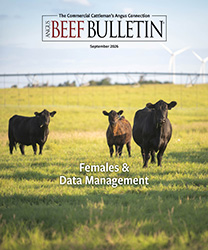
Our September issue focuses on the females of the herd and the records that validate them.