LRP-Feeder Cattle Insurance
Recent enhancement and performance history.
July 23, 2026
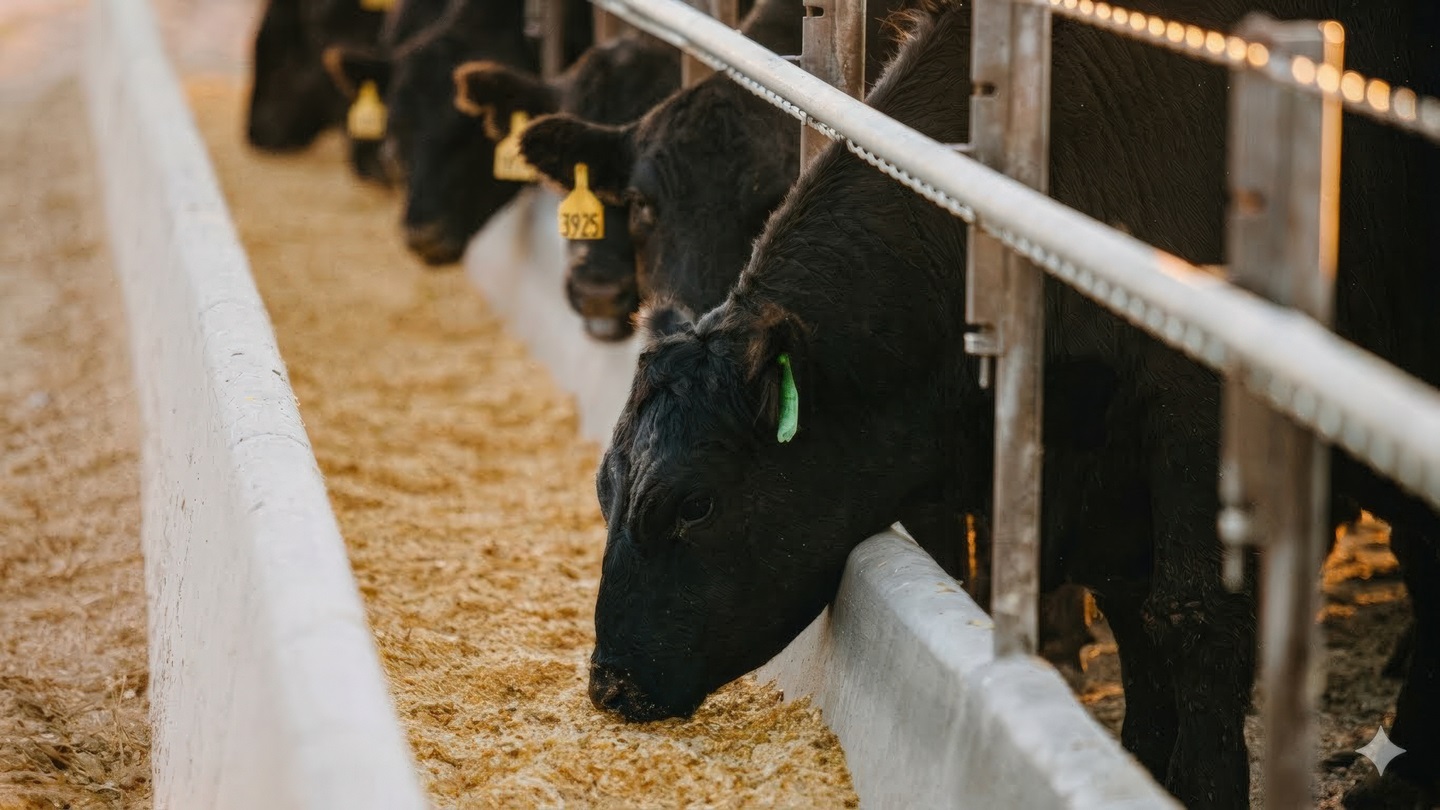
LRP insurance has become a widely used price risk management tool for Nebraska cattle producers, with more than half a million feeder cattle insured annually in recent years. Expanded premium subsidies, including additional assistance for new and beginning producers, have made LRP more affordable and accessible. [Photo by Real Ag Stock.]

by Jay Parsons, University of Nebraska–Lincoln
Livestock Risk Protection (LRP) insurance became available for cattle producers in 2003. In 2018, several enhancements and improvements began to take place that resulted in lower costs, as well as increased access and ease of use for producers using LRP. For example, premium subsidies increased from a flat 13% to the current range of 35% to 55% with new and beginning producers receiving an additional 10%-15% subsidy on top of those rates.
The due date for premiums was also moved from the beginning of the insurance period to the end of the insurance period, making it easier for producers to initiate insurance coverage. These, along with other changes, led to a dramatic increase in the use of LRP.
Table 1 contains producer participation data in Nebraska for the LRP-Feeder Cattle insurance program from 2015 to 2025. LRP-Feeder Cattle insurance is available in five different forms for beef cattle: Steers Weight 1 [< 600 pounds (lb.)]; Heifers Weight 1 (< 600 lb.); Steers Weight 2 (600-1,000 lb.); Heifers Weight 2 (600-1,000 lb.); Unborn Bulls & Heifers Weight 1 (< 600 lb.); Unborn Bulls & Heifers Weight 2 (600-900 lb.); and, Unborn Calves (60-99 lb. sold within two weeks after birth). The latter version of it was created to provide coverage of beef-on-dairy day-old calves. LRP-Feeder Cattle insurance is also available for Brahman and dairy cattle in the Weight 1 and Weight 2 classes.
Table 1 shows the dramatic increase in sales and volume of cattle covered by LRP-Feeder Cattle insurance in Nebraska starting in 2021. The number of feeder cattle insured annually in Nebraska has increased from the tens of thousands to more than half a million head in recent years. Producer loss ratios (returns per dollar of producer premium after subsidy) remain variable depending on market outcomes vs. expectations. However, from 2015 to 2024, 64% of LRP-Feeder Cattle policies earning premiums in Nebraska paid out some level of indemnity. The producer loss ratio averaged 1.15 (indemnities exceeded producer premiums by 15%) over that period.
Table 1a: LRP-Feeder Cattle summary of business for Nebraska |
||||||
| Livestock Risk Protection Feeder Cattle Insurance (LRP-Feeder Cattle) usage in Nebraska, 2015-2025 | ||||||
| Year | Policies sold | Policies earning premium | Quantity, hd | Liabilities, $ | Total premium, $ | Policies indemnified |
| 2015 | 1,457 | 141 | 15,456 | $23,890,729 | $616,680 | 69 |
| 2016 | 1,402 | 75 | 9,885 | $10,773,447 | $460,552 | 67 |
| 2017 | 1,552 | 191 | 21,735 | $20,816,435 | $995,861 | 50 |
| 2018 | 1,224 | 117 | 15,802 | $16,967,064 | $640,475 | 45 |
| 2019 | 1,238 | 69 | 8,958 | $10,390,904 | $309,240 | 47 |
| 2020 | 1,237 | 46 | 7,231 | $8,403,175 | $324,531 | 18 |
| 2021 | 1,721 | 291 | 61,698 | $74,252,751 | $3,126,675 | 211 |
| 2022 | 2,595 | 599 | 199,083 | $273,807,929 | $11,230,777 | 473 |
| 2023 | 2,275 | 1,376 | 487,410 | $848,243,077 | $32,544,716 | 600 |
| 2024 | 3,377 | 1,725 | 527,431 | $1,118,980,976 | $51,904,234 | 1,364 |
| 2025 | 4,621 | 2,619 | 765,306 | $1,702,594,318 | $76,248,014 | 66 |
| Avg. | 1,808 | 463 | 135,469 | $240,652,649 | $10,215,374 | 294 |
Table 1b: LRP-Feeder Cattle summary of business for Nebraska (continued) |
||||||
| Livestock Risk Protection Feeder Cattle Insurance (LRP-Feeder Cattle) usage in Nebraska, 2015-2025 | ||||||
| Year | Indemnity, $ | Loss ratio | Subsidy, $ | Subsidy, % | Producer prem, $ | Producer loss ratio |
| 2015 | $872,264 | 1.41 | $80,165 | 13% | $536,515 | 1.63 |
| 2016 | $625,482 | 1.36 | $60,411 | 13% | $400,141 | 1.56 |
| 2017 | $195,421 | 0.20 | $128,310 | 13% | $867,551 | 0.23 |
| 2018 | $406,191 | 0.63 | $82,998 | 13% | $557,477 | 0.73 |
| 2019 | $584,929 | 1.89 | $40,691 | 13% | $268,549 | 2.18 |
| 2020 | $224,896 | 0.69 | $70,725 | 22% | $253,806 | 0.89 |
| 2021 | $1,186,861 | 0.38 | $1,105,096 | 35% | $2,021,579 | 0.59 |
| 2022 | $11,181,705 | 1.00 | $3,953,344 | 35% | $7,277,433 | 1.54 |
| 2023 | $12,121,426 | 0.37 | $11,422,399 | 35% | $21,122,317 | 0.57 |
| 2024 | $49,709,981 | 0.96 | $18,247,496 | 35% | $33,656,738 | 1.48 |
| 2025* | $628,037 | 0.01 | $26,669,356 | 35% | $49,578,658 | 0.01 |
| Avg. | $7,710,916 | 0.75 | $3,519,164 | 34% | $6,696,211 | 1.15 |
|
*2025 is still in progress and not included in the averages. Source: https://www.rma.usda.gov/en/Information-Tools/Summary-of-Business, June 30, 2026. |
||||||
I have tracked LRP-Feeder Cattle insurance for a 13-week policy purchased in early August with an expiration date the first week in November since 2005 (see Fig. 1). During those 21 years, LRP had a net positive effect (producer premium < indemnity) 10 times. Circled in black in Chart 1, these occasions were 2006-2009, 2015-2016 and 2020-2023.
LRP has the effect of evening out the valleys of unexpected price changes. For example, in 2008, the actual ending value in November was $21.51 per hundredweight (cwt.), below the expected ending value that was projected back in August. This resulted in an indemnity of $20.81 per cwt., minus the producer premium of $4.06; the purchase of LRP insurance added $16.75 per cwt. to the bottom line. Similarly, in 2015 and 2016, the last time we emerged from drought with recovering cattle inventories, LRP insurance added more than $9 per cwt. to the bottom line in consecutive years. From the producer’s perspective, losses under LRP insurance are capped at the premium cost, whereas gains are variable and potentially much larger. As a result, despite seemingly equal chances for gain or loss, the producer loss ratio averaged 1.40 during the 21 years depicted in Fig. 1.
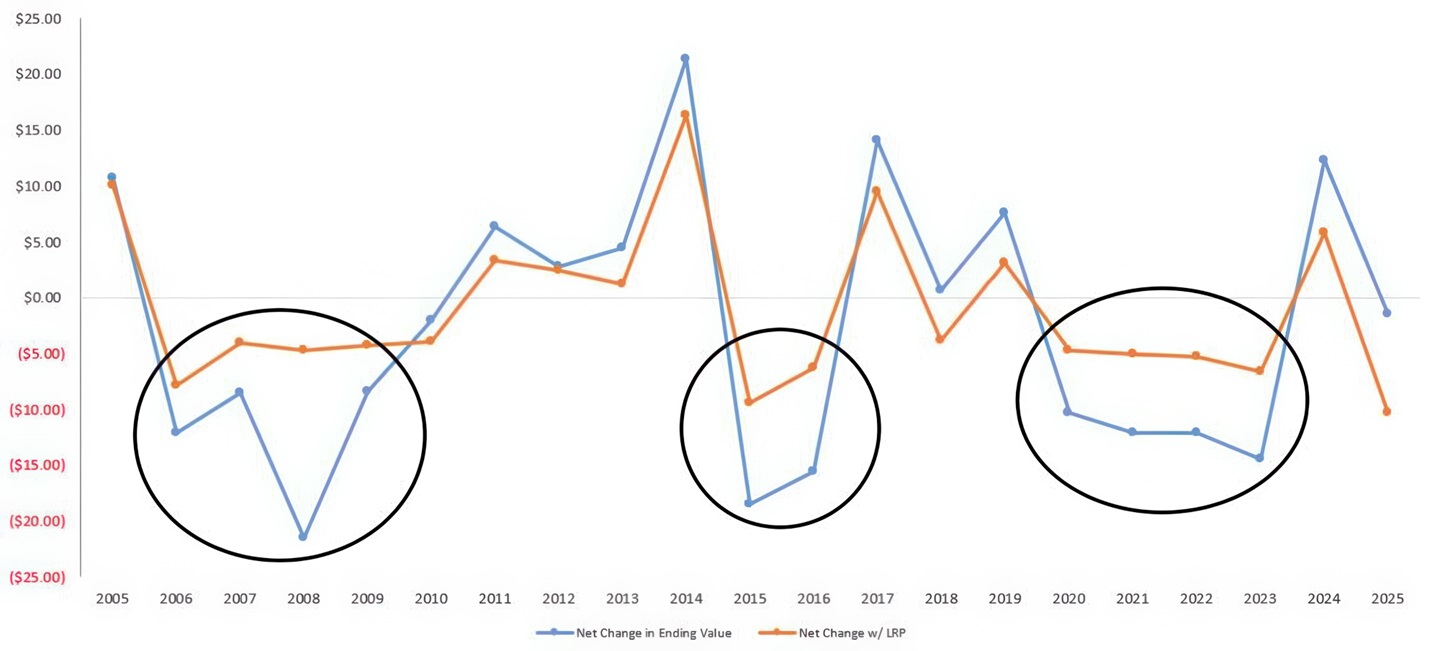
Fig. 1: LRP-Feeder Cattle insurance performance for Steers Weight 2 with purchase date Aug. 6-8 and expiration date Nov. 5-7 relative to the expected ending value insured at the highest level

Like most insurance products, LRP is not something producers should purchase expecting to receive a payout. Instead, it is most effective when incorporated into a broader market risk management strategy, helping protect profits during years when cattle markets decline.
LRP continues to evolve, with ongoing changes designed to increase its value and accessibility for cattle producers. One of the most recent enhancements affects premium subsidies for new and beginning producers, bringing the program into alignment with provisions in the One Big Beautiful Bill Act (OBBB) of 2025.
As cattle markets continue to experience periods of volatility, producers should evaluate how LRP fits within their marketing and risk management strategies.
For all producers, LRP subsidy rates range from 35% to 55%, depending on the selected coverage level (see Table 2). Historically, new and beginning producers have received an additional 10-percentage-point subsidy above the standard schedule. Under the OBBB changes, premium assistance is increased further during the producer’s first four years of operation. New and beginning producers now receive an additional five percentage points in years one and two, three percentage points in year three, and one percentage point in year four.
As a result, beginning producers in their first two years of operation can receive a total premium subsidy of 50% even at the highest LRP coverage level, making the program more affordable for beginning producers while strengthening its role as a risk management tool.
LRP insurance remains an important tool for cattle producers seeking to manage market price risk. While it is not intended to generate large profits through indemnity payments, it can help preserve profitability when cattle prices decline unexpectedly. The program’s simplicity, combined with government-supported premium subsidies, makes it an attractive option for producers looking to strengthen their overall risk management plans.
Table 2: Standard LRP Insurance premium subsidy levels |
|
| Coverage level | Subsidy |
| >95% | 35% |
| 90%–95% | 40% |
| 85%–90% | 45% |
| 80%–85% | 50% |
| 70%–80% | 55% |
| Source: USDA Risk Management Agency (RMA), Livestock Risk Protection program. | |
As cattle markets continue to experience periods of volatility, producers should evaluate how LRP fits within their marketing and risk management strategies. When used consistently and in combination with other management tools, LRP can provide valuable downside price protection and contribute to the long-term financial resilience of cattle operations.
Editor’s note: This work is supported by the North Central Extension Risk Management Education Center, project award no. 2025-70027-45398, from the U.S. Department of Agriculture’s National Institute of Food and Agriculture. Jay Parsons is an ag economics professor at the University of Nebraska–Lincoln. This article was first published in the Department of Agricultural Economics “Cornhusker Economics” series on July 15, 2026.
Angus Beef Bulletin EXTRA, Vol. 18, No. 7-B
Topics: Business , Industry News , Marketing , News
Publication: Angus Beef Bulletin
Related Content


Current Angus Beef Bulletin
Our September issue focuses on the females of the herd and the records that validate them.