




In the Cattle Markets
Strong demand and cattle inventories are both driving beef demand.
July 8, 2026


by James Mitchell, University of Arkansas
A lot has been said about beef prices in 2026, and there has been a lot of productive discussion about what is driving them.
Some point to historically tight cattle supplies. U.S. cattle inventories are at their lowest since the 1950s, and federally inspected cattle slaughter through May is 1.12 million head below the same period in 2025 and 2.56 million head below 2022, the cyclical peak for the current cattle cycle.
Others argue exceptionally strong consumer demand is the primary reason beef prices have reached record highs.
While total per capita beef consumption has remained relatively stable over the last several years, ground beef has become an increasingly larger share of consumption.
Both explanations are correct, and the market is more nuanced than either explanation by itself.
Total beef disappearance has declined much less than cattle slaughter would suggest. According to the Livestock Marketing Information Center (LMIC) balance sheet, total beef disappearance in 2026 is forecast to be 2.6% below 2025, but still 0.2% above 2022. This reflects two important factors affecting total beef supplies. First, heavier dressed weights have partially offset lower slaughter numbers by producing more beef per animal. Second, larger beef imports have kept total U.S. beef supplies from plummeting.
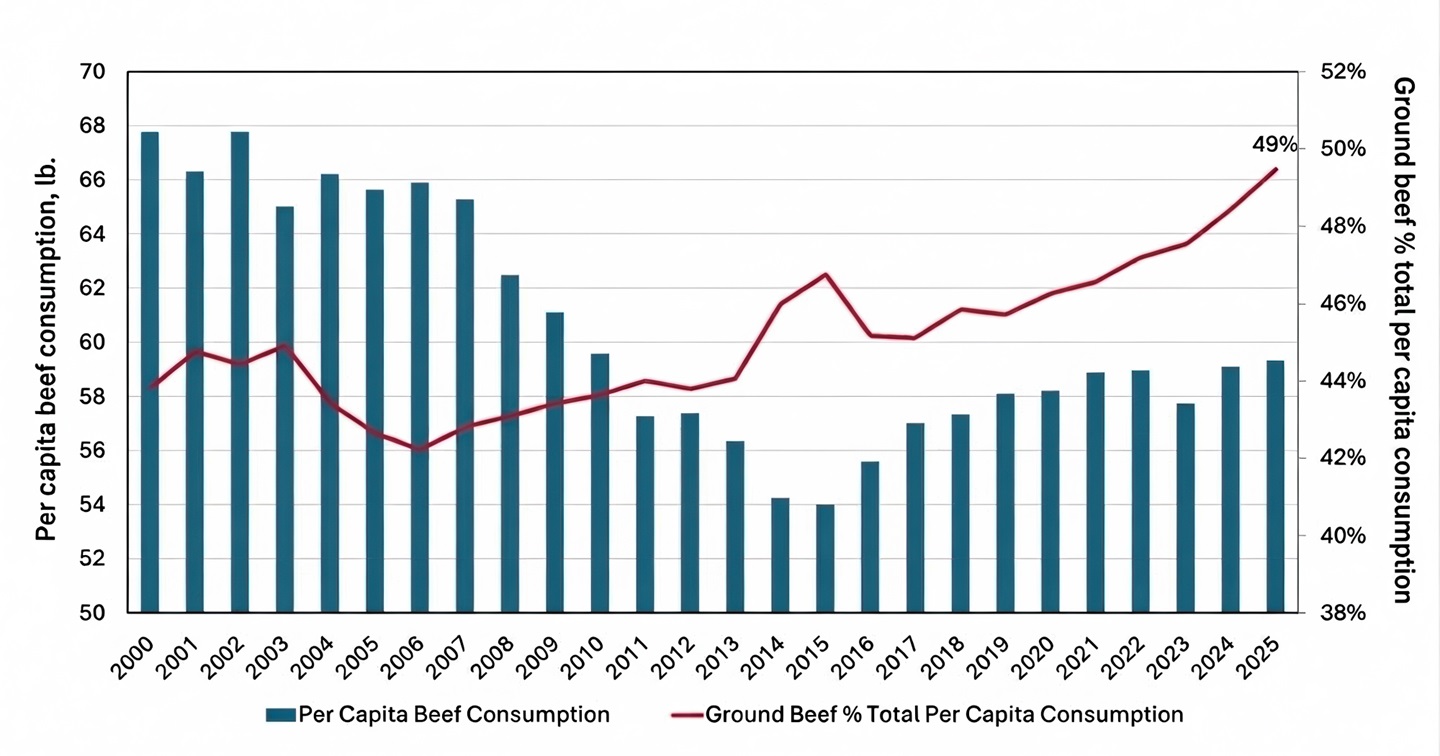
Fig. 1: U.S. beef consumption and retail prices, per capita, retail weight, annual pounds per capita

Fig. 1 helps illustrate why this is important. While total per capita beef consumption has remained relatively stable over the last several years, ground beef has become an increasingly larger share of consumption. Ground beef accounted for 47% of per capita beef consumption in 2022 and is expected to account for 50% in 2026. This shift is not surprising. Heavier carcass weights produce more fat trim for grinding, and beef imports have historically been an important source of lean trim for the U.S. beef market. Total pounds of beef may not have changed much, but the mix of beef products available to consumers certainly has.
That distinction is important because “beef” is not a single homogeneous product. Beef is consumed in many different forms, from ground beef to steaks and roasts, and both at home and away from home. Each of those products has its own supply and demand fundamentals, which have unquestionably changed the relative price of different beef products. Looking only at either total beef disappearance or cattle inventories provides an incomplete discussion.
This is a good example of ceteris non paribus. Historically tight cattle supplies, stronger production efficiency, larger beef imports, and resilient consumer demand are all occurring at the same time. That is why record beef prices are not simply the result of lower cattle numbers or stronger demand. Ultimately, total beef expenditures continue to increase, which supports higher revenues throughout the U.S. beef industry.
Editor’s note: James Mitchell is assistant professor and extension economist in the Department of Agricultural Economics & Agribusiness at the University of Arkansas. Reprinted with permission from the June 29, 2026, “In the Cattle Markets” published by the Livestock Marketing Information Center, available at https://lmic.info.
Angus Beef Bulletin EXTRA, Vol. 18, No. 7-A
Topics: Industry News , Marketing , News
Publication: Angus Beef Bulletin
Related Content



Current Angus Beef Bulletin
Our September issue focuses on the females of the herd and the records that validate them.