



One Decision, Many Outcomes
Why feed management decisions ripple through beef production systems.
May 6, 2026

by Hector Menendez et al., South Dakota State University
Every beef operation asks these questions at some point:
- Should I change the supplement type?
- Is this new technology worth it?
- Will this management change or technology improve performance without increasing risk or cost in the long term?
Menendez et al. (2026) illustrate with the “domino effect” why these questions are harder than they appear and why feed management must be viewed as a system rather than a single choice.
The ‘domino effect’
The row of dominoes represents how a single management decision sets off a chain reaction across the ranch.
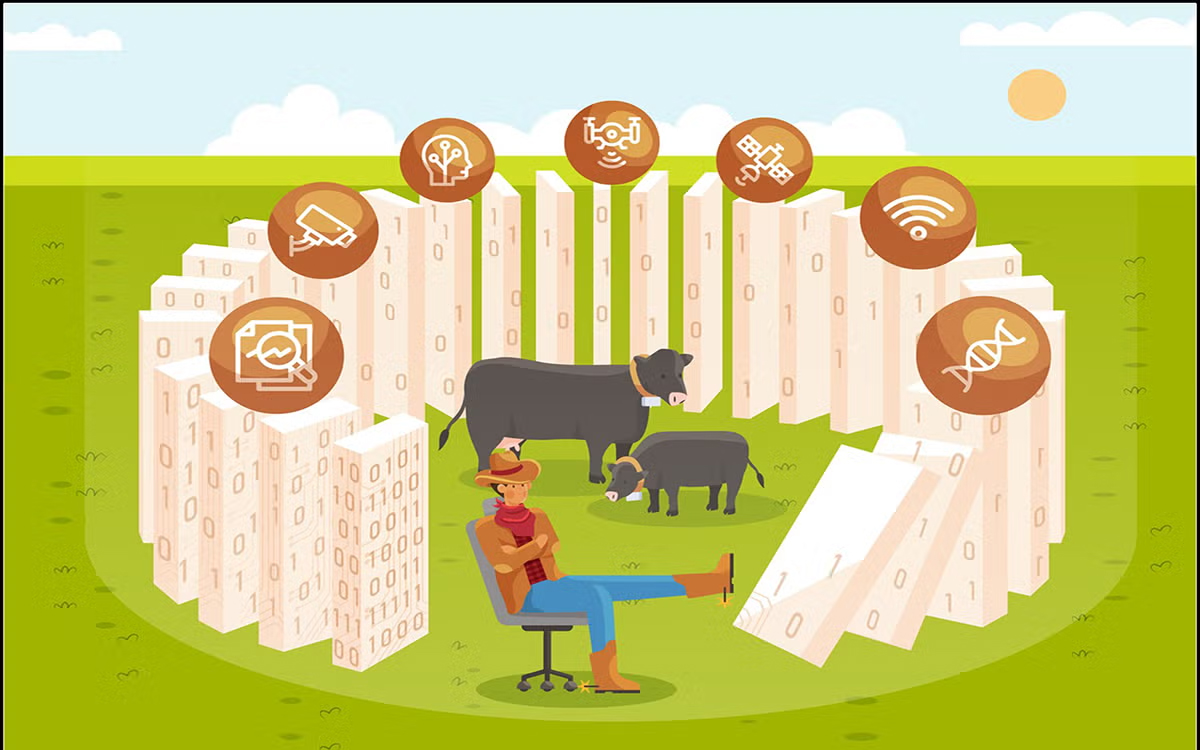
Fig. 1: The first domino represents a rancher making a management decision. They may apply one or multiple management interventions. However, the consequences are often delayed and hard to anticipate (the last domino).
Source: Menendez et al., 2026.

The first domino: a feed management decision
The first domino represents a producer making a decision, often related to feed or nutrition, such as:
- adjusting protein or energy supplementation;
- changing forage allocation or grazing timing; or
- adopting precision feeding or monitoring technology.
From a National Animal Nutrition Program (NANP) Feed Management perspective, this is where nutrition science meets daily management — the moment research becomes practice.
The middle dominoes: tools and technologies that amplify decisions
Once a decision is made, it is often implemented through tools, including:
- wearable precision livestock technologies;
- automated feeders or intake systems; and
- forage monitoring, sensors or data analytics.
These tools do not replace the fundamentals of nutrition; they amplify them. Data-driven, biologically relevant and financially feasible feed management decisions become more precise; whereas, decisions based on gut feelings, business-as-usual practices or ineffective technology implementation reduce efficiency and livestock productivity.
The last domino: delayed and unintended consequences
The final domino represents outcomes that often show up later, such as:
- changes in feed efficiency or cost per pound of gain;
- shifts in manure nutrient distribution;
- increased data burden or management complexity; and
- labor, infrastructure or cybersecurity challenges.
These outcomes are difficult to trace back to the original decision due to time delays. Producers are often left wondering where they went wrong, or, more frighteningly, they don’t know there is a problem until it’s a big problem.
This is essential to the USDA’s Natural Resources Conservation Service (NRCS) planning, where practices are evaluated not just on immediate performance, but on long-term system outcomes tied to conservation, nutrient management and sustainability.
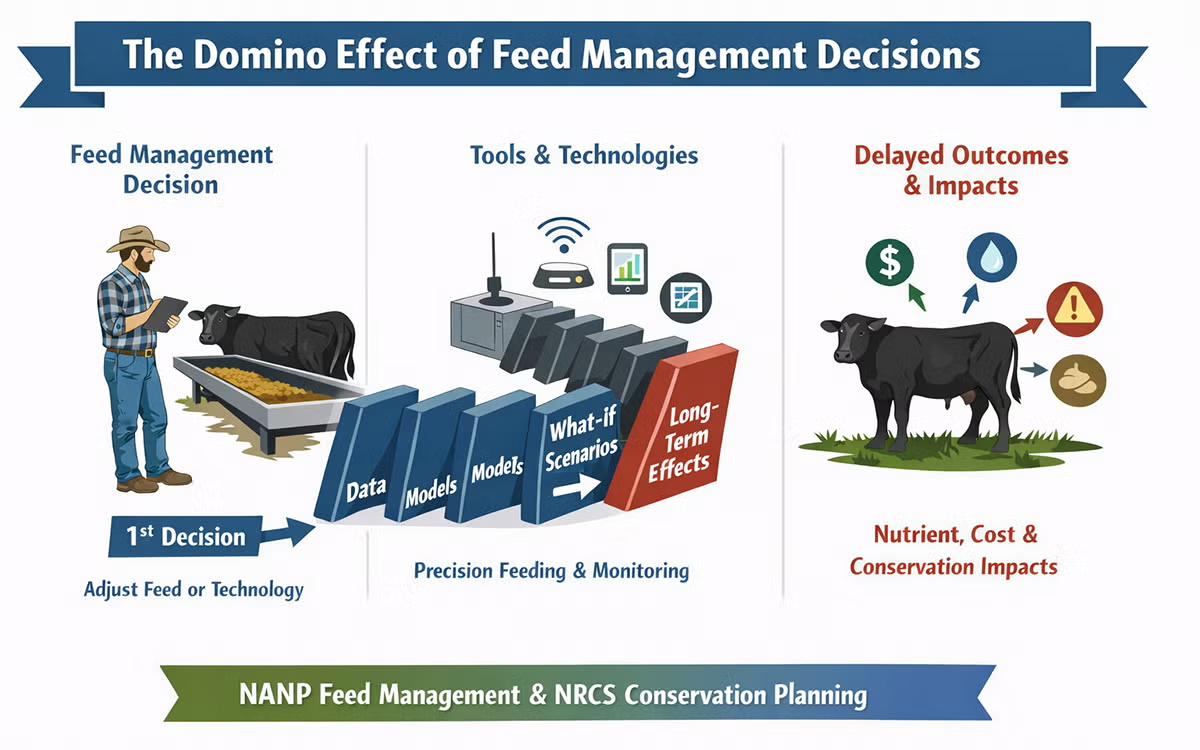
Fig. 2: Beef feed management decisions create cascading effects. A single feeding decision influences data use, nutrition models and management tools, with ramifications on performance, costs and conservation over time.
Source: Luis O. Tedeschi.

Why feed management is the anchor
While technology, models and data streams evolve rapidly, feed management remains the anchor point:
- In many systems, it is the first domino, as animals always require feed.
- It is the most controllable decision.
- It is where research-based nutrition delivers real-world value.
Menendez et al. (2026) reminds us feed management is never “just feed.” It is the starting point of a system that rewards informed decisions and magnifies uninformed ones. That is why NANP Feed Management, supported by modeling and aligned with NRCS conservation planning, is essential for sustainable, profitable beef production.
Producers who use feed management nutrition models are often able to reduce waste, increase gains and decrease costs. Further, models don’t just provide an answer; they help the dominoes to fall in favor of the rancher as insight is gained into what is driving change in livestock feeding management. If you have more questions or want training in nutrition models, for any livestock species, reach out to Luis Tedeschi or Hector Menendez.
Producers who use feed management nutrition models are often able to reduce waste, increase gains and decrease costs.
Learn more and get involved
Explore the NANP Feed Management Committee and access fact sheets, reports and decision support tools at the NANP website.
Whether you’re a producer, extension agent, planner or researcher, your voice is critical in building the future of sustainable livestock production — starting with what we feed and how we manage it.
Editor’s note: Hector Menendez is assistant professor and SDSU Extension livestock grazing specialist. This article written collaboratively by Hector Menendez, Jordan Adams, Julia Travassos da Silva, Karun Kaniyamattam and Luis O. Tedeschi. [Lead photo by Shauna Hermel.]
Angus Beef Bulletin EXTRA, Vol. 18, No. 5-A
Topics: Management , Nutrition
Publication: Angus Beef Bulletin
Related Content


Current Angus Beef Bulletin
Our September issue focuses on the females of the herd and the records that validate them.