


Open Freezers, Community Connections
Indiana family’s open-freezer days foster connections with community.
October 21, 2025
Brock Farms Angus Cattle didn’t start out by selling 90-100 head per year as freezer beef. A challenge-turned-opportunity took David and Kris Brock’s business in a new direction more than a decade ago, and they haven’t looked back.
The operation, located just outside Stilesville, Ind., sits along U.S. Highway 40. The well-traveled commuter highway, as it turns out, is a convenient location for a freezer-beef business, providing an opportunity to support the next generation of Brocks as they return to the farm.
David graduated from Vincennes University with an associate degree in agribusiness in 1989 and then headed back to the family farm with his wife, Kris. They rented a nearby farm that was the former site of an implement auction. With the new property, rented on halves, David and Kris began the transition from the hog business to the cattle business.
They started their cattle business as a cow-calf enterprise, selling feeder calves to a couple buyers. One had a feedlot and contacts out east, including a packer in Pennsylvania. Only a few calves were retained for their family’s freezer.
Kris, formerly a nurse, took over bookkeeping for the farm after son Andy’s birth in 1997. Four ladies she knew from church began asking for beef a few years later, and the family started keeping a few heifers or steers back to sell to them. Kris handled the scheduling at the processors and communication with the customers, and the freezer beef business grew by word of mouth. They were soon selling 10-15 head per year.
Challenge turned opportunity
Drought in 2012 caused the operation feeding the majority of the Brocks’ calves to shut down due to high corn prices.
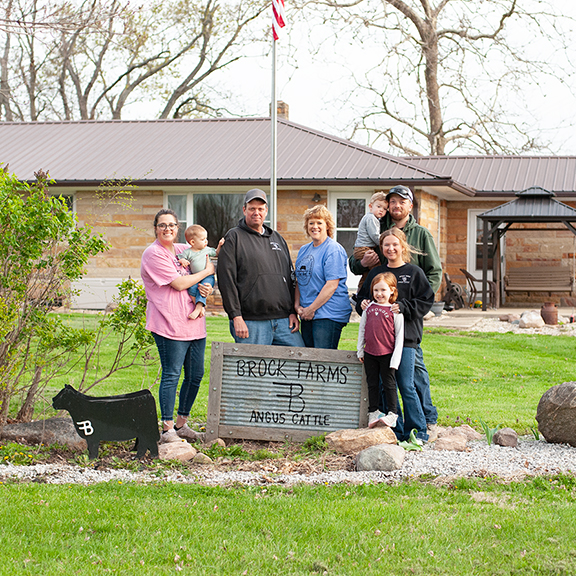
The Brock family includes (back row, from left) Katie (Brock) Pennington holding Charlie; David, Kris, Baylor and Andy; with Courtney and Hadleigh in front. Not pictured is Katie’s husband, Collin Pennington.


“That year we had 50 calves we were trying to sell,” Kris says. “[David] said, ‘What do you think? Can we sell them off the farm?’”
They increased their marketing efforts and, with the help of word of mouth through customers, sold many of their calves as freezer beef that year. They then geared up to start selling all their calves off the farm moving forward.
Location fortunate
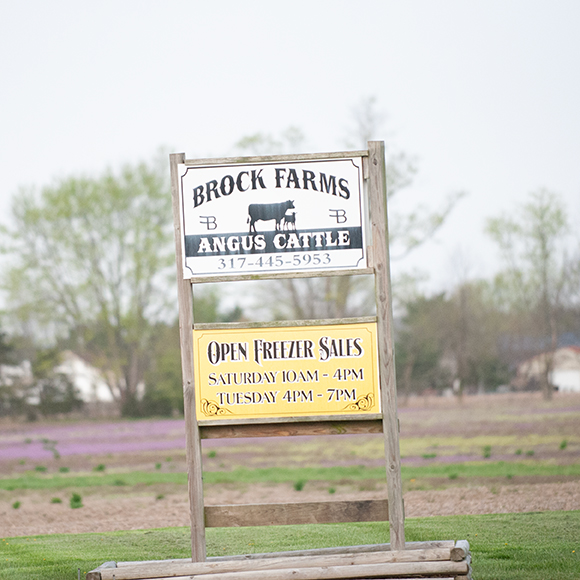
Their location is convenient for families commuting between Greencastle and Plainfield to do their grocery shopping. Signs at the house and by the road announce when the freezers are open for sales. Open-freezer days are hosted on Tuesdays, Thursdays and Saturdays, with other times available by appointment.
David says, “We do get a lot of people on Saturday that’ll go to Walmart and get their fruits and vegetables, and they come here and get their meat.”
The Brocks’ farm is only about half an hour’s drive from Indianapolis, which also is a pull for customers from the city.
Being close to Indianapolis, home to many different culinary tastes, provides a market for cuts not as common in American cuisine. The Brocks offer tongue, hearts, kidneys and oxtails alongside more traditional cuts.
“Our location has made us very fortunate,” says daughter Katie (Brock) Pennington. “We’ve never gone to farmers’ markets or anything like that. We haven’t had to have that infrastructure.”
The growing business meant that with appointments already in place at their local processor, the Brocks were able to meet the demand for beef when it skyrocketed in 2020 due to COVID.

They filled their garage with freezers and opened their doors for open-freezer days. Shoppers could come and pick up whatever cuts they needed — a couple ribeyes to grill, a roast for the slow cooker, or ground beef to stock their freezer. Individual packages or larger quantities, such as a quarter or side of beef, were offered as options.
A lot of families don’t have big chest freezers anymore, so they would come to get a few roasts or 10 pounds (lb.) of ground beef that would fit in their refrigerator’s freezer, Kris explains.
Customers could also place an order through the Brocks’ online store and arrange for pickup later. Accommodations were made for beef buyers who preferred no-contact pickup by using coolers set outside.
Andy’s wife, Courtney, joined Kris three years ago to give the freezer beef program a full-time person. She coordinates butcher dates and cutting instructions and keeps customer lists for wholes, halves and quarters, and all the wholesale cuts for keeping the garage freezers stocked. She has played a key role in social media marketing and was instrumental in starting the open freezer days on the farm.
The family says people seem to enjoy coming to visit and picking out their cuts of meat.
Some ladies “just come to visit with Courtney and the kids,” Kris says. “They come and get 2 pounds of hamburger and a roast, but they’ve made that connection.”
That connection allows customers to ask what cuts are best for various cooking methods, and the Brocks will make suggestions. Some customers will ask, “Where are the calves?” and are delighted when the Brocks simply point across the road.
David says they’re also given the opportunity to clear up misconceptions about beef. While the Brock calves are not given growth implants, that’s a topic asked about frequently, along with questions about GMO feed and commercial beef from the grocery store.
He doesn’t discount buying beef from the store, explaining it’s just as healthy and nutritious. But “If you think that’s worth the flavor and the experience, the eating experience is worth coming here.”
David usually focuses on tasks in the pastures and fields, but he has had occasion to step in and help with the open-freezer days. One particular Saturday, when the ladies were attending a baby shower, David stepped in, learned the Square site, and got to experience the point-of-sale side of the business.
“It is neat to see that side of it because a lady, she wrote a … pretty nice check,” David says. “She said, ‘Oh, it’s just money well-spent.’”

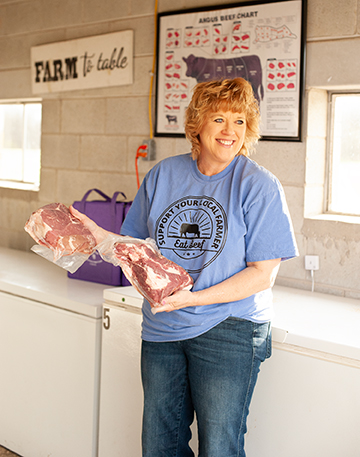
Kris Brock
Getting them hooked
Social media plays a role in the Brocks’ marketing strategies, particularly Facebook. They recently redesigned their website and are able to make sales there. The Brocks have also introduced a loyalty program, where the more beef customers purchase, the more they can save. This program is managed through the Square site, so it’s not a hassle to track.
Another way the Brocks simplify the payment process is by having set pricing for cuts of beef instead of selling by the pound. The even dollar amounts allow the Brocks to not worry about making change in cents, as some customers prefer to pay in cash.
Referring to beef sold off the farm, Pennington says, “Once you get them hooked, then they usually have a hard time going back to the grocery store.”
Kris agrees: “I think people just got really used to the quality. It is not a lot more expensive, and they know where they’re getting their meat from.”
The Brocks work hard to remain competitive with grocery store pricing and other providers in the area.
While demand for beef directly from the farm waned in some areas after the height of COVID, the Brocks have seen growth in freezer beef sales in the years since.
“I’ve noticed a lot of our customers that used to come to those open-freezer days and get 20 pounds of burger ... now they’re starting to look into, well, if I’m going to do this every two weeks, what’s a quarter?” Pennington says. “[They’re] starting to talk about getting freezers and starting to see the value more in buying the wholesale meat.”
The open-freezer days now feature other protein choices, as well, to provide variety for customers — like a one-stop shop for meat. Pork is available for purchase, and there are plans in motion to start offering chicken in the near future. Eggs are offered for sale by some local girls to fund their 4-H projects.
Trucking on
The Brocks use This Old Farm Meats and Processing, a USDA-certified processor, to allow for sales off the farm. The processor offers many custom cutting options to optimize the wholesale beef cuts as well as vacuum-sealed products popular with customers.
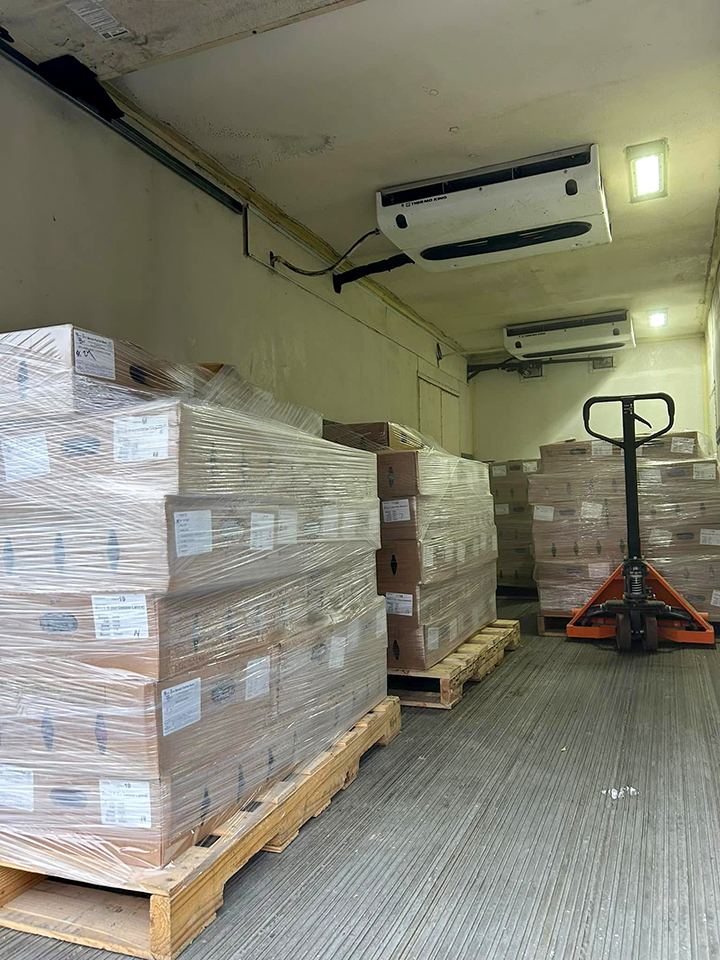
The recent purchase of a full-size freezer truck has improved the process of transporting large quantities of meat from those processors, as 10 head are sent for processing at a time, and one is an hour and a half away. The biggest advantage though, is that the truck allows more time for customers picking up beef.
“We had to meet people or have freezer space to put it away … It got to be too hard to get everybody here,” Kris says. “So that freezer truck has given us flexibility, where we can literally move the truck running, and I can go pick it up on a Wednesday, and people can come all through the rest of the week and through the weekend picking up meat.”
Their success has presented a new challenge for the business in the form of selling all the calves they can currently raise. The Brocks’ management is based on calving in spring, but they occasionally source fall calves from another local family, the Alcorns, to fill processing dates when gaps in availability occur.
Other improvements are also being considered, such as hoop barns, to allow for future growth. The Brocks don’t see any signs of the freezer business slowing down, and continue to work together to keep all aspects of the business running.
Says Pennington, “It takes us all to do it. So every now and again, everybody gets involved in every part of it.”

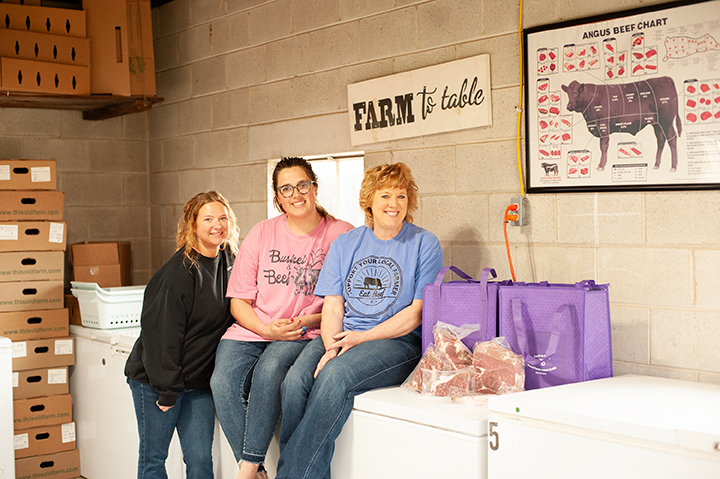
Pictured from left, Courtney Brock, Katie Pennington and Kris Brock host open-freezer days at the farm.


Family business
Brock Angus Farms was founded by David Brock’s grandfather with the purchase of land near Coatesville, Ind., in 1962. Keith and Sharon Brock purchased the farm across U.S. 40 in 1970 and started a Hereford cow herd in 1972. The diversified farm raised more hogs than cattle and eventually was transformed to focus on crops and beef when David moved back home after college. He enjoyed the cattle herd and began to grow it, converting it over time to mostly Angus genetics.
Both of David and Kris’s children have now returned to the farm with their families, and everyone has a role in the operation. Son Andy, also a certified John Deere service technician, focuses on the row-crop side of the operation. Andy’s wife, Courtney, manages the day-to-day responsibilities of the freezer-beef business and staffs their open-freezer days.
Daughter Katie was drawn more to the cow herd. She returned to the farm in 2020 after earning her agribusiness degree at Lake Land College to manage the cattle herd and handle paperwork for the registered animals. Katie’s husband, Collin Pennington, is involved in his family’s cattle operation, but helps the Brocks, too, from time to time.
The Brock herd includes 125-150 head of mama cows, mostly commercial with some registered cattle. David studies the expected progeny differences (EPDs) and performance data and uses embryo transfer (ET) to keep up with trends. They sell a few show calves each year, mostly to local families.
With Andy and Courtney’s daughter, Hadleigh, eligible for showing cattle in just a few years, the Brocks maintain their string of show cattle to keep their genetics current.
“I think we’ll always have a handful of show cattle … because of the kids,” Pennington says.
Several bulls are also offered for sale every year, and the Brocks will buy back calves out of their bulls at a premium at the local sale barn in Rockville to help those bull buyers. A few additional bulls are sent to the IBEP Bull Evaluation near Bedford, Ind., each year.
The current bull market has prompted some conversations with his bull buyers. David explains to them the opportunity cost of selling those bulls as opposed to cutting them for steers and getting $3,000 apiece.
With five-weight calves selling for what they are today, he says, “you’ll pay for him pretty quick.”
Topics: Business , Consumer , Marketing , Success Stories
Publication: Angus Beef Bulletin
Issue: November 2025
Related Content


Current Angus Beef Bulletin
Our November issue focuses on the females of the herd and the records that validate them.