


Meet the Familiar Face Joining the Commercial Programs Team featuring Alex Tolbert
Season: 5 — Episode: 18
September 16, 2026
Our mission here at the Angus Beef Bulletin is to get practical solutions on health, nutrition, marketing, genetics and management into the hands of profit-minded cattlemen.
If you’re a longtime listener, you’ve joined us for conversations in the past involving GeneMax® Advantage™ and AngusLink® marketing tools like the Genetic Merit Scorecard® and AngusVerifiedSM .
On this episode of Angus at Work, we would like to reintroduce you to a longtime Angus advocate who is stepping into a new role. Join us as we visit with Alex Tolbert about:
- Growing up within the National Junior Angus Association
- The experiences that shaped his professional career
- Programs that improve profitability for users of registered Angus genetics
- And more!
Thank you to Custom Cattle Tags for their sponsorship of this episode.
Additional Resources:
- Tolbert to Lead Commercial Relations and Producer Education
- Finding Foundation Females with Tiner, Tolbert and Tuckwiller
- Commercial Programs at the American Angus Association
- AngusLink program information
- Subscribe to the Angus Beef Bulletin EXTRA
Host Lynsey McAnally (00:28):
Angus at Work, a podcast for the profit-minded cattleman. Brought to you by the Angus Beef Bulletin, we have news and information on health, nutrition, marketing, genetics and management. So let’s get to work, shall we?
Hello and welcome back to Angus at Work! Our mission here at the Angus Beef Bulletin is to get practical solutions on health, nutrition, marketing, genetics and management into the hands of profit-minded cattlemen. If you’re a longtime listener, you’ve joined us for conversations in the past involving GeneMax® Advantage™ and AngusLink® marketing tools like the Genetic Merit Scorecard® and AngusVerifiedSM.
On this episode of Angus at Work, we would like to reintroduce you to a longtime Angus advocate who is stepping into a new role. Join us as we visit with Alex Tolbert about growing up within the National Junior Angus Association, the experiences that shaped his professional career, programs that improve profitability for users of registered Angus genetics, and more. So, let’s dive in!
Custom Cattle Tags ad (01:25):
Are you looking for a hassle-free way to order your livestock ID supplies? Ordering your custom cattle tags should be quick and simple. And at customcattletags.com, it is. Whether you need TSUs or tags with unique numbers, personalized text, or even your logo, we've got you covered. Visit customcattletags.com today to get started or call the American Angus Association to place your order. Custom Cattle Tags, where tags are available your way.
Host Lynsey McAnally (02:02):
Welcome to Angus at Work. I'm your host, Lynsey McAnally, and today we're joined by our very own Alex Tolbert. Alex, welcome to the show. I know you've got some exciting news, but do you mind if we kick the conversation off with your history in the breed and a little bit of what your time as a young person in the Angus family looked like?
Alex Tolbert (02:22):
Yeah, thank you for having me, Lynsey. And yeah, some exciting news for sure. But yeah, to go back, my earliest memories are walking down our dirt road behind my brothers. They're walking their Angus show heifers and I was walking with my dad and those are my earliest memories, some of my fondest memories. Growing up under as the grandson of Joe Ed Tolbert, there was one cow and that's the Angus cow. And my granddad saw things in black and white, and that's the way things were for our family. And so I've only known the Angus cow and I have been intrigued by the animal and the breed ever since. So it was natural for me. My first cow show ever was the National Junior Angus Show in I believe 1996 in Perry, Ga. I may have the year off, but it was definitely in Perry, Ga., and that was my first cow show.
And so getting involved in the junior program as a young man, the program has taken me all over the country and really enjoyed that and was fortunate enough to serve on the National Junior Angus Board when I was in college. Went to college at NEO in northeastern Oklahoma livestock judging and went to Oklahoma State from there. Got a degree in animal science and then would've served on the board - the National Junior Angus Board - at that time. And so my Angus roots: I'm a third generation Angus enthusiast. Like a lot of people in the Southeast, we didn't have a lot of cattle, but the passion for the Angus breed? That's where it was born just from my early days in the youth. And something that I still feel really strong about. The Angus cow, the Angus breed and breeders being the best partner for the commercial cattleman.
Host Lynsey McAnally (04:15):
That's awesome. So fun fact about life, I actually went to Connor State College in Warner, Okla., which is how I wound up out here from the Florida Panhandle. But no, I didn't know you went to NEO. How cool is that?
Alex Tolbert (04:29):
Yeah, no kidding. And you just think about the NEO, but you think about our junior program, just how you get to meet people across the country and you get to travel the country. We move that junior nationals around each summer. I can go about anywhere in the country and I've got somewhere to lay down. I may call somebody like, "Hey, I'm going to be in your area. You got a bed I can sleep on." And that's the cool thing. It goes back to the people that we get to work for and with, just great people. But man, just the junior association meant so much to me when I was of that age just trying to. I like Angus cows and you start digging in and these people are A-okay. That's a neat thing for me. And think back how could that have gone differently? Man, I wouldn't trade it for the world.
Host Lynsey McAnally (05:27):
I oftentimes think about those relationships that we build and our next edition of the Angus Beef Bulletin that's coming out in November is kind of focused on building those relationships. But I think all the time about how for a lot of people, the world has got to just seem like a big scary place. I'm not saying that there's not things out there to be concerned about, but it's a lot easier to run down the highway when you know if I blow a tire, I probably know somebody somewhat close that if I get in a predicament, I can call them. There's not very many vocations in life that lead you into contact with people as good as those of the cattle persuasion, I suppose.
Alex Tolbert (06:10):
I try. You mentioned blowing a tire. I mean, could be running out of gas. I won't throw any regional managers under the bus, but it's nice to have those breeders that are close by to help you out if that were to ever happen to you.
Host Lynsey McAnally (06:23):
For sure. So you went to NEO and then went on to Oklahoma State. A little birdie told me that you had a stint with USDA. Can you tell us a little bit about that role and the experience you took away from that?
Alex Tolbert (06:39):
Yeah, so I had interned with the USDA AMS Livestock and Grain Market News the last two years of college, and then I had a job offer right out of school to go work for them. The biggest part of what that branch does is, and what I did right out of the gate, you sit in sale barns across the country and keep up with the price of feeder cattle. And so right out of college went to Sioux Falls, S.D. and was in the sale barns there in Sioux Falls. I lived there for 10 months and from there moved to Des Moines, Iowa. When I moved to Des Moines, Iowa, actually it's one of the coolest things of working for the USDA for me. I got to work on the box beef report, and so I got to do that for two years, and that opened my eyes to part of the industry growing up in the Southeast.
It's a small cow-calf operation down there. I didn't have really a lot of experience in that area, and so it was neat for me to sit there and really understand how the value of cattle really starts right there, the value of beef. And so that was a really cool experience for me.
Two years later, I transferred down to Oklahoma City, and so I would've spent two years there in Oklahoma City working with livestock and grain market news there. Tina Colby was my boss down there and a great boss. I just say that, I had great bosses throughout the process at USDA that took me under their wing and just taught you more about life as much as they did about the job that we were doing. But we spent two years there in Oklahoma City in the sale barns in and around Oklahoma. I moved to Kentucky and took the … Technically the job was called Officer in Charge, but really just helping run the program in Kentucky. So helped working with the state government, the Kentucky Department of Agriculture. It was a partnership with USDA and the State Department and helping manage that program in Kentucky. And then right before, I guess the last year I was actually running the program in Kentucky and Tennessee.
So again, just working in the stockyards and helping manage those programs and gave me a lot of just interesting perspective and got to learn a lot again about how cattle are traded and the value of the cattle and how that relates back to today where I work, where I did work as a regional manager covering Tennessee, Kentucky and Ohio. But those feeder cattle really help to derive and determine the price of a bull. And so seeing all those stops along the way, it's been really interesting for me and just built some perspective. And that part of my career made me better, I believe, as a regional manager, just understanding how some of those things work.
Host Lynsey McAnally (09:51):
And you said it best, that's not a perspective that a lot of people get. And so to be able to zoom out and see that and then take the role that you did as a regional manager working with those seed stock providers and with those commercial cattlemen that are purchasing those Angus bulls, that's got to have helped put a little bit of perspective on the whole dynamic, right?
Alex Tolbert (10:17):
I work in this role as regional manager and I don't remember where I found this quote, and so I don't know who to give credit to. I guess I've been using it as long as I can remember is the seed stock industry exists as a business to meet the needs of the commercial cattlemen. I would share that as regional manager really no matter who the audience was, because I share that with Angus producers just to remind ourselves, get our foot back on base about who we're really working for and serving and who our customer is. And of course, ultimately that's consumer, but our first customer is the commercial guy, and just to remember that and to remember what's important to them. But on the other hand, I would say that in front of commercial audiences and say, "Hey, it's your job to keep our feet to the fire, and it's your job to have an open line of communication with your seedstock provider.
So when we're not bringing you what you need, tell us about it so we can ultimately work together so that everybody wins." And that's a quote that I've used, and I still just believe that. And that perspective being in the sale barn, seeing the value of those feeder cattle, and then coming into the role of regional manager, starting to watch the value of feeder cattle and how that would change the value of a bull. Of course, it's always behind the price of feeder cattle, but just fun to watch that and how those things tie together. It's been neat now to come back to the commercial side of things in a new role. It's pretty exciting, and I've got to knock some rust off some information that I used to use every day that I haven't used in a while.
Host Lynsey McAnally (12:06):
I always am curious, do you have any good stories about working with commercial cattlemen in your role as a regional manager or any standout moments?
Alex Tolbert (12:16):
Their want and passion to do better and to work with them, especially progressive ones that are. I work with some commercial guys that are as progressive and take better notes, better data than a lot of purebred guys. And to see that, guys that really take it serious. I mean, it's fun to visit with them because then it becomes a lot like a conversation with a purebred breeder. And that's been fun to me, but I mean the things that stick out are just the relationships that you build and you sit down at the kitchen table with them and just become part of the family in some places. And one of the better ones I'd say is I've worked with dad for a long time on buying bulls. Now in the last couple years, I'm working with the son as he's come home and come back into the operation and taken over some of those roles.
And so now I'm working with the son to help buy bulls and find bulls that fit what they're doing. So it always comes back to the people for me, whether it's sitting at the table with them or in that instance, starting to take that step into the next generation and working with them. It's pretty cool.
Host Lynsey McAnally (13:26):
I think if you ask anybody that's involved in the livestock industry, in particular the cattle industry, it always comes back to the people, right? The good cattle and good people. We always come back to those two fundamental truths.
Alex Tolbert (13:42):
Yeah, 100%. We all have differences of opinion. I mean, that's just part of being independent as American farmers and ranchers, but at the same time, we have so much in common and to remember that and to spend time over that and the people in particular that, man, we've got so much in common. Yeah, it's just reassuring that we do, because you think about people in Oklahoma and Texas right now that may talk about rain to those guys and they almost, "What's that?" But just the camaraderie that's built there that everybody's struggling right now, the 40, 60 days, whatever, over a hundred and no rain, and that everybody's there together just fighting through it and what that does for a community and what that does for a group of people, man, when you've got that common burden that you have to bear. And it gets back to just the resilience, the people we get to work with and their passion just to work the land and feed people is cool.
Host Lynsey McAnally (14:46):
So we talked about your time as a regional manager, and you've just had an announcement made about a new role, and correct me if I'm wrong, but your new title is director of commercial relations and producer education, correct?
Alex Tolbert (15:01):
Yeah, and that is exciting, and I'm looking forward to it. I think that title is all encompassing. A mouthful. Yeah, it's a mouthful and all-encompassing as you really stop and think about it. The cool thing is, for me, look over some of the things that I've been doing the last three or four years, I mean, it's just an extension of that. The last couple years as a regional manager, I've turned focus to outside of sales season, but turned focus to inventory reporting, and then from there, I've started to focus on AngusLink, and in particular, GeneMax Advantage, and just the opportunity that both of those tools present, not just to Angus Breeders, but realistically to the entire industry. I just started to focus on those things because of that opportunity. And then when this role came available, I thought I'd like to continue that. And the role of educator, I guess you break that down first.
I mean, so the commercial programs piece is probably the first one that comes to mind, that's a position, so to speak, that we've had for a little while, AngusLink being a big part of that, and I can't help but think about GeneMax Advantage being a piece to that, and as we talk about that pathway to progress for the commercial industry, and then that segues right into producer education. I think realistically that we've got some really cool tools available, and to me, these are tools that can really change the industry, promoting those programs realistically. The tools are only useful if you know how to use them.
The education piece, to me, comes right along with it, to work with the seed stock producers and the great seedstock producers in the Angus business and help them understand a little more about Angus Link and how it works. But really, a lot of those guys already know, and so for them, it's just providing them with the tools they need to educate and I guess to educate their commercial producers and bull buyers and teaching them how to use those tools and giving a seed stock guy, empower them with the information he needs to feel comfortable to have those conversations. Because I think realistically, it goes back to those guys selling bulls and working with the commercial producer, that's where they stand to have an advantage in terms of customer service, not to get in too deep, but I don't think everybody can buy the feeder cattle back.
And so this is a way that as a Angus producer, I may not have that capital to do that, but I do have some time. And so just taking the time to work with my commercial customer to help him through Angus Link to get some more return on his investment, and then through utilizing a tool like GeneMax Advantage where I've got some benchmarks on this set of heifers, and as much as anything, I can do a better job helping my commercial producer pick out the right bull in my sale. I think the tools are just. I think that's what they're there for, is to help really just to be an extension of that seed stock provider to better help his customers so they can both do a better job and hopefully they can both find a level of success.
Host Lynsey McAnally (18:51):
And I appreciate you talking through that. Obviously, the commercial programs department is a pretty vital piece of what we do here at the Angus Bee Bulletin talking about these programs and the opportunity that's out there for commercial producers, but specifically talking to that commercial audience, what would you say to them to encourage looking into these programs, and what do you hope to do in your new role to bring attention to those programs?
Alex Tolbert (19:21):
I go back to my experience. A lot of the commercial producers that I have helped and worked with here in my territory, most of them think about genetics once every three or four years, and that's when it's time to buy a new bull. Some of them think about if they've got a bigger herd, they'll think about it yearly, but once they get the bulls purchased and turned out, they don't think about genetics again. I just believe these tools offer a better way for him to communicate the genetic value of the calves that he's selling, and also gives him some tools to do a better job, hopefully, giving him some information to keep some better replacements and to make some better breeding decisions as the biggest thing I see is guys know, you know the heifers that breed up on time, and those are the ones to keep.
I can utilize that tool like GeneMax Advantage and make a better breeding decision next time. Or if I'm keeping a lot of heifers, I'm probably going to keep those ones that breed up early, but here's a way for me to communicate value on the next cut that I want to sell for your customer selling bred heifers. And so having those tools to be able to do that and communicate that value to their customer I think is something that's really, really neat and adds a lot of value up and down the supply chain, I think, when you think about the ultimate goal of working with the land and your resources to feed people.
Host Lynsey McAnally (21:01):
Sure. Anything I missed on that or anything you want to add about this new role that you're excited about?
Alex Tolbert (21:10):
No, and maybe this goes back to the question you asked, but we talk about this pathway to progress, and it's something you'll hear me talk a lot about, but starting with the registered Angus bull and setting your priorities for your herd, and those priorities are going to be based on your economics. And so based on those economics, you're going to make a purchasing decision. The next thing to do is we talk about using the right tools, tools like GeneMax Advantage on your commercial heifers to help identify where they are in terms of some benchmark traits, and probably as critical as anything, some of those traits that you cannot see. GeneMax Advantage provides those traits that many times we cannot see, and using that in conjunction that's powered by the World Angus evaluation and to give us a level of confidence in those selection tools.
And from there, it cycles back to buying that right bull, buying the right semen to breed those heifers with, and then using that information, market smart is kind of what we say, using that Angus link to, again, communicate that genetic value of those cattle in the marketplace and provide a tool for the next user, some traits that are critical to his bottom line and to help him make a better buying decision. I think that pathway to progress just kind of follows right along the supply chain and the beef value chain, and hopefully adding a level of transparency there. So we all make better decisions, and hopefully it helps everybody to add to their bottom line.
Host Lynsey McAnally (22:55):
There's a lot being asked of cattle producers currently, right? We will definitely include some notes or rather some links in the show notes to either previous podcast or over to the commercial programs webpage. I would absolutely be remiss if I didn't go back to one of our earlier talking points, which was you are not the only Angus kid in your household, are you?
Alex Tolbert (23:25):
I am not the only Angus kid in my household. No, you're right. So my wife, Hannah McCabe Tolbert, grew up and was very active in the Junior Association. Her whole family was very active in the Junior Association, and she'll remind you that she won record number of crystal awards, and so I say that …
Host Lynsey McAnally (23:47):
As she should.
Alex Tolbert (23:49):
Yeah, as she should. I've said that, so I'm going to stay out of trouble that way, but the other family was very active and that's how they spent their summers. Oddly enough, we actually met at Angus Convention, Hannah and I did, a long time ago. It was actually my first year on the job, and I was helping to lead a tour, pre-convention tour as a regional manager, and she was on the other end as Boehringer Ingelheim. We were in Kansas City, and so we were touring some of their facilities, and she was on their end helping welcome and provide a familiar face for BI from their perspective. And so that's actually where we met, was at Angus Convention, my first year as regional manager. I
Host Lynsey McAnally (24:39):
Love that. How special. And you guys have a lovely little family. Tell us a little bit about the kiddos.
Alex Tolbert (24:48):
Oh yeah, we're blessed. We've got a seven-year-old, Elijah, who is in second grade now, and we've got a five-year-old, Judah, and Judah started kindergarten this year, and the boys were playing baseball, played this past spring, and now we're playing this fall, and trying to do all those things as they grow and get better, and do all that in amongst a busy schedule that she and I both have. But yeah, we've got two good boys, we do, and they attribute. A lot of you know the job of regional manager is spent on the road, and so I'll attribute all that to her. Now that I may be home more, I'm not sure what that'll bring.
Host Lynsey McAnally (25:39):
I appreciate the confidence there, Alex.
Alex Tolbert (25:41):
Yeah, right, right. Yeah. Hanna's done a good job so far.
Host Lynsey McAnally (25:47):
Well, I think you guys will continue raising two fine young gentlemen. Any chance the kiddos show Angus cattle in the future too?
Alex Tolbert (25:58):
Of course, mom and dad sure hope so, right? But it's got to be their decision for the most part. But yeah, we've here at the Kentucky Preview the last two, three years, the family's here, they treat us so well and take good care of us, but they've made sure that our boys have been showing in Peewee showmanship …
Host Lynsey McAnally (26:19):
Very nice.
Alex Tolbert (26:20):
Yeah, here at our preview show. And in fact, Brianna Smith and her brother, Blaine, they've been the ones bringing my boys along, and so it's been fun to see that. First time, actually, it surprised me. I wasn't ready for it, but of course, the Kansas Angus mom in Hannah, she was beaming,
And it's been fun to watch, and I think Elijah turned seven here this past summer, so he'll be eligible next year. We'll see how that goes, but yeah, Hannah and I are hoping that they'll get involved. And from our perspective, even for me as a junior, I didn't show every year, but I would always go and participate. And so I doubt those boys have any option to whether they're going to be in a speech contest. They may not have to show a heifer, but I'd say those boys are going to have to be in a speech contest.
Host Lynsey McAnally (27:19):
And that's the beautiful thing about the junior side of the American Angus Association, is there's an opportunity for all interests and all kiddos.
Alex Tolbert (27:30):
That's probably our favorite part, the heifer, the steer, the bull, whatever. I mean, it's just a ticket in the gate. Yeah, that get me excited. I mean, it's just something I love, and all the other things that are there, the families, the people, and those other career building opportunities and contests are what helped shape me into who I am, and we're going to hopefully use that tool to do the same thing with our boys.
Host Lynsey McAnally (28:00):
I just want to say I'm so excited for your next journey within the Angus family. As we end Angus at Work, on a positive note, what is one thing happening in your life personally or professionally that you are thankful for?
Alex Tolbert (28:18):
Yeah, it's a tough question. Not tough to answer, but probably maybe tough to spit out. The thing I'm most thankful for that for the last 12 years, the people in Kentucky, Tennessee, and Ohio have treated me like family. They have been gracious to me and gracious to my family, just like I mentioned, the Smiths, bringing my boys into showmanship. Yeah, I can't mention all names, but the people have been so good to me and been understanding when I was young and fresh on the job and have been, gosh, just the support for me in making this next step. They're the people that I'll call on too, but man, I can't say thank you enough for their confidence in me and for their patience with me when I was behind or forgot to call back. But if there's one thing that I'm thankful for today, it's the breeders and the awesome people in the Angus business in these three states. They mean a lot to me, they mean a lot to my family, and we look forward to still being right here and being a part of it as a family. And so very, very, very thankful.
Host Lynsey McAnally (29:38):
That might've been one of the best answers to that question that I've heard in a very, very long time. So thank you so much for joining us today, Alex.
Alex Tolbert (29:47):
Thank you, and I look forward to seeing everybody on the road.
Host Lynsey McAnally (29:57):
Listeners, for more information on making Angus work for you, check out the Angus Beef Bulletin and the Angus Beef Bulletin EXTRA. You can subscribe to both publications in the show notes. If you have questions or comments, let us know at abbeditorial@angus.org and we would appreciate it if you would leave us a review on Apple Podcasts and share this episode with any other profit-minded cattlemen. Thanks for listening. This has been Angus at Work!
Topics: Marketing , Association News , News
Publication: Angus Beef Bulletin
Related Content


Current Angus Beef Bulletin
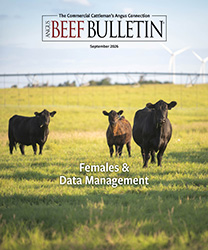
Our September issue focuses on the females of the herd and the records that validate them.