


Finding Foundation Females with Tiner, Tolbert and Tuckwiller
Season: 5 — Episode: 16
August 12, 2026
As an editorial team, the Angus Beef Bulletin staff, field editors, columnists and various other communicators conduct a bundle of interviews each year. While typically those interviews are used to craft the feature stories and columns you see as a finished product in either the Angus Beef Bulletin or the Angus Beef Bulletin EXTRA, on this episode we’re pulling back the curtain to share interviews from one September 2026 Angus Beef Bulletin story titled, “A Rock Solid Foundation,” as well as an additional interview from Radale Tiner.
Our September print edition focuses on females and data management, includes the Female Foundations special advertising section, information on commercial programs, Angus Convention and much more. We invite you to join in the conversation as we catch American Angus Association Regional Managers Tiner, Alex Tolbert and Reese Tuckwiller on the road to explore how to select females that will pull their weight in your herd.
Additional Resources:
-
A Rock-Solid Foundation: Tips to Select Females That Will Pull Their Weight in Your Herd
-
AngusLink program information
Thank you to GeneMax® Advantage™ for their sponsorship of this episode.
Host Lynsey McAnally (00:04):
Angus at Work, a podcast for the profit-minded cattleman. Brought to you by the Angus Beef Bulletin, we have news and information on health, nutrition, marketing, genetics and management. So let’s get to work, shall we?
As an editorial team, the Angus Beef Bulletin staff, field editors, columnists and various other communicators conduct a bundle of interviews each year. While typically those interviews are used to craft the feature stories and columns you see as a finished product in either the Angus Beef Bulletin or the Angus Beef Bulletin EXTRA, on this episode we’re pulling back the curtain to share interviews from one September 2026 Angus Beef Bulletin story titled, “A Rock Solid Foundation,” as well as an additional interview from Radale Tiner.
Welcome to Angus at Work! Our September print edition focuses on females and data management, includes the Female Foundations special advertising section, information on commercial programs, Angus Convention and much more. We invite you to join in the conversation as we catch American Angus Association Regional Managers Tiner, Alex Tolbert and Reese Tuckwiller on the road to explore how to select females who will pull their weight in your herd. So, let's dive in.
GeneMax Advantage ad (01:42):
Unlock your herd's genetic potential with GeneMax® Advantage™. It's the only genomic test that delivers Angus dollar values, the gold standard in beef cattle genetic selection on Angus-based commercial females. New in 2026, turn GeneMax's genetic insights into more marketing power when you test and market calves inside of the AngusLink℠ Genetic Merit Scorecard® (GMS). Order GeneMax Advantage today at genemaxangus.com and select females with confidence. That's genemaxangus.com.
Host Lynsey McAnally (02:22):
First off, here is some sage advice from Reese Tuckwiller, regional manager for the Northeast.
If you had someone that was brand new to the industry that called you and they were looking to start their herd, how would you recommend they find and then go about purchasing the females to be the foundation of their herd?
Good question, right? It's a big one.
Reese Tuckwiller (02:43):
Great question, and I probably take a different approach than most. I make them give me a ... what is their five-year outline, and what's their five-year goal?
Host Lynsey McAnally (02:56):
That's good.
Reese Tuckwiller (02:56):
Because there's so many ... there's not only genetics or management or what have you. Or what camp - terminal or maternal. You've got to figure out what their goals are. So we establish that, and we get a game plan. I hate the statistic that the average Angus breeder is in the business for less than five years. How do we keep them in business longer? How do we make their business model sustainable? Ultimately, I think you build and foster a better relationship with those folks.
You make a plan and then once they figure out what they want, how many animals or how many units they can handle on their farm, things of that nature. Then you start making some recommendations. Is it more feasible for you all to buy commercial cows and put in embryos or are you more inclined to want to go buy a set of bred cows or bred heifers? Those are the kind of conversations I would have at the beginning.
Host Lynsey McAnally (03:57):
No, that's a great place to start. I think another thing that a lot of people think about is — or maybe don't think about — is finding cattle that are "adapted to your area."
Reese Tuckwiller (04:10):
Yeah, I mean that's a good point. Fetal programming's a heck of a tool. We find if you bring cattle out of the West and put them on fescue, it takes them three to five years to adapt, but if you bring in an embryo, it's fetally programmed to be already adapted. We can mitigate a lot of that on fescue. It's not foolproof. [It] doesn't work 100% of the time, but it's pretty dang accurate. People can make a lot of genetic progress without the limitation of environment.
On that segment, I think it's probably more important that you stay local simply because you build a network and a community. We've got less and less producers than we ever have in the U.S. If you can have some relationships locally, it just strengthens, I call it a coalition of agriculturalists. You share ideas, maybe share equipment, you share labor. It mitigates a lot of the things that we're struggling with in ag business.
Host Lynsey McAnally (05:18):
No, I love that. My next question goes with that. You hear people that are in two different camps: the people that are very, very focused on EPDs (expected progeny differences) and the people that are very, very focused on phenotype. How do you think you strike a happy balance between those two things when you're looking to find and purchase those cows?
Reese Tuckwiller (05:39):
Yeah, you really dug in on these. I mean, we've got a factory that can do both. I'm not going to say people are misinformed either, I just think we put blinders on and disregard some fundamental things that brought us to the dance. Fertility, mothering ability, those things are all well and good. These cattle already marble super well, but I would tell them keep the fundamentals in check. Carcass traits are highly heritable and you can inject those in one click if you want to.
Host Lynsey McAnally (06:15):
Okay. So if you were a new producer, an existing producer, and you're going to buy cows, are there health considerations you need to keep in mind and vaccination, I guess, history that would be good to know? How do you balance that — the health and vaccination side of things — when you're bringing new cattle in?
Reese Tuckwiller (06:37):
I joke with Mark [McCully] all the time that we wear more hats than we did when I started 7 years ago because you're not only just an Angus rep, you're a nutritionist, you're part veterinarian, all those things. I would say the most frequent thing that I give into this area is just know what they've had. There's so few people who actually do full leukosis, full anaplasmosis and Johne’s. Now there are some Johne’s-free herds, and I applaud them for that, but there's not a big access to find those cattle.
Host Lynsey McAnally (07:13):
Sure.
Reese Tuckwiller (07:14):
So, yeah, I would definitely ... Your standard protocol, your modified-live, Blackleg, maybe a Pinkeye [vaccination], maybe a wart [vaccination]. Just ask questions. What do you do with the heifers or the animals you keep at your place? Which goes back to the community conversation: What are you doing? What's working for you?
I don't know ... I haven't perused through all the salebooks nationwide, but I would have in pretty high confidence ... Almost all the books that I deal with or the production sales that I'm involved with, they do publish what those animals have had prior to sale day. So I almost think it's self-mitigated because it's in print.
Host Lynsey McAnally (07:58):
No, that's great.
Reese Tuckwiller (07:59):
So that's very helpful. That's very helpful for folks.
Host Lynsey McAnally (08:02):
Yeah. Either read it or ask, right? But make sure you know what your background is. I think there's also a good case for potentially if you're a new producer looping in your veterinarian ahead of time to say, "Hey, what questions are there that I should ask?" Whether that's on the repro side of things, the nutrition side of things, or just the general health side of things.
But you are so right in saying building that network of people is so important. I think that goes into building your network of experts, too. If you are a new producer, this is probably the spot where you're going to put down your baseline. If you're an established producer that already has an idea of what your schedule of management is going to be within your herd, how do you decide when to time buying those females?
Reese Tuckwiller (08:52):
I think for the majority of folks, they're going to procure females after they establish what their herd basis is. So usually after a preg check. See how that pans out, see how many they're going to have to cull out due to open cows and get their numbers back. Or your typical scenario, I'd say there's always a surge in heifer purchases before the tax calendar.
Host Lynsey McAnally (09:18):
Sure. Alright. Anything else that you would recommend if you're looking for those really good foundation individuals in your herd or foundation groups in your herd? Anything else you would recommend to keep in mind when purchasing?
Reese Tuckwiller (09:35):
Go to multiple operations and figure out what you like and what you don't like and ask a bunch of questions.
Host Lynsey McAnally (09:41):
That's solid.
Next up, we'll hear from Radale Tiner, regional manager for the states of Texas and New Mexico.
The question I've started off with for everybody I've talked to so far has been: If you had a new producer, so somebody that was new to the industry or maybe just new to the breed, and they're wanting to start a herd of Angus-based females — we're talking commercial females — what do they need to do to find those cows or heifers? So how would you recommend they go about finding that provider to actually purchase those cows from?
Radale Tiner (10:16):
First of all, I would recommend them calling their local regional manager. What they want to do is they want to find cattle that are acclimated to their environment. Find someone that you know and trust and knows what your goals are. Finding a ranch that has similar goals to what they're wanting to do ,whether it's more maternal-focused, more carcass-focused, an all-around, whatever that goal is. Finding a seedstock provider ... Or I guess, in this case, a commercial provider that would have the similar goals in their program that they have.
Host Lynsey McAnally (10:57):
Do you have any recommendations for producers as far as health and vaccinations when they're buying new females? Maybe what questions they need to ask or things that they need to make sure that those cattle have had prior to moving them to their operation?
Radale Tiner (11:14):
Yeah, I would find out exactly what they've had. A lot of times if you're moving them very far, let's say 100 miles or more, I've been told that you need to give them a booster vaccine. Even if they've had it, give them another one. Probably not a bad idea to re-vaccinate them once you get them to your place because different regions, different areas, depending on soil type and different other factors.
Host Lynsey McAnally (11:44):
Absolutely.
Radale Tiner (11:45):
The local veterinarian would know what they're more susceptible to in that area ...
Host Lynsey McAnally (11:52):
I think that they have a better idea of maybe what you need to vaccinate for, maybe things that aren't as big of a concern. Next two questions go hand in hand, but you always hear about people that are concerned about EPDs and you hear about people that are concerned about phenotype. Do you have any advice on how a new producer or maybe like I said, somebody that's just getting into Angus cattle should balance both?
Radale Tiner (12:16):
Yes. I would definitely look into a ranch that you're buying from, making sure they put some kind of selection pressure on for all of that. You don't want somebody that just kept every heifer as a replacement. You hope that they cull the bottom 25% or whatever that number is. So over time they're getting better.
Host Lynsey McAnally (12:41):
Okay. So, again, this one goes hand in hand with that last question. If you're looking at buying a group of commercial females, would you recommend that people evaluate those animals on an individual basis or do you recommend that they evaluate that group as a whole? Or I guess ...
A little tricky, but I would recommend just looking at them as a whole. Because anytime you buy a group, there's always going to be some in there that maybe are not as good. A lot of times, whether you're buying 50 or 100, you're buying them ... They're not all going to be top or the best. I would look at them as a whole, knowing that there's some not as good as others.
Host Lynsey McAnally (13:22):
Last question for you: What do they need to keep in mind when timing buying those females? Is it their calving window? Is it sale season? Is it a combination of both? When in your region should they be thinking about buying those females and what should they keep in mind on that timing?
Radale Tiner (13:40):
So in Texas, we have spring and fall. Whereas in New Mexico, it's primarily spring calving. So the answer varies, I guess, from one state to the next. I tell people always buy within your window on calving. If your whole herd is fall calving, well, at a sale, you might not buy something that's due in March or February because it becomes a pain in the butt unless you have two distinct groups large enough to mess with. Having 50 that calve in the fall and three that calve in the spring. it just doesn't work out good. Adding to that, I would buy them that are confirmed bred. Generally I'd say at least two to three months safe when you're shipping them very far just to be safe. When you're shipping them and they're 30 days bred, well, you just have more chances of things happening.
Host Lynsey McAnally (14:47):
Sure.
Last but certainly not least, here is Alex Tolbert, regional manager for the states of Ohio, Kentucky and Tennessee.
If you had somebody reach out to you and they were going to start a new herd, what would be the first thing you would tell them to look for?
Alex Tolbert (15:05):
I don't know. One thing I always tell people when they get in the business is you're a grass farmer. Don't forget that. As a result of that, as you begin to build a program, you've got to find a female that fits your environment. The grasses, forages, those available nutrients in your particular part of the world are going to be different. I always encourage people to look for genetics that are in their region. Again, from my perspective, I'm a people guy. I typically go to people for research to gain some understanding and get perspective. And I'm going to go visit some purebred guys that are selling bulls with a reputation in my part of the world. Visit with them. I'm going to try to learn from them what I can and try to find and source some females through them and let them help guide that direction a little bit.
So I'm going to, again, focus on the forage and the nutrition part of it. The females fit what I'm going to set up, the management system that I'm going to set up. Then connect with the people. Go find those purebred guys that are in my area, visit with them, tell them what I'm trying to do. As I visit with those people, hopefully I'll be able to source a set of commercial females that'll fit my environment, fit my management and find something that a guy can build around.
Host Lynsey McAnally (16:37):
How would you recommend if you are, again, if you're new to the industry or new to the breed, how would you recommend they find those seedstock providers? If they're going to go talk to them or observe what they're doing in their operation, how do they track those guys down?
Alex Tolbert (16:53):
A lot of those guys, you're going to find them in the Angus Beef Bulletin as advertisers. You're going to find them in the Angus Journal as advertisers. But they'll also be a part of your state cattlemen's organizations. They'll be a part of the state Angus associations. So looking to those places to find those people is probably the easiest way. I mean, of course, you can always Google or ask ChatGPT. They'll probably point you in a direction, too.
But again, I'm a lot of times a people person. Those organizations are probably going to have the people I'm looking for. I'm going to look at who's involved in those organizations or the advertisers in those magazines to help get me started. And from there, as you get started, it's always appropriate ask. "Who else do I need to talk to?" I think you end any of those conversations that way. Who else would you suggest I talk to?
Host Lynsey McAnally (18:03):
So you just mentioned buying cattle that are bred to perform in your area. Would you say that there's a sweet spot between doing that and then adding new genetics? And how would a producer balance those two things?
Alex Tolbert (18:19):
Yeah. I mean, it is a sweet spot. I'm not going to tell you there's a great way. What I've seen work, especially if you're new to the business ... In any business, when you're new, you don't know what you don't know. Working with those people that are ... they're dealing with the same problems I am in my environment. In the Southeast, we deal a lot with fescue. Fescue is not the worst thing in the world. It offers a lot, but you have to know how to manage it. It's the same in other regions of the country. You've got some things that fit your environment really well and some things you have to deal with. North Dakota and up that way, you've got to deal with a lot of snow. Calving in the snow and how you manage that. We don't have to.
So I get back to, I mean, it's working with those people. If you're trying to get basic cows that have been selected to thrive in that environment over generations. And then I think it is expanding that network and knowing what's important to you, what you have to have in order to be successful in your production system, and to go look for what am I missing then?
Utilizing tools like GeneMax Advantage can help you to understand and see the things that you can't see on your cattle. It allows you to identify some traits that may not be tier one priority traits, but to be that next tier. It's easy to look at those carcass traits as an example. We can't always see that. In the Southeast, we don't always necessarily directly get paid for that. But as I think about my next customer and what makes him successful, or my customer rather, the next owner of the cattle, my product, I can use a tool like that to build focus on the cattle that thrive in my environment. I can start adding to those traits that help my customer. Using the tools like GeneMax Advantage to say, "This is where I am today." Again, I use that carcass traits as an example for marbling and ribeye. Then I can go select genetics that are within my part of the world through the use of bull or through the use of AI to add those genetics.
Host Lynsey McAnally (20:57):
I feel like there's usually two pretty distinct camps. We've got the folks that are very, very focused on EPDs, and then we've got ... when they're purchasing cattle. And then we've got the folks that maybe don't look at EPDs and they just look at phenotype when they're purchasing cattle. I'm curious what you would say towards the importance of balancing both of those things. I know EPDs, we're not talking about registered cattle, but even in the genetics that make up those commercial females, how would you recommend they balance the data and the phenotype?
Alex Tolbert (21:35):
I think the balance is key because in particular in a commercial setting, we look at one female. I've got a female that shows up every day and does her job and has a calf on time, raises an above average calf every year. Those are the kind of things that are going to keep me in business. Having a calf, those kind of things are ... a phenotype and you still got to keep a problem-free female that does that. So if I got a female that does that, more than likely, when we talk about phenotype ... Feet and udder are two things that come up a lot, especially in just functional females. Well, I've got a cow that does those things over and over and over. She usually has feet that don't have a problem. While they may not be perfect, they don't cause a problem. Same thing with the udder.
So that means a lot to me. I'm going to keep that female. But if I've got some genetic predictors, what that allows me to do is mate her better to a bull. Or if I've got daughters of a bull in particular, they show up on time, but from a terminal perspective, maybe they don't. Again, it's those things that you can't see. That data allows me to think about my customer who is a cattle feeder to help select those traits. That data allows me to do that. Just that balance of the female that shows up every time and does her job, good footed, good udder, at least they're functional. And balance that with trying to make the next generation better.
I do think it's a balance because if you just try to chase the one, whether maybe that's phenotype ... Well, maybe you give up some pounds for your customer or maybe it doesn't set your customer up for success when you're not paying attention to the calf crop's genetic potential for their gain on feed or their potential harvest performance in the cooler. I think it's there, again, if that's all you look at you could end up with cows that you're continually having to replace. You're having to replace the whole herd when they're 3, 4 years old and [that's] not allowing you to be profitable because your turnover rate is too high.
Host Lynsey McAnally (24:01):
Do you recommend that they go in and evaluate those animals on an individual basis or do you recommend they go in and evaluate that group as a whole depending on what their goals within their operation are?
Alex Tolbert (24:11):
I think any time I'm buying a group, you've got to look at the group as a whole. I mean, that's what I'm doing. You're hiring employees, you're not going to be able to hire all the all-stars anyway.
Host Lynsey McAnally (24:24):
Sure.
Alex Tolbert (24:27):
I look at them as a group. If there's one on either end that doesn't quite fit, I may use that as a negotiation piece. But, yeah, I'm going to buy them as a group. As you go through there, you may look at them individually. But as a whole, I'm thinking on this group scale, buying a group of cattle. Maybe that makes it easier from a commercial standpoint. I can aggregate those genetics. When it comes time to buy a bull or purchase semen, I'm going to have one bull or buy one AI sire more than likely. If I manage them as a group, it makes those decisions a little easier. If I do that, realistically, my goal is to have a consistent product. So if I manage them that way, I can hopefully end up with a consistent product easier or at least simpler.
Host Lynsey McAnally (25:28):
My next two questions really have to do with health and then timing. So anything else you would add on just deciding what you are looking for with your cattle?
Alex Tolbert (25:39):
Yeah, that's the only thing I would add is just simplify it. One, you have to hire the right employees to fit in your production system. You've got to have a product that the buying public wants to buy if you want to stay in business. That's just true in any business. I think you have to think about the cattle business that way. You have to be mindful of your customer and how they're successful. If I don't have that in mind when I'm breeding cattle and when I'm buying them and making breeding decisions, then it's easy to get lost.
Host Lynsey McAnally (26:20):
Alright. So whether they're new completely to the industry or they're new to the breed, as far as health and vaccination history on those females, what would you recommend they ask? Is that of importance for them to know? Is that something they should talk to their veterinarian about? What would you recommend on the health side if they're bringing new cattle in?
Alex Tolbert (26:44):
I mean, first thing I'm going to do is I'm going to build a relationship with a vet that I'm going to work with. I'm going to ask him those questions. I'm assuming, especially if I'm new, he probably already works with people in my area. He knows the ins and outs of the region, what to look for, what to prepare for, those kind of things. I'm going to work with him to develop a vaccination protocol. Then I'm going to let him help me form that conversation. When I'm asking a producer about that ... but I do think it's, first of all, to answer the question: yes. I mean, it's very important because if they're not healthy, then they won't perform for you. If they're not going to perform, it's going to cost you a lot of money. Again, I would go back to your vet to help you develop protocol and outline that conversation to have.
Then as you go visit with the potential sellers, ask them what they do. Number one, it's going to give you an opportunity to learn what different people do. It will allow you to come back and visit with your vet about what they've done. Ultimately, is there is anything, depending on what set or cattle you buy, then it'll help you develop a plan to bring them into your program and get them settled in. Get them on the right foot to move forward.
Host Lynsey McAnally (28:13):
Alright. One more ...
Alex Tolbert (28:15):
I could have said that with a lot fewer words ...
Host Lynsey McAnally (28:17):
No, you're good. You're good. I know we've just talked about some of the timing things, but when it comes to deciding when to actually source those females ... From your perspective, how do they need to time contacting somebody to locate those females and then purchasing those females? What considerations do they need to put thought to as far as how those cows fit into their herd or into the program goals they have.
Alex Tolbert (28:45):
The market is where my mind goes always. Timing with the market. Getting them bought right and knowing where the cycle is. But otherwise, I mean, I think doing the research ahead of time, knowing what you want. The biggest thing timing-wise ... I guess I really think about it as calving. When do you want to calve? For most people, I'm going to suggest that they calve once a year because it minimizes the number of management groups that you have. You've got one set of weaned calves. You've got one set of steers. You got one set of yearling heifers or one set of bred heifers. Whatever ... Rather than having twice that many. Always having to shuffle.
Now, when you get big enough, economy of scale and all that can take over and you can have multiple calving groups. But most of the people I deal with here, our average herd size is 27 or 29 to 19. Somewhere in there, depending on the state you're in. For those people, the timing issue is when do they calve? And then it's having a plan for buying those things at the right time. Probably if I'm new, I'm going to buy those things after they've calved so I don't have to learn those hard lessons right out of the gate. The biggest thing of timing to me is when they calve and having a pretty tight calving interval.
Host Lynsey McAnally (30:06):
Anything else you would say as far as advice for finding those good foundation females?
Alex Tolbert (30:13):
I do think it's important to deal with people that have been in the business a long time, or at least they're sourcing genetics from somebody who's been in the business a long time in your area. Just knowing that those cattle hopefully will do what they're supposed to in that environment to help you be successful and start moving cattle out. I think that's just easier for a first timer. Getting to know the right people and making sure you've got good neighbors. Visit with them too. You're going to have fence and so there's somebody on the other side of the fence. It's important to at least get to know them too.
Host Lynsey McAnally (30:49):
Listeners, for more information on making Angus work for you, check out the Angus Beef Bulletin and the Angus Beef Bulletin EXTRA. You can subscribe to both publications in the show notes. If you have questions or comments, let us know at abbeditorial@angus.org and we would appreciate it if you would leave us a review on Apple Podcasts and share this episode with any other profit-minded cattlemen. Thanks for listening. This has been Angus at Work!
Topics: Female Foundations , Genetics , Health , Selection
Publication: Angus Beef Bulletin
Related Content


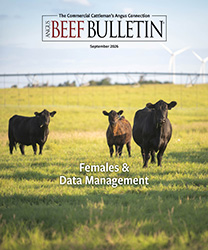
Current Angus Beef Bulletin
Our September issue focuses on the females of the herd and the records that validate them.