



A Rock Solid Foundation
Tips to select females that will pull their weight in your herd.
August 11, 2026
Famed motivational speaker Zig Ziglar once pointed out many people wrongly spend more time planning their wedding than their marriage. It’s a caution to keep in mind when picking the females to which you are hitching your herd’s future.
To build a solid, long-lasting relationship with those new herd additions, consider where you want to be five, 10 or 20 years down the road.
“You have to have an idea of where you want to go. Look around your region to some successful people. See what they’re doing,” recommends Landon Andrews, American Angus Association regional manager for California, Nevada, Utah and Arizona. “Make a point to pick their brain a little bit. Ask what they’ve learned through trials, tribulations and failure.”
Taking the time to ask questions and learn from those individuals who seem to have figured “it” out means the learning curve — and thus the corresponding opportunity for failure — shrinks.
Beginning with the end point (and potential buyer) in mind is admirable, says Mark Johnson, Oklahoma State University Extension specialist for livestock evaluation. Building in a degree of flexibility? That’s just plain smart.
“My plan may be to retain ownership through finishing, but the one certainty of beef production is that environment, climate and intended marketing end points — those change,” Johnson warns. “Producers need to have some degree of flexibility built in based on that variation.”
Observing and learning from producers who have already experienced that fluctuation is educational. But in the end, producers need to decide what product they’re producing and who they want to market that product to in order to truly position their operation for the future.
Reese Tuckwiller, regional manager for the Northeast, echoes the need to identify direction early with a sobering reminder.
“I hate the statistic that the average Angus breeder is in the business for less than five years,” Tuckwiller shares. “How do we keep them in business longer and make their business models sustainable? Ultimately, you need to make a plan.”
Your ideal partner
At the end of the day, producers have to have a product the public wants to buy if they want to stay in business, says Alex Tolbert, regional manager for the states of Ohio, Kentucky and Tennessee.

To stay in business longer than the average, producers need to have a plan, says Reese Tuckwiller, American Angus Association regional manager.

You have to be mindful of your customer and how they gauge success, Tolbert emphasizes. “If I don’t have that in mind when I’m making breeding and management decisions, it’s easy to get lost.”
Tolbert reminds new producers that they are a grass farmer — and they can’t forget it. They need to build a program around a female that fits their environment, their grasses and the quantity of forage available.
Forages and their particular nutrients are going to differ from one place to another, he explains. That means more emphasis should be placed on females with a proven record of performing in your particular environment.
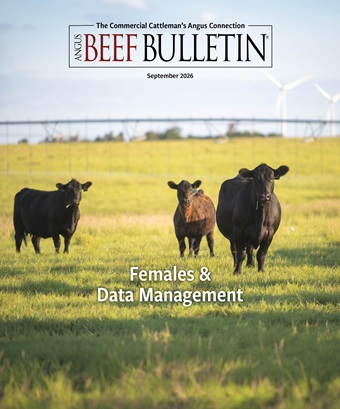
Every decision is relative to what each operation labels as success, says Jeff Mafi, regional manager for Kansas and Oklahoma. Regardless of available resources from ranch to ranch, if it rains and the weather otherwise cooperates, producers could find themselves looking for more cows.

Having a product the public wants to buy is a key to staying in the cattle business, says Alex Tolbert, Association regional manager for Ohio, Kentucky and Tennessee.

The important thing to consider, he says, is that purchasing cattle isn’t always as simple as handing over payment and walking away.
“People buy and sell cattle every day of the week,” says Mafi, noting that producers know when they need to boost their in-herd numbers in order to balance the grass Mother Nature and good management have provided.
Finding those genetics might be as easy as leafing through the Angus Beef Bulletin or asking around your area for producers willing to share more about their operation. Whether that means you’re purchasing bulls, sourcing females or simply enjoying good conversation, go visit with those cattlemen who have a system similar to the one you see yourself creating.

Association Regional Manager Jeff Mafi advises new cattlemen to visit ranchers that have a system similar to what they are trying to create to see what has and what hasn’t worked for them.

Sourcing females whose mature cow size and level of milk production match the forage available means cows have a better shot at breeding back earlier in the breeding season, calving early in the calving season and weaning a calf each year, Johnson says.
“That sounds pretty basic. It’s pretty simplistic, but I think any time we’re looking at replacement heifers, that is fundamental,” Johnson says. “If they do breed early, calve early and wean a calf each year, they will turn into the kind of cows that we get to cull when they’re 10 or 12 years old.”
The animals that fail to calve, don’t match their production environment or have some kind of issue should be culled from production or they will be a drain on profit potential, he explains.
How should producers ensure they’re selecting the right replacements? Johnson believes in selecting only the top end of heifers to develop as replacements. Their mothers should be a good environmental fit because they’re mature females that have already proven their worth in their unique production situation.

Mark Johnson, Oklahoma State University

“Identifying those earlier-born heifer calves out of the older cows is pretty sage logic to apply to the selection of heifer calves,” Johnson suggests, noting not every producer has the luxury of sourcing replacements from within their own herd. “If we’re not producing those heifers ourselves, there’s a lot of useful information that comes from GeneMax® Advantage™.”
For more information on GeneMax Advantage and the benefits genomic testing can have in your commercial cow herd, visit www.genemaxangus.com.
All good things in moderation
With so many options available when it comes to purchasing commercial females, Andrews recommends raising cattle you enjoy looking at and want to feed. He cautions against single-trait selection, especially where replacement females are concerned. After all, there’s a fine balance between preference and potentially heading down a bumpy road.
“Don’t chase extremes in any direction,” Andrews says, sharing phenotype ranks high on his list but doesn’t mean everything. “We all want that unicorn. We all want those perfect numbers and cattle that look really good to boot. Understand that’s a hard animal to replicate.”
While balance between phenotype and performance is needed, says Johnson, there’s also a balance among genetic values. For example, he says, most cattlemen love growth and pay weight regardless of the end point they’ve chosen for their calves. Whether selling at weaning, as yearlings or retaining ownership through processing, producers need to balance growth genetics at any of those marketing end points with the mature size of the cow they’re living with 365 days a year.
Johnson says it is easier to take one or two traits to the extreme; however, the best cattle combine a number of things to a high degree, and the ideal animal is seldom the most biologically extreme.
“Think about beef production from a standpoint of dollars generated per acre of pasture as opposed to how much we made per cow,” Johnson summarizes.
“We all want that unicorn. We all want those perfect numbers and cattle that look really good to boot. Understand that’s a hard animal to replicate.” — Landon Andrews

Landon Andrews, Association regional manager

Once you’ve done your homework to define the cow that will fit your environment, the traits your customer will value and the potential sources of replacements, then what?
“I get more phone calls looking for heifers bred to a low-birth-weight Angus bull. They’re hard to come by,” Andrews shares. “Everybody’s afraid of an open heifer. My opinion is I would love to have that open heifer at home for a year. Have her in my environment, have her on my protocol. Then when I breed her, she’s in line with everything I have going.”
Purchasing open females may also give producers some flexibility to use genetics from other parts of the country while capitalizing on aspects of in utero calf development.
Fetal programming is a tool producers can use to introduce new genetics to their herd while mitigating a portion of the risk cattle might face in a new environment or when consuming new forages, says Tuckwiller.
“If you bring cattle out of the West and put them on fescue, research says it takes them three to five years to adapt,” he explains, noting that embryos or utilizing artificial insemination (AI) means that resulting calves are already on the way to be being adapted.
“It’s not foolproof and doesn’t work 100% of the time, but it’s one way producers can make a lot of genetic progress without the limitation of environment,” he adds.
With that said, there is no replacement for building a network in your own community, Tuckwiller says. With fewer producers than ever before, building relationships with fellow local farmers and ranchers allows sharing ideas and collaborating on issues currently facing the ag industry.
Another benefit of networking and finding like-minded producers to purchase your replacement females through involves understanding generational genetics, as well as herd health history.
“Nearly all of our commercial producers who are selling females have a real solid herd health program,” Mafi says. “They document that program and put it in front of their buyers. If that documentation isn’t available, just ask for it.”
Angus Beef Bulletin EXTRA, Vol. 18, No. 9-B

Selecting Replacements via GeneMax Advantage
Near Spickard, Mo., the University of Missouri’s 1,600-acre Thompson Research Farm has been home to a predominantly commercial Angus-focused operation since 1995. For one student, what started as a summer project turned into a proving ground for GeneMax® Advantage™.
Determining whether to keep or market potential replacement females can be one of the most difficult decisions a commercial producer has to make. Even when considering the performance of a heifer’s mother, there can still be room for error when tasked with determining future productivity. That’s where GeneMax Advantage — a DNA test created by Angus Genetics Inc., Certified Angus Beef and Zoetis for commercial Angus replacement females — shines.
Thanks to AI, buying quality Angus cleanup bulls and purchasing GeneMax Advantage-tested heifers, Mizzou’s research team was poised to test both the accuracy and value of genomic predictions within commercial herds.
“How well does that cow value as a mama cow in the herd? How well is that value predicted by the DNA test?” questions Jared Decker, the Wurdack Chair of Animal Genomics and associate professor in the Department of Animal Science. “We took the performance of that cow’s calf and compared it to her DNA test score. That’s really what the DNA test is trying to predict — is what is her value as a parent.”
Researchers didn’t look at every trait predicted by GeneMax Advantage, Decker says, but the team looked at the low-hanging fruit: traits with data readily available. Weaning weight, carcass weight, fat thickness, ribeye area and marbling all made the cut. Each calf’s weaning weight was also compared to data on their dam’s predicted milk production.
Researchers compiled the data on GeneMax Advantage-tested females born from 2001 through 2017, compiled the performance of their calves and compared it. The result was definitive.
“Every trait that we looked at, the GeneMax Advantage score accurately predicted the average performance of the calf,” Decker confirms. “For every trait that we looked at, the GeneMax Advantage score was providing information on the value of that cow as a mother in our herd.”
There’s so much randomness in genetics; millions of genes and biology, says Decker. Every calf produced is a random shuffle of its parents’ genes and chromosomes with infinite possibilities for how that deck of genes and chromosomes falls.
The impressive thing about genomic testing is it allows producers to identify how that deck was shuffled from the sire to the calf, Decker concludes. Instead of needing to work with long-term averages or expectations, cattlemen can directly test the DNA of their replacements and define the genes that individual inherited from its parent.
“The benefit of commercial testing is that that type of information has not been available to [commercial producers] until recently,” says Jamie Courter, assistant professor in beef genetics extension and research. “What the industry has done is taken all of the work and the knowledge and the things that we’ve gained at the seedstock level, and we’re now making that available to the commercial cattleman.”
Decker echoes that the principles shown in the GeneMax Advantage validation paper apply whether one is talking about DNA testing commercial heifers or DNA testing herd bulls.
“We can either be at the mercy of the random shuffle and not know clearly what we’re getting, or we can choose to have the deck stacked in our favor and buy those bulls that have genomically enhanced EPDs,” he explains. “What that’s going to do for us is simply remove some of the risk of that bull purchase.”
The information above is from a larger conversation on the Angus at Work podcast. The June 12, 2024, episode titled “Selecting Replacements via GeneMax Advantage with Decker and Courter” covered the basics of genomic testing, why testing commercial females is a sound management strategy, how genomic data can help decrease genetic risk and more.
— by Lynsey McAnally
Topics: Female Foundations , Genetics , Management , Selection
Publication: Angus Beef Bulletin
Issue: September 2026
Related Content


Current Angus Beef Bulletin
Our September issue focuses on the females of the herd and the records that validate them.