The Link
Positioned or discounted: The new reality of sale season.
May 6, 2026


The lessons from the feeder-cattle market over the past several years have been very clear — and are likely to persist well into the future. The market is effective at price discovery. But, it is not just about the market; it’s about preparation.
We tend to think of the “market” as something so complex it defies understanding. In reality, it plays two simple roles:
- It establishes baseline prices, and
- Buyers sort cattle based on real — or perceived — value.
What’s changed is this: Buyers are sorting faster, more precisely and with more confidence than ever before.
That means success is no longer determined the day your calves sell; it’s determined months earlier by how well they’ve been positioned to be understood, trusted and valued.
The cattle that generate the most interest — and ultimately the most dollars — have three things in common:
- They’re known.
- They’re predictable.
- They’re easy to buy.
Everything else is noise.
This article outlines seven fundamentals shaping today’s cattle market.
1. Buyer psychology has changed. We must change with it.
Today’s buyers aren’t just purchasing pounds; they’re managing risk. Feedyards, order buyers and backgrounders are under more pressure than ever to hit performance targets — gain, efficiency, carcass quality and grid outcomes. Margins are tighter, expectations are higher, and variability is more costly.
Every group of cattle purchased today carries more financial risk than at any point in recent history. It’s not surprising, then, that buyers gravitate toward cattle that reduce uncertainty — cattle that offer more marketing options and clearer expectations.
The most profitable cattle are no longer the cheapest. Growth, efficiency and marbling still matter. But increasingly, the most sought-after cattle are those buyers who can understand and categorize with confidence.
That’s the shift. If your cattle aren’t accurately described and clearly defined, buyers are forced to assume risk — and risk gets discounted. The operations separating themselves today are those moving beyond general descriptions and providing a more objective, comparable snapshot of what their calves are likely to do.
2. Uniformity, consistency and predictability drive profit — but it’s not enough
We’ve always preached uniformity — and for good reason. A load of calves that look alike still draws attention. It signals management, discipline and consistency. But uniformity today goes beyond what the eye can see. Visual uniformity gets you noticed. Data-backed uniformity gets you paid.
Buyers need to know:
- What genetics are behind these calves?
- How consistent is their performance likely to be?
- Where will they land on the grid?
Two sets of cattle may look identical in the alley or on the video screen; but, if one comes with documented, credible information and the other doesn’t, they will not be valued the same. And that gap is widening.
Tools like AngusLink® and the Genetic Merit Scorecard® help standardize how genetic potential and expected outcomes are communicated. In a format buyers can quickly interpret, they are becoming a meaningful advantage in the pricing equation.
3. The majority of marketing happens before sale day
If a buyer is trying to assess the value of your cattle in the seconds before the gavel falls, you’re already behind. The most successful producers are marketing their cattle long before they market their cattle. They:
- share information early with reps and buyers;
- clearly define and communicate their offering; and
- provide tools that build buyer confidence ahead of sale day.
Because the reality is simple: Buyers don’t pay premiums for surprises. They pay premiums for certainty. If your calves show up as an unknown, the market will treat them accordingly.
Producers who consistently generate strong demand have already done the work of organizing and presenting their cattle in a way that allows buyers to see the value before they bid.
4. Documentation is no longer optional
We’ve reached a point where data is becoming a trait — just like weight, just like health, just like genetics.
Cattle that come with documentation — health protocols, genetic insight, program eligibility, source and management information — are fundamentally different in the eyes of the buyer. It’s not because they perform differently biologically. It’s because they perform differently economically.
Information allows buyers to:
- bid more aggressively;
- sort cattle into higher-value programs;
- manage them more precisely; and
- align them with specific end targets.
Most importantly, it allows them to do so with confidence. In many ways, documentation is becoming a kind of common currency — a shared language that aligns expectations across segments of the industry.
5. Make your cattle easy to buy
This is the simplest concept — and one of the most overlooked. Friction kills demand. If buyers have to work to understand your cattle, guess at their potential or fill in missing information, many simply won’t engage.
Not because your cattle don’t fit their program — but because there are other cattle they can understand faster.
The producers gaining traction are those who’ve simplified the process — presenting cattle in a way that connects genetics, management and expected outcomes into a clear, usable profile. If your cattle aren’t easy to buy, you’re leaving money on the table.
6. Timing still matters, but positioning matters more.
We spend a lot of time trying to outguess the market — when to sell, what weight to target, which channel to use. And timing does matter.
But here’s the truth: Well-positioned cattle outperform poorly positioned cattle in any market.
In strong markets, they capture premiums. In weaker markets, they protect against discounts. Positioning isn’t about chasing the market; it’s about preparing for it.
And preparation today includes not just how cattle are raised — but how well their story is captured, backed and communicated.
7. The future belongs to the transparent.
Our industry often moves in multiple directions, but there is clear alignment on one front: We are moving toward more information, more alignment and more accountability.
Some cattle will continue to be marketed as commodities with minimal differentiation — but that model is becoming increasingly limited. The most valuable cattle will be those that can objectively define and communicate their genetic merit, giving buyers confidence in expected performance and aligning value from ranch to rail.
In the seedstock sector, expected progeny differences (EPDs) created a standardized way to describe and compare cattle across operations — bringing clarity to what was once a highly subjective marketplace. Today, tools like the Genetic Merit Scorecard and programs like AngusVerifiedSM are beginning to play a similar role in the commercial segment.
We are seeing the emergence of more consistent, standardized ways to describe cattle, helping buyers make better decisions and creating more opportunity for producers. Competition is healthy. Competing on price alone is not.
The sale is the outcome, not the strategy
It’s easy to think of sale day as the finish line. In reality, it’s just the scoreboard. The real work — the work that determines buyer interest and price — happens long before:
… in your genetics.
… in your management.
… in your documentation.
… in how you choose to position your cattle.
In today’s market, the question isn’t: Are these good cattle? It’s Can a buyer clearly see — and trust — that these are good cattle?
Producers who can answer yes to the latter — clearly, credibly and consistently — are the ones separating themselves. Increasingly, they’re doing it by turning information into an advantage.
Editor’s note: Troy Marshall is director of commercial industry relations for the American Angus Association.
Angus Beef Bulletin EXTRA, Vol. 18, No. 5-A
Topics: Business , Feeder-Calf Marketing Guide , Marketing , EPDs
Publication: Angus Beef Bulletin
Related Content


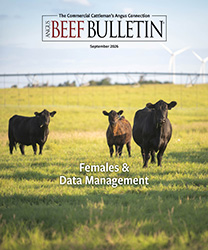
Current Angus Beef Bulletin
Our September issue focuses on the females of the herd and the records that validate them.