



Prices, Weights & Quality Escalate
A 2025 Recap: Entrenchment of supply constraints benefits cattle sector.
February 20, 2026
Some of the most important themes in the modern beef supply chain are expect the unexpected and avoid artificial limits on possibilities. At the close of 2024, cattlemen had a strong sense that higher prices awaited in the year ahead. The trajectory of price increases for all classes of cattle far outperformed the “sensible” guesses. Consumers proved a greater willingness to buy beef at prices equally unforeseen. With quality leading the way, 2025 was another remarkable year in beef.
Contracting supply
At the beginning of 2025, we saw a continuation of smaller fed-cattle supplies on the heels of U.S. cow herd contraction. Drought concerns through 2024, combined with a handful of management and financial considerations at the cow-calf level, had already positioned the 2025 fed-cattle harvest to decline by 700,000 head for the year.
Domestic feeder-calf supplies had already strained the supply chain, pressuring both cattle feeder and packer margins. The industry soon felt another shock from the extended closure of the Mexican border to feeder-cattle imports through the end of the year. What would normally be a 1.2-million-head supplement to southern feedlot inventories for the year was concluded in May with just 229,000 head crossing the border.
The ramifications of the lost Mexican supply would not be seen in the fed harvest counts until the second half of the year, but it was felt in Texas feedlots from the onset of the closure. A small annual decline in Canadian imports deepened the theme of reduced supplies in 2025.
Final numbers show a 5.1% reduction in U.S. fed-steer and -heifer harvest with a total of 23.7 million head, down 1.27 million head on the year. This was 8.7%, or 2.27 million head, fewer cattle than were harvested in 2019, the largest post-expansion year in the cycle.
Carcass weight to the rescue
Perhaps just as unforeseen as the disappearance of Mexican feeder-cattle imports is the continued trend of escalating carcass weights. Frequent reports that weights are 20+ pounds (lb.) heavier than a year ago have become so common the metric is practically dismissed.
Recognize this phenomenon was not limited to 2025. Since February 2023, carcass weights have averaged 25 lb. more than in the same week the previous year. The extended run of 69 weeks during which this has been true has culminated in weekly 2025 carcass weights averaging 47 lb. heavier than their 2023 counterparts.
The cumulative weight gain over two years significantly underpinned the fed-beef supply in 2025. Adding it up, the average weight per head in the two-year comparison equates to an extra 23,245 head of weekly fed-cattle supply in contrast to the average carcass weights of 2023. The actual weekly difference in steer/heifer harvest between the two years was 26,000 head.
Simply adding weight is not necessarily preferential to increasing head counts, but carcass weights have made an oversized contribution to the supply equation.
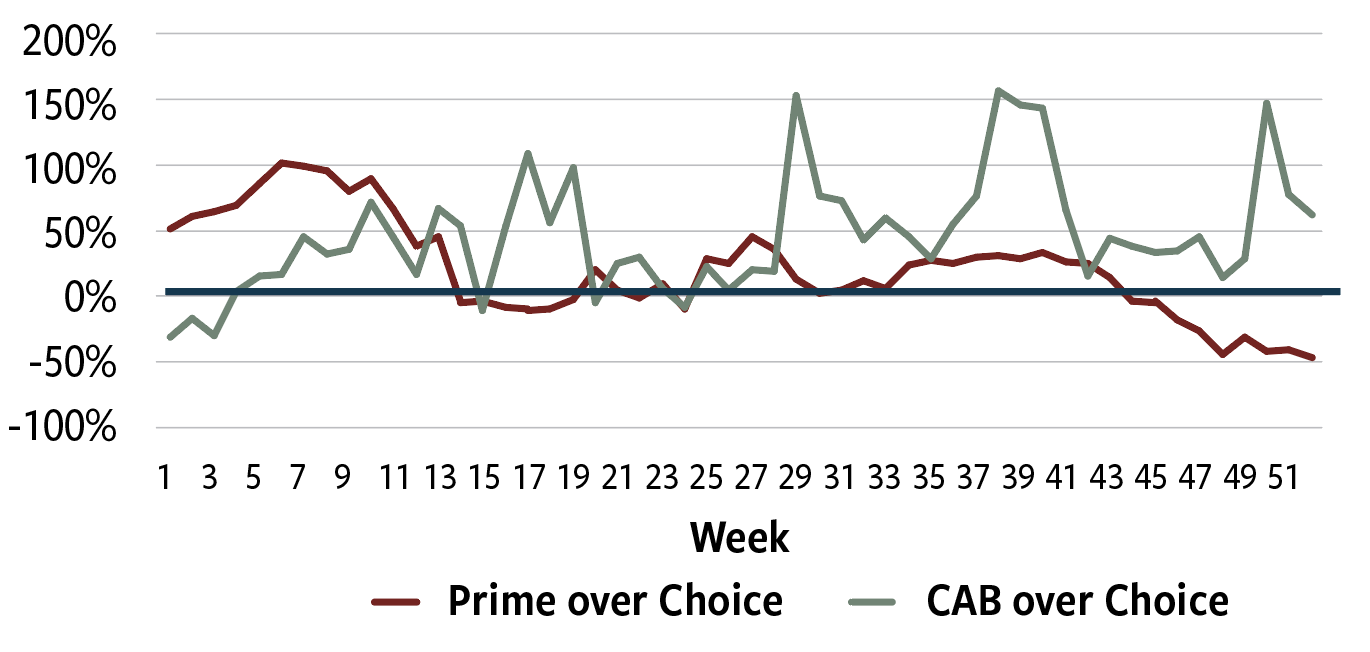
Fig. 1: USDA Prime and CAB® and cutout value with 2025 premium as a % of 2024

Grade trends
The upswing in carcass weights provides a segue to the topic of carcass marbling trends and quality grade.
A year ago we noted the rapid increase in the average number of days on feed (DOF) recorded by feedyards in 2024. In both 2024 and 2025 it has been common to see cattle fed 190 days or more. Examples are prevalent with pens fed much longer, boosted somewhat as the typically longer-fed beef-on-dairy supply is now a standard component of mainstream fed-cattle metrics.
Heavier weights and the longest average feedlot stays on record contributed to the industry achieving a record-high 84.4% USDA Choice and Prime carcasses in 2025. This edged out last year’s number by 1.2 percentage points (ppt).
The increase came in the Prime grade, as the premium category made a big 1.3 ppt jump to an average of 11.8% of fed-cattle carcasses for the year. Prime grade improvement was prevalent from north to south, with regions topping 16% Prime periodically.
Although Texas typically lags northern packers in quality grade, USDA reports the most improvement there as the Texas Prime grade moved 1.4 ppt higher to average 7.1% Prime for the year. The absence of lower-grading Mexican cattle in the fourth quarter seemed especially evident as the Texas percent Choice and Prime reached as high as 77%.
Gains in Prime were matched with a shrinking share of cattle grading USDA Select. The multiyear slide in the nation’s Select percentage has tracked from a modern day high of 41% in 2006 to just 12.5% in 2025. While the 20-year trend is revolutionary, last year’s decline of a full percentage point from 13.5% in 2024 is notable.
As packers reined in head counts — pressured by negative margins and inventory — the Certified Angus Beef ® (CAB®) brand supply was challenged by smaller throughput. Acting as a counterbalance, a robust 70% of fed cattle met Angus-type eligibility to be considered for the brand.
CAB fiscal year data shows a stronger marbling trend among eligible carcasses, with 37% meeting all 10 carcass specifications to reach CAB certification. This acceptance rate was achieved despite record-high carcass weights, especially in the fall, disqualifying a significant share of marbling-rich carcasses exceeding the brand’s 1,100-lb. upper limit.
Year-end production volume placed the certified carcass count at 5.78 million head, or 24.3% of all fed cattle. While the downturn in fed harvest limited certified carcasses to the fifth-largest head count in history, the brand’s sales volume was the third-largest ever at 1.235 billion lb.
Gains in the USDA Prime grade supported subsequent growth in CAB Prime sales volume in 2025. The year’s 7% growth placed CAB Prime sales at 55 million lb. The bigger picture is more impressive: A decade of steady growth shows the 2025 total was quadruple the volume sold under the Prime brand label in 2015.
Growth continues at the grocery store level, with the most obvious middle meats accounting for 62% of the CAB Prime product in the meatcase. However, consumers continue to choose quality across a variety of cuts, as CAB Prime end meats volume increased 22% and deli meats increased 25% in retail stores last year.
Price and demand stronger in 2025
As domestic harvest volume continued to seek the lowest level in the cycle, carcass cutout values pressed sharply higher last year. The comprehensive cutout price, including all grades for all delivery periods, surged more than 16% year over year, averaging $357 per hundredweight (cwt.). The annual high arrived in September with a staggering $409-per-cwt. comprehensive average, besting the July 2024 high by 26%.
Even as we focus on fed-cattle metrics, it’s imperative to consider ground beef demand and the 90% lean trim value on the total beef market. Having already jumped 22% in 2024, another 15% increase last year brought the two-year wholesale price inflation for 90% lean trim to 37%. This tended to prop up prices for higher-valued cuts across fed cattle, simultaneously pushing cull cow prices to new records — as high as $170 per cwt. in the fourth quarter.
Quality-based price spreads for fed-cattle carcasses remain a focus, particularly as the combined share of Choice, CAB and Prime carcasses found new heights in 2025. The USDA Prime premium above Choice fell well below the record $56-per-cwt. average set in 2022. However, the $39-per-cwt. average in 2025 is considerably stouter than projected, up $4.72 per cwt. on the year, given that Prime carcass tonnage was the largest in history.
The CAB premium over commodity Choice proved that demand for the brand’s traditional upper two-thirds Choice product is thriving. The 2025 average of $20.73 per cwt. wholesale cutout premium was up $5.59 per cwt., while the prior five years posted a tight range from $15.14 to $17.76 per cwt. CAB grid premiums paid by packers have been more consolidated in the same period, averaging in the $4- to $5-per-cwt. range.
The Choice-Select spread remained significant enough to capture premiums for feedyards in 2025, although the annual average of $14.90 per cwt. was just $0.09 per cwt. higher than the previous year. As Select production waned to just 12.5% of total fed cattle, the ubiquitous supply of Choice and higher product pressured the Choice premium at times. A rich grade mix in December, coupled with conclusion of the height of middle meat demand, saw the Choice-Select spread narrow dramatically to end the year.
Fed-cattle prices responded to added leverage in 2025 with a 19% increase over 2024. Midyear values featured the peak with the August Five-Area price touching $244 per cwt. Political rhetoric and the announcement of Tyson’s Lexington, Neb., plant closure and Amarillo, Texas, production pullback set prices back $28 per cwt. in a matter of six weeks before the market staged a recovery into December to close the year at $231 per cwt.
Regional price disparity was a feature of the 2025 market, with historically wide price differences favoring the northern states for the majority of the year. The spread flipped in the second half as the void left by the Mexican border closure began to run Texas feedlots short on cattle while ample heavy cattle from Nebraska and Iowa shipped to southern plants to supplement supply.
Onward
Most fundamental beef supply issues remain intact for the 2026 market, with a tightening grip on fed numbers creating further strain. Another 2.5% decline in fed cattle is anticipated, but potential reopening of the Mexican border remains an unknown as of this writing. As such, fed cattle availability will likely continue to keep prices near a year ago, but with high potential volatility.
Cow-calf producers have started the year at record price levels and supplies remain tight. Expectations for a calf crop 300,000 head larger in 2026 provide a supply relief indicator for downstream customers. The fruits of that expansion will not come to bear for several months, while a meaningful herd rebuilding will be a matter of years.
Editor’s note: Paul Dykstra is director of supply management and analysis for Certified Angus Beef LLC.
Topics: Feeder-Calf Marketing Guide , Industry News , Management , Marketing , News
Publication: Angus Beef Bulletin
Issue: March 2026
Related Content


Current Angus Beef Bulletin
Our September issue focuses on the females of the herd and the records that validate them.