




Battling a New Eight-legged Foe with Olds and Tarpoff | Part Two
Season: 5 — Episode: 10
May 21, 2026
It’s been a week since we posted Part One of the Theileria orientalis Angus at Work episode! Have you had a chance to go listen?
If not, we welcome you to venture back in time before jumping into Part Two of our discussion with Kansas State University’s Cassandra Olds, assistant professor of veterinary entomology, and A.J. Tarpoff, associate professor and beef extension veterinarian, regarding the Asian longhorned tick and Theileria orientalis.
Additional Resources:
- Asian longhorned tick | USDA APHIS
- Story map | USDA APHIS
- Bovine Theileriosis | USDA APHIS
- Subscribe to the Angus Beef Bulletin EXTRA
Thank you to GeneMax® Advantage™ for their sponsorship of this episode.
Host Lynsey McAnally (00:04):
Angus at Work, a podcast for the profit-minded cattleman. Brought to you by the Angus Beef Bulletin, we have news and information on health, nutrition, marketing, genetics and management. So let’s get to work, shall we?
It’s been a week since we posted Part One of the Theileria orientalis Angus at Work episode! Have you had a chance to go listen? If not, we welcome you to venture back in time before jumping into Part Two of our discussion with Kansas State University’s Cassandra Olds, assistant professor of veterinary entomology, and A.J. Tarpoff, associate professor and beef extension veterinarian, regarding the Asian longhorned tick and Theileria orientalis.
But first, we want to take a moment to thank GeneMax® Advantage™ for their sponsorship of this episode.
GeneMax Advantage ad (01:10):
Unlock your herd's genetic potential with GeneMax® Advantage™. It's the only genomic test that delivers Angus dollar values, the gold standard in beef cattle genetic selection on Angus-based commercial females. New in 2026, turn GeneMax's genetic insights into more marketing power when you test and market calves inside of the AngusLink℠ Genetic Merit Scorecard® (GMS). Order GeneMax Advantage today at genemaxangus.com and select females with confidence. That's genemaxangus.com.
Cassandra Olds (01:49):
And then I would say the other thing that we really need to keep in our minds: We frame this as a tick-borne pathogen, but it is not just a tick-borne pathogen. You can never have the Asian longhorned tick and you can have a whole lot of problems with Theileriosis because we, number one, have the relapse. So you can bring in infected animals, not know that they're infected and you could have severe disease relapse. Importantly, it can be transmitted mechanically. We've talked about the tick. That's biological transmission, which means that tick can take in a small amount and amplify it.
We also have mechanical transmission. I always use the example of you carrying your groceries from the trunk of your car to your kitchen. However much I wish that when I pick up that bag from the trunk of my car, there's miraculously going to be more groceries. When I put it off in my kitchen, there never is. I'm just moving it from one place to the other. So we have mechanical transmission through blood-sucking lice. We have needle transmission. We probably have transmission through biting flies, and then there is a small level of transplacental transmission. So people just need to keep in mind that this is more than just a tick-borne pathogen. Did I miss anything in my elevator pitch? Did I get off on floor three instead of floor five?
A.J. Tarpoff (03:11):
Well, it depends on how big the building is.
Cassandra Olds (03:13):
Yeah, there you go. There you go.
A.J. Tarpoff (03:17):
I was asked recently, it's like, "Okay, just give it to me straight, Doc. What's Theileria? Why do I care?" And I'm like, "Okay, blood-borne pathogen. Destroys red blood cells during its replication. Can cause anemia and death or you have a lifelong infection that could ... Usually it doesn't get sick anymore. If it survives after the initial exposure. If it survives, high likelihood it's never going to have an issue again. Unless we have very severe stress on that animal, then you can see problems later on." So it's one of those things where we have other diseases that are similar in some aspects. In a lot of other things, this is a brand new challenge that we really haven't been able to ... We don't have perfect answers for. It spreads very differently than other diseases we're used to. It's not as simple as, "Oh, you have a bacterial infection, you get this antibiotic and we're going to be fine." We don't have some of those cures.
We don't have some of those ultimate control measures. It's a little bit different and it's a new challenge that our industry is going to battle and hopefully overcome.
Cassandra Olds (04:35):
One thing I'll add to that is that it's changing. We're learning new things all the time. I mean, if I even think about what we thought we knew a year ago vs. what we see now, I think that's really important for people to keep in mind. Listen to these talks again and again and again. I'm telling you now: in six months we're going to have learned new things. Keeping up to date with all the new things that are coming out. We're learning as we're going along. We're figuring it out, we're putting the pieces of the puzzle together, which is great. It also means it's a rapidly changing situation. Keeping up to date with the latest information is good.
A.J. Tarpoff (05:18):
And Kansas is a unique area. We're a net importer of animals from all over the country. Now when we have in quote-unquote "endemic locations" from the East Coast throughout Middle America. We're importing animals over the last decade that have been positive for Theileria. Well, if we've been importing animals to Kansas that have been positive, have we been seeing massive outbreaks within the state of Kansas? Well, no, we haven't. Have we had issues? Have we had positives? Yes, of course we have because we're importing positive animals almost every day, but that's where what we're seeing today is very different than outbreaks in the past. It's not like the outbreaks that happened in Australia and New Zealand and some of those locations. It's not like what originally was occurring in Virginia early in these courses. What we're seeing today, we've trickled in some of these Theileria over the last decade and just now has that competent biologic vector of the Asian longhorned tick caught up with the spread of the disease.
This is a new frontier. We have a host herd within Kansas that has probably been exposed over the last decade, but it's the young calves that we're continuously bringing in as feeders and backgrounders and going into the feedlot. That stress of transportation and the stress of marketing is causing some unforeseen problems that we really didn't anticipate.
Cassandra Olds (06:53):
Yeah. And that we didn't see in other states because that's not how they produce their beef. They send their beef to us. And so I think that sometimes it's fascinating how these things evolve and how it changes over time just based on where it impacts next and what that production system looks like.
A.J. Tarpoff (07:16):
So I guess with Theileria, what somebody would see ... If I'm a producer and I'm bringing in animals or I just have a home herd. What is Theileria? What does it matter for me or what should I keep my eyes on? It may look like very similar ... In some of our mature animals, it may look very similar to something called anaplasmosis, which is a bacterial infection that actually gets into the blood and the red blood cells and causes anemia. So we can see anemia with Theileria, but anaplas usually impacts older animals. Older, naive cows and bulls within those areas. With Theileria, we can see it equally almost - if they're all naive - we can see it in older animals or younger animals. It's an equal opportunity employer from that perspective. We can see the traditional jaundice. We can see white mucus membranes.
We can see extreme lethargy, just overall not doing well. If the animal dies, we will see some things typical of anemia. We can see an enlarged spleen, we can see either the yellowing or very pale fat, one or the other. Depending on how long it's been going on or we can have some things in feeder cattle where we have immune disruption and we have animals that are just nonresponsive. They're nonresponsive. We think it looks like Bovine Respiratory Disease or pneumonia and we treat them accordingly and then all of a sudden we realize, "Boy, our treatment success is so far out of whack from what we were expecting." That we have nonresponsive animals. It's a different thing to think about that. It's something out of the ordinary. That's what I keep harping on with producers and veterinarians. That when you see something abnormal, that should ring a bell.
Either it's, "Boy, ticks are really bad this year and my animals are inundated with 10,000 ticks." That should send off a red flag. Why are all these ticks here all of a sudden? Is this the same thing I've always been battling? And then on the feeder side, keeping documentation. Making sure that we're tracking animal health, morbidity and mortality. Sickness and death loss. If our treatment success just goes downhill and maybe the necropsy results of some of those animals that succumb to illness doesn't match what the clinical signs were. Those should all be red flags that, "Hey, maybe something else is going on here."
Cassandra Olds (09:51):
So A.J. mentioned anaplasmosis. We do have cattle that are coinfected with both anaplasma and Theileria. I think sometimes people have been thinking that they've got anaplasma issues and - again - it's not responding to treatment. If you haven't historically had issues with anaplasmosis and then all of a sudden you think, "Oh, I've got a lot of anaplasmosis." It may not be anaplasmosis, it may be Theileriosis. We're doing research now that's looking at, okay, if you're infected with both, what do you do? Because this is a thing that we need to look at the animal exists in its environment and it may be coinfected with both these things and they have very similar disease progression. There are differences, but these are both diseases that do have some similarities. One of them being anemia. So how do these interact with each other? We just don't know yet.
A.J. Tarpoff (10:48):
And I do want to point out this is not a human disease. Theileria orientalis, that's not a human disease. This is a cattle-specific disease. So for producers listening in, anybody listening in, this is not a human health issue. This is not a food safety issue. The beef, everything, we have no concerns there. We can see some issues with production and morbidity, some of these issues. So I guess that's one thing to always consider. The other consideration is just because an animal was exposed doesn't mean it's a death sentence. In the vast majority of circumstances, infections go unnoticed. So by the time that we've realized we have Theileria going through a group of animals, essentially everybody's already been exposed. Maybe only a very small percentage had any issues. It's not an immediate death sentence.This goes through groups. By the time we realize what the issue is, it's probably spread through massive amounts of animals before we realize what happened.
So just because an animal's positive doesn't necessarily mean that's a death sentence, but it gives us an indication of what might be happening on the bigger scale.
Cassandra Olds (12:02):
I can't tell you how many people I've spoken to who - once we get the herd tested - that they're like, "But this can't be right. I never had any disease." The rule is that it comes in without any incidents. It's the exception where we start seeing clinical disease. It's just those are the ones everybody talks about. Nobody talks about the herd that never had any disease because they didn't know it was there. So there's this sort of skewed perception of how bad it can be sometimes.
A.J. Tarpoff (12:30):
But even going back to originally finding some of these issues, I'll take Virginia as an example. It was going through Virginia, they were having cow-calf herds that were having problems and I was discussing this in one of my classes. I had a student come up to me afterwards and said, "Hey, Doc, my family's herd was one of the sentinel herds in Virginia." I said, "You got to be kidding me. So you're well versed in Asian longhorned tick and Theileria." He said, "Absolutely." I asked him, "What was the outcome?" He goes, "Well, by the time they figured out that it was Theileria, we blood tested the entire herd. Everybody was positive and we stopped having problems." It's almost consistent that we see that a lot with Theileria.
Cassandra Olds (13:15):
And encouraging. And I always say this to people that everybody's gut reaction is, "I'll keep it out at all costs and if I have positive animals, I'm going to get rid of them no matter how good they are." And I think we've got to think about this in the long run. We are never getting rid of Theileria. We are never getting rid of Asian longhorned tick. So if we can get herd stable as soon as possible, there is a way to bring this in safely and really get in a good position. I think people have ... And I always say vigilance, not panic. We need to be vigilant. We need to be watching animals. We need to be paying special attention, but we don't need to necessarily be panicking and making poor decisions that are going to impact us in the long run because of something we're scared of right today.
A.J. Tarpoff (14:03):
Yeah. It's almost like a flashbang grenade. It kind of goes off, goes boom and then there's nothing else. There's no after effects, anything like that. It's a flash. It's a bang. It's like, "Okay, that happened?" Yes, but then we start looking at it and everything calmed back down. So for a lot of cow-calf operators, that's the scenario that we live with. With Theileria as it's moved across the U.S. and what we're seeing today from the feeder-calf aspect, it's a little bit different. A lot of what we're going to deal with is management and ensuring that we're reducing stress. We're acknowledging that some of the impacts that this disease can have where we really turn to husbandry as our way out. That is truly our crutch. That is what's going to get us through some of these scenarios and reducing some of the impacts of Theileria. Low stress, managing those animals, managing the immune system, doing the best we can on the husbandry side. That's what pays dividends on reducing the impacts of Theileria on those feeder animals.
Cassandra Olds (15:10):
And these are things that ... Sorry, sorry. I was just going to say, these are things that are good for animal health anyway. If you do these things to protect yourself against hopefully having issues with Theileria, they're good for the animals anyway. They're good for the bottom line anyway.
Host Lynsey McAnally (15:26):
Absolutely. I have a question and - like I mentioned maybe before we started recording - I figure if I have a question, maybe somebody else does. This might be a little bit of a chicken ... What came first, the chicken or the egg? If we have other insects, biting flies, other types of ticks that can transmit Theileria …
Cassandra Olds (15:46):
So no other ticks that we know of in the U.S. can do it. Just the Asian longhorned tick.
Host Lynsey McAnally (15:50):
Okay, perfect. Thank you. But if we have other insects that we, or just that manual transmission ... maybe if we're vaccinating, not changing needles, things like that. If that's the case, how did the Asian longhorned tick become the poster child for transmitting Theileria?
Cassandra Olds (16:10):
Oh, that's a great question. So I think it comes down to the fact that nine times ... So they were probably brought in in separate events and there's probably been multiple bring in events. Hands down the tick is the most effective way of doing this. Now in Australia, in New Zealand, they had already played around with this idea of there are alternative transmission roots. So it was known, but it looked very different. And A.J. kind of alluded to this. It looked different there. They've got different production systems, they've got different breeds and it was largely just ... It settled down and everybody moved on with their lives for the most part. So when it came into the U.S., we had the tick and the pathogen erupting around the same time. It was on the East Coast where the tick established itself very, very well.
And in any vectorborne disease that we talk about, the biological transmission is the most effective. So that is the primary driver. What happened was we then started seeing situations here in Kansas where we knew this was prior to us finding ... We've still only had one recorded single tick, right? We are not infested where we've got this everywhere yet.
A.J. Tarpoff (17:40):
And it was in a dog, by the way.
Cassandra Olds (17:41):
It was in a dog. A dog that was hit by a car on the road. We were having cases of within herd transmission here in Kansas where we had no tick vector present. And so that kind of set off alarm bells with me and I was like, "Well, hang on, there's got to be a different plan." And to be honest, I had been focusing on this as a tickborne disease. It's only when I started seeing these herds ... and the only reason we know this is because of Extension. Because we work directly with people and this is the importance of how important Extension is. When Extension does research, we can do great things. And so this was a producer I was working with. He had brought in cattle from out of state and had had a wreck and we were looking at it sort of two, three years later. We had calves from these animals that had initially been brought in as replacement heifers.
And we're like, hang on, why are all these cattle infected? They shouldn't be infected. And we started seeing this in multiple places, then spoke to the folks in Virginia and they're like, "Yeah, we also suspected that there were other methods of transmission, but by the time we were suspecting this, we were overrun by the tick and we didn't have any negative animals left to look." This idea that here, at least in Kansas, we were on the cusp of it and we still have the opportunity to really investigate this. So the tick steals the show and then we forget about these other things. It's only when we started looking at, well, what about when we talk about these states that are predicted to not ever be colonized by Asian longhorn tech, we look at states where you may only get colonization in certain areas and then realizing, hang on, Kansas is one of these states, there are other states and that we need to be better at, and then adding in the relapse factor, we need to be better at educating people of all their risks.
Hands down, a tick is the most effective way. However, if you do not have the tick, you will still potentially have a problem. And so just making sure that people are aware of all of the options. A.J., did I miss anything there?
A.J. Tarpoff (19:48):
No, yes, the tick takes the show because it's the most important biologically, but we can't ignore all the other potentials. And the research, sure, lice, biting lies or stucking lice, I should say, have been shown and proven to be able to transmit it, not biologically but mechanically. So as they share some of those lice from animal to animal and close quarters during the winter, they can transmit Theileria. So if lice are effective, what about some of our other biting insects? Well, it just hasn't been proven, but that doesn't mean that it's not happening and that's the piece that we need to be aware of.
Cassandra Olds (20:31):
Yeah. So we did find Theileria orientalis, so I'm getting ready to publish this right now and I'm really excited about it. We found it in the mouth parts of stable flies and we know that stable flies can transmit anaplasmosis and we've got this phenomenon of within ... And I always say you don't have to be good at something if you've got numbers on your side. And if anybody's been out in the summer and being bitten by stable flies, they've got numbers on their side. And so our next step is like, okay, can we prove that they are transmitting this? They're probably not terribly good at it, but it doesn't matter. You don't have to be very good. If you're getting 10,000 bites a day, maybe one or two of them had a little bit of Theileria leftover and there you go.
Host Lynsey McAnally (21:19):
That's something- Sorry, Dr. Tarpoff, go ahead.
A.J. Tarpoff (21:23):
No, I was just going to say we can't rule out some of those things. That's the key takeaway.
Host Lynsey McAnally (21:27):
When we talk about ticks, at least in my area, I live in a dry area. The panhandle of Oklahoma. We don't have as much of a tick problem here generally as we do a fly problem. And so in my mind, I had kind of knocked off, "Oh, well, maybe we won't have to worry about Theileria orientalis and you've just given me another thing to think on." So both good and bad there. But I think again, if we're all individuals and we all have access to different information, maybe some of the same information, but I'm betting that somebody listening to this just had a light bulb moment as well.
Cassandra Olds (22:01):
Yeah. I always put up the slide, "No tick, no problem?" We don't think about these other ways. And forewarned is forearmed. My goal is not to get anybody panicked, but just to know there are plan B, C, D and E. We need to be thinking about Theileria as a vectorborne pathogen, not a tickborne pathogen.
Host Lynsey McAnally (22:25):
Thank you for that. I think that's a major takeaway for myself and I think probably for our listeners as well. We've talked about what it is, both the tick itself and Theileria. We've talked about some of those symptoms or rather some of the things that we might be seeing in our operation in the animal and in performance that we need to be looking at. So talk to me a little bit about where this is a reportable disease, who we need to be telling, when do we need to be taking samples? And if we are taking samples, where do those need to go? And then maybe a little bit on the side of we might know it sounds like we might know that we have Theileria before we even know that we have the Asian longhorned tick. So how does all of that interplay with one another?
A.J. Tarpoff (23:18):
Yeah. Well, I guess for finding out, we have to be able to test something. So we're looking at clinical signs, we think that there's a problem. If an animal died, what kind of sample would we take? A lot of times we can take spleen. So spleen is an excellent ... From necropsy, if a veterinarian's doing a necropsy, they can take spleen. If you're looking at a live animal, we're looking at blood samples. So if that protozoal ...
Cassandra Olds (23:43):
And purple top.
A.J. Tarpoff (23:44):
Purple top. Purple top, correct. So purple top tubes common, just about every vet clinic has purple top tubes laying around, but just a purple top sent into not necessarily every diagnostic lab. And, Cassandra, helped me out here, but I know there's only a few diagnostic labs around the country that have validated tests to be able to find Theileria. Kansas State is one of them. Who else has availability?
Cassandra Olds (24:12):
I believe most of your ... My general rule of thumb is if a state has a vet school if normally has a diagnostic lab. I think Iowa has one, Texas -
A.J. Tarpoff (24:24):
But not all diagnostic labs test for Theileria.
Cassandra Olds (24:27):
Yet. Not all of them do. Yeah. But K-State, we know 100% does. I think Nebraska also. Possibly? I may be wrong. I just always go to K-State, so I haven't paid too much attention of anybody else.
A.J. Tarpoff (24:42):
But for folks that are out there, for veterinarians, for producers, if you call your local state diagnostic lab, they will tell you if they have capabilities or who they suggest to ship to. So I'm from Kansas. Cassandra's from Kansas. Obviously, we know where we send samples here, but in your home state, ask your local diagnostic lab. If they can, if they can't, they'll tell you who to ship to. I know our diagnostic lab gets samples from literally all over the country looking for Theileria. So no matter where you're from, reach out communication, we can get samples transferred across the country, no problem. So that is something. Thankfully, whenever you have the diagnostic lab run those samples, they can say yes or no. If they're exposed or positive, they handle reporting. So in the state of Kansas, it is reportable to the state animal health commissioner.
So once it goes to the state animal health office, they just track to see how it's going along. They are not doing anything beyond that, but just as an awareness of, yes, it's here. Here are some of the locations that it's around, but we don't have state movement restrictions or anything else in the United States.
Cassandra Olds (25:57):
Well, depopulation. I've been to a couple of events where they've been like, do we have to depopulate ... This is reporting just so that we know the extent of where it is. It's not reporting for any term. It's just reporting for surveillance, not for control, if that makes sense. Correct. Even if you don't have clinical disease. A lot of people are scared about this coming in and they already have it without knowing it. So I always say that if you do have the money that you can spend, test your herd just to know where you're at because if you don't know your starting point, then you can't evaluate your risks going forward.
Host Lynsey McAnally (26:30):
Sure. That was going to be my next question is if that was something that you would recommend, because I know there are folks out there that would like to maybe as much as possible get ahead of it and just kind of know where their baseline is at. And then we have folks I'm sure that are scared and maybe don't want to know where they're at. I always err on the side of the more data you can have and the more information you can have about your herd, that just gives you more information to make decisions down the line if it comes to that or just in management, which I guess is where I kind of want to go next. We've talked about earlier in the presentation the role that wildlife can play as a host in different life stages, but it was my understanding in that conversation that it's really only cattle that are affected by Theileria.
A.J. Tarpoff (27:21):
That's correct. Yeah. So this is a cattle-specific disease and the tick can have many hosts, but Theileria orientalis is a bovine issue. So your dog's not going to get it, we are not going to get it, your cat's not going to get it, other livestock on operation, your horse isn't going to get it. So it is just a bovine-specific issue. A lot of it has to do with receptors and how it attaches that it has the preference for that species because that's how it originated however many millennia ago with wild animals, that's how this disease progressed.
Host Lynsey McAnally (28:04):
And we talked about spread. So here in my notes, I just wanted to kind of go back over this. We can have that transmission from a tick bites an animal that has Theileria and then transmits that chemically we don't have transmission from cattle to other species, but can we talk a little bit about the spread where we have someone that's coming in, maybe we're vaccinating blood draws, whatever that looks like and we help with that mechanical spread and maybe how we can implement practices within our own operations to calm that down a little bit or stop that from happening.
Cassandra Olds (28:46):
And I think it's been shown in its dose dependent. The more parasites you pull out of one animal and give to another animal, the shorter that pre-patent period, which is the time between inoculation and disease symptoms and the more severe the disease symptoms is. So a bigger inoculation is worse than a smaller inoculation. So it's about dose. It has been shown to occur. There hasn't been a lot of study on how much do you need if you do this or you do that or the do the next thing, how much will it impact it? I think that it's just safe to assume that it's occurring now. A.J., maybe you can talk on this more. I have a hard time philosophically wrapping my head around the fact if we know we can transmit it by needles, we can remove that. But if we've got lice and we've got potentially flies, does it matter?
And I don't know. I have a hard time because vets have asked me this and they say, "Well, does it matter or should I change every 10 animals or what should I do? " And I I have a hard time because we don't have good data on what the best practice would be. So we've always been saying to use single needles just to be safe.
A.J. Tarpoff (30:10):
And from that point of view is there are things we can control well. There are things that we can't control well. And we don't live in a perfect world. So getting our risk to zero, it's not realistic. Now we do know with diseases like anaplasmosis, bovine leukemia virus. So BLV, anaplasma, potentially Theileria, can it be transferred off the tip of a needle? Well, for those first two - BLV and anaplas - yes, we can. Anything that has blood transfer has the potential to be able to spread some of those diseases. So if there is bloodborne transfer of those, if Theileria is on the landscape as well, if it's a potential, anything that you can do to reduce the likelihood of blood transmission from one animal to another is just good general recommendations. So not necessarily just for Theileria. This is kind of broader in a big scope of is this a good idea or not?
There's a lot of cow-calf operators that due to anaplas have already gone to single use needles, which is good practice. And there's a legitimate reason for that, that it's 60% likelihood of transmitting anaplasma. We don't know what that looks like for Theileria, but I don't think we really need to. This is more generalized best management practices of overall health and wellbeing, not necessarily just for this disease because we don't live in a bubble and that's not the only concern that we're trying to manage.
Cassandra Olds (31:43):
I think that's a great way to look at it.
Host Lynsey McAnally (31:45):
Awesome. All right. So rolling on into what are some of our options to control Theileria? And I know that could look like pasture management, that can look like treating the cattle themselves, but from both of your perspectives, what would you recommend for folks if they're looking for that kind of management aspect?
Cassandra Olds (32:05):
Burn, baby, burn. And so we've always wondered why has it taken so long for Kansas to be impacted and why haven't we seen it come sooner? And I think it's because we burn the Flint Hills every single year. And so we've done great research that has shown that burning significantly reduces your tech populations. Now, this is not an option for everybody and there's a lot of caveats that come with burning, but I think that is an option. If you can't burn mow pastures, that's an option. You just want to make life hard for the ... We're never going to get rid of all of them, but mowing reduces the grass height, removes that protection from them. Burning does the same thing. One thing that is not effective, but it's everybody's go-to is pasture spraying actually. So, unfortunately, when people get an infestation, they're like, "Can I spray it?"
And where I've kept in touch with the people, I've said, "Well, you can, but it's probably not going to work." And then they say, "Well, I'm going to spray it anyway because I have a crop dust and I can." I say, "Okay, let me know how it goes." And then they inevitably give me the callback and say, "It didn't work. Can I burn it?" And I say, "You sure can." The reason is that ... so the way ticks work is they actually hide very close to the ground where they're protected by the thatch and the humidity. A tick doesn't want to dry out. When they sense the carbon dioxide in the environment from an animal breathing, they will wake up and they will climb up the blade of grass and then attach onto the animal. When you're spraying a field, you're only getting insecticide contact on that very upper level where 99% of the ticks are not.
Most of them are lower down. And so you also then kill off all the beneficial insects in the environment and stuff like that. So if people can avoid spraying. And then the other thing that I also say is if you do have an infestation, and I'm talking about when you've got tens of thousands of ticks on those animals, if you can take all the animals off the pasture and do not graze that pasture that year. And the reason why I say this is that a tick will lay as many eggs as the blood meal she takes in. And so if you think about it, if there are no cattle on the pasture, there can be 10 million ticks there, but they're hoping that that one bunny jumps across and finds them. If you've got 100 cow-calf pairs, then everybody gets a meal. And so if you remove the buffet, you take the foot of the gas for that population. Let winter come in, mow it or do whatever you can to get it short. Then let winter kill them and hope that you have a cold, hard freeze for a long period of time.
And so in terms of pasture management, I would say is really important. And then, A.J., do you have anything to add before we move to on animal?
A.J. Tarpoff (35:12):
Yeah. So environmental control, truly, I think it can be targeted. I mentioned earlier in our discussion that ticks are not found equally throughout the landscape, that they really target certain areas. We want really tall grass. We're talking about woody brush. We're talking about transition areas from a grassland into a woodlot where we kind of have that transition area where we have different types of brush. So one thing that we can focus on knowing that those key locations are where we can focus our efforts, controlling some of those brush species that aren't helpful for us anyway, either for conservation efforts or for livestock production, spraying and getting rid of bush honeysuckle, making sure that we're getting rid of invasive cedar trees. Here in Kansas, the eastern redcedar is extremely invasive, provides a very unique habitat that ticks thrive in and loves. So burning those, cutting those, whether it's chemically, whether it's physically like cutting or it's using cultural burning practices.
Obviously, everybody doesn't burn. We're not going to go out and burn fescue every year, burn bermuda fields or some of the improved pastures, but for native warm grasses, it works fantastic doing the spring burns. But we can also focus on that if you're in an environment that you really can't burn, that's okay. Focus on strategic brush management through your operation can pay dividends long term. And it's not a silver bullet. It takes a lot of time. It takes a lot of dedication. It may take numerous years to be able to help with some of the brush control, but everything you do from the brush control management takes away the habitat that those ticks thrive in. So that's where it's a long-term investment, not the instant gratification.
Cassandra Olds (37:13):
Like I said, I think I said it here, we're just trying to make life as hard for them as possible. So expose them to extreme conditions, take their resting areas away and stop their easy access to food. On animal control is tricky because ticks are hard to kill. And so it really comes down to picking, depending on how bad the scenario is. So I will say that people tend to panic and then they make big decisions that cost them in the long run. So the best tick control is a spray on pyrethroid where you can cover the whole animal. Now you can use the hand spray, you can use spray race, you can use any number of things, but a pyrethroid that covers the entire animal is most effective. A pyrethroid poron is not effective because it'll kill any ticks along the backline. We saw this when we've had major outbreaks where all the ticks along the backline died, but in other areas like that, we just don't get a high enough concentration.
You don't get it moving through the hair enough and it's enough to kill off flies and things like that, horn flies, but is not enough to kill ticks that are on other parts of the body. So then we start going into situations where it's an organophosphate spray would also work, but those can be quite nasty and there's fewer options. Then there's the part that I, and I'm so glad A.J. is on here with us because one thing that people do is they'll either use a injectable ivermectin or a pour-on ivermectin. And I've seen this happen a lot where people are worried about the tic coming in and doing it prophylactically. If you have a hyperinfested animal, this will help. Ticks are actually not very well controlled by ivermectins, but it is an option. But what we see is sometimes people doing it prophylactically. I heard this outbreaks in Kansas or Iowa or wherever, and so I'm just going to treat my whole herd with an injectable ivermectin.
And this is a problem. I always say don't use injectable ivermectins for external parasite control. They are not good for external parasite control because the way we ... And jump in, A.J., if I've got this wrong, but for internal parasite control, you don't want to be treating the whole herd. You want to be picking out your animals that specifically need treatment for gastrointestinal nematodes. That way you have refugia where you have populations that aren't being selected for. When you treat for ectoparasites, everybody gets a shot. And so now we have this thing where what we are doing for one thing may impact the other. And especially from an ectoparasite control, you have this long tail of period where the product's getting excreted from the system and your ectoparasites are feeding on that product and they're getting sublethal doses. And so anytime this happens, there's the potential to drive insecticide resistance.
And so I really, if at all possible, do not use injectable ivermectins over your whole herd for external parasite control. It's just going to get us in a really, really tricky situation in the long run and limit the things that we have. And as we have this potential of new world screwworm coming in, one of the only things that we can use to treat animals are injectable ivermectins. And so we don't want to be using these willy-nilly when this might be the only option that we have coming down the road. And so AJ, do you have anything to add from that, especially from the gastrointestinal nematode direction and sort of how what you do for external parasites may be causing issues for internal parasites?
A.J. Tarpoff (41:28):
Right. So gastrointestinal parasite resistance is real and it is regional. It's a bigger concern in some locations versus others. I will say that we have, as an industry, I'll just say that we have overused some of the avimectin classes over the last several decades. It's been a very effective tool for us. Long term, I mean, we will need to change some of the practices of how we use those, but I like to think very simply and very directly in looking at the situation. Ticks will not equally infest every single animal at the same rate. So it's a by chance and very unique on how it gets transmitted. Well, when do we treat all of our animals? We treat them all at the same time. So even depending on the injectable product, and it doesn't matter if it's ivermectin, it's any of our avermectins. There's Doramectin, there's Eprinomectin, there's Moxidectin, there's a lot of different products that are out there all again, very useful for different things, but when we treat them all at the same time and then we turn out it into a pasture, all of those animals are not going to be equally exposed to ticks at the same rate.
And because of that, we don't have seasoned long coverage with the use of these products. So because of that, we'll have free exposure after a couple weeks where there's legitimately no efficacy and our animals are still getting exposed. So to me, treatment comes down to we have to physically touch that tick. If you're not going to physically touch that tick, we can't just assume that one dose, there's not an easy button, unfortunately. And I think that the use of broad scale just treat everybody with an avermectin and we'll be covered. That's not necessarily accurate just because it's not season long lasting. They're still going to be exposed at varying times and we're trying to do a pinpoint thing that I think makes us feel a little bit better versus overall efficacy in the field. Now from that point is once they're on the animal, then we can physically see them, we can spray them, we can physically touch them because pyrethrins and those organophosphates that we have spray availability to, they're not systemic.
So we physically have to touch that chemical to that tick to have efficacy. So unfortunately with ticks, different than flies, different than internal parasites that I like to wrap my mind around it that I want to use something that'll physically touch that tick and that's what I'm going to have the best efficacy on. So yeah, that's not an easy button, probably a lot of listeners aren't going to be thrilled with that answer, but that's reality is we need to think outside the box, think about different ways. That means working cattle during the grazing season that you may not normally do, but once that infestation happens, having the flexibility to administer some of these treatments, whether working them through a chute, working them through a treatment facility, utilizing some of our portable sprayers, whether even off an ATV tank sprayer to be able to effectively coat and treat each individual.
So those are some things to think about, but yeah, there's no easy button and that's the best thing I can say about take control.
Cassandra Olds (44:59):
And I think as you alluded to, A.J., for a long time we do things because it's convenient, not necessarily because it's impactful and sometimes we do it because it's convenient and it makes us feel better. But I think we've got to start thinking about how can we maybe look at changing some practices to be most impactful instead of most convenient.
Host Lynsey McAnally (45:20):
That's all really good information. And I appreciate you touching on that sometimes we do things to make ourselves feel better because it's a helpless feeling. So what have we forgotten or I guess what have I forgotten to ask in all of this? Well,
A.J. Tarpoff (45:35):
One thing we haven't discussed pertains to Theileria and once an animal becomes infected or is clinical, can we treat the animal?
So that's something we have not covered. So one thing that's unique with this protozole parasite is we do not have an effective treatment mechanism to treat that disease. So that's something that is different than for anaplasmosis, we can treat them with oxytetracycline, antibiotic. We don't have that capability when it comes to Theileria. We don't have any products in the United States. We don't have anything that is effective, it's back to husbandry. The animal is dressed, it has low red blood cells and it's having some of these immune disruption issues. It's back to basic husbandry, everything we can do to reduce stress in that animal to have a better outcome. So that's one thing that is different from other diseases is we don't have a perfect control or treatment mechanism for Theileria.
Host Lynsey McAnally (46:40):
Anything else? I had a quick question again, might not include this, but a little bit ago when we were talking about pasture management, we mentioned if there's a large infestation in one pasture, get those animals off that pasture. This I'm sure could go for any tick really, but what are the risk of potentially moving that tic to a new location if you do that? Or what are we doing to kill off the parasite on the animal before we move them?
Cassandra Olds (47:18):
You're going to want to drench those animals in spray, right? If you could put them through a dip, that would be the best case scenario. Run them through a dip. So I think that getting the animal and I mean head to tail tip covered with an insecticide. And then if one could, I mean, ideally you would put them on a dry lot situation just to make sure that if anybody was insecticide resistance, anyone doesn't get enough insecticide, if they're on a dry lot, that's going to break that life cycle right there.
A.J. Tarpoff (47:55):
And I wanted to make sure we touched on that is when an animal enters a feedlot, enters a dry lot scenario, that ticks do not survive that environment. They will not survive. That is a dead end area. So whatever an animal has going into a feedlot, it's not going to spread to ground. That tick will die. So that's one good thing that we have to help break some of those cycles, that if we do have an infestation, we put them in a dry lot after treatment, but after we kill and those alt ticks, whatever doesn't die, they fall off after they've taken a blood meal, that's good. They can go back out to a different pasture that maybe not infested. So there's different options and it's thinking outside the box and just understanding some of those things. But if we can reduce the survivability of those ticks in that given environment, that helps us the following year.
Host Lynsey McAnally (48:52):
So one more question and this one might not be super popular, but what kind of due diligence do producers need to be taking when it comes to purchasing animals or selling animals as far as Theileria and/or the Asian longhorned tick go?
A.J. Tarpoff (49:11):
Right. So we have so much of the United States that's already endemic, right? And from my perspective, I'm less concerned about Theileria with purchasing replacements and things like that, at least from where I'm sitting today. Everybody is a little bit different. Everybody has different caution. Everybody has different biosecurity practices. So I think there's no cookie cutter. For me, my bigger concern is I don't want those animals to be transmitting ticks as they're going from one location to the other. I think that is very realistic. I think that is legitimate. I think making sure that we are appropriately treating those animals before transport, if they do have some ticks, having a good ... That's why we do health papers. As a veterinarian, if I go look at a group of animals that are crossing state lines and they're inundated with ticks, I'm not going to sign that paper until I make sure that they treat those animals and have a plan in place, then they're ready to go.
So I think that's number one is due diligence is making sure that you're not transmitting that external parasite because once we don't want to reestablish a new population, that's a much bigger concern in my opinion than what may or may not be floating through the bloodstream and which may or may not ... Yo may already be 90% prevalent in your own herd. And in that circumstance, if you're endemic, if you have a very high infectivity rate for Theileria in your own operation, your only risk of purchase is bringing in a naive animal and it's only that naive animal that would be at risk. So there's no cookie cutter and I would recommend for anybody talk and work with your local veterinarian. Have a plan in place, understand some of these things at a deeper level because where you are, whatever state you're from, whatever, this is not just Theileria or the Asian longhorned tick, this is any disease.
Having a pre-thought out plan in place and effectively implementing that plan, I think is where it all starts and I think that's what everybody should consider. So very good question, not a perfect answer, but we don't live in a perfect world.
Host Lynsey McAnally (51:31):
I think one thing that's been proven throughout this conversation is there's so many things that have shifted and changed with our understanding of this disease despite the fact that the tick has been around for a very long time, millennia, there's still things that we're learning about them. And so I feel like our audience is going to take a lot away from this episode. I know I've taken a lot away from this episode, so thank you to both of you for answering those questions. And I hope that there's a little bit of peace that they take from this episode as well. There's so many things in the news right now that make it feel like the sky is falling and maybe our conversation today can help people get their arms around the risk that there may be and then understanding Theileria and the Asian longhorned tick better.
It's quite the poster child, so maybe it won't be as much of a villain moving forward. We can hope that for it, right?
A.J. Tarpoff (52:32):
It's not the boogeyman.
Host Lynsey McAnally (52:33):
There you go. What a great note to end on there. We've just said our audience was in for quite the ride and are in for quite the ride on this episode as far as where the conversation went and just understanding both the tick and Theileria better, but we always like to end Angus at Work on a positive note. With that in mind, what is one thing happening in both of your lives, whether that's personally or professionally that you are thankful for?
Cassandra Olds (53:05):
A.J., you go first.
A.J. Tarpoff (53:07):
Well, that's an easy question for me: getting to raise my son. He's a little over a year and he is an absolute ball. It is so much fun watching him run around because he went from crawling to full speed and now we got to make sure that he's not climbing on top of different furniture and getting himself in trouble. I am loving every minute of it. So the best thing that I'm thankful for is my family and that's an easy one.
Host Lynsey McAnally (53:38):
I can picture that. I can picture you trying to keep him off of furniture.
A.J. Tarpoff (53:44):
Again, there's no perfect answer. It's more control and measures just to try to mitigate risk. Yeah, I'm not afraid of a bruise. I just don't want him rolling down the stairs.
Host Lynsey McAnally (53:57):
That's fair. Very fair.
Cassandra Olds (53:59):
Oh, that's wonderful. For me, the people. New World screwworm, Theileria orientalis, as entomologists, we've had a rough go over the past year or so. So the people that I get to work with on a daily basis, including A.J. right here, who I will say, I arrived at K-State six years ago now and here's this weird person who's kind of an entomologist, kind of a microbiologist with weird, crazy ideas and he and everybody else here have been so just wonderfully supportive and just being like, "Yeah, let's try that. Let's do this. Let's introduce you to people. " And I've got great producers who I work with and it gets really demoralizing and tough being out there, never being able to give anybody nice answers. "We can't control the tick. We can't control the pathogen. You're going to have to do this, you're going to have to do that
"And so I very rarely get to give anybody ... I give them good advice. I don't get to give them nice things. And so really what keeps me going through all of this stuff is the people who I get to work with who are phenomenal. I just am so appreciative for each and every one of them.
Host Lynsey McAnally (55:16):
Again, thank you guys both so much.
Listeners, for more information on making Angus work for you, check out the Angus Beef Bulletin and the Angus Beef Bulletin EXTRA. You can subscribe to both publications in the show notes. If you have questions or comments, let us know at abbeditorial@angus.org and we would appreciate it if you would leave us a review on Apple Podcasts and share this episode with any other profit-minded cattlemen. Thanks for listening. This has been Angus at Work!
Topics: Animal Handling , Health , Industry News , Pasture and Forage , News
Publication: Angus Beef Bulletin
Related Content



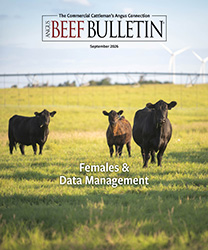
Current Angus Beef Bulletin
Our September issue focuses on the females of the herd and the records that validate them.