



All That Glitters Isn’t Gold
While facilities are a major player in effective cattle handling, stockmanship plays a critical supporting role.
February 20, 2026
We hear it in nearly all the classic Western films: A weathered cowboy sits on a good-looking horse overlooking the herd as he waxes poetic about freedom and the beauty of livestock grazing on open ground.
While few would disagree with how appealing the scene is on film, those involved in the cattle business understand what happens behind the scenes to manage and protect animals in the modern day.
Processing cattle is, without a doubt, an enlightening experience. Whether that is positive or negative depends on whether planning was done prior to cattle handling and whether the facilities are in place to complete the task at hand. After all, facilities might have to scale, switch focus or be repaired throughout their lifetime, notes Dale Moore of Cattleman’s Choice Feedyard, but the fundamentals still apply.
Where to begin
When Moore and his wife, Mary, purchased the Gage, Okla., property that would later become Cattleman’s Choice Feedyard in December 2000, it didn’t take long to figure out what didn’t work when it came to handling cattle.
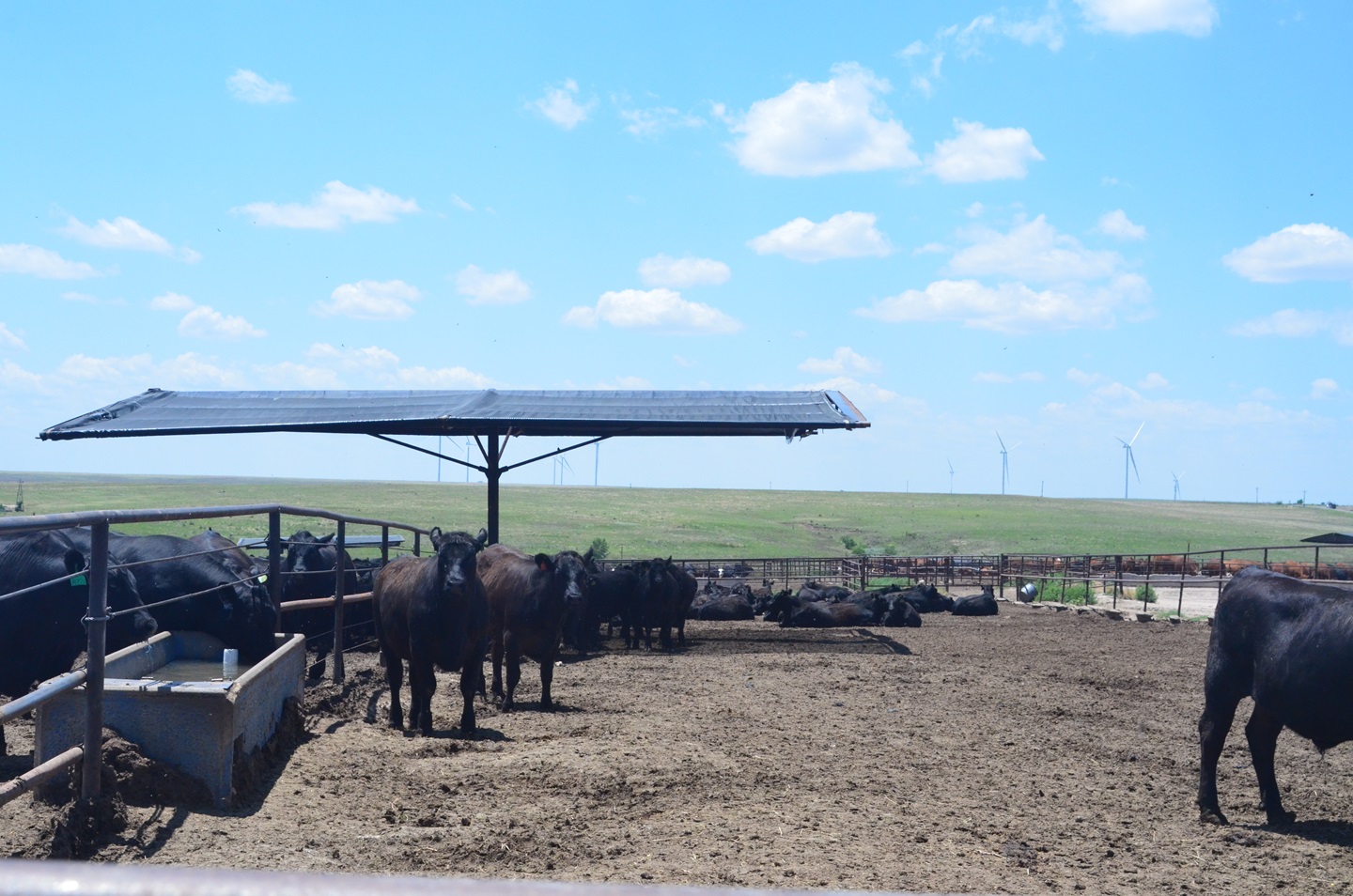

“When we came out to Cattleman’s Choice, it was a bunch of grown up kochia weed pens with 300 or 400 little calves in it,” Moore says, recalling that the first thing they checked off their list was completely tearing out the existing handling setup. “I think within the first 10 days, we spent all night long with a cutting torch and a welder. We didn’t have the money and we didn’t have the time to go find what we needed, so we built something that I felt was more cattle- and user-friendly.”
Time is a commodity often short on farm and ranch operations, but when Moore found a little, he was able to sit down and design a setup that worked better for the cattle and — eventually — better for the consumer and the rancher.
Attending an early 2000s Bud Williams cattle handling clinic in Woodward, Okla., changed the trajectory of what working cattle looks like for Dale and Mary. After striking up a rapport, Williams asked if he could swing by to see what exactly the Moores were working with.
“It’s life changing to just be in the presence of somebody like that for a week. He worked with Mary and I and all of our crew. We looked at facilities; we looked at pen designs; and, on a newspaper, [Williams] drew out his ideal processing facility,” Moore recalls. “Fifteen years later, I built that same facility. It’s been operating for probably five years now, and it’s all set up on Bud’s design of simple cattle handling and low stress.”
Cattle welfare is at the forefront of priorities for Taylor Ranch, as well. Based in Cheyenne, Okla., Taylor Ranch was founded by Jimmy Taylor’s father in the 1950s.
Facilities haven’t changed a great deal over the past several decades, but updates are made with a focus on cattle welfare and the safety of those involved with cattle handling.
“Our facilities are basically the same design as when [my father] came to the place. The difference is it was board corrals back then,” Taylor recalls. “When I was a kid, that was one of my jobs. Before we worked cattle, we had to repair lots because boards rot and, when cattle hit them, boards break.”
In the early 1980s, Taylor Ranch made the transition from wood to steel. While improvements are made here and there, the family has kept the same basic design because it just plain works — for both the Taylors and their cattle.
After all, says Moore, thinking about cattle comfort is where cattle raising and finishing begins.
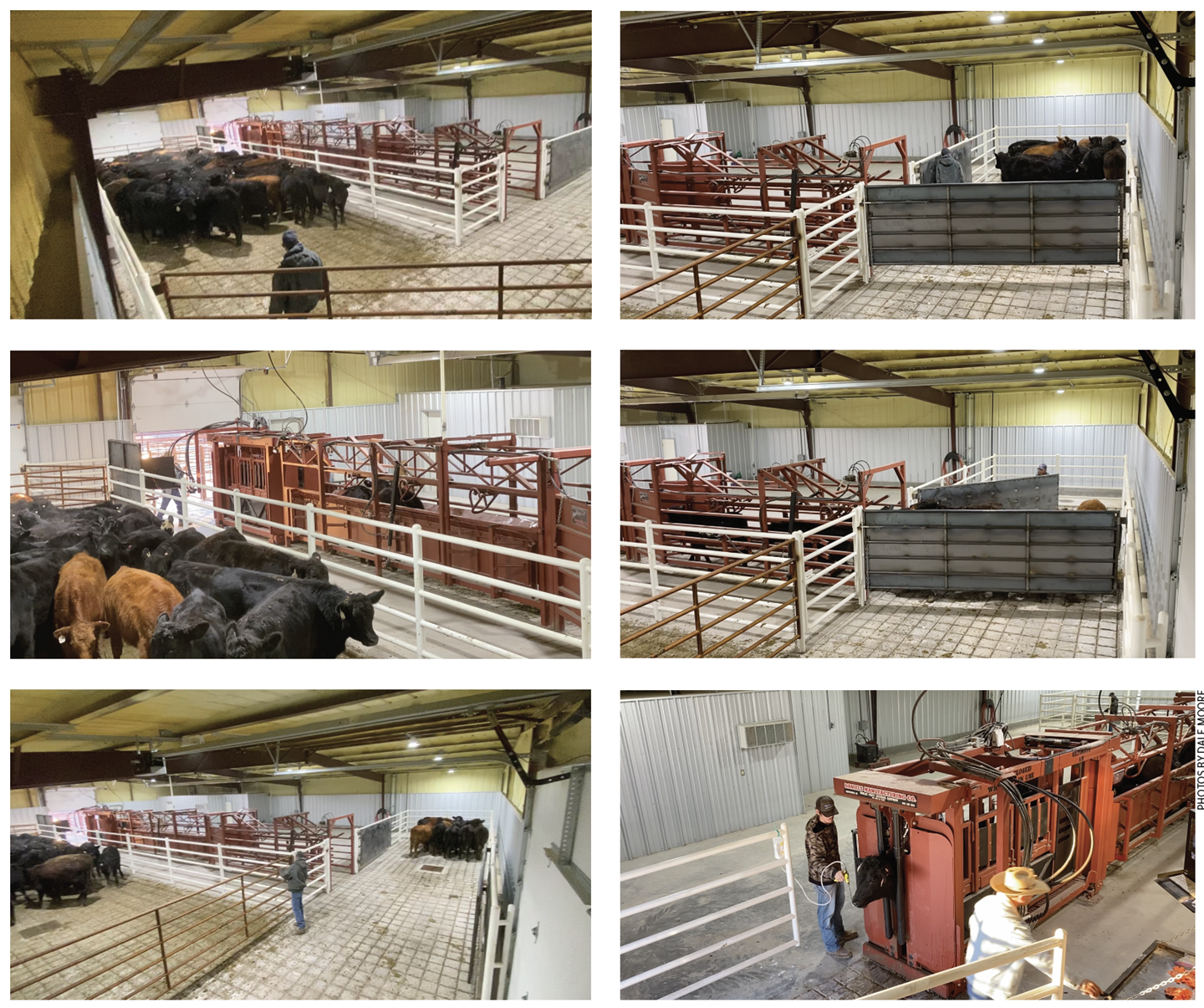
The indoor processing facility at Cattlemen’s Choice Feedyard provides a comfortable environment to process cattle rain or shine. Design input from Bud Williams assures good animal flow, minimizing stress on cattle and people.

The power of stress
What is the No. 1 driver of animal health? In Moore’s experience, not managing animal stress just makes a potentially bad situation worse.
“The first thing that comes to mind whenever somebody says stress is coccidiosis, mycoplasma, [bovine respiratory disease], going off feed, injuries ... I mean, you name it. That stress is the Number 1 factor driving the success of these animals,” Moore says.
Add the inputs associated with steers bringing $3,500 to $4,000 straight out of the feedyard to the ever-decreasing number of cattle available to put on feed, and the margin for error narrows considerably.
“We need to keep every one of them we can and get it to the consumer,” stresses Moore.
How do feeders like Moore accomplish that? Making cattle comfortable with, and in, their surroundings.
“When they get here, we make sure that they are very, very settled in. We’re not in a rush to run them through and vaccinate them and worm them, because my ranchers have followed our protocols,” he says.
When the time comes to process calves through their facility, Moore rests easy knowing that its design is cattle friendly and safe for Cattleman’s Choice employees.
The facility at Cattleman’s Choice has the ability to manage 500-600 head of cattle per day, but that doesn’t mean working those animals is a timed event, says Moore. The consideration for the animals becomes apparent very quickly.
“What makes us different than a lot of facilities is that we’re a 100% retained ownership yard. We work for ranchers. We are recording the eID (electronic identification). We are recording the ranch tag. We are recording the weight. We’re recording everything. I’m just throwing this out there, but I’m not going to be very far off. We might have five head of cattle bawl in that 500 head. It’s just amazing how the system works.”
Perhaps a complete pivot when it comes to facilities and yet a mirror image where cattle welfare is concerned, the Taylors work cattle through their pens seasonally as needed.
One of Taylor’s fondest memories working cattle as a child involved rounding up cattle to bring them to the central handling pens that still serve Taylor Ranch.
“I was riding with John Wayne, and we were really getting Western,” recalls Taylor, admitting that despite the fun, savvy older cows made the last bit of the task much harder. “The toughest part of the roundup was the last quarter mile, because those old cows knew they were going to a lot at that point. We would have to really work to get them there.”
Thinking through their system, Taylor moved four large troughs into their existing pens and began lightly feeding cows in those troughs. After two or three times, that became the easiest part of the roundup, he says. Cows knew they were going in there and that there would be cake.
“That changed the whole thing, but working cattle is like that. If you make it the cow’s idea, it’s a lot better,” Taylor says. “I’m always looking at how to work with the cattle where it’s best for the cattle.”
Learning the cowboy way
While the working system plays a huge role at Cattlemen’s Choice, Moore says keeping cattle low stress comes down to plain good stockmanship.
When asked whether he has any nonnegotiable handling rules, Moore acknowledges he has a whole list. At his yard, employees learn by example and shadow a veteran feedyard employee before ever being turned loose on their own.
“I don’t know that you can ever spend too much time training, but we probably spend more time training than a lot of places just because these animals can’t take care of themselves. They depend on us to take care of them,” Moore explains, noting ranchers take care of that animal for 150 to 200 days. “Then they turn them over to us. Facilities are a huge part of it, but 100% honest, the stockmanship side of it is a bigger part of it for the animal’s well-being than the facilities are.”
Over at the Taylors’ place, the notion of understanding their cattle, as well as low-stress cattle handling, is alive and well.
Something as simple as moving cattle from a pen up an alleyway is an opportunity to observe cattle behavior and alter handling methods to work with animals instead of against them.
“When we’ve got a lane full that we’re getting ready to run through the chute, it gets pretty packed in there,” Taylor says, explaining that the old way of doing things was walking down the lane against the animals and letting cattle move around you. “If they’re pregnant, they all bunch up at the far end and put pressure on themselves. We’ll actually do a little extra work when we get them pushed in there. We’ll step out of that lane, go around and push animals from the bottom of the lane.”
In most cases, cattle take the path of least resistance and flow smoothly without a handler in the way.
Speaking of people, Taylor suggests making sure cattlemen have enough hands to get the job done efficiently. Always try to look ahead and have enough people there to do the job, he cautions, but always move easy. You don’t want to excite the animals because when a cow is relaxed, everything seems to flow better, in his experience.
If there was one piece of advice Taylor could share with new cattlemen looking to decrease the amount of stress their cattle experience?
“One thing — if I had to pick a couple here to tell somebody that was helping me — is to watch the cattle,” Taylor imparts. “They’ll tell you what you need to do.”
Facilities and New World screwworm
While the immediate concern for U.S. beef producers seems to have steadied a bit when it comes to New World screwworm (NWS), producers shouldn’t rest easy just yet.
Cool weather and a Herculean effort by animal health entities have given cattlemen on this side of the border a little bit of breathing room, but experts say now could be the ideal time to plan cattle handling systems should close monitoring or frequent treatment be needed.
“One of my biggest concerns, frankly, with New World screwworm and its threat here in the U.S. is access to facilities to be able to treat,” says Rosslyn Biggs, assistant professor with Oklahoma State University’s School of Veterinary Medicine. “[Facilities] have got to make sense. At a very minimum, we’ve got to be able to get those animals caught and get them handled based on what we could potentially face.”
What we face should NWS make it to the United States isn’t very pretty.
“This is a fly that when it attacks, the animals will die within a week or two if no treatment is done. So every animal with a wound has to be treated,” says Sonja Swiger, entomologist with Texas A&M AgriLife Extension. “Your hope is to find it before the fly does and get that wound cared for. If you don’t, then you’re having to do posttreatment and get all those larvae removed.”
Swiger cautions producers that having protocols in place for gathering animals, treating screwworm infestations and wound care are important, but that killing all the larvae is a must. Any living larva is another generation, she says, so the problem doesn’t go away if [larvae] continue to live.
Biggs’ other major worry? Given the amount of time that has passed since previous incidences of NWS, the vast majority of producers don’t remember what dealing with such a menace daily was like.
Preparation and education remain critical to handling the potential threats of NWS, she says.
Biggs suggests looping your veterinarian in when it comes to planning out new facilities. Not only does a new set of eyes offer a unique perspective, but facility consults allow new producers to draw on the experience of their veterinarian when it comes to must-haves and things to avoid.
Facilities don’t necessarily need to be fancy, Biggs notes, but they do need to be safe and functional for both laborers and livestock.
“If there was a time to invest in facilities, it’s probably now,” she says, while noting that facilities could improve your experience across the board. “What you may find is that handling facilities will improve your cattle experience if you get good ones, right? I don’t know how many times we’ve been just dealing with something and — once we finally make the investment — it’s like, ‘Why did we wait so long to do that?’”
New products designed to control NWS are in development and receiving approvals, buoying the number of products available to treat NWS should it cross the border. All the same, Swiger hopes the pest can be stopped before it gains traction near the U.S. border.
“We really won’t want it to come back at all. Everyone has had the luxury of [farming] for the last 50 years without having to think about [NWS] and the impact it has on those that deal with it. Yes, it is something you can control … but, it’s so much nicer to not have to worry about it than have to deal with it.”
Digital EXTRAs
Managing the Effects of Wildlife on Livestock with Rosslyn Biggs
The Buzz on Flies of Importance with Sonja Swiger
Topics: Animal Handling , Equipment / Facilities , Management
Publication: Angus Beef Bulletin
Issue: March 2026
Related Content


Current Angus Beef Bulletin
Our September issue focuses on the females of the herd and the records that validate them.