


Policy Matters
A multitude of factors play into today’s beef prices.
February 16, 2026
During his 2024 campaign, President Donald Trump regularly pledged to make America affordable again by bringing down the price of goods. Groceries were repeatedly mentioned, along with other stressors, such as energy, housing and cars.
In fall 2025, beef prices became the focus.
On Sept. 21, tucked into a release about New World screwworm (NWS), the administration teased it would soon release a significant plan to help rebuild the American cattle supply, incentivizing our great ranchers, and driving a full-scale revitalization of the American beef industry.
Tight supplies
As of Jan. 1, 2025, U.S. cattle supplies were at their lowest in 74 years at 86.7 million head. Numerous factors, including persistent drought, record costs and profitability challenges led to this point.
Tight supplies have also been affected by reduced feeder-cattle imports. Mexico is a major supplier of feeder cattle to be finished in U.S. feedyards. Typically, around 1.15 million Mexican feeder cattle enter the United States each year. However, concern about the New World screwworm moving further north within Mexico has caused the United States to close its borders to live animal imports.
The initial closure occurred in November 2024. While the border was reopened in February 2025, it was closed again in May. A second attempt to reopen in July was short-lived, and the border has been closed since. By the end of November 2025, the United States had imported only 214,394 feeder cattle from Mexico for the year.
Rumors spread throughout cattle circles about what an incentive to rebuild the herd could look like, including speculation about payments to retain heifers. This was squashed by U.S. Secretary of Agriculture Brooke Rollins at the Agri-Pulse Ag Outlook Forum Sept. 25. She clearly stated there were no current plans to offer any payment to beef producers. Instead, Rollins highlighted that an upcoming announcement was expected to focus on opening access to working lands and expanding risk-mitigation tools.
President highlights price
Before that announcement could take place, the conversation shifted to a larger stage with President Trump telling reporters, “We are working on beef, and I think we have a deal on beef that’s going to bring the price down. That would be the one product that we would say is a little bit higher than we want it … and that’s going to be coming down pretty soon, too. We did something; we worked our magic.”
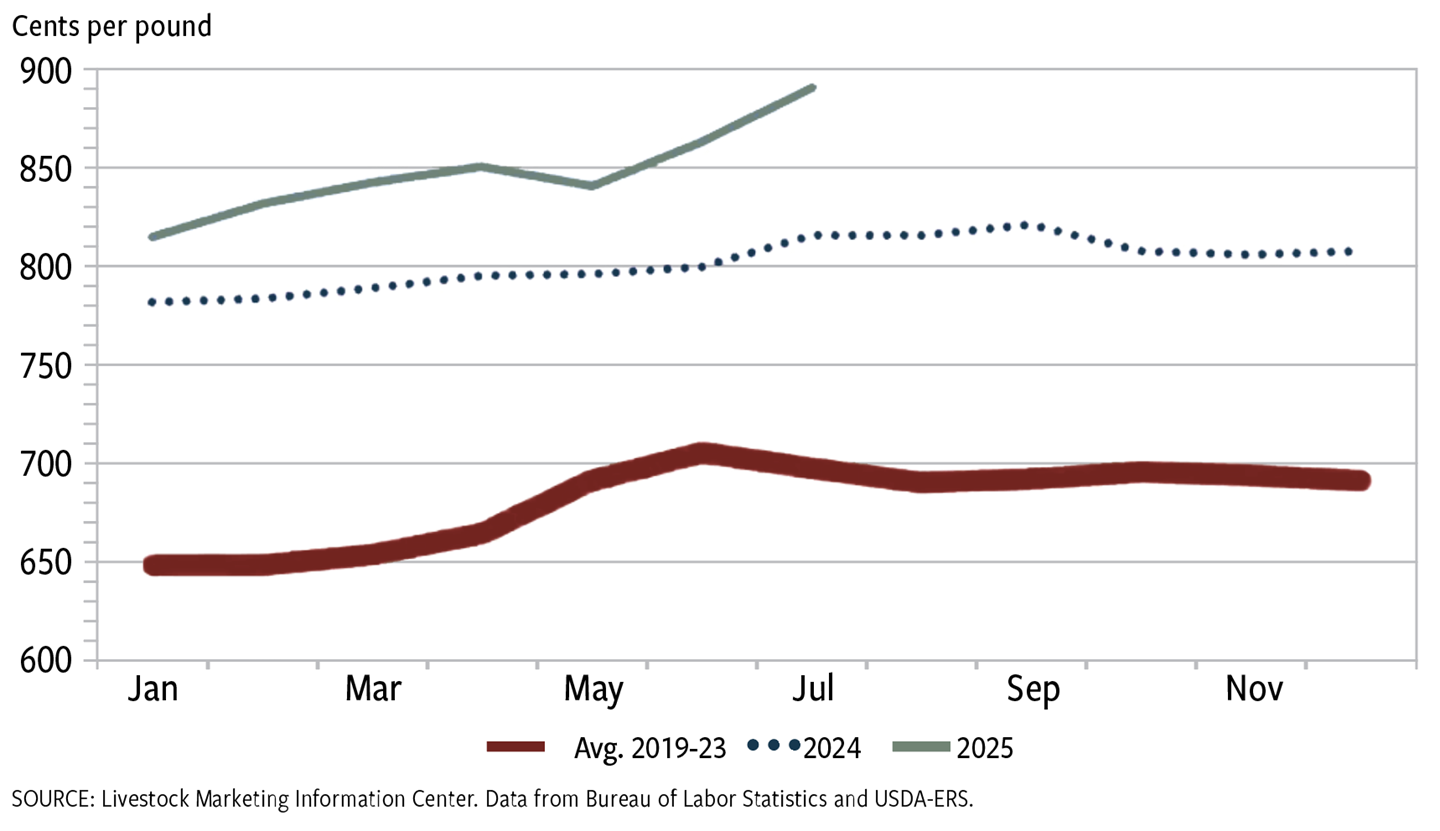
Fig. 1: Retail beef price, all fresh, monthly, ¢/lb.

But just how high are beef prices? USDA data reveal retail beef prices were 13.9% higher in August 2025 than in August 2024. This is outpacing overall food prices, which were 3.2% higher. During the same period, the all-items Consumer Price Index (CPI), a measure of economy-wide inflation, increased 2.9%.
Tight supplies help explain this increase; however, robust prices don’t occur without demand strength.
“It is misleading to only look at the supply side of any market, as both supply and demand have a role in price determination,” said Kansas State University ag economics professor Glynn Tonsor, who tracks data monthly with the Meat Demand Monitor. “Fortunately for the beef industry, consumer beef demand has been robust, leading to much higher prices (retail beef, wholesale beef and cattle prices from seedstock to feedlot) than would otherwise be the case. Simply put, we would not have the current price levels observed absent consumer demand support.”
Research from the University of Arkansas shows beef demand is relatively price inelastic. When beef prices go up, the drop in the amount people buy is usually much smaller than the price increase. As a result, total consumer spending on beef often rises, even when consumers purchase slightly less. Some analysts point to this as payoff for the beef industry focus on increasing beef quality and consistency since a low water mark in demand in the late 1990s.
Imports take center stage
The President’s comment about beef prices being too high sparked significant industry concern, especially coming off meetings he had with Argentinian President Javier Milei. Speculations were verified just days later.
“We would buy some beef from Argentina,” President Trump told reporters on Sunday, Oct. 19, aboard Air Force One during a flight from Florida to Washington. “If we do that, that will bring our beef prices down.”
Reactions from cattle producers were negative and swift. The President took notice.
 On Oct. 22, President Trump posted on Truth Social: “The Cattle Ranchers, who I love, don’t understand that the only reason they are doing so well, for the first time in decades, is because I put Tariffs on cattle coming into the United States, including a 50% Tariff on Brazil. If it weren’t for me, they would be doing just as they’ve done for the past 20 years — Terrible! It would be nice if they would understand that, but they also have to get their prices down, because the consumer is a very big factor in my thinking, also!”
He followed with a second post: “In addition to everything else, Tariffs on other Countries SAVED our Cattle Ranchers!”
Producers pushed back through social media, pointing to high input costs and a low U.S. cattle supply. Many expressed a sentiment that the profitability was a welcome offset to tougher years for cattle producers. Some also encouraged additional context. According to CattleFax data, it takes the average worker 13-14 minutes to earn enough to buy a pound of ground beef — a metric that has stayed fairly stable for the last decade (see “No Apologies” ). While on the upper end of the range, this is similar to the time needed around the 2014 cattle cycle highs.
Organizations lined up to oppose the Argentinian imports, including the National Cattlemen’s Beef Association (NCBA), U.S. Cattlemen’s Association (USCA), and Ranchers Cattlemen Action Legal Fund United Stockgrowers of America (R-CALF).
“The National Cattlemen’s Beef Association and its members cannot stand behind the President while he undercuts the future of family farmers and ranchers by importing Argentinian beef in an attempt to influence prices,” said NCBA CEO Colin Woodall. “It is imperative that President Trump and Secretary of Agriculture Brooke Rollins let the cattle markets work.”
Despite the pushback, increasing beef imports from Argentina is moving forward.
For years, the United States has had a beef import quota for Argentina of 20,000 metric tons. This beef is imported with minimal tariffs. After that amount, additional imports are subject to a higher 26.4% tariff. The Trump administration is planning to quadruple the quota to allow 80,000 tons to enter with the minimal tariff.
Economists point out that Argentina is not a dominant source of U.S. beef imports. According to CattleFax, even if the quadrupled tariff rate quota import amount was met, this would increase per capita beef supply by just ¼ pound a person and likely not make a significant difference in price.
However, other markets, like Brazil, do have the potential for the volume of beef imports that could make a meaningful difference.
In 2024, Brazil ranked third in U.S. beef imports, trailing only Australia and Canada, and accounting for 15% of U.S. imports. Alternatively, Argentina was the eighth-largest beef and veal importer, accounting for just more than 2% of 2024 U.S. imports.
In April 2025, the Trump administration imposed an additional 10% duty on beef shipments from Brazil above the annual quota, raising the total tariff to 36.4%. In July, the administration issued an executive order implementing an additional 40% tariff on Brazilian beef, leading to a much higher rate of 76.4%.
This effectively halted beef trade between Brazil and the United States. However, in November the administration reversed the additional 10% and 40% tariffs. Now back at the 26.4% tariff level, imports from Brazil are expected to pick back up.
Competition concerns
In addition to the import conversation, competition in the beef industry has also been brought to the spotlight.
On Nov. 7, President Trump posted on Truth Social: “While Cattle Prices have dropped substantially, the price of Boxed Beef has gone up — Therefore, you know that something is “fishy.” We will get to the bottom of it very quickly. If there is criminality, those people responsible will pay a steep price!”
The post was paired with an announcement the Department of Justice (DOJ) will investigate meatpacking companies. The announcement came following a White House meeting with senators from beef-producing states.
Investigations are nothing new in this space. In the first Trump presidency, the DOJ investigated the spread between live-cattle and boxed-beef prices. During COVID, packer margins were significant, while cattle producers suffered. This investigation closed quietly.
Leverage in the marketplace has since shifted. Tyson’s beef business suffered adjusted losses of $426 million in the 12 months ended on Sept. 27. On Nov. 21, Tyson announced the closure of a major beef plant in Lexington, Neb. At the same time, Tyson said it will reduce operations at a beef plant in Amarillo, Texas, to a single, full-capacity shift.
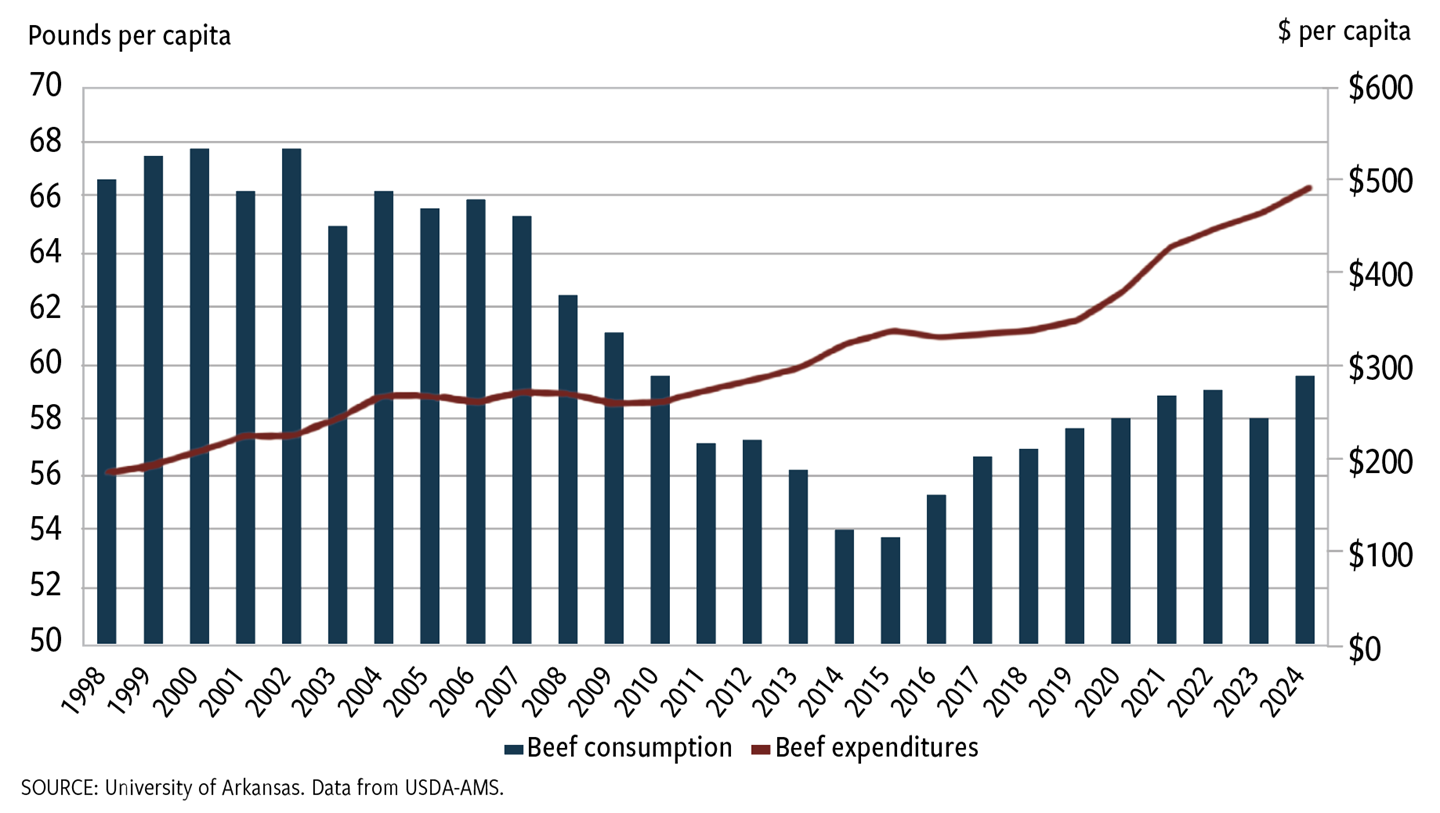
Fig. 2: Annual U.S. beef consumption and expenditures, per capita, retail weight

This is in contrast to USDA’s “Plan to Fortify the American Beef Industry,” unveiled Oct. 22, which seeks to invest in more meat-processing capacity by small and local processors. The plan also expands grazing access to federal lands, improves disaster and drought programs, and increases access to loans and risk-management tools. In addition, the plan includes changes to the voluntary “Product of USA” label. Starting Jan. 1, this label will be permitted only if the animals were born, raised, slaughtered and processed in the United States.
Almost continual shifts in tariffs, federal policy and market dynamics make the future difficult to predict. The cattle industry has shifted to a mode of expecting the unexpected, as it seems unlikely that the intense focus on the cost of beef will subside anytime soon.
Editor’s note: Chelsea Good is an advocate, strategist and attorney with deep roots in the cattle industry and a proven record of shaping ag policy at the state and federal levels. She founded Good & Associates to help ag clients navigate complex issues, strengthen stakeholder relationships and turn challenges into strategic wins. Prior to launching the firm, she served as vice president of government and industry affairs and legal at the Livestock Marketing Association (LMA), where she successfully led policy efforts resulting in major legislative wins. She is also a former Angus Journal® intern.
Related Content


Current Angus Beef Bulletin
Our September issue focuses on the females of the herd and the records that validate them.