



In the Cattle Markets
Last fall highlighted the cost of price risk, and 2026 could be no different.
March 4, 2026


by James Mitchell, University of Arkansas
In late August 2025, a producer in Arkansas looking to sell 550-pound (lb.) steers in November could have purchased Livestock Risk Protection (LRP) coverage with a coverage price of $394 per hundredweight (cwt.) at a 100% coverage level. The policy would have cost the producer $12 per cwt. in LRP premiums.
During the 13-week coverage period ending Nov. 24, 2025, the actual ending value for the LRP policy was $365 per cwt. That would have triggered an indemnity of $29 per cwt. After accounting for the premium, the net return from the policy would have been $17 per cwt. On a 550-lb. steer, that would translate into $94 per head, or $8,500 per load.
LRP is not about increasing the odds of an indemnity payment or maximizing profit. It establishes a price floor and reduces downside risk.
In Arkansas, the cash price for a 550-lb. steer without LRP was $378 per cwt. for the week ending Nov. 21. With LRP, the realized price would have been $378 + $17 = $395 per cwt.
Fall 2025 was a reminder of how sensitive the cattle market is to news and surprises. A look at the November 2025 Feeder Cattle futures contract and weekly cash prices in Arkansas highlight just how quickly prices can move (see Fig. 1).
The scenario that played out last fall occurred in a historically high price environment. LRP and option premiums are not cheap, because cattle prices are high. This reality has led some to question whether price risk management is “worth it” at today’s price levels. A $20- to $30-per-cwt. decline is the same dollar loss per head regardless of the price level. But when cattle are worth more per head, there are simply more total dollars at risk in the operation.
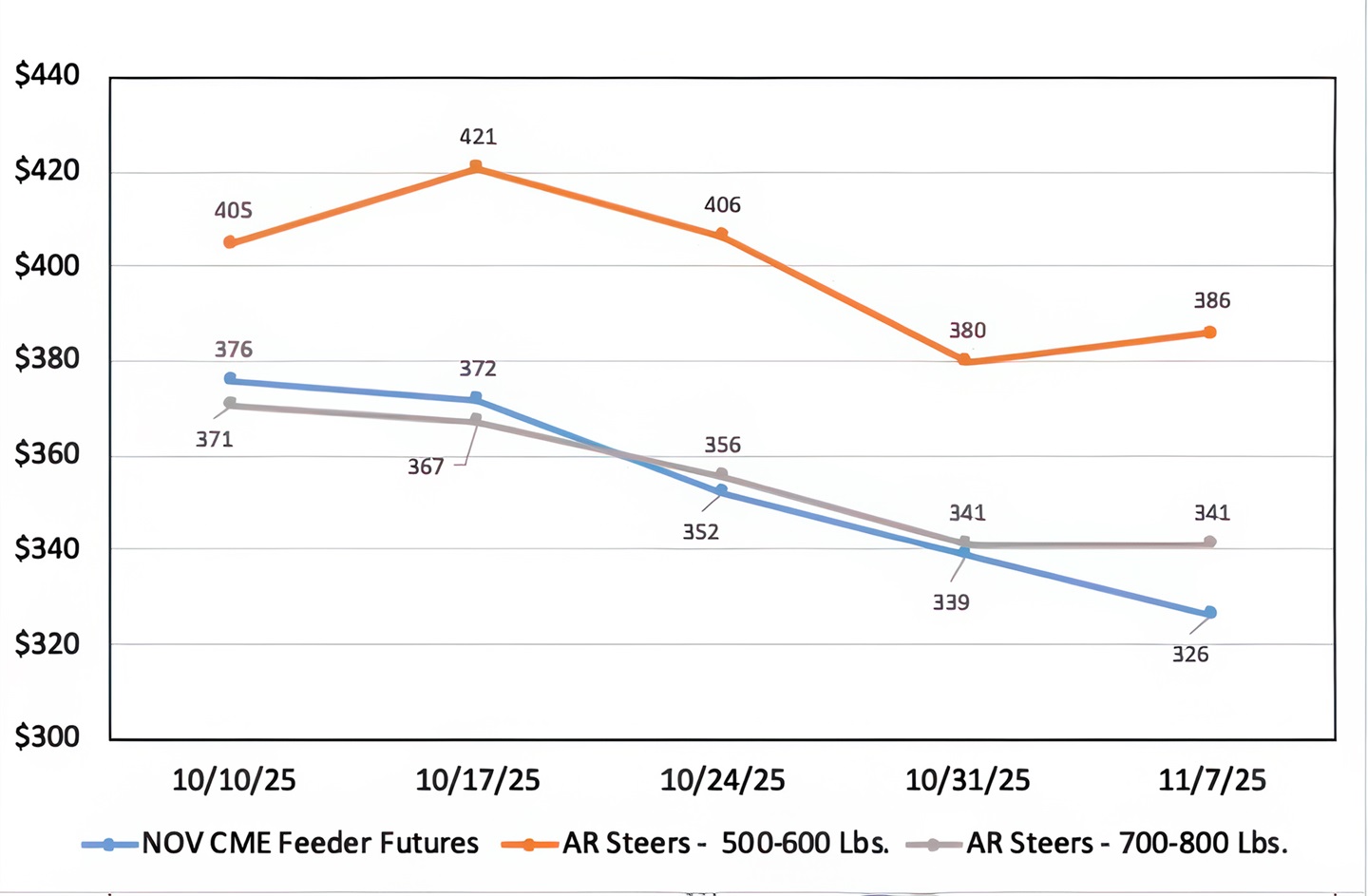
Fig. 1: Arkansas weekly cash prices and November CME feeder cattle futures prices

Given that the cattle inventory cycle is now positioned for a slow rebuilding phase, there is a reasonable expectation that the market will remain supported for the next few years. But as fall 2025 showed us, cattle markets are not immune to volatility. While some producers may be able to absorb a $20- to $30-per-cwt. swing in price without much consequence, many do not have that flexibility due to debt obligations, recent herd expansion, or tighter operating margins. For both producers, the cost of LRP is better framed as an operating expense, budgeted on a per cow basis.
LRP is not about increasing the odds of an indemnity payment or maximizing profit. It establishes a price floor and reduces downside risk.
Admittedly, the example in this article perfectly times the purchase of LRP with the fall 2025 downturn in cattle prices. Buying LRP earlier last year would not have triggered an indemnity because the market rallied leading up to the fall. A common complaint today is that it can feel like spending money unnecessarily when the market continues to rise.
In general, price risk management may make you feel like you are paying for protection you don’t need when there’s upside in the market. However, using LRP to establish a price floor that covers breakeven or provides a desired return on costs is a more reliable approach than trying to time the market.
Editor’s note: James Mitchell is assistant professor and extension economist within the Department of Agricultural Economics & Agribusiness at the University of Arkansas. LRP coverage prices, rates and actual ending values are available at https://public.rma.usda.gov/livestockreports/LRPReport.
Angus Beef Bulletin EXTRA, Vol. 18, No. 3-A
Topics: Feeder-Calf Marketing Guide , Marketing , Management , Genetics
Publication: Angus Beef Bulletin
Related Content



Current Angus Beef Bulletin
Our September issue focuses on the females of the herd and the records that validate them.