



Reminders on Livestock Care During Wildfire Season
OSU Extension offers tips for handling animals before a fire and caring for them afterward.
March 3, 2026
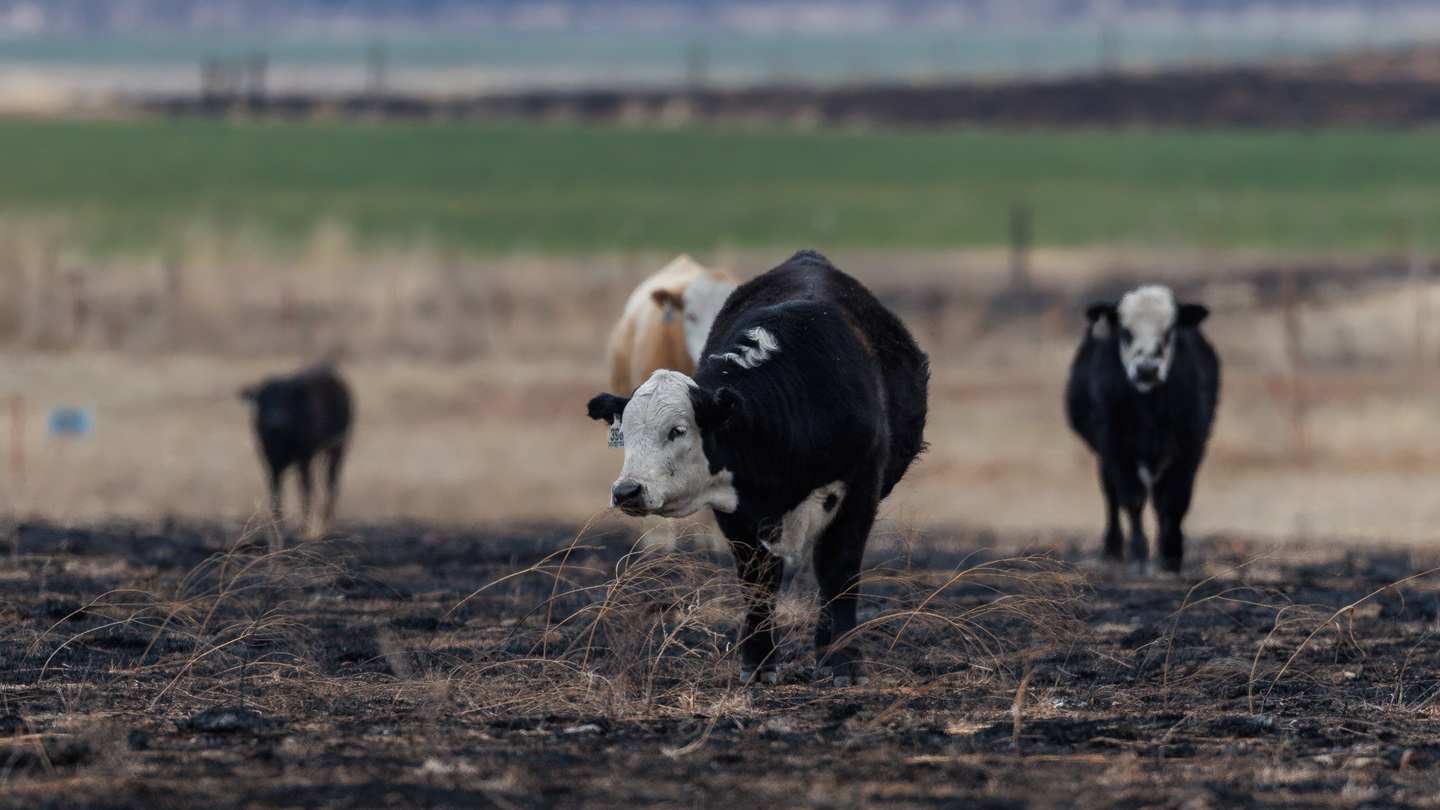
Enhanced monitoring of surviving livestock after a wildfire is crucial. [Photo by Mitchell Alcala, OSU Agriculture.]

by Dean Ruhl, Oklahoma State University
As Oklahomans and their nearby neighbors in Kansas endure wildfire season, Oklahoma State University (OSU) Extension specialists offer tips to keep your livestock safe, as well as help with recovery efforts.
Livestock welfare after a fire
Monitoring surviving animals is crucial in the days after a wildfire, says Rosslyn Biggs, OSU Extension beef cattle specialist.
“We need to be thinking about long-term repercussions,” she says. “Thermal injuries, burns can be a big issue on these animals. We also need to be thinking about smoke inhalation and the systems that those affect.”
Enhanced monitoring of the surviving animals is crucial after a wildfire, Biggs explains. In addition to nutrition, hydration is key. Cows that are in the later stages of pregnancy need to be thought about, too. Consider their capacity to care for either calves on the ground or those they will soon birth.
Post-wildfire evaluation can lead to difficult decisions, too.
“It’s very important in these disaster-type situations that animal welfare needs to be our first consideration,” Biggs says. “How are those animals that have survived going to be able to recover from those injuries? In many cases, unfortunately, euthanasia may be the most humane decision that we have to make.”
Protecting horses during wildfires
Have your horses loaded and ready to go before you see a wildfire reach your property, says Kris Hiney, OSU Extension equine specialist.
“So many animals, when fire is coming, it causes panic,” Hiney says. “They may be harder to handle, so if trouble is coming, have the horses already up in a small lot where you can catch them. In a burning building, horses won’t want to leave, but now we’re talking about a threat to human safety as well.”
Horses will often be reluctant to leave an environment they deem safe, Hiney says. Keep the horses together and avoid isolating one horse at a time, as this could cause further panic.
“The calmer the handler can be, the better the horses will act,” Hiney says.
Preparation is also key. Maintaining your property, like mowing fencelines and creating fire breaks, is important. Be aware that fire structures, such as hay storage, can be extremely dangerous for animals to be near. Have photographs and records of all your horses, Hiney says.
If smoke is high in the air, even if not directly where fire is affecting your land, respiratory health in horses is important. Hiney recommends not working the horses when the smoke particulate matter is high.
Emergency cattle nutrition
Wildfires can ravage forage, requiring producers to pivot in the aftermath.
There are several strategies to minimize weight loss until hay can be secured. One option is to provide a commercial “creep feed” product for four to five days. Commercial creep feeds will generally contain 12%-14% protein and are an easily accessible option, with this feed bagged and ready to ship immediately.
The feeding rate is equivalent to 8 pounds (lb.) of feed per day, assuming cows weigh 1,200 lb. If hay is more abundant, 15 lb. of grass hay fed with 5 lb. of a 28%-32% range cube can maintain a 1,200-lb. cow in the last trimester of pregnancy.
Mineral supplements with a high calcium level are essential to offset the high phosphorus levels in concentrate feeds. Work with your local OSU Extension educator to ensure a well-balanced diet for your cattle in limit-feeding scenarios.
The priority is to meet nutritional needs while stretching hay supplies.
Documenting losses
After a wildfire, documenting losses will be crucial for producers. Review your existing records and then create a line of documentation on a day-to-day basis after a disaster.
“Having documentation becomes very important from a financial aspect,” Biggs says. “It can be as simple as, if we have losses, documenting those with photographic evidence. Most people can use their cellphones to take pictures that can be timestamped. For many emergency-type programs, it’s going to be necessary to have verifiable records.”
Carcass disposal
Burial will be the best option for disposing of livestock carcasses, says Doug Hamilton, OSU Extension water management specialist.
“You need to be in a high spot,” Hamilton says. “You need to be well above a flood plain. You’re going to have to dig a hole 4 to 6 feet deep and be at least 2 feet above where the water table may rise.”
It is also important to keep burial sites at least 300 feet away from water sources.
The state of Oklahoma has five methods for disposing of livestock: landfilling, rendering, incineration, composting and burial. Finding a landfill to take a dead animal will be difficult, even in an emergency. Rendering will be hard if the animal has been dead for several days and incineration requires expensive and specific equipment.
Composting is viable, but it will require wood shavings or sawdust and management. An advantage of composting is that once you’ve completed it, the land site will be viable for use again.
If you are affected by the wildfires and have agricultural, livestock care or forage questions — or wish to donate or receive hay — contact OSU Extension by calling 405-780-4569 or emailing disastersupport@okstate.edu.
Editor’s note: This article is provided by Dean Ruhl, communications and media relations specialist for Oklahoma State University.
Angus Beef Bulletin EXTRA, Vol. 18, No. 3-A
Topics: Animal Handling , Health , Management
Publication: Angus Beef Bulletin
Related Content


Current Angus Beef Bulletin
Our September issue focuses on the females of the herd and the records that validate them.