



Beyond the Feedbunk
OSU researchers redefine how producers understand cattle stress.
January 6, 2026
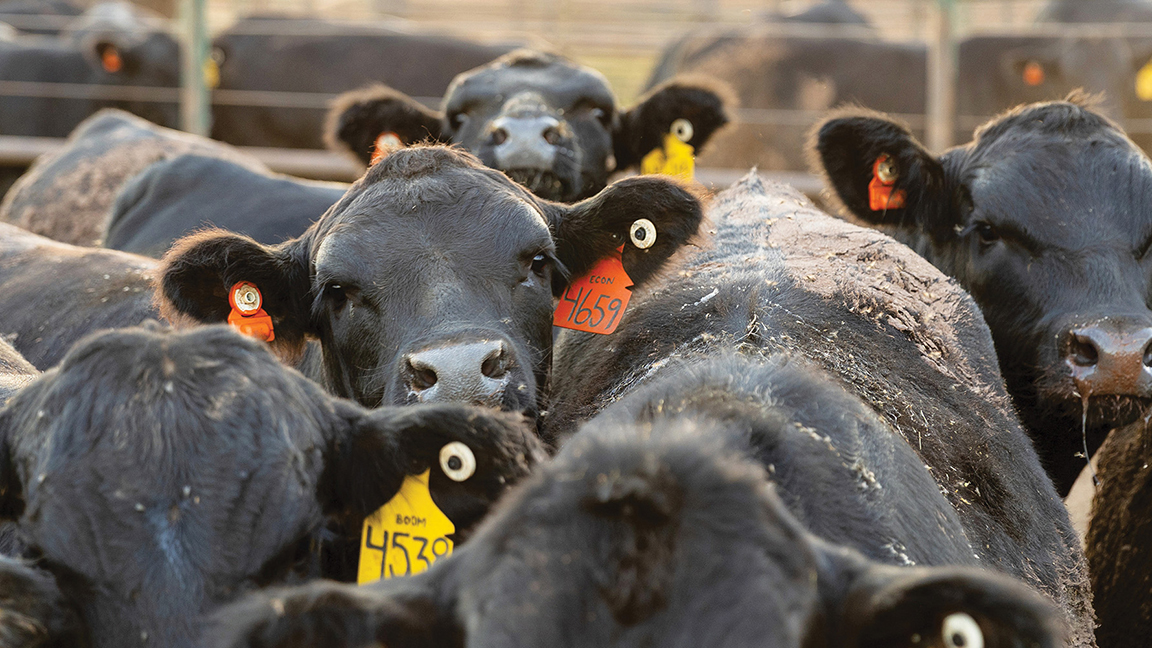
Cattle in research pens are monitored daily as part of a multiyear study on stress and well-being conducted by researchers in Oklahoma State University’s Department of Animal and Food Sciences. [Photo by Allison McNamara.]

by Allison McNamara, Oklahoma State University
Hidden stressors, from transportation to temperature swings, can affect animal health, meat quality and a producer’s bottom line, says Oklahoma State University’s (OSU’s) David Lalman. Understanding what causes stress and how to manage it is the focus of new research at the university.
Researchers are tackling the issue head-on through a four-year, $1 million project funded by the USDA Agriculture and Food Research Initiative. The multidisciplinary research effort uses artificial intelligence (AI), sensor technology and producer perspectives to better understand how cattle respond to stress and what can be done to manage it.
The project brings together animal and meat scientists, sociologists, engineers and computer scientists. Their goal is to identify cattle at risk of stress and develop practical tools producers can use to reduce its effects, says Ranjith Ramanathan, animal and food sciences professor.
One of the major challenges producers often face is unexplained losses during the finishing phase of production, Lalman says.
“The industry has seen a gradual increase in unexplained death loss in finishing cattle,” he explains. “Some believe this is related to how we have selected for faster and more efficient growth. This kind of growth requires so much energy that may come at the expense of immune function and overall resilience.”
Stress not only threatens animal health but can also affect meat quality. In packing plants, carcasses from highly stressed animals are often discounted. Ramanathan is researching the biological changes that occur when cattle experience stress.
“The industry has seen a gradual increase in unexplained death loss in finishing cattle.” — David Lalman
“We are collecting samples from cattle that have experienced sudden death to analyze proteins and metabolites,” Ramanathan says. “This helps [us] understand what is happening inside the animal at the molecular level.”
These samples provide insight into the biological pathways involved in stress, Ramanathan says, but the research team is also using new technology to monitor cattle behavior in real time. Sensors and video systems track indicators such as heart rate, steps and body temperature.
“The goal is to see if we can develop tools to identify at-risk animals early on,” Ramanathan says. “These tools could make a big difference for producers in the future.”
By combining molecular data with sensor-based information, the research team is building predictive models using AI, Ramanathan explains. The models could help producers spot cattle predisposed to stress before major losses can occur.
“The goal is to see if we can develop tools to identify at-risk animals early on.” — Ranjith Ramanathan
Still, even the most advanced technology has to be realistic for on-farm use. That is why the project also includes a social science component, Ramanathan says.
The team is collaborating with producers to understand how they view new technologies and what factors influence adoption, explains Ashley Railey, sociology assistant professor.
“Producers are very practical in their decision making,” Railey says. “They want to know if the technology will really help them make better decisions, if it is affordable and if it is something they can realistically implement in their operations.”
The cost of adoption is often the most significant factor, she says. Even when research demonstrates benefits, producers want to know the return on investment before they commit.
“Producers need to be confident that the technology will pay off in the long run,” Railey says. “Understanding those perspectives is critical to making sure our research can be applied beyond the lab.”
The team’s multidisciplinary approach reflects the complexity of the problem. Cattle stress is not caused by a single event, but by a series of environmental, genetic and management factors that build over time. Addressing it requires perspectives from across the spectrum of animal health, science and sociology, Lalman says.
Collaboration among different fields has been one of the most valuable parts of the project so far, Ramanathan adds.
“This work requires multiple perspectives,” he says. “By working together across disciplines, we can connect what is happening at the cellular level with what producers see every day in their herds.”
The research is ongoing, but early findings suggest genetics play a role in how cattle respond to stress. Monitoring and sampling have also shown potential for identifying early warning signs before visible symptoms appear, he adds.
For producers, the implications could be significant. Improved ability to manage stress would not only help animal well-being but also reduce financial losses linked to discounted carcasses and unexplained death loss, Ramanathan says.
The beef industry has always been resilient in the face of challenges, and this project is one more step toward ensuring long-term sustainability, Lalman says.
“Understanding stress is not just about avoiding losses,” Lalman says. “It is about giving producers the tools they need to raise healthy cattle in an efficient, sustainable way.”
The ultimate test of success will be whether producers find the results practical, Railey says.
“Technology has to make sense on the ground,” Railey says. “Our job is to ensure producers’ perspectives are included so the tools we develop can actually be used where it matters.”
“The goal is not just to study stress for the sake of science,” Ramanathan says. “The goal is to find solutions that help producers, improve animal welfare and strengthen the beef industry as a whole.”
Editor’s note: This story was written by OSU student Allison McNamara for the Cowboy Journal, a magazine produced by ag communications seniors in their final semester of college.
Angus Beef Bulletin EXTRA, Vol. 18, No. 1-A
Topics: Feeder-Calf Marketing Guide , Health , Industry News , Management , News
Publication: Angus Beef Bulletin
Related Content


Current Angus Beef Bulletin
Our September issue focuses on the females of the herd and the records that validate them.