


Brushing Away Bovine Stress
K-State collaboration results in cattle stress relief product that could increase reproduction rates.
June 18, 2025

by Bret Lanz, Kansas State University
A new product that reduces animal stress could be a key to increasing artificial insemination (AI) rates in cattle. Kansas State University’s (K-State) Technology Development Institute (TDI) collaborated with faculty in the College of Agriculture to design, produce and test the product.
Assistant Professor Nicholas Wege Dias and Professor Sandy Johnson, both in K-State’s animal science and industry department, specialize in beef cattle reproduction and have been involved in several projects designed to improve the fertility of the animal. Their initial studies indicated that acclimating the animals to their surroundings during the AI process reduced animal stress and increased reproduction by up to 10%.
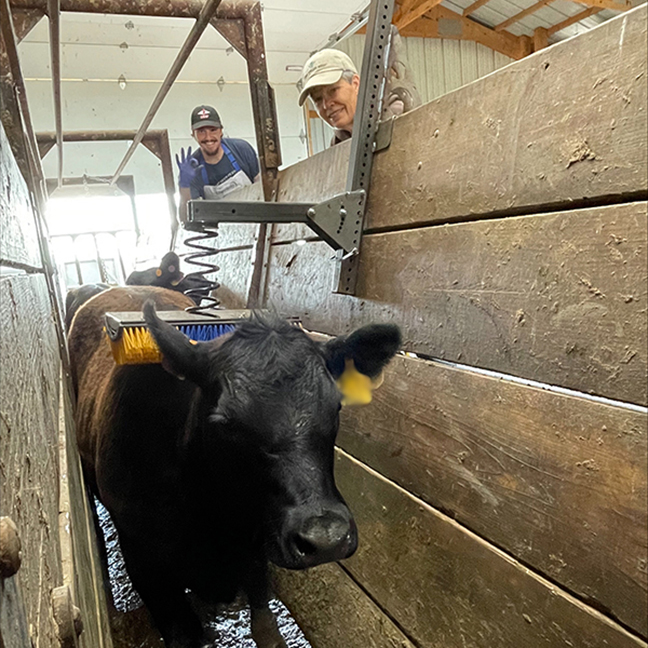
Nicholas Wege Dias, back, and Sandy Johnson test the new cattle stress reduction tool produced by the Technology Development Institute. [Photo courtesy K-State University.]

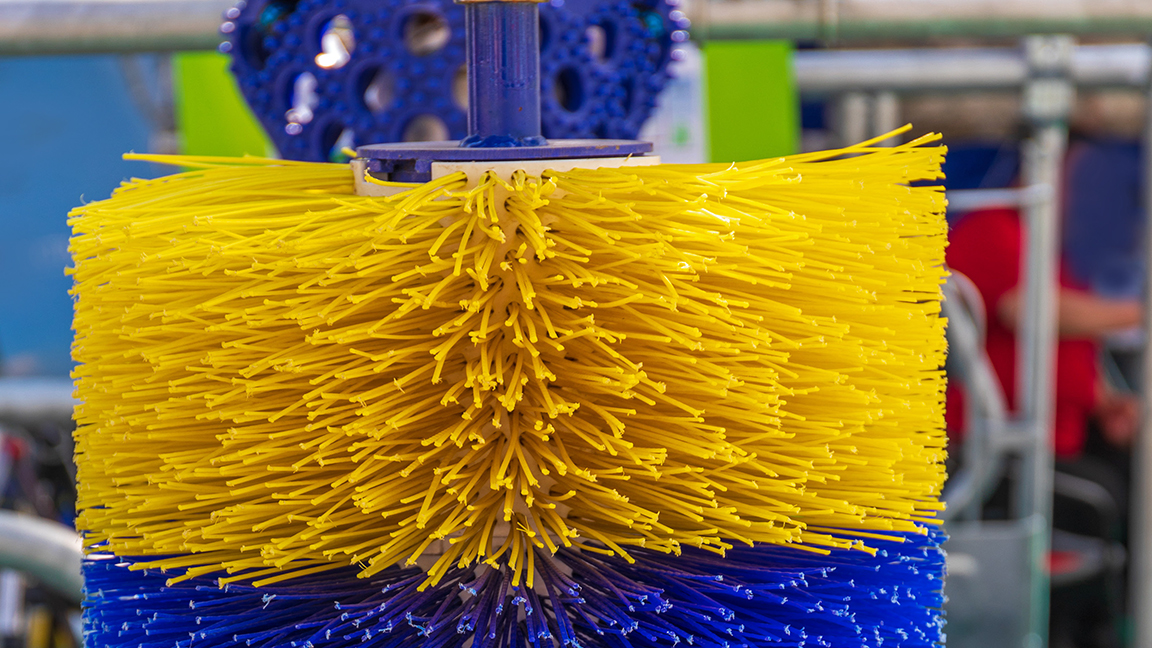
“Once we saw the benefits of getting animals acquainted with the facilities on AI success, we began to think about adoptable strategies to promote positive reinforcement during handling,” Dias says. “You often see cow brushes and how the animals enjoy rubbing against them on social media, so we thought, ‘Let’s come up with a way to place a cow brush in the alleyway, so the animals can enjoy themselves while they wait their turn.’”
Their goal was to position a brush in the center of the alley just below bovine head height so the animals could rub their backs with the brush to reduce stress.
While Dias and Johnson had an idea of what they wanted, they needed help to design and fabricate a device that could be installed on any type or size of chute and that was able to withstand the force generated by the animals. Dias and Johnson contacted the TDI to discuss the idea and determine if the institute could help develop a prototype for testing.
TDI engineers and interns began working on various designs that could easily be installed on chutes made of wood, pipe or any number of materials. The device had to be adjustable in height due to differences in wall and animal height, and it also needed to be able to adjust to sloped alley walls. TDI developed various concept designs and, with feedback from Dias and Johnson, finalized the design.
The team then fabricated two prototype devices that are currently being used by Dias and his students to determine the effectiveness of having such devices included during the AI process.
“We always enjoy working with industry experts who can clearly define their needs,” says Bret Lanz, commercialization director of the TDI. “This simplifies our job to create a product specification and design a new product that meets the needs of our customers. Nicholas and his team have been great to work with, and we are hopeful that this new tool will help to aid in their studies and perhaps have a large impact on the cattle industry.”
Editor’s note: Bret Lanz works in the Technology Development Institute at K-State. [Lead photo by Adobe Express.]
K-State’s TDI in the Carl R. Ice College of Engineering is a U.S. Department of Commerce Economic Development Administration University Center and received a grant from the Research and Entrepreneurship Federal Matching Grant Dollars Fund. TDI provides a broad range of engineering and business development services to both private industry and university researchers to advance the commercial readiness of new products or technologies.
Angus Beef Bulletin EXTRA, Vol. 17, No. 6-B
Topics: Equipment / Facilities , Management , Reproduction
Publication: Angus Beef Bulletin
Related Content


Current Angus Beef Bulletin
Our November issue focuses on the females of the herd and the records that validate them.