Wicked Weeds
Weeds not only compete with forage for sun and water, but some can be deadly. Here are four to watch out for.
March 20, 2026
Weeds not only compete with forage for sun and water, but some can be deadly. Here are four to watch out for.
Perilla mint
Twenty-five years ago, Chuck Madaris fenced in a 6- or 7-acre patch of woods for a group of young bulls. Even though they didn’t have any grass, they had access to a self-feeder and a round bale of hay. When he checked them, one of them looked like he had pneumonia and was struggling to breathe.
“I tried to walk him up to the pen. It was only a quarter of a mile away, and he died on the way,” he recalls.
The Hope Hull, Ala., purebred producer loaded the bull’s body on the trailer and took him to the Auburn University diagnostic lab.
“The next day, another bull was showing the same symptoms. His tongue was hanging out, and he was panting,” Madaris says. “He died while I was trying to load him.”
He, too, went to the diagnostic lab.
“They were diagnosed with perilla-mint poisoning,” Madaris says. At the time, he didn’t even know what the weed looked like, but walked into the shaded lot and saw where the bulls had nipped the tops off the toxic plants.
A leafy plant with square, ribbed stems, green to purple leaves with toothed edges and small spikes of white or purple flowers, perilla mint smells like mint when crushed. Like Madaris discovered, it is highly toxic to cattle, sheep and horses, and will often kill them before their owners even know they’re sick.
The good news is perilla mint is fairly easy to control if it is detected early.
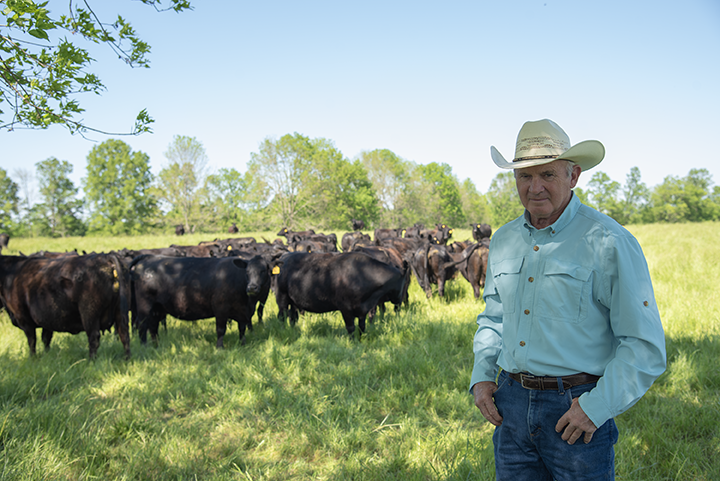
Hope Hull, Ala., cattleman Chuck Madaris lost two young bulls to perilla mint poisoning.

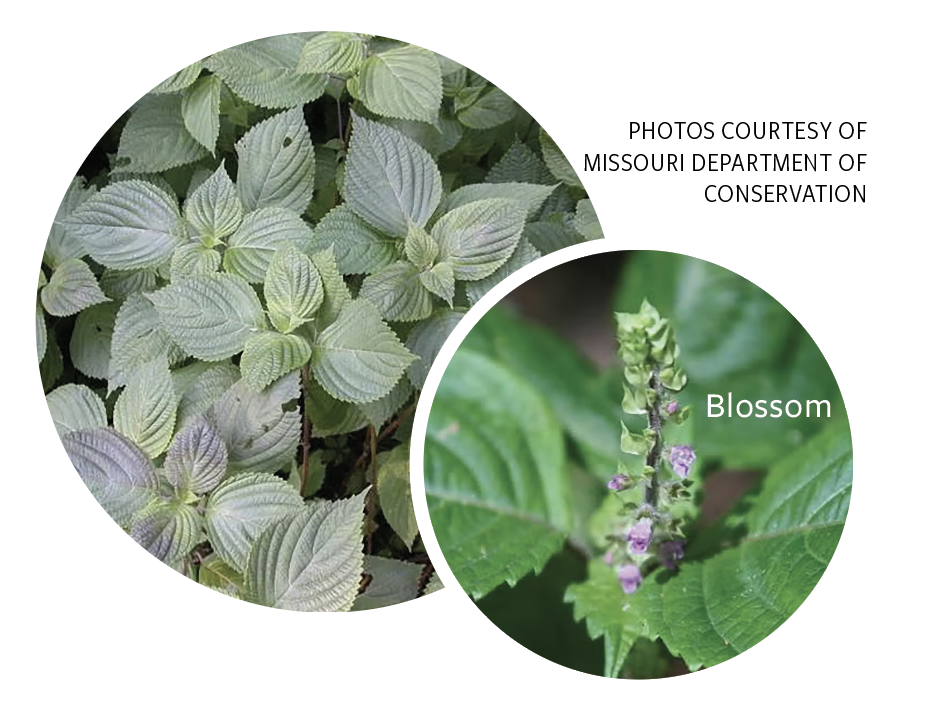
Perilla mint

“It is very susceptible to broadleaf herbicides like 2,4-D and dicamba,” says David Russell, Auburn University weed scientist. “We just have to be mindful what else is growing in that area — for example, if we’ve got clover we’re trying to maintain.”
However, Russell says, “I would rank the threat of a toxic plant more important than trying to save the clover on field edges.”
Mowing perilla mint in late summer before it makes mature seed is also an option, Russell says. “But remember, it’s an annual plant, and if there’s any moisture left in the soil, there’s a very good possibility that plant may try to regrow before the frost gets it in the fall.”
He warns the toxic weed likes to grow in protected areas, and it may take up to two or three frosts or freezes before it dies.
Russell says he can make an argument for spraying over mowing because spraying may kill the plant to the root.
“Those plants that have germinated may not recover as easily from a herbicide application as they might if you just mow it,” he says.
With either method, he says, it is important to remove grazing livestock until all vegetation is gone, because toxic compounds can persist in green or dying plant tissue.
“Because perilla mint is such a prolific seed producer, if you’ve got a population this year, more than likely some seed is going to survive in the soil into next year and possibly the next,” he adds, “so we need to keep scouting our fields in those same areas.”
For Madaris, the bad news is that perilla mint likes shady spots, and he has a lot of those. There are places in his pastures where the trees are so thick he can’t get in with a four-wheeler. Thankfully, he hasn’t lost any more cattle to the toxic weed, but, he warns: “Don’t ever fence cattle in a wooded area where they don’t have access to grass.”
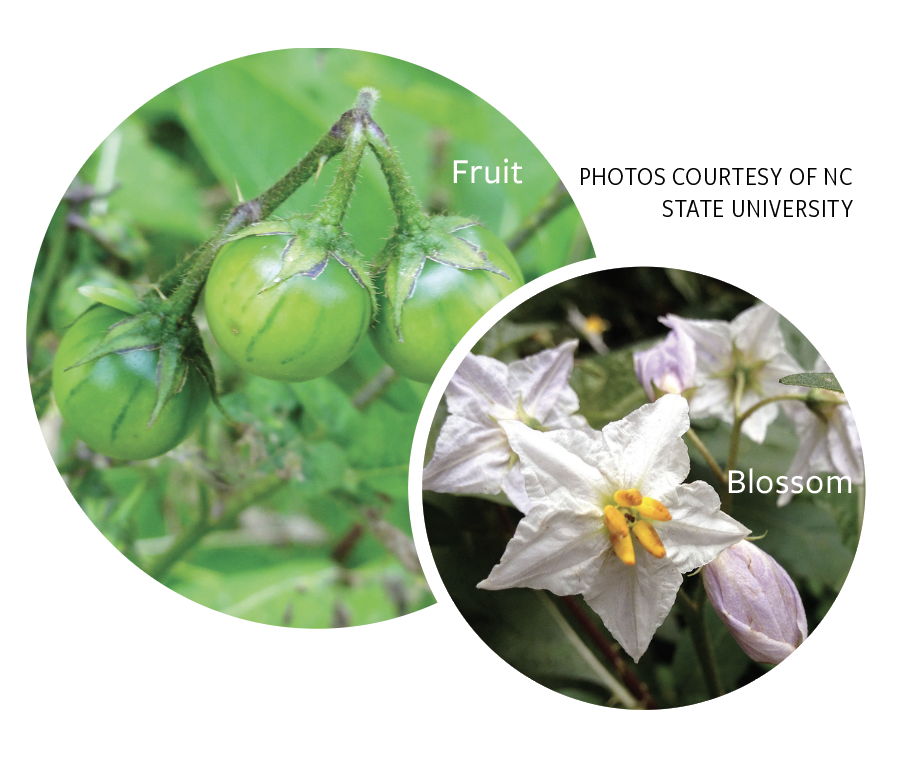
Carolina horsenettle

Carolina horsenettle
Texas A&M AgriLife Extension Forage Specialist Vanessa Corriher-Olson says they do see perilla mint in Texas, but Carolina horsenettle is also common, especially in East and Central Texas.
“It isn’t site-specific and grows all over, in both well-drained and wet areas,” she says. Although the warm-season perennial is toxic, she says it is rarely a problem because cattle typically don’t eat it unless it is in hay or silage and they can’t eat around it.
A member of the nightshade family, Corriher-Olson says the ripe fruit looks like a tomato, and that’s where most of the toxins accumulate. It affects the gastrointestinal tract and nervous system. Cattle will suffer from anorexia, diarrhea, depression and weakness.
“Obviously, call a vet if you suspect your cattle have eaten it,” she says.
A herbicide containing aminopyralid will work on it, Corriher-Olson says, but adds: “It can take up to three years to get control. Spray it when it is flowering. The timing of the herbicide application is dependent on the weather and season.”
Kochia
Kochia is similar in forage quality to alfalfa, very palatable and will grow in dry weather when other forages struggle. So, what’s not to love?
“It is a very competitive invasive plant,” says North Dakota State University Extension Forage Specialist James Rogers. Even worse, it accumulates nitrates with the best (worst?) of them.
“That will generally happen when it’s actively or rapidly growing,” says Rogers. “During that time, any plant is pulling up lots of nutrients. With kochia, it might hit a time, especially in drought, when the growth will slow down or stop. It’s pulled up all the nitrate, and is just sitting there in the plant with nowhere to go.”
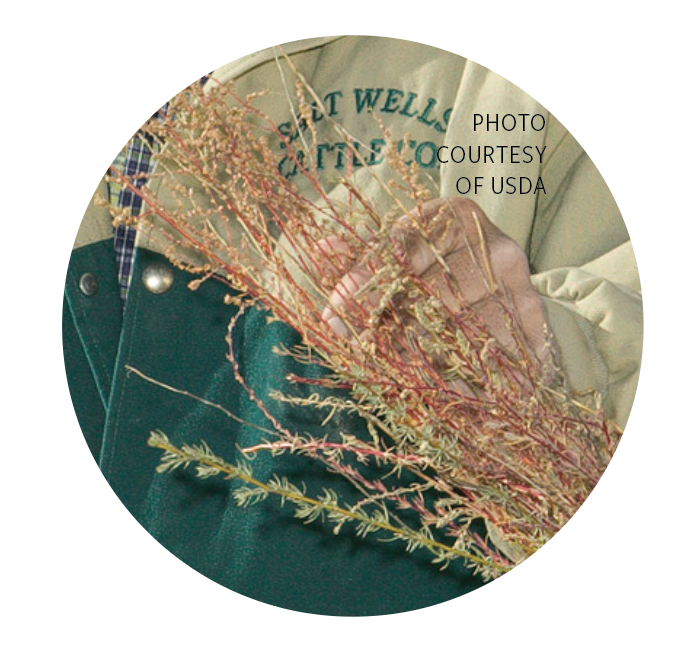
Kochia

The forage specialist says that if dry weather hits and the nitrate level is high, when a producer harvests it for hay, those nitrates are still there.
“If you suspect your hay might have high levels of nitrates, get it tested,” he warns. “Depending on the nitrate level, we may be able to dilute it or come up with some other management strategies to utilize it.”
Since the nitrates tend to accumulate toward the base of the plant, if a producer lets his cattle graze it close, they can pick up a toxic level of nitrates, too.
The symptoms of nitrate toxicity with cattle include weakness, rapid and/or difficult breathing, muscle tremors, staggering and collapse. Blue-tinged (cyanotic) or chocolate-brown membranes and chocolate-brown blood are other symptoms. If they live, they may also abort.
If you suspect your cattle may be suffering from a nitrate overload, call your vet and move them (gently) off or away from the suspected forage.
If you have kochia, but want to get rid of it, good luck. Rogers says the annual forb is a prolific seed producer. One plant can produce 14,000 seeds.
“Kochia can also be called tumbleweed,” he notes. “During the fall and winter, after it sets seed, it can break off and blow, and as it blows along across the field, it’s dropping seed. A producer could be doing everything totally right, but the wind might carry some of the kochia tumbling across his pasture. Suddenly, he’s got the start of an infestation, especially if he might have some bare areas in his pasture or range.
“Another problem is that kochia has really developed resistance to quite a bit of our chemistry that we could use to control it,” he continues. “It’s one of those species that, most of the time, people hate. However, there are situations where it might be the only thing we have. If you talk to producers around here, kochia has probably bailed them out of some tight spots when things [got] hot and dry.
“One good thing about it,” he says, “is that even though it does produce a lot of seed, the seed don’t tend to stay in the seed bank very long, a year or two. If it drops seed and they don’t germinate, you might be able to come in and do some control.”
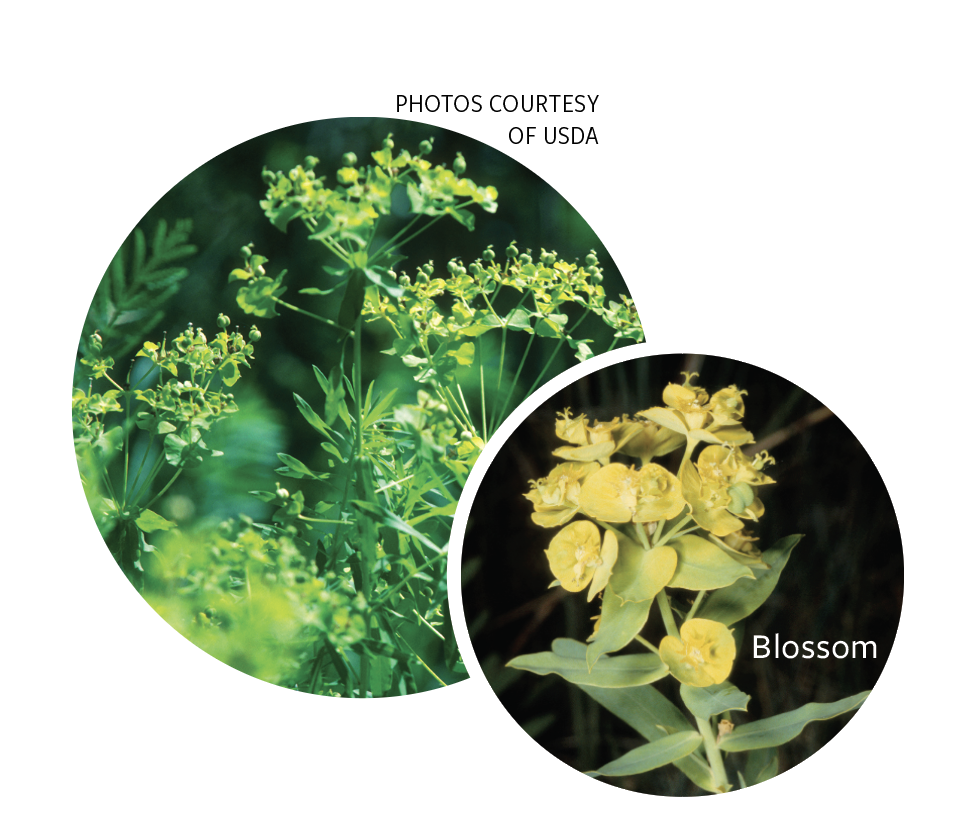
Leafy spurge

Leafy spurge
With leafy spurge, Rogers says, “Cattle tend to avoid it, which gives it more of a chance to propagate in areas where you probably don’t want it, as well as crowd out more desirable species in a pasture or range.”
Rogers says cattle may eat it, if it is in hay and they can’t pick it out. As far as toxicity, scours is the main symptom.
The North Dakota forage specialist says the perennial has a very extensive root system, which makes it hard to control. It can also produce a large amount of seed, although thankfully, not as much as kochia. He adds that it has a very unique seed distribution system.
“It produces a seed-containing pod, then once the seeds are mature, the pod explodes or bursts,” he says. “It can throw seed out around that plant as far as 15 feet or so.”
To control it, Rogers says producers will typically use more than one method. Along with herbicide, they’ll graze sheep and/or goats, which tend to be more tolerant of it than cattle.
“I have talked with a producer that has forced cattle to eat it, and he’s been doing that for years,” he says. “Over time, his herd has probably developed a tolerance to it.”
Kochia and leafy spurge are both opportunistic plants, Rogers says, “so good grazing management is always the key to try to prevent them from entering your pasture or range.”
Editor’s note: Becky Mills is a freelance writer and cattlewoman from Cuthbert, Ga.
Digital EXTRAs — There’s an app for that
Auburn University Extension Weed Scientist David Russell says he has a 4-inch-thick book in his office titled Toxic Plants of North America. Searching through it to try to keep up with what might be in your pastures or range is not realistic. Fortunately, your phone can do a great deal of the work for you.
“My favorite app is iNaturalist,” says Russell. “You can take a picture with your phone, or you can upload an image from your photo library of previous plants you’ve taken with your phone.”
You can enter GPS coordinates along with a photo, he explains. “It will give you a list of possible plants and its geographic distribution.”
Best of all, iNaturalist is free.
Texas AgriLife Extension Forage Specialist Vanessa Corriher-Olson is a fan of PictureThis. “It will ID any plant or tree, grasses, broadleaf plants and diagnose problems.”
“It isn’t free, but worth an investment,” she says.
For more information, see:


Related Content


Current Angus Beef Bulletin
Our September issue focuses on the females of the herd and the records that validate them.