The Digestive Tract
Preparing your cow herd to prosper this winter.
November 3, 2025
As fall sets in, cattle producers turn their attention toward preparing the cow herd for the challenges of winter. This transition period is critical. Decisions made now will directly influence subsequent cow body condition scores (BCS), reproductive success, calf health and overall herd profitability in the coming year.
With that in mind, building a nutritional program for a cow-calf system requires understanding nutritional requirements, knowing the “stress periods” that can happen, having built-in nutritional contingency plans, and understanding both the quality and quantity of your forage resources.
Use BCS as a guide
Observing cow body condition scores is a staple management tool to determine supplementation goals and strategies. For many spring-calving herds, the time between now and winter is best to increase the BCS of the herd prior to winter weather.
A cow with a BCS of 5-6 on a 9-point scale is in ideal condition. Cows that are too thin (BCS of 3 or 4) will struggle to maintain body temperature. Conversely, obese cows (BCS of 7 or higher) can have calving difficulties. BCS is an insurance policy. It’s risk management.
It is easier to stay ahead, maintaining adequate BCS, than letting cows slip and get behind. Getting behind during late gestation and early lactation can decrease pregnancy rates and affect calf performance.
Separate thin cows and provide them a higher plane of nutrition. This may involve supplementing their diet with a high-energy feed to help them gain condition before winter hits.
The last chance to economically increase cow BCS during late gestation is within 90 days prior to calving. However, weather changes and forage availability and quality can make achieving an optimum BCS 60-90 days before calving difficult. After that, adding additional body condition on a thin cow that has calved and is lactating can require large amounts of high-quality feeds to meet increased nutrient requirements.
Typically, a cow must gain 75-100 pounds (lb.) to increase one full condition score. During late gestation, that number increases to account for fetal growth and placental weight.
Thin cows (BCS ≤ 4) or young cows can be sorted and fed separately from the mature cow herd. This would allow for more strategic supplementation and decrease overall feed costs.
Cows in a BCS of 6 or slightly greater prior to winter influence the winter supplementation strategy, too. This additional fat cover on the cow can be utilized as an energy supplement to offset potential energy deficiencies. However, this needs to be done very strategically, not allowing cows to lose too much condition prior to calving.
The American Angus Association offers a guide to conditioning scoring at http://bit.ly/3V8Ur4r.
Forage analysis
Forage or hay nutrient analysis is vital for calculating the correct supplement to meet the herd’s needs.
A few years ago, a producer called to have some winter rations developed for his cow herd. He stated his hay generally was 10% crude protein (CP). When tested, the hay came back at 4% CP. Not knowing the true protein content would have resulted in undesired herd performance.
As forages advance in maturity, crude protein content decreases, which effectively limits energy intake and overall intake itself. Forage or hay intake declines rapidly as forage crude protein falls below about 7%, a relationship attributed to a deficiency of nitrogen (protein) in the rumen, which inhibits activity of the rumen microbes.
If the forage diet contains less than about 7% CP, feeding a protein supplement generally improves the energy and protein status of cattle by increasing forage intake and digestibility of the feedstuff.
Winter supplementation
Outside of physiological stage, winter supplementation strategy for the cow herd should be based off the current BCS or direction that BCS is going, as well as forage condition or hay quality.
Keep in mind, moving from mid- to late gestation increases a cow’s energy requirement by 25% and her protein requirement by 10%. If cows are thin and forage quality is low, we may need to increase both energy and protein supplementation to meet the cow’s need and increase condition score prior to calving. If cows are in good condition and forage quality is low, protein supplementation alone can meet the cow’s needs.
Daily energy intake can be a limiting factor for cow performance while grazing winter forage or lower-quality (< 7% CP) hay. A lot of producers ask if they can feed corn as an energy feed to increase intake of lower-quality forage or hay. Without meeting the protein needs, feeding corn to supplement a low-quality forage-based diet can reduce forage intake and digestibility due to the increased levels of starch from the corn altering rumen microflora and ruminal fermentation.
The level of protein in the diet determines how corn supplementation affects cow performance. If the cow’s protein requirement is not met, feeding corn alone may actually increase body weight loss during gestation (see Table 1) compared with feeding corn plus protein or protein alone.
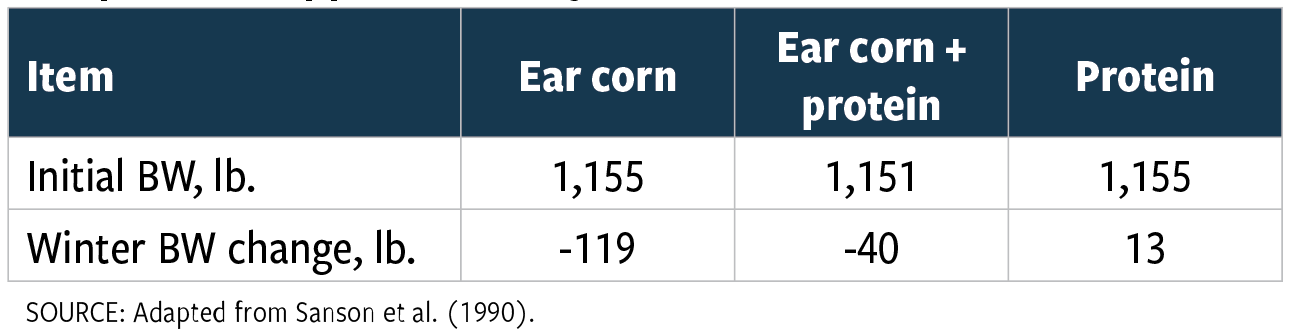
Table 1: Late gestation body weight change of cows supplemented with corn only, corn and a protein supplement, or a protein supplement only

If protein supplementation is needed, protein supplements can be offered to cows daily, three days a week or as infrequently as once per week to maintain adequate performance. As a rule of thumb, feeding 0.3 lb. to 0.6 lb. CP per day during late gestation to mature cows maintains cow performance and fetal growth.
When deciding on protein supplements, it is important to consider your goal for feeding the protein supplement and that not all protein sources are equal. Type of protein refers to rumen degradable protein (RDP) or rumen undegradable protein (RUP).
RDP is the type of protein that is degraded or utilized by the rumen microbes. Examples of RDP sources would be cottonseed meal, soybean meal or alfalfa hay.
RUP is protein that is protected from degradation at the rumen and will be absorbed or utilized by the cow. Research has shown that meeting the rumen microbe requirements for nitrogen first — with the remaining portion of crude protein being RUP — can result in increased growth or weight gain, increased reproduction and increased protein utilization.
The ideal formulation would provide at least 50% bypassing the rumen (i.e., rumen undegradable protein), with the remaining portion of the protein being rumen degradable, during the greatest nutritional stress periods.
Cold stress
While cattle are generally hardy, protection from wind and wet conditions is essential for conserving body heat and reducing stress. The effects of winter weather, especially wet winter weather, should not be ignored.
When the effective temperature is below the animal’s lower critical temperature, the animal must increase heat production to maintain a constant body temperature. Depending on hair coat and wet or dry conditions, the lower critical temperature is somewhere around 18°-20° F. If cows have a summer or light coat and if the hair coat is wet, the lower critical temperature is around 60° F.
To produce more heat, a cow must either receive more energy from the feed ration or draw on her body stores. Seven days or more of cold, windy or wet weather will increase cow energy requirements 10%-30%. If hay or forage quality is good (i.e., 10% CP or greater), intake will increase. However, the increased intake and overall energy intake may not meet requirements.
With low-quality forage, cows will need additional energy supplementation during extreme weather. If cows are not fed enough during cold stress periods, they can easily drop a BCS in 30 days or less.
Thin cows going into a wet, cold winter have less body condition or fat reserves available to help offset the lack of dietary energy. These cows will be more susceptible to decreased performance and health for both the cow and subsequent offspring.

Takeaway
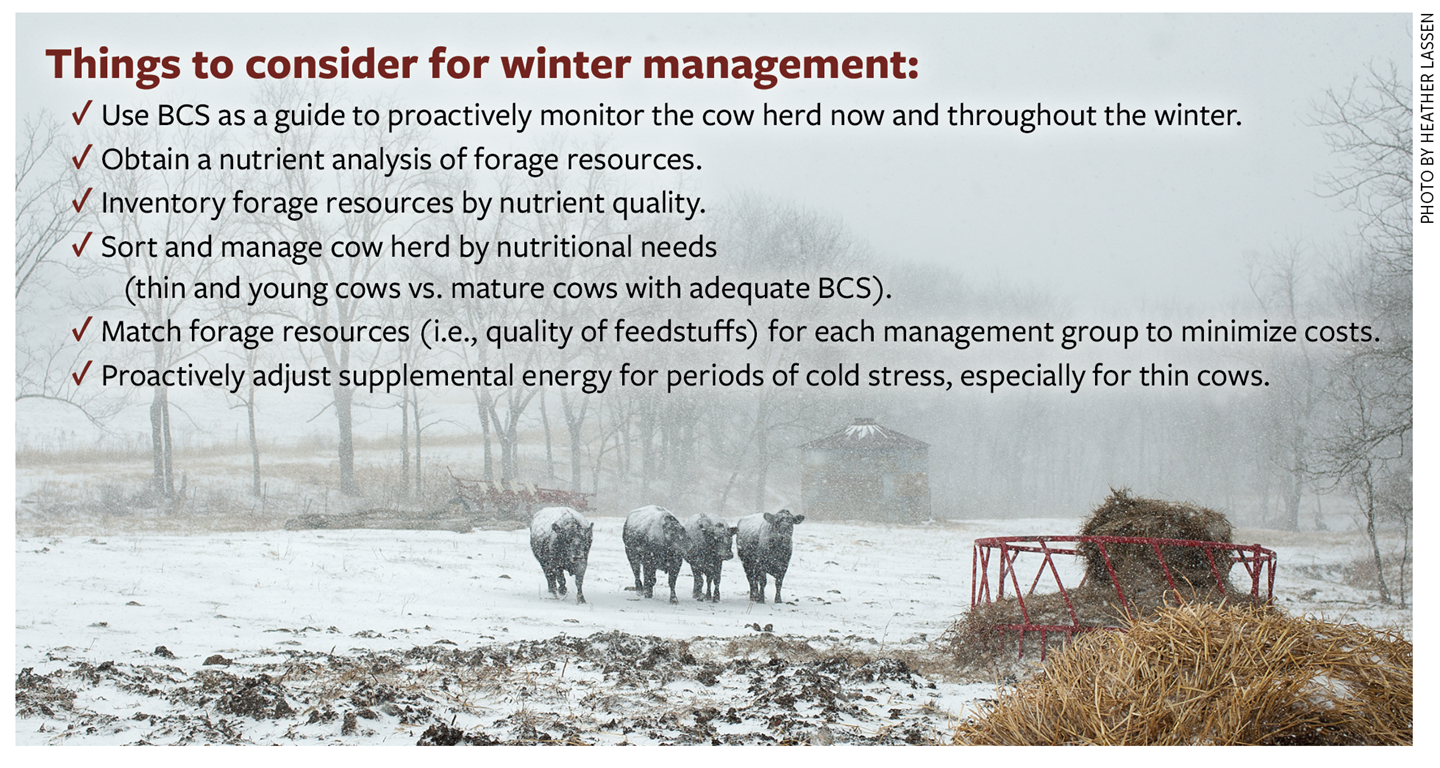
Overall, protein supplements improve cow nutritional status by increasing digestibility and intake of low-quality forages and/or increasing nutrient flow of protein from the rumen to the cow. If cows are thin, both protein and energy supplementation is needed to increase BCS.
For cows with an acceptable BCS, protein supplementation on low-quality forages can maintain BCS or slightly increase BCS over winter. Thin cows (BCS ≤ 4) or young cows could be sorted and fed separately from the mature cow herd. This would allow for more strategic supplementation and decrease overall feed costs.
Typically, a cow must gain 75 lb.-100 lb. of body weight to increase one full condition score, but during late gestation that number increases to account for fetal growth and placental weight. Thus, it is important to distinguish body weight differences due to differences in BCS and body weight changes resulting (and required) by fetal growth.
Editor’s note: “The Digestive Tract” is a regular column focused on nutrition for the beef cattle life cycle. Travis Mulliniks is the Glenn & Mildred Harvey Professor of Beef Cattle Management, as well as the associate head of the Department of Animal and Rangeland Sciences, at Oregon State University.

Topics: Feedstuffs , Nutrition , Pasture and Forage
Publication: Angus Beef Bulletin
Issue: November 2025
Related Content


Current Angus Beef Bulletin
Our September issue focuses on the females of the herd and the records that validate them.