Build Cows That Stay
Smarter heifer development fosters long-term productivity.
July 9, 2026

by Kacie McCarthy & T.L. Meyer
Setting replacement heifers up for cow herd longevity is more than achieving a first pregnancy. It requires building females that remain productive within the constraints of their production environment (forage resources, climate and management).
Research across a range of development systems demonstrates similar pregnancy rates can often be achieved under both traditional and extensive management programs. This suggests producers have flexibility to reduce development inputs while maintaining acceptable reproductive outcomes. However, one factor consistently drives long-term success: early conception during the first breeding season.
Foundation of longevity
Heifers that conceive within the first 21 days of their initial breeding season calve earlier, have more time to recover postpartum and remain in the herd longer. These females also wean more pounds of calf throughout their lifetime compared to later-conceiving counterparts. As a result, early conception is one of the most important predictors of lifetime productivity and retention.
While early conception is critical, achieving it depends on how well the heifer development program aligns with the production environment.
Fit the heifer to the environment
A successful heifer development program must match the resources and constraints of the production system. Factors such as forage availability, climate and management intensity all influence reproductive performance. Research comparing intensive (drylot) and extensive (range-based) development systems has shown similar pregnancy rates, indicating high-input systems are not always necessary.
The key is not maximizing inputs, but developing heifers in a way that reflects the conditions they will experience as mature cows.
The key is not maximizing inputs, but developing heifers in a way that reflects the conditions they will experience as mature cows. Developing heifers under conditions similar to the production environment helps ensure they are capable of maintaining performance when resources are limited.
Within the context of environmental fit, nutritional management, particularly protein supplementation, plays a critical role in supporting reproductive success.
Nutrition strategies and protein type
Nutritional strategies during development influence both short-term reproductive success and long-term cow performance. Mulliniks et al. (2013) evaluated spring-born heifers developed under three strategies: range-developed with either low or high rumen undegradable protein (RUP) supplementation and drylot-developed heifers targeting higher rates of gain.
Heifers developed on range with higher RUP supplementation exhibited greater retention in the breeding herd through 5 years of age compared to both low-RUP and drylot-developed heifers. These results suggest protein type, not just level of nutrition, plays an important role in supporting reproductive success in forage-limited environments.
Even with appropriate development and nutrition, one of the greatest challenges in cow herd productivity occurs after first calving, when young females must balance growth, lactation and rebreeding.
Birth date, age at first calving and sourcing replacements
Birth date and age at first calving play an important role in long-term reproductive performance. In a May-calving system, Goodnight et al. (2025) compared March-born heifers (“Convert”) to May-born heifers born either early or late in the calving season.
After five years, a greater proportion of March-born females remained in the herd, with no difference observed between early- and late-born May heifers (see Fig. 1). These results suggest age at first calving, rather than position within the calving season, has a greater influence on retention. Heifers that are older at first calving are typically better equipped to meet the nutritional demands of lactation and rebreeding, particularly in limited-resource environments.
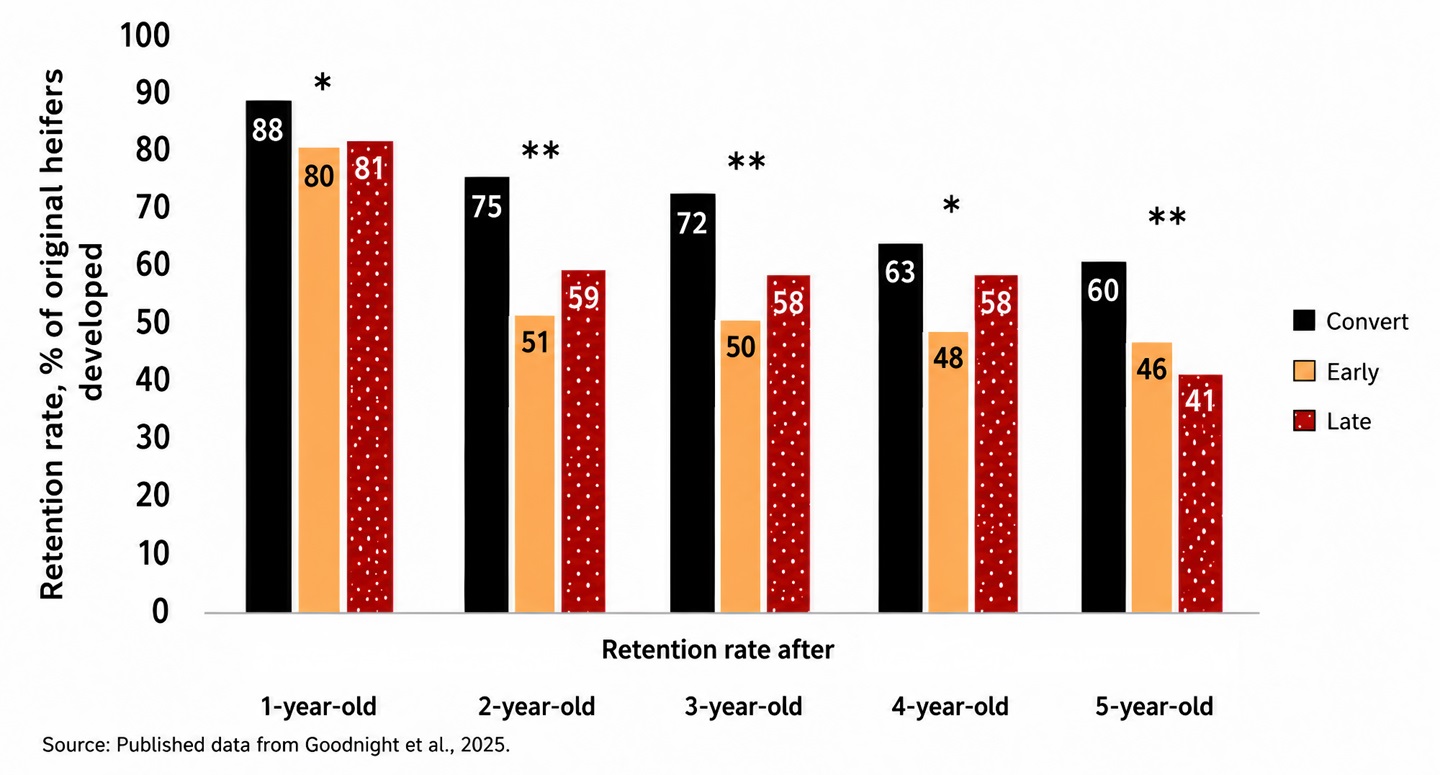
Fig. 1: Retention rate of converting March-born heifers (Convert) into a May-calving herd compared to May-born heifers
May-born heifers were retrospectively grouped into two groups: heifers born in the first 21 days of calving (Early) or heifers born after the first 21 days of calving (Late).

This advantage becomes important in young cows. Two- and 3-year-olds often struggle to consume enough energy during early lactation, which can delay return to estrus and reduce pregnancy rates. In contrast, more mature cows can maintain intake more effectively, even when forage crude protein falls below 7%.
From a management perspective, incorporating older replacement heifers from earlier-calving herds or incorporating March-born heifers into May-calving systems can improve rebreeding success, increase retention and support long-term herd productivity.
If you are retaining replacements, this means prioritizing heifers born earlier in the calving season. When purchasing replacements, particularly for summer-calving systems, it may involve sourcing heifers from earlier-calving herds, such as March-calving operations. In both cases, older females are better prepared to meet the demands of lactation and rebreeding, resulting in improved retention and productivity.
Managing the young cow bottleneck
Reduced pregnancy rates in 2- and 3-year-old cows are a concern for beef producers. These young females are still growing while also lactating, which increases their nutrient requirements. In many systems, especially when forage quality declines during the breeding season, young cows are unable to consume enough feed to meet these nutrient requirements.
This limitation often results in delayed return to estrus and lower pregnancy rates. Addressing this challenge requires both nutritional management and strategically selecting females more likely to succeed under these conditions. Evaluate factors that influence a heifer’s readiness at first calving, including birth date and selection criteria that match your operations’ goals.
Body condition score (BCS) at the start of the breeding season is one of the most influential factors affecting reproductive performance. Cows entering the breeding season at a BCS of 5.0 or greater have improved pregnancy rates, calf survival and weaning weights (Cooke et al., 2021).
Adequate body condition supports earlier return to estrus and increases the likelihood of maintaining a yearly calving interval. Over time, these advantages translate into greater pounds of calf weaned per cow exposed. Management strategies that maintain body condition, particularly in young cows, are critical for overcoming the challenges associated with rebreeding and sustaining long-term productivity.
A systems approach to cow herd longevity
Long-term cow herd performance comes from managing heifer development as part of the whole system. Early conception, environment, nutrition, age at first calving and body condition all work together to influence whether a female stays productive.
These results suggest age at first calving, rather than position within the calving season, has a greater influence on retention.
Develop heifers under the same conditions they’ll face as cows, prioritize early-born and early-conceiving females, maintain body condition, and use protein supplementation strategically.
Programs built around these principles improve rebreeding success, increase cow longevity and produce more pounds of calf over time, especially in forage-limited systems.
References:
Cooke, R.F., G.C. Lamb, J.L.M. Vasconcelos, K.G. Pohler. 2021. Effects of body condition score at initiation of the breeding season on reproductive performance and overall productivity of Bos taurus and B. indicus beef cows. Anim Reprod Sci. 232: 106820. doi: https://doi.org/10.1016/j.anireprosci.2021.106820
Goodnight, T., J.A. Musgrave, K.L. McCarthy, and J.T. Mulliniks. 2025. Converting spring-born heifers into summer-calving herds increases subsequent cow longevity and productivity. Trans Anim Sci. 9: 1-8. Doi: txaf077, https://doi.org/10.1093/tas/txaf077
Mulliniks, J.T., D. E. Hawkins, K. K. Kane, S. H. Cox, L. A. Torell, E. J. Scholljegerdes, and M. K. Petersen. 2013. Metabolizable protein supply while grazing dormant winter forage during heifer development alters pregnancy and subsequent in-herd retention rate. J Anim Sci. 91: 1409–1416, https://doi.org/10.2527/jas.2012-5394
Editor’s note: Kacie McCarthy is a Nebraska Extension cow-calf specialist, and T.L. Meyer is a Nebraska Extension educator. [Lead photo by Shauna Hermel.]
Angus Beef Bulletin EXTRA, Vol. 18, No. 7-A
Topics: Female Foundations , Management , Nutrition , Selection
Publication: Angus Beef Bulletin
Related Content


Current Angus Beef Bulletin
Our September issue focuses on the females of the herd and the records that validate them.