



Simple Changes Make the Difference in Cooling Off Cattle
K-State beef extension veterinarian provides solutions for managing heat-stressed cattle.
June 18, 2026
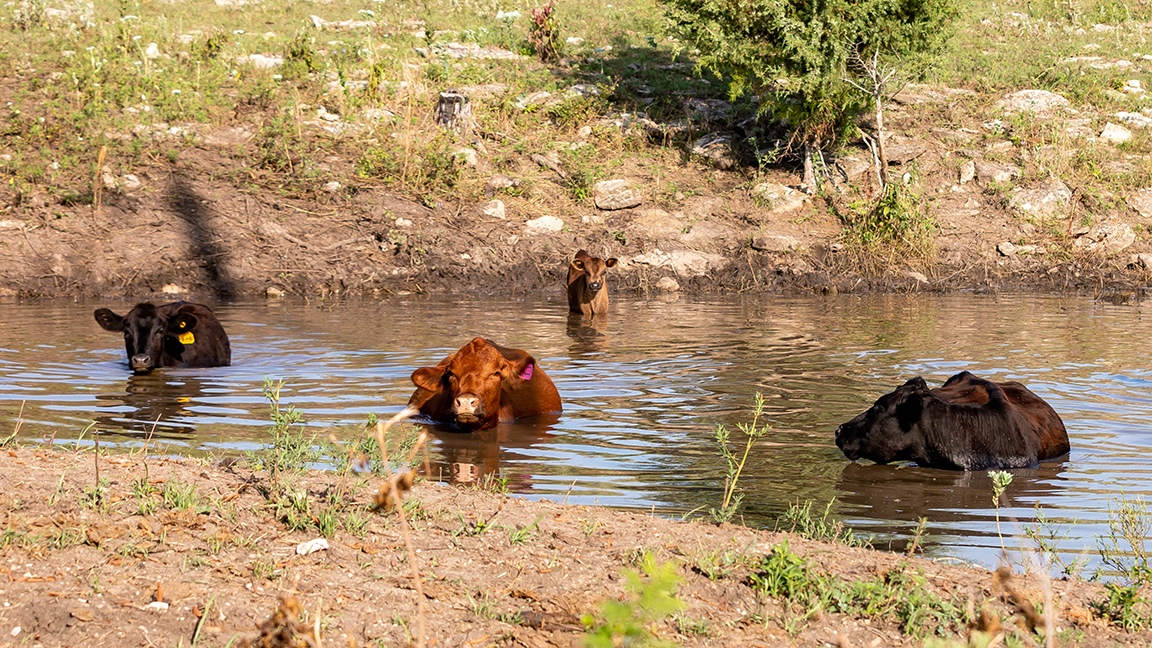
K-State beef extension veterinarian A.J. Tarpoff says managing heat stress has been a part of cattle production since their domestication. [Photo courtesy K-State Extension.]

by K-State Extension news service
Cattle incapable of relieving themselves of high temperatures experience heat stress. Humans alleviate overheating through sweating, but cattle do not have that option, says Kansas State University (K-State) beef extension veterinarian A.J. Tarpoff.
“Heat stress coping behaviors is what we see when cattle are adapting to warmer temperatures,” he says. “Whenever we get hot, we sweat to maintain homeostasis. For livestock species, and especially cattle, that capability gets overwhelmed.”
Tarpoff adds: “They dissipate heat in other ways, like increasing their respiratory rate (breathing) by panting.”
Besides panting, producers identify heat stress by their increased standing, large groups of animals bunching up close to water tanks and crowding in shaded areas.
“They’re trying to get increased airflow by standing, but they actually end up using each other as shade, which is counterproductive,” Tarpoff says.
Key contributors
High temperatures, high humidity, slow wind speeds and increased solar radiation comprise the four weather conditions contributing to heat stress.
“When we’re comfortable, cattle might not be and vice versa. We really need to consider those four key parameters,” Tarpoff says. “We have an animal comfort index that uses the four of them to get a feel on how cattle are experiencing their environment.”
Monitor the current and seven-day animal comfort indexes in Kansas through the K-State Mesonet.
Correctly managing heat stress has proven to be essential for maximizing animal well-being and performance, says Tarpoff.
“It is one of those critical chores just as important as feeding or making sure the animals have water. Whether we are asking them to be good cows or an animal to produce beef in a feedlot, we need to put them in scenarios where they’re more comfortable, because then they are more productive,” he says.
Managing the heat
Tarpoff urges operations housing their cattle in dry lots to keep it simple when developing a plan to lessen the consequences of heat stress.
“Whenever it comes to heat stress, it’s back to the basics: feed and water.” — A.J. Tarpoff

A.J. Tarpoff

“Whenever it comes to heat stress, it’s back to the basics: feed and water. Water intake can nearly double as temperatures rise from 70° to 90° (Fahrenheit). We need more water access, flow and availability for those animals,” he says.
He adds: “We might be able to modify our feeding times to alleviate some of these stressors. Whenever we feed cattle, we feed the rumen microbes, and that comes at a cost called the heat of fermentation. We can feed later in the evening, so the digestion happens during the cooler nighttime hours.”
Tarpoff cites two recent studies that show reduced water usage (as a metric for heat stress) during the summer months when shifting feeding times:
- Effects of alternative feed timing on growth performance and water usage of growing beef x dairy heifers fed a high-roughage diet.
- Effects of alternative feed timing on growth performance and water usage in limit-fed growing beef x dairy heifers.
Producers often construct shades to cool off cattle in times of unrelenting heat. A recent study conducted by K-State researchers looking at effects of shade on heat stress revealed that shade structures can affect more than just animal temperature.
“They are a piece of infrastructure,” Tarpoff says. “That two-year trial showed added benefits of investing in shades. We saw increased feed efficiency, increased growth rate and increased average daily gain. We also saw reduced panting rates and water consumption needs by over a gallon per head per day.”
Additionally, bedding pens with straw can reduce the pen floor temperature by 25° and fence-line sprinklers help lower ground temperatures and keep cattle cool if used in the overnight hours, according to Tarpoff.
Angus Beef Bulletin EXTRA, Vol. 18, No. 6-B
Topics: Animal Handling , Health , Management
Publication: Angus Beef Bulletin
Related Content


Current Angus Beef Bulletin
Our September issue focuses on the females of the herd and the records that validate them.