



Market Update and Options
Update on the cattle market, where to begin when looking to market your cattle and how your Angus genetics can pay off on sale day.
May 6, 2026
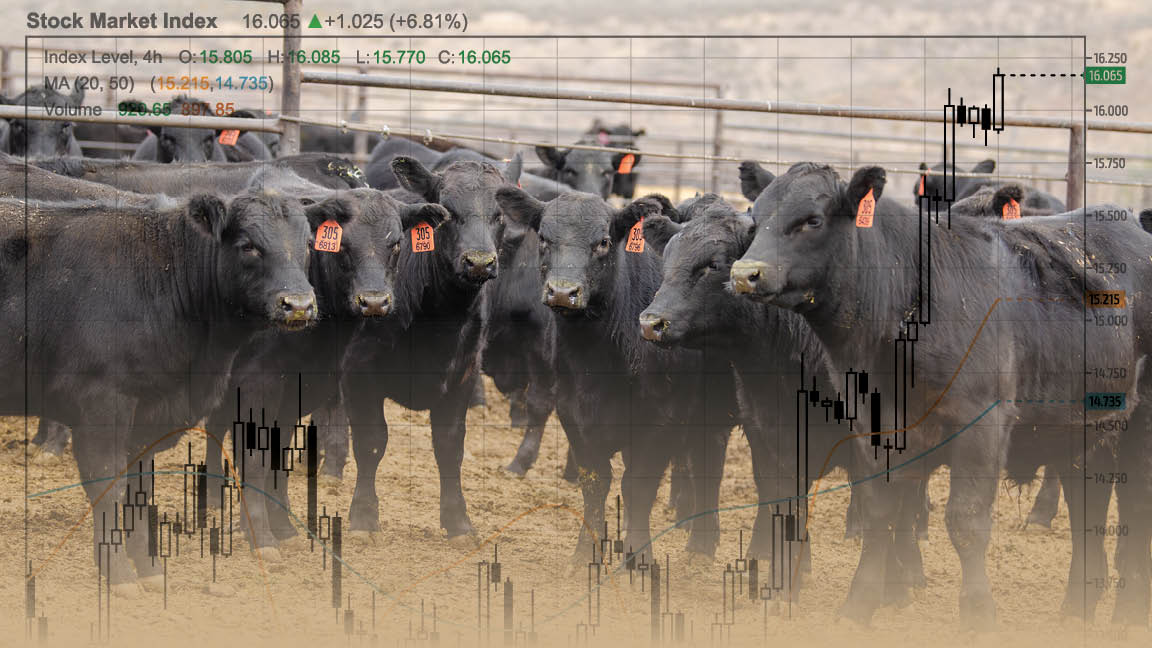

The cattle market has seen its fair share of ups and downs over the years. Despite ever-changing circumstances, many cattlemen are currently enjoying satisfying prices and investing in their operations — whether that’s by paying down debt, building facilities or seeking out even better genetics.
On a recent episode of Angus at Work, Shauna Hermel visits with Trent Stewart, auctioneer and sales representative with Superior Livestock, and Troy Marshall, director of commercial industry relations for the American Angus Association, about the state of the cattle market, where to begin when looking to market your cattle and how your Angus genetics can pay off on sale day.
The state of the market
The cattle market has been kind to many producers during the last few years. With that in mind, how can producers reinvest that capital for the eventual dip in the cycle? Stewart has a suggestion.
“I’d pay off some debt if it were me right now, and try to keep the very best genetics that you can,” he says, noting that strengthening the cow herd now could strengthen the operation when the market eventually adjusts.
The market may be treating cattlemen well, but that doesn’t negate the other challenges to production being faced across the country. One such challenge is the drought many regions are currently facing. It’s very dry out West, Stewart notes. Coming out of the mildest winter that he can remember in his lifetime, Stewart says central Oregon in March has reached near 80° F with a very limited snowpack.
As far as herd expansion, Stewart says — optimistically — the cycle is likely two to three years out, though he remarks that in 2014 it seemed the cow herd rebuilt nearly overnight. Stewart says he is cautiously optimistic, though weather is going to dictate at least a portion of the total herd rebuild.
“On the other side of things, it’s been such a great market. A lot of people kept heifers back because they didn’t want to take any more income, either,” Stewart notes. “Two years ago, or a year ago, they were saying, ‘We can’t afford not to sell them because they’re bringing so much money.’ This year, on the contrary, they’re [saying], ‘We don’t want to take any more income, and we’re going to build more cows and keep some heifers.’”
Given a few words to describe the current market, Stewart says he has three: on the moon. He says every day we see new highs and defy gravity. Things worldwide can be upside down, and the cattle market has continued to hold its line, Stewart adds.
“Two years ago, or a year ago, they were saying, ‘We can’t afford not to sell them because they’re bringing so much money.’ This year, on the contrary, they’re [saying], ‘We don’t want to take any more income, and we’re going to build more cows and keep some heifers.’” — Trent Stewart
“I think that there’s a lot of demand out there for it. We’ve never created a better product,” Stewart says, nothing that it all comes down to what’s on a plate. “We just have to have a functional cow to go with it, but we can’t leave that out. We’re trying to create the anomaly of great maternal genetics and having a carcass.”
Video marketing options
Where marketing cattle is concerned, cattle producers have options, including video sales. Knowing your options is one thing; but understanding the video marketing process end to end is another entirely. Stewart says selling through Superior has been designed to make marketing and delivery simple for both the buyer and seller.
The process needs to start at the beginning of the year, when calves are on the ground and have been banded. Developing a relationship early on with a representative for your cattle is as easy as reaching out to Superior Livestock by phone or visiting their website at superiorlivestock.com.
“Find a worthy representative, get in touch with them and tell them about what you’re thinking about marketing and the time frame that you’re going to do it,” Stewart says. “Have it in mind already. Should I wean them? Should I not wean them? Which vaccines should I use? Which value-added program: Should we make them NHTC, non-hormone treated cattle? Should we make them all-natural? It changes all the time right now because there’s different [programs] out there where they’re looking for all-natural meat or not.”
After finding your representative, the next step is to set a date to get together with that representative. A representative will likely come out within several weeks to tour the cattle, do a ranch visit and get some good video of the cattle. He recommends trying to get everything submitted two weeks prior to sale time to make sure that all information — including pedigree, where you’ve been buying your bulls, all your Genetic Merit Scorecard® information — is in place with the American Angus Association.
Stewart recommends having an open line of communication when the sale approaches. Another piece of the puzzle that needs to be decided is the fair market price for your cattle. While the seller doesn’t have to agree to an absolute sale the day of, Stewart encourages it.
“A good rep will get you the market. That’s all we’re looking for that day is to sell within the market,” he notes, adding that making delivery decisions comes next. “It depends whether it’s immediate delivery or not. If it’s for a deferred delivery, it might be several months before you set up a delivery.”
Pickup could take that long, but most cattle are delivered within 30 days of purchase, Stewart says, though he encourages about a 10-day to two-week window. When delivery arrives, your representative brings you the cattle, weighs the cattle, sorts them up for size and kind. As far as trucking, the buyer furnishes transport 99% of the time, according to Stewart, so it’s a user-friendly transaction.
“We try to make [cattle] fit the contract to a ‘T’ and do the very, very best job we can, because it’s a residual business we want to get,” Stewart says. “Just give [the buyer] exactly what we sold.
“The Superior representative will write a customer, the cow-calf operator, a check for the cattle at that time and Superior will collect those funds from that buyer,” he continues.
“The Superior representative will write [the cow-calf operator] a check for the cattle at that time and Superior will collect those funds from that buyer.” — Trent Stewart
Editor’s note: The information above is summarized from the April 15, 2026, episode of Angus at Work. To access the full episode — including more information on video marketing and the current state of the cattle market — check out our Angus at Work archive on www.angus.org. [Lead photo by Shauna Hermel.]
Angus Beef Bulletin EXTRA, Vol. 18, No. 5-A
Topics: Feeder-Calf Marketing Guide , Management , Marketing
Publication: Angus Beef Bulletin
Related Content


Current Angus Beef Bulletin
Our September issue focuses on the females of the herd and the records that validate them.