



The Dirty Dozen
Thirteen invasive plants that pose a danger to Oklahoma rangeland beyond just upsetting your neighbors.
December 17, 2025

by Dean Ruhl, Oklahoma State University Extension
Are you being a good neighbor?
It’s a question Karen Hickman, a professor of natural resource ecology and management and director of the environmental science program in the Oklahoma State University Ferguson College of Agriculture, poses while discussing invasive plant species in Oklahoma.
Some of those invasive plants can spread onto neighboring properties, meaning upkeep and removal are important. But the “Dirty Dozen,” which encompasses 13, not 12, invasive plant species widespread across the state, pose dangers to rangeland in Oklahoma beyond just upsetting neighbors.
“Typically, we care about these invasive species because of the harm to human health, harm to the economy or harm to biodiversity,” Hickman says.
Leaving the plants on your property could result in decreased forage. The plants could be toxic. The invasive species could be detrimental to wildlife habitats, decreasing populations for hunting purposes. Fire dangers can increase, too, if species are left untreated.
“We see that a lot with eastern redcedar,” Hickman says.
Of the 13 invasive species listed, one — musk thistle — lands on Oklahoma’s noxious weeds list. Scotch and Canada thistle are also considered noxious weeds in Oklahoma. That means landowners are legally required to control, treat or eradicate them. A light infestation is quantified by less than two plants per acre, a medium infestation is two to nine plants per acre, and a severe infestation is 10 or more plants per acre.
Properties on the border of other states also need to remain aware of what those states have legally defined as noxious weeds.
“There are noxious weeds that your Kansas neighbors are going to have to control, and Oklahoma landowners are not legally going to have to,” Hickman says.
Treating the problem will depend on the specific species and the growth stage, Hickman says. She stressed the importance of reaching out to your county Extension office and asking for assistance with species.
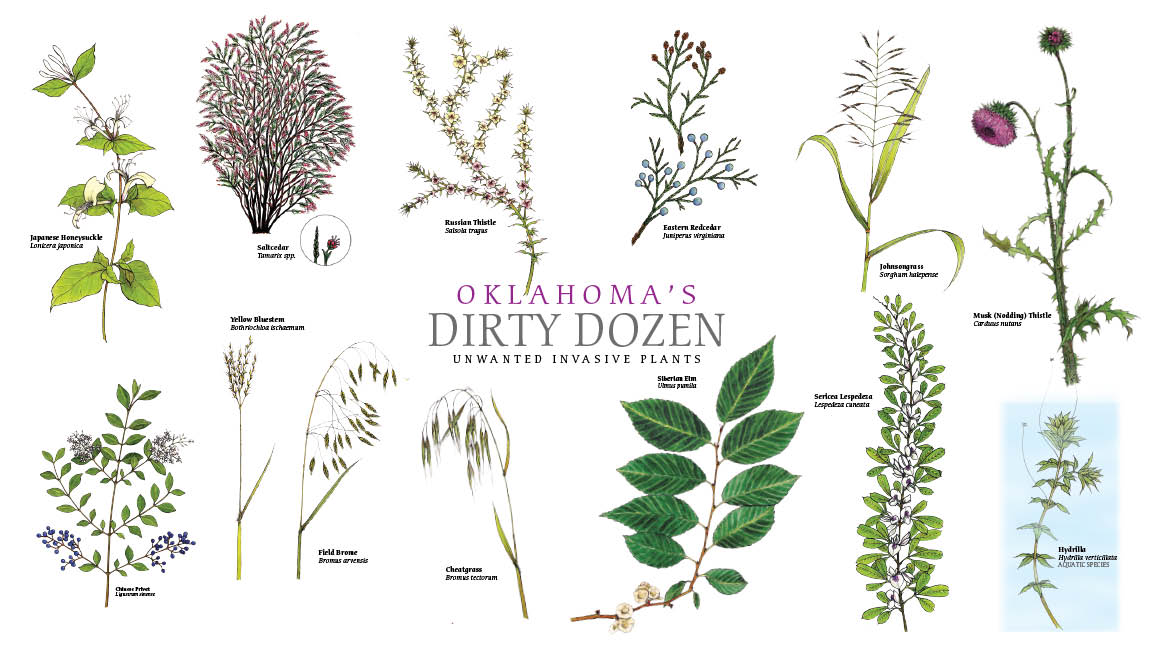
Oklahoma’s ‘Dirty Dozen’ invasive plants:
- Cheatgrass — Bromus tectorum
- Chinese privet — Ligustrum sinense
- Eastern redcedar — Juniperus virginiana
- Field brome — Bromus arvensis
- Hydrilla — Hydrilla verticillata
- Japanese honeysuckle — Lonicera japonica
- Johnsongrass — Sorghum halepense
- Musk (nodding) thistle — Carduus nutans
- Russian thistle — Salsola tragus
- Saltcedar — Tamarix spp.
- Sericea lespedeza — Lespedeza cuneata
- Siberian elm — Ulmus pumila
- Yellow bluestem — Bothriochloa ischaemum
“For instance, if it is eastern redcedar and they are small, you can conduct a prescribed fire safely and burn and kill them all,” Hickman says. “If it’s Johnsongrass and it’s totally covering an area, you either are going to have to graze it or spray it with an herbicide.”
Hickman stresses the importance of reaching out to local Extension educators to decide which herbicide is best, depending on the season and species. Digging the plant up and properly disposing of it can be done, too.
Other invasive plant species that aren’t as prevalent across the state can be found on okinvasives.org, where a watchlist for species and the land type they invade (e.g., gardens, rangeland, forested area) is kept up to date.
The OSU Extension website offers a variety of resources to assist landowners in identifying and treating invasive species. OSU provides information on “plant this, not that” recommendations on all invasive species. Local Extension offices can also help with species and connect people with specialists.
But, as Hickman explains, species on the Oklahoma “Dirty Dozen” list will never be eradicated from the state.
“We’ve planted them, we’ve spread them,” Hickman says. “Our goal is to increase awareness across the state of these species so that we can protect areas that haven’t been invaded yet.”
Editor’s note: Dean Ruhl is a communications and media relations specialist with Oklahoma State University Extension.
Angus Beef Bulletin EXTRA, Vol. 17, No. 12-B
SOURCE: Educational poster developed by the Oklahoma Invasive Plant Council to illustrate to Oklahomans the worst, both economically and ecologically, invasive plants in our state.
Topics: Management , Pasture and Forage
Publication: Angus Beef Bulletin
Related Content



Current Angus Beef Bulletin
Our November issue focuses on the females of the herd and the records that validate them.