Replacing Corn with Milo in Cattle Diets
How to use milo to replace or complement corn in finishing diets.
October 7, 2025
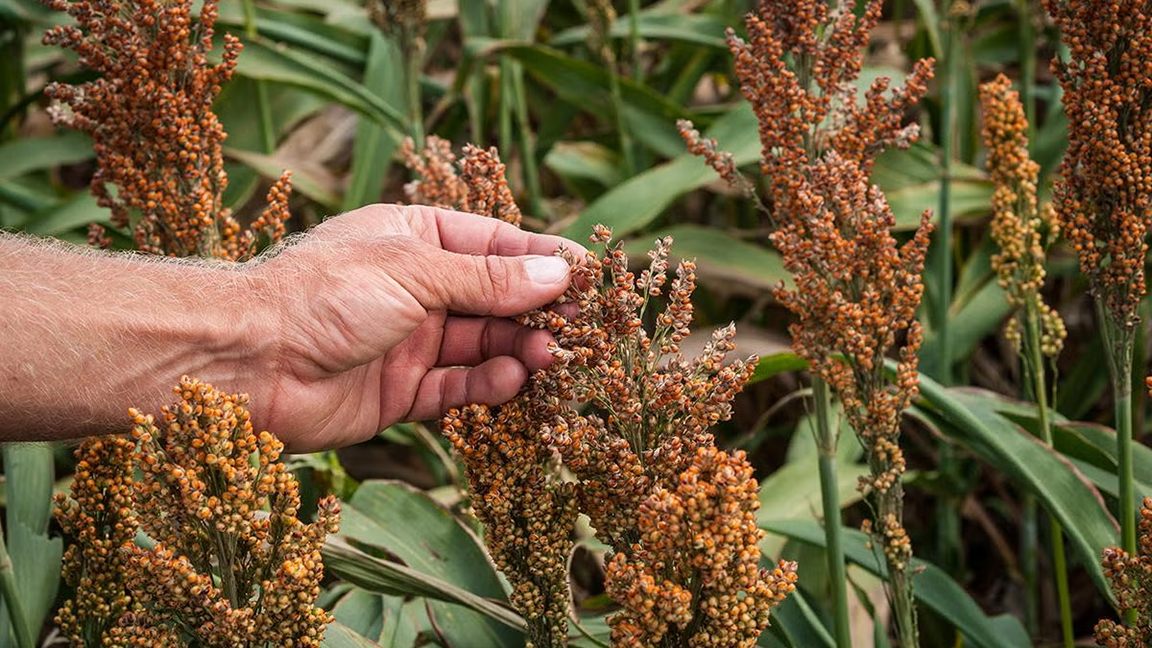
Milo or sorghum grain can be an excellent substitute for corn grain. [Photo by Lance Cheung, USDA.]

by Warren Rusche, South Dakota State University
Corn is king when it comes to cattle diets, especially in the Corn Belt. However, that does not mean that corn grain is our only option. Milo (grain sorghum) can be a viable option under certain market conditions. Here we address some common questions.
What is the feeding value of milo grain?
Milo contains less energy than corn grain does, although the protein content between the two grains is similar (or greater) for milo. Because of the differences in energy, we value milo at approximately 90% the value of corn. In other words, if corn is worth $4 per bushel, milo is a “buy” anytime it is priced at $3.60 or less.
Do I need to process milo before feeding?
Yes. Milo has a hard seed coat that resists digestion in the rumen and small intestine. We need to process the grain to reduce particle size and create opportunities for rumen microbes to degrade starch. Steam-flaking results in the greatest improvements in digestibility. Grinding or rolling are also effective for feedlots without access to a steam-flake mill. Rolling produces a more consistent feed than does grinding through a hammer mill, but both approaches are acceptable.
Fine-ground milo resulted in a 3% improvement in average daily gain and a 7% improvement in feed efficiency compared to coarse grinding.
Performance improves with more aggressive processing. Fine-ground milo resulted in a 3% improvement in average daily gain (ADG) and a 7% improvement in feed efficiency compared to coarse grinding. Keep in mind that more extensive processing leads to more rapid starch digestion in the rumen, which increases the risk of acidosis and bloat. Careful bunk management and using ionophores can reduce the risk of adverse outcomes.
Can you harvest high-moisture milo?
Harvesting high-moisture milo works well as a strategy to both reduce field losses and improve cattle performance. Harvesting milo at 22%-30% moisture allows for earlier harvest and reduces grain loss from head shatter. High-moisture milo has greater starch digestibility compared to dry grain, which would support greater cattle performance. High-moisture milo can be harvested using a combine, or a forage harvester can be used to harvest the seedhead, along with a portion of the stalk, sometimes referred to as “headlage.” Headlage is like earlage in that the feed contains both grain plus a crop residue. Harvesting as a high-moisture feed does not eliminate the need for processing, so the grain would need to be ground or rolled before the bunker or pile, or a kernel processor would need to be used if headlage was harvested.
Can milo be fed in combination with corn?
Feeding a mixture of milo with corn grain for growing or finishing cattle works well, especially when dry-rolled milo is combined with high-moisture corn. Starch from high-moisture corn is more extensively digested in the rumen compared to starch from milo. Feeding a blend of dry-rolled milo with high-moisture corn resulted in greater gains and improved feed efficiency compared to either 100% high-moisture corn or 100% dry-rolled milo in a series of studies conducted at the University of Nebraska. These researchers attributed the response to increased ruminal digestion of the dry-rolled milo and less risk of acidosis compared to when the two feed grains were fed alone.
Bottom line
Feeding milo is financially feasible when priced at 90% or less than the value of corn; however, the grain must be correctly processed to capture the full value and optimize its use. Feeding milo as a high-moisture feed or in combination with more rapidly fermentable grain sources can lead to improved performance. Cattle feeders should consult with a nutritionist or extension specialist, particularly if they have not fed milo in the past.
Editor’s note: Warren Rusche is an assistant professor and SDSU Extension feedlot management specialist.
Angus Beef Bulletin EXTRA, Vol. 17, No. 10-A
Topics: Feedstuffs , Nutrition , Management
Publication: Angus Beef Bulletin
Related Content



Current Angus Beef Bulletin
Our November issue focuses on the females of the herd and the records that validate them.