Beefing Up the Cattle Industry
Secretary Rollins announces plan to bolster American ranchers and consumers.
October 23, 2025

Adapted from USDA release
Wednesday, Oct. 22, U.S. Secretary of Agriculture Brooke Rollins, Secretary of the Interior Doug Burgum, Secretary of Health and Human Services Robert Kennedy Jr., and Small Business Administrator Kelly Loeffler announced a suite of actions to strengthen the American beef industry.
Since 2017, the United States has lost greater than 17% of its cattle ranches — more than 150,000 operations, according to USDA. The national herd is at a 75-year low, while consumer demand for beef has grown 9% during the past decade. Because increasing the size of the domestic herd takes time, USDA is investing now to make these markets less volatile for ranchers long term and beef more affordable for consumers.
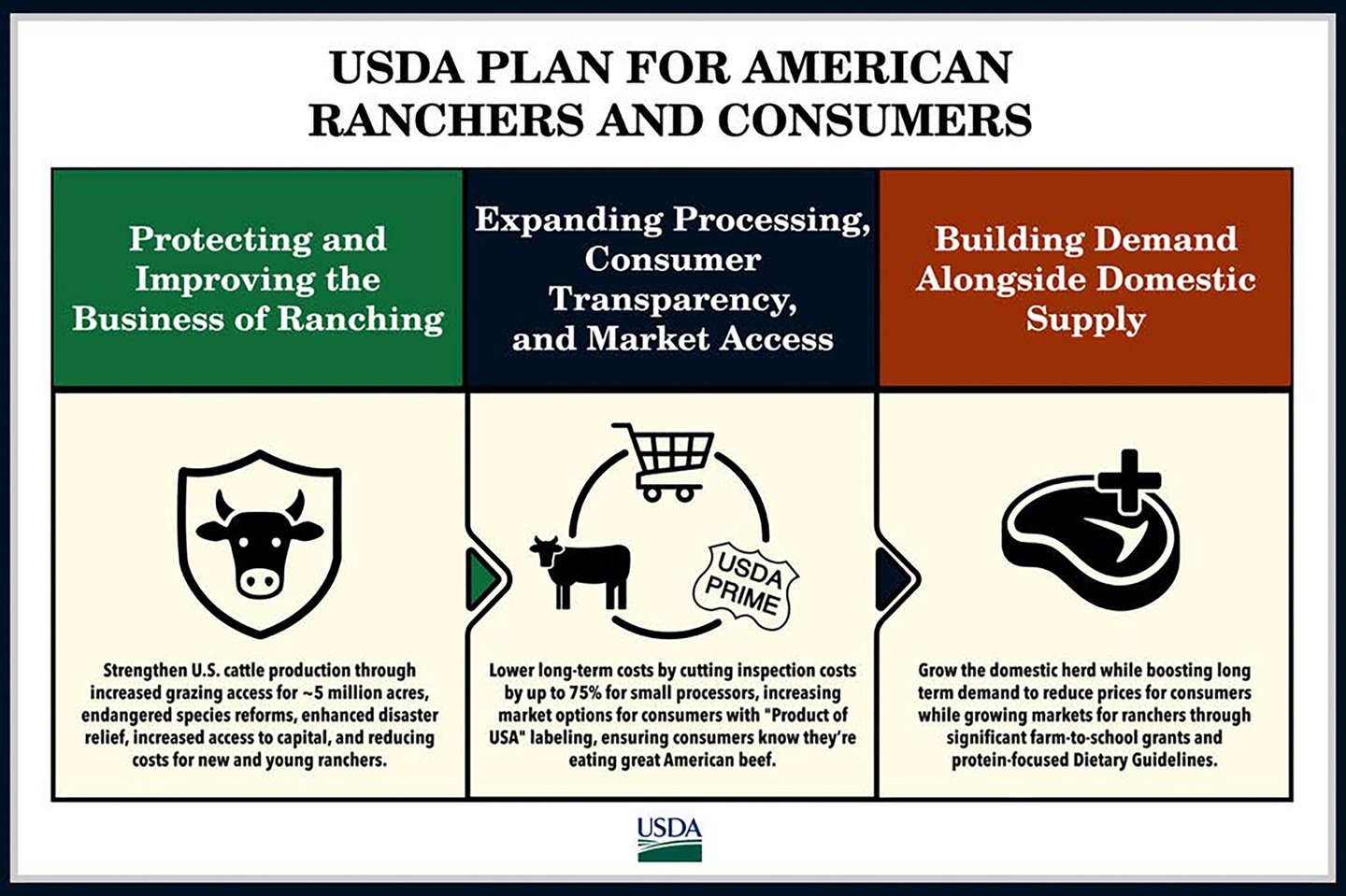
As rolled out by USDA, the plan for fortifying the American beef industry focuses on three coordinated priorities:
- Protecting and improving the business of ranching by strengthening the foundation of U.S. cattle production through endangered species reforms, enhanced predation and disaster relief, increased grazing access, increased access to capital and affordable risk-management tools.
- Expanding processing consumer transparency and market access through lowering long-term costs; increasing marketing options; and ensuring consumers have clear, truthful information about American beef.
- Building demand alongside domestic supply through growing the domestic herd while boosting domestic and international demand so ranchers are not trapped in the boom/bust cycle that has defined past cattle markets.

“America’s food supply chain is a national security priority for the Trump administration. We are committed to ensuring the American people have an affordable source of protein and that America’s ranchers have a strong economic environment where they can continue to operate for generations to come,” Rollins said, making the announcement as the Trump administration took heat from the cattle industry regarding plans to increase the volume of beef being imported from Argentina. “At USDA we are protecting our beef industry and incentivizing new ranchers to take up the noble vocation of ranching.
“Today,” she continued, “USDA will immediately expedite deregulatory reforms; boost processing capacity, including getting more locally raised beef into schools; and working across the government to fix longstanding commonsense barriers for ranchers like outdated grazing restrictions.”
“At Interior, the Department is slashing red tape and restoring grazing access on public lands to support the livelihoods of hardworking Americans in the ranching industry,” Burgum said. USDA and DOI anticipate launching a joint Grazing Action Plan in November that seeks to expand and streamline grazing on federal lands, positioning grazing as a central element of federal land management.
USDA and DOI will also work together for predator management and Endangered Species Act (ESA) reform. In addition to enhanced disaster and predation support and more affordable risk-management, USDA will prioritize new and beginning ranchers as well as increasing veteran-owned and -operated ranches.
Center of the plate
“We face a chronic disease epidemic in this country largely tied to the foods we eat,” Kennedy noted. “Under President Trump, we are restoring whole foods as the foundation of the American diet and ending the decades-old stigma against natural saturated fat in beef and dairy products. We will strengthen America’s ranching industry so families can choose nutrient-dense, minimally processed foods. Bottom line: We cannot Make America Healthy Again without America’s farmers and ranchers.”
The plan for ensuring the 2025-2030 Dietary Guidelines for Americans (DGA) “reflects sound science and practical advice for the American family, including encouraging protein as the foundation for every meal.”
It also calls for expanded access to locally raised beef for American students.
Transparency
As part of its efforts at expanding consumer transparency, the plan includes enforcement of labeling claims for meat and poultry products bearing the “Product of USA” claim. According to the plan, “Effective Jan. 1, 2026, FSIS (Food Safety and Inspection Service) inspection personnel will begin enforcing compliance on FSIS-regulated products that bear voluntary ‘Product of the USA,’ ‘Made in the USA,’ and other U.S.-origin claims before they may enter commerce.”
To promote fair and transparent beef markets, the plan calls for USDA’s Agricultural Marketing Service (AMS) to continue to publicize cattle and beef market information under the Livestock Mandatory Reporting program and to provide the Cattle Contract Library and other reporting tools.
AMS will expand its remote-grading program and expand its Instrument Enhanced Grading program, leveraging camera technology to improve consistency and accuracy while reducing staffing needs and lowering costs, according to the plan.
Other marketing focal points include enhancing local processing to increase marketing options, enhancing access to feeder-cattle data and advancing deregulatory reforms under the Clean Water Act.
Noting ranchers and farmers are the original small business owners, Loeffler added: “The SBA is committed to doing its part by cutting burdensome regulations and supplying government-guaranteed loans to support our producers as they work to strengthen the American beef supply — for consumers, our national security and the proud American tradition of ranching.”
To view the USDA Plan to Fortify the American Beef Industry, click here.
Editor’s note: This article was adapted by Editor Shauna Hermel from a news release by USDA and the plan itself. [Lead photo by USDA.]
Angus Beef Bulletin EXTRA, Vol. 17, No. 10-B
Taking heat for Argentina
Several cattle industry groups took issue with comments by President Donald Trump that importing beef from Argentina may help resolve high beef prices at retail and restaurants.
The Friday following Trump’s comments, Feeder Cattle futures were limit-down and Live Cattle futures traded sharply lower, Certified Angus Beef’s Paul Dykstra notes in his CAB Insider newsletter Oct. 22.
“The National Cattlemen’s Beef Association (NCBA) and its members cannot stand behind the President while he undercuts the future of family farmers and ranchers by importing Argentinian beef in an attempt to influence prices,” said NCBA CEO Colin Woodall. “It is imperative that President Trump and Secretary of Agriculture Brooke Rollins let the cattle market work.”
Woodall pointed out trade with Argentina was already imbalanced, with Argentina shipping beef valued at more than $800 million to the United States in the last five years while purchasing only $7 million in U.S. beef.
Furthermore, Argentina is a nation with a long history of foot-and-mouth disease (FMD) and, according to NCBA, USDA has not completed the necessary steps to ensure Argentina can guarantee the safety of the products being shipped here, further endangering America’s cattle herd.
“If President Trump is truly an ally of America’s cattle producers, we call on him to abandon this effort to manipulate markets and focus instead on the promised New World screwworm facilities in Texas; making additional investments that protect the domestic cattle herd from foreign animal diseases such as FMD; and addressing regulatory burdens, such as delisting of the gray wolf and addressing the scourge of black vultures,” Woodall said.
National Farmers Union (NFU) President Rob Larew called for strengthening fairness and competition within the U.S. beef industry rather than relying on imported products.
“Lowering beef prices for consumers starts with restoring fairness in the marketplace, not by importing beef from Argentina and undercutting American ranchers,” Larew said. “Years of drought, depressed cattle prices and unchecked corporate consolidation have already pushed many family farmers and ranchers to the brink, all while consumers pay more at the grocery store.”
Larew continued: “In times of extreme uncertainty in the farm economy, we should be doubling down on our efforts to support family farmers and ranchers here at home. The answer isn’t foreign beef; it’s rebuilding herds to meet domestic demand, restoring competition in meatpacking, enacting mandatory country-of-origin labeling so consumers know where their beef comes from, and creating a fair marketplace that works for both farmers and consumers.”
Topics: Business , Industry News , News , Policy
Publication: Angus Beef Bulletin
Related Content


Current Angus Beef Bulletin
Our November issue focuses on the females of the herd and the records that validate them.