

Why Baleage?
This method of storing forage can be advantageous for first-cutting hay.
May 22, 2024

by Makenzie Hereth & Beth Reynolds, Iowa State University
As we approach our first cutting of alfalfa, we have had consistent rainfall. This has been beneficial in relieving some drought conditions, but frequent rainfalls can be a hindrance in making dry hay. An alternative is to produce baleage.
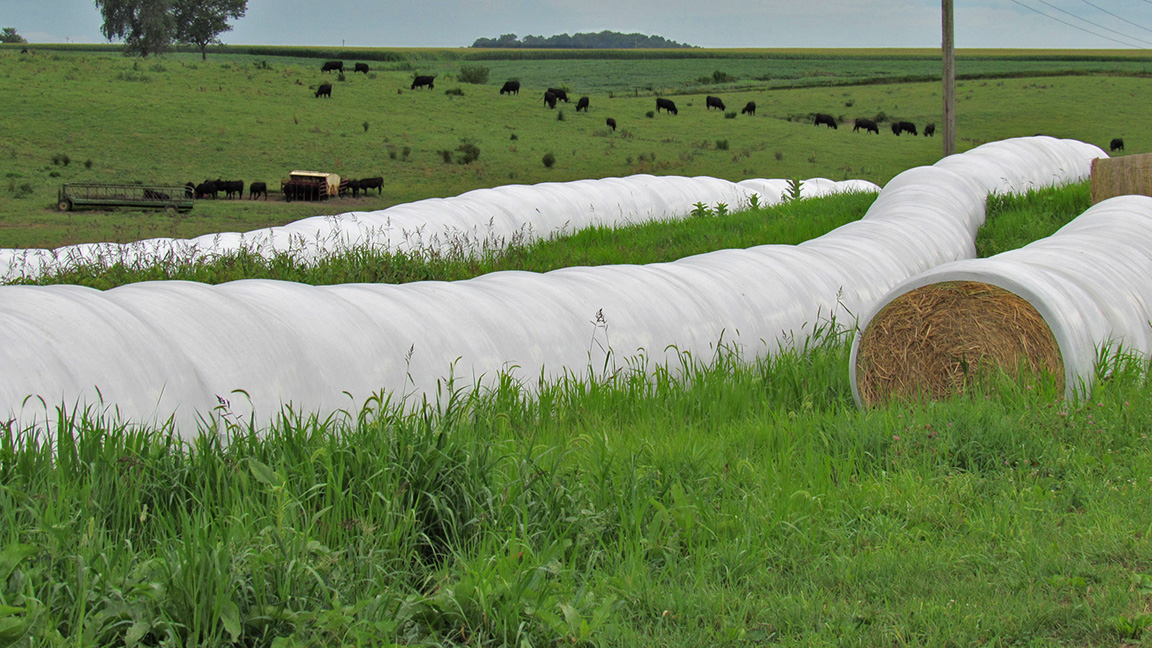
Baleage can be cut and harvested more quickly than dry hay since it is baled at a higher moisture content (40%-60%). This makes the harvest window much smaller. Additionally, baleage provides advantages when feeding cattle. Baleage provides a high-quality, palatable product, with less dry-matter (DM) loss during harvest.
When to cut
The forage crop should be cut at the maturity stage that combines yield and quality sufficient for a producer’s feeding requirements. Legumes should be cut at 10% bloom, and grasses should be cut at the boot stage. Early-maturating forage is ideal to ensure there are enough soluble carbohydrates for ensiling. For alfalfa, a good way to estimate the best time for your first cutting is to use PEAQ — Predictive Equations for Alfalfa Quality.
For both legume and grass species, nutritional quality declines as plants mature. Cutting at an early maturity stage is not only important to ensure a high-quality feed, but it is beneficial in achieving good fermentation because anaerobic bacteria need adequate highly soluble carbohydrates to grow. Cutting at this early maturity stage will produce good baleage and optimal feed value per acre.
Producers should also ensure they bale at the proper moisture content. The optimal moisture for baleage is much higher than dry hay, 40%-60%. This is typically achieved with a mower-conditioner, and a short wilting period in the field. Baling at too high of moisture content (>60%) can lead to clostridium growth and botulism. On the other hand, too dry of material leads to poor packing and an aerobic environment that can lead to bacteria and mold growth.
General management goals
Once producers cut their baleage, it must be handled properly during harvest and stored correctly. Baleage is baled at 40%-60% moisture and then wrapped with an airtight seal. When baling, a slow ground speed can help create a densely packed bale to create a more anaerobic environment. Wrapping in net wrap can also be beneficial to prevent twigs and stems from puncturing the plastic.
For ideal storage, apply six to eight layers of plastic within 12 hours of baling. This will create a good barrier to exclude oxygen. Between respiration and microbial activity, they quickly use the oxygen available, creating an anaerobic environment.
An anaerobic environment is key for fermentation. Anaerobic bacteria on the plants use plant sugars to create lactic acid, decreasing the pH, creating a stable environment. This will lead to some losses in carbohydrates, but considerably less in comparison to raking, tedding and baling dry hay.
Exposure to oxygen leads to the growth of yeasts and molds, resulting in dry-matter loss, increased concentrations in fiber components and decreased energy density. Handling the bales is important to not puncture holes or cause deterioration of the plastic barrier.
The advantages
There are clear advantages when it comes to baleage:
- Gives a greater ability to harvest forage at an ideal maturity since it can be baled at a higher moisture content.
- Allows producers to better control their cutting schedule.
- Better dry-matter retention; lower harvest losses/leaf shatter.
- Requires one-half to one-third drying time in comparison to regular hay.
- Better palatability than dry hay.
The disadvantages
No harvest method is perfect, and disadvantages for harvesting hay as baleage exist, as well. Producers should consider:
- Requires investment in a wrapper or a custom harvest crew.
- Before feed can be utilized, wait at least six weeks to ensure proper ensiling.
- Bales are typically two-thirds the size of dry round bales due to their weight. Larger equipment is needed for handling and transportation.
- Baleage is hard to market and transport, and it is often utilized within the operation.
- Have to dispose of the plastic.
Editor’s note: Reprinted with permission from the Growing Beef monthly newsletter, which is free and provides timely information from the Iowa Beef Center on topics that matter most to Iowa beef producers. Makenzie Hereth is an Iowa Beef Center communications intern, and Beth Reynolds is an Iowa State University extension program specialist. [Lead photo courtesy of the Iowa Beef Center.]
Angus Beef Bulletin EXTRA, Vol. 16, No. 5-B
Topics: Equipment / Facilities , Feedstuffs , Management , Pasture and Forage
Publication: Angus Beef Bulletin
Related Content


Current Angus Beef Bulletin
Our September issue focuses on the females of the herd and the records that validate them.