




Tips for Attracting a Premium at Auction
SDSU project evaluates factors influencing feeder-calf prices.
March 8, 2023
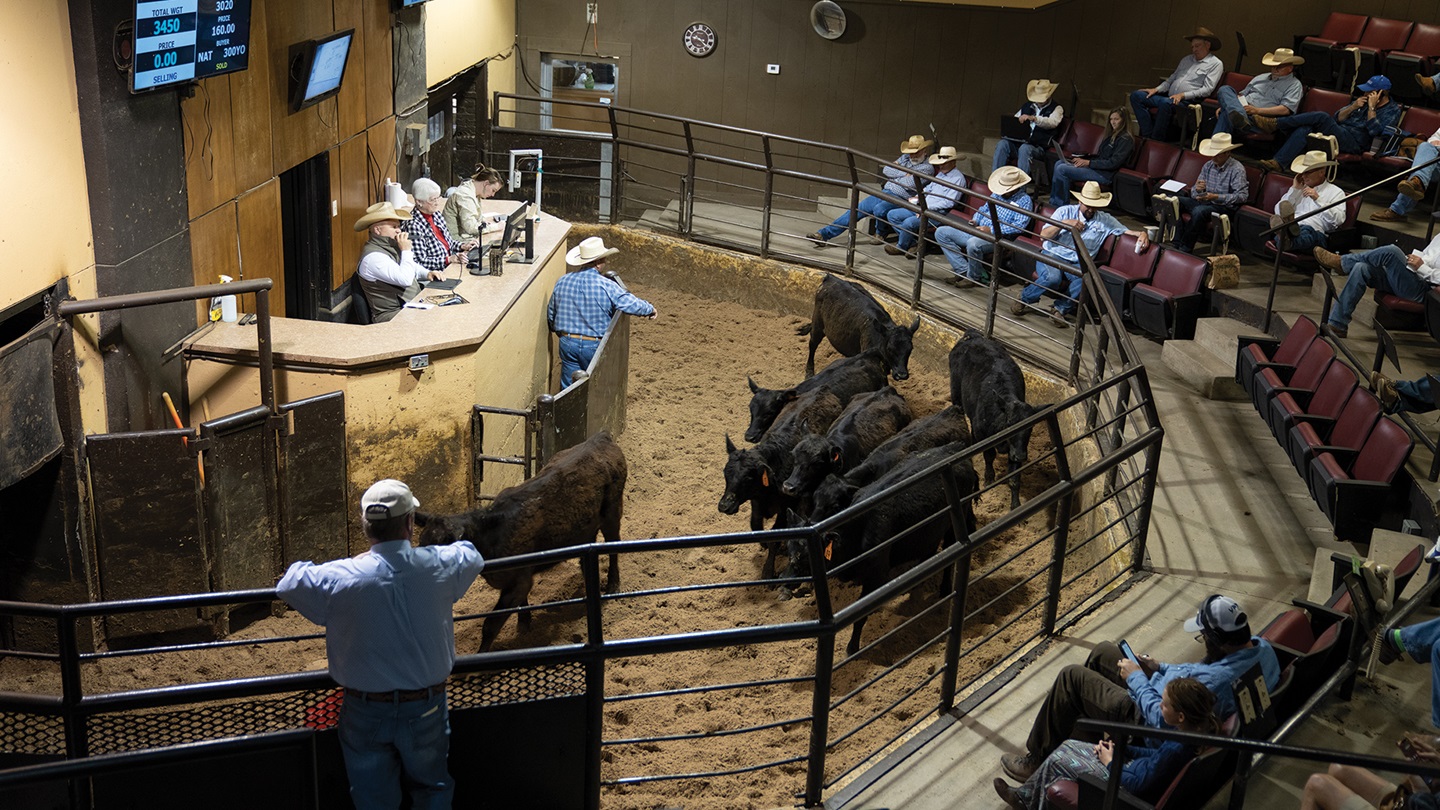

Data on 116,000 head of calves marketed at five South Dakota auction barns in fall 2021 were collected and evaluated by South Dakota State University (SDSU) Extension specialists to gain better insight into the factors influencing selling prices.
The project found that lot sizes of more than 100 head tended to garner the highest premiums. Additionally, premiums were generally received for steers vs. heifers, black-hided calves and calves with vaccination history.
Data for this project was collected at Faith, Philip, Hub City (Aberdeen), Mitchell and Fort Pierre livestock auctions during the weeks of Oct. 4, 11, 18 and Nov. 1, 2021. Olivia Amundson, a SDSU Extension cow-calf field specialist based out of the Sioux Falls regional center, worked with Extension colleagues Robin Salverson, Heather Gessner, Julie Walker, Kiernan Brandt and former specialist Adele Harty to collect the data from 24 sales.
Data collected included auction barn, date, seller identification (ID), gender of calves, number of head per lot, average weight, hide color, vaccination data, whether calves had been creep-fed, whether calves had received implants, if calves were part of a branded program, wean status, if calves had horns, mud score, price per hundredweight (cwt.), price per head and additional comments.
To maintain statistical integrity, calves weighing less than 265 pounds (lb.) and those weighing more than 800 lb. were removed from the database, as were lots of one or two calves.
Black and black-white-face calves were combined and classified as black, and red and red-white-face calves were classified as red because the analysis indicated no difference in price between solid color (black or red) and white-face lots.
The vaccine protocols tracked included whether calves had received a seven-way clostridial vaccine, or four- and five-way respiratory vaccines. This study also compared any price difference between calves given modified-live virus (MLV) vs. killed vaccine and saw no price premium difference between the two.
Additionally, the researchers found no statistical differences in selling price for implanted cattle vs. non-implanted cattle or creed-fed calves vs. calves that had not been creep-fed.
What pays
Overall, the SDSU Extension specialists concluded that uniform calf lots — meaning calves similar in type, kind and size — in larger groups of more than 100 head generated the most robust premiums. Larger groups of calves may help fill a semitrailer load and minimize the need to commingle with other calf groups or to find other calf groups to make a uniform load, the SDSU researchers theorize.
When looking at lot sizes of 101 head or more, 50-100 head, 21-50 head and 3-20 head, the SDSU analysis found premiums of $15.85 per cwt. between the largest lot size and the smallest lot size. Premiums of $10 to $6 per cwt. did still exist among calf lot groups less than 100 head, while calf groups of 20 head or fewer had minimal premiums.
The SDSU research data showed black-hided cattle earned premiums of $9.75 to $34 per cwt. compared to other colors and color combinations.
Steers reaped a $19.77-per-cwt. premium compared to heifers and a $23-per-cwt. premium to bull calves.
Interestingly, this SDSU research found that the fall calf run produced a premium for sale barns located west of the Missouri River in South Dakota, vs. that east of the river. The SDSU Extension specialists suggest, due to the timeline of data collection, time of year is an important marketing consideration based on where the volume of buyers are consolidating purchasing efforts.
They attribute this to the fact that during the fall calf run, western South Dakota ranches often sell feeder calves in large lots. As a result, western South Dakota auction barns often boast higher numbers of calves for sale in the fall, which can attract more buyers at the west-river sale barns.
Vaccination programs also benefited sellers. Calves given a seven-way clostridial vaccine at birth and in the fall garnered a $17-per-cwt. premium vs. the calves receiving only one dose. There was an $18- to $25-per-cwt. premium given for vaccinated calves vs. those that were either unvaccinated or for which vaccination status was unknown at sale time.
Management suggestions
For producers aiming to earn future premiums, these SDSU Extension specialists suggest striving for calf crop uniformity. This is typically best achieved with a defined calving season within an 80-day window instead of across 120 days.
Also, producers might consider working with neighbors or other cattlemen to coordinate selling a uniform calf group to get a better price on sale day. To make this work, calves from different herds should be born in the same time range and should be managed similarly for castration, dehorning and vaccinations.
Amundson offers these perspectives gleaned from interviews with order buyers and sale barn owners:
- Vaccinations do matter. Amundson suggests producers communicate vaccination history with prospective buyers and work with a sale barn that helps them convey that information.
- Lot sizes do matter. This primarily is for efficiency, so buyers can build a semitrailer load. Recognizing this, Amundson stresses the importance of producers working with the auction market, especially for smaller-scale producers. She explains: “Working with your sale barn can help group your calves with larger lots to make a potload.” Having loyalty to your auction market can be beneficial, as well, she says, giving the example of trusting your sale barn to place your cattle in an order that will benefit price received even if that means selling later in the afternoon.
- Regarding hide color, Amundson suggests, “Pick a color and run with it.” If you have a group of black calves with two or three red calves, the three colored calves will get pulled and receive a significant discount. Having one color to run through the ring reduces discounts, she explains.
- As for steers vs. heifers, there is a spread, but it is likely this spread will be tighter this year due to a combination of things. One factor is that some producers will be holding on to heifers to rebuild their herd, so less of the front-end heifers will be coming to town to be sold, and there’s a tight inventory across the state and country.
To learn more about this research, listen to SDSU’s podcast, “Sale Barn Data,” Cattle HQ, Episode 17.
This project was funded through the North Central Extension Risk Management Education Center, with funding provided by USDA’s National Institute of Food and Agriculture. The SDSU Extension team surveyed the same sale barns for four weeks in spring 2022 to collect data on backgrounder cattle. Results of that study will be forthcoming.
Editor’s note: Kindra Gordon is a freelance writer and cattlewoman from Whitewood, S.D. [Lead Photo by J.D. Rosman.]
Angus Beef Bulletin EXTRA, Vol. 15, No. 3-A
Topics: Feeder-Calf Marketing Guide , Industry News , Marketing , News
Publication: Angus Beef Bulletin
Related Content


Current Angus Beef Bulletin
Our September issue focuses on the females of the herd and the records that validate them.