



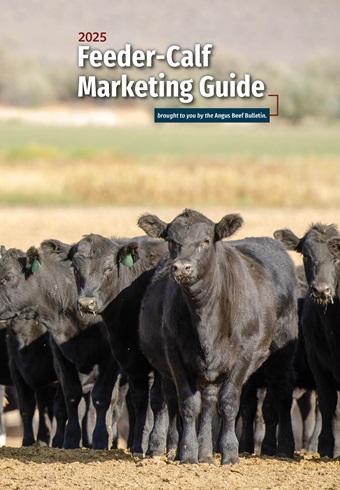
Feeder-Calf Marketing Guide
Celebrate the Present; Prepare for the Future
Cattle prices are high now, but they won’t always be. Prepare now.
July 31, 2025
Everyone should take time to celebrate the current cattle market. Historically strong demand, tight supplies and near-record profitability have combined to create what promises to be one of the longest-lasting periods of prosperity that we have ever experienced in the cattle business.


 The higher prices predicted for the next several years are a welcome reward considering all the challenges ranchers have faced in the past. Market volatility, the whims of Mother Nature and economic downturns are just part and parcel of our business. They are nearly as constant as death and taxes.
Changing dynamic
However, our industry has had some very specific challenges. We had to deal with declining demand, fueled by a segmented industry saddled with a commodity pricing system that did not enable feedback or economic signals to be efficiently sent through the production system.
The result: We were constantly disappointing consumers. Dollars flowing into our industry were declining on an inflation-adjusted basis. The industry was experiencing consolidation and concentration as a result.
 We should celebrate that those dynamics have changed. The industry has never been in a stronger position from a supply and demand standpoint. We should celebrate the success of the Certified Angus Beef ® (CAB®) brand and its positive effect on beef demand. We should applaud ourselves for the improvements we have made in quality and efficiency and how we have more dollars flowing into this industry.
We should be excited about how the value of genetics has increased dramatically, and how the marketing system is evolving to provide more price differentiation and information flow that leads to improvements in product quality.
 The next couple of years will strengthen producers’ balance sheets and bottom lines. Celebrating successes is one of the true joys of life.
No time to rest
History also teaches us that while we are enjoying the fruits of current successes, we should simultaneously prepare for the future by beginning to put into place what we believe will set the stage for future achievements.
Success in agriculture is never a destination. Rather, it is a continuous process of steady incremental improvement, building upon past accomplishments while preparing for what’s to come.
There is a lot of uncertainty about the future, the most successful ranchers will be those who can adapt to the rapid change and continual transformation we see in our industry.
While we may not know entirely what the future holds, there are a few trends we can be certain will drive the next stages of the cattle industry.
 Trend #1
The value of genetics will continue to be the primary differentiator in the marketplace.
Good management is almost a given at this point. It is expected. The value difference between an industry-average pen and an industry-leading pen of cattle can be more than $600 per head.
We routinely see exceptional cattle return grid premiums $150 per head greater than average pens. We see similar differences when measuring differences in feed efficiency. An additional 50 pounds (lb.) of carcass weight contributes yet another $150.
It is understandable that we focus on pen and individual differences in value that occur because of genetic improvement. These are vital metrics, but we need to keep in mind that genetics have been the driver behind improved beef demand.
The base price we are using to calculate all of these differences is $800 per head higher than it would have been if the industry had not turned around beef demand. Premiums for things like quality grade are significant, but their greatest effect has been on demand.
At today’s price levels, small genetic differences have large economic ramifications. Increasingly, cattle buyers understand that genetics are not only the largest driver of differences in profitability, they are also the best way to mitigate risk. Cattle feeders are increasingly using two hedges to reduce risk — they lay risk off on the Chicago Merchandise Exchange (CME), and they invest in a “genetic hedge.”
Of course, herd health, lot size, condition and distance from the feedyard will always play a role in determining value, but genetics are increasingly the primary way we differentiate cattle. Market access and market flexibility will also remain important.
Programs like CARE, non-hormone-treated cattle (NHTC) and All-Natural require a little more effort. But they continue to show positive returns on investment (ROI) as they increase the number of buyers, and they are niche markets that have customers who have proven to pay premiums.
Much like genetics, if you are making the investment, you should take steps to get rewarded for those investments.
 Trend #2
Verification, documentation and collaboration are becoming vital components of the marketing equation.
The seedstock industry went through a similar evolution. At one point, it was strictly phenotype and reputation that determined value. Then we began to performance-test and provide performance information. Eventually we evolved to having genetic evaluations and providing expected progeny differences (EPDs), which removed a lot of the guesswork. Reputation was replaced by brand equity.
The market will continue to see more and more price differentiation, but in order for buyers to have the confidence to pay premiums, they will require verification and documentation of the data they are being provided. Differentiation of cattle requires documentation and verification.
Verification and documentation provide assurance to buyers about the genetic merit and management practices the cattle have received.
Collaboration is more closely aligned to genetics, in that collaboration increases overall value.
 Info-based relationships
“Supply chain” was little more than a buzzword 10 years ago. Today, millions of cattle are moving through dedicated supply chains. Collaboration is about collecting and utilizing information to create more value throughout the supply chain. It breaks down the barriers that exist between our highly segmented industry. Collaboration is made possible through information and relationships.
Information is vital to making better management, marketing and genetic decisions. Information is what makes price differentiation possible. Information allows the market to send appropriate market signals and to make decisions that will make relationships sustainable over the long haul. In the world of artificial intelligence (AI), large datasets can be mined to improve efficiency, increase value and drive demand.
Relationships are more important than ever, and all relationships are built upon trust. Trust comes with integrity and communication. Feedback loops that provide information up and down the chain make long-term relationships possible.
There are a lot of reasons for cattlemen to celebrate, and the celebration should be one of the longest-lasting ones we have experienced. With that said, the cattle cycle is alive and well.
Position for the future
Cow-calf producers will not always have the leverage. It will shift to the feeders and to the packers as it always does. There is a misconception that premiums go away in up markets and increase in down markets. The data do not bear that out; in fact the premium for documented genetics and genetic merit are historically high at the same time we are experiencing historically high prices.
Admittedly, when you are making $1,000 per head, a $100-per-head premium is not as impactful as when you are breaking even. The dollars are the same, the ROI is increasing, but taking part in these programs may not be as impactful in the short term.
I would argue the AngusLinkSM program and these marketing opportunities’ primary value has always been in helping operations position themselves for the future (benchmarking), and by building relationships and increasing value of those cattle not only in the good times, but in the tough times, as well.
The industry has been experiencing phenomenal improvement in both efficiency and quality. We have driven beef demand and increased the number of dollars coming into the industry as a whole.
Perhaps the most exciting and most frightening thing about how fast the industry is changing and evolving is the fact the bar is rising at a frightening pace. Excellent cattle five years ago are average cattle today.
Today’s price levels do not signal the time to take a breather and risk getting behind. Rather they are an opportunity to position our operation for the future. I truly believe the AngusLink program is one of the most valuable tools cow-calf producers have in ensuring success not only today, but in the future.
Give us a call, and let’s discuss not only how we can help you document the genetic merit of your cattle, but how we can help you build relationships with your seedstock supplier and the buyer of your calves.
Editor’s note: Troy Marshall is director of commercial industry relations for the American Angus Association.
Topics: Business , Feeder-Calf Marketing Guide , Marketing
Publication: Angus Beef Bulletin
Related Content


Current Angus Beef Bulletin
Our November issue focuses on the females of the herd and the records that validate them.