

Market Update with Derrell Peel | Winter 2025
Season: 4 — Episode: 22
November 26, 2025
You don’t have to look too far to find positive news for the beef industry these days. While not every news story is a glowing outlook for ranchers, a solid market and demand for beef certainly can put a smile on our faces.
On this episode of Angus at Work, we welcome you to listen in as we visit with Oklahoma State Agricultural Economist Derrell Peel regarding:
- what 2025 looked like from a market standpoint;
- what opportunities and challenges exist for cattle producers in 2026;
- whether the potential reopening of the U.S.-Mexico border will have much effect on supply moving forward; and
- more!
A huge thank you to Purina for their sponsorship of this episode.
Find more information to make Angus work for you in the Angus Beef Bulletin and the Angus Beef Bulletin EXTRA. Make sure you’re subscribed! Have questions or comments? We’d love to hear from you! Contact our team at abbeditorial@angus.org.
Intro (00:04):
Angus at Work, a podcast for the profit-minded cattleman, brought to you by the Angus Beef Bulletin, we have news and information on health, nutrition, marketing, genetics, and management. So let's get to work, shall we?
Host (00:27):
You don't have to look too far to find positive news for the beef industry these days. While not every new story is a glowing outlook for farmers and ranchers, a solid market and high demand for beef certainly can put a smile on our faces. On this episode of Angus at Work, we welcome you to listen in as we visit with Oklahoma State agricultural economist Daryl Peel, regarding what 2025 looked like from a market standpoint, what opportunities and challenges exist for cattle producers in 2026, whether the potential reopening of the U.S.-Mexico border will have much of an effect on supply moving forward, and much more. So, let's dive in.
Purina ad (01:08):
Raising cattle demands, grit, determination and the right nutrition. That’s why cattle producers have turned to Purina Animal Nutrition for over 130 years. From starters that help set calves up for success to protein that fuels cattle growth to minerals to help keep herds performing, Purina has the products and expertise that work as hard as you do. Get rewarded for your work with proven nutrition from Purina. Learn more at purinamills.com/cattlecare. That's purina mills.com/cattlecare.
Host (01:38):
Welcome to Angus at Work! I'm your host, Lynsey McAnally, and today we're discussing the current state of cattle markets. Derrell, I'll be honest. This isn't my area of expertise, which probably doesn't come as too much of a surprise, but luckily it's yours. Do you mind kicking the episode off with an introduction for those listeners who may be new here?
Derrell Peel (01:58):
Yeah, you bet. So I'm Derrell Peel. I'm a professor in the Department of Agricultural Economics at Oklahoma State University and I'm the extension livestock marketing specialist. That's a position that I've had for my entire career here at OSU. I've been here a little over 36 years now in that position. All I do is watch markets, develop educational risk management and marketing education programs for the industry. I'm on campus so I do advise graduate students. I teach a little bit as well, but the bulk of my work has been with the industry as an extension specialist.
Host (02:39):
And that entails you going out into the world and explaining livestock markets or discussing livestock markets with cattlemen. What does that kind of look like for you?
Derrell Peel (02:49):
I do anywhere from 50 to 75 meetings a year all over the state, the country, and even internationally. So I do a lot of meetings. I also do a lot of media work. Market outlook is very dynamic, constantly changing. I have some schedule planned media things, things we produce on campus or whatever. But I also respond on demand to media requests, so I do a couple hundred media things a year as well.
Host (03:24):
Perfect, and responded back to me and here you are, right?
Derrell Peel (03:27):
Exactly, exactly.
Host (03:29):
Perfect. We're so excited to have you. I neglected to mention that our guest today is a part of our quarterly market update. If you haven't gone back and listened to our three previous guests for the year, please do that. Those are noted over on the Angus at Work page on whatever platform you're listening on. Today we're going to be talking about the market as a whole and doing a wrap up here at the end of the year, right before Thanksgiving headed into the greater holiday season. But Derrell, from a market perspective and from your perspective, has this been a good year for cattle producers?
Derrell Peel (04:07):
Oh, I think this has been an outstanding year by and large for cattle producers. The cattle industry has been on a tremendous run in terms of prices. This is really the third year we've seen almost uninterrupted increases in prices. So we've had record levels across the board for all classes of feeder cattle and fed cattle. So it is been a remarkable year for the most part subject to some volatility. We'll probably talk about that a little bit. At the same time, this market is in a tremendous run and it is the result of conditions that have been developing for a number of years.
Host (04:42):
So watching the prices coming through sale barns and on video sales and on Facebook posts and just at the local coffee shop, it seems like there was plenty to celebrate from a market perspective in 2025. I'm glad to hear you confirm that. Sometimes I just like to hear confirmation! Do you mind sharing with us a little bit about where the cattle market currently stands as far as feeder calves?
Derrell Peel (05:07):
Yeah, the feeder cattle market ... Again, all of this is in response to the underlying supply situation combined with the demand side. We've got both of those elements that are really supporting these record prices, price levels that generally that we're at. So we will maybe come back to demand at some point. Demand has been outstanding. That's probably all you really need to say about beef demand has been remarkable from a supply standpoint.
We have the lowest cattle inventory in multiple decades coming into 2025. The beef cow herd was at the smallest level since 1961, and this has developed over the last several years. The latest cyclical peak was in 2019 and we would've normally liquidated somewhat from that level, but then drought kicked in over the last five years or so and has taken us down to much lower levels than we intended to be anticipated being at. The market is telling us with the price levels that we're smaller than we need to be. So the market is trying to provide incentives for this industry to rebuild back up to a higher level than we currently have.
Host (06:20):
I think that with the current state of prices, we are seeing a lot of folks capitalize on cull cows. Maybe something that they would've held onto previously, but with prices where they're at, it is pretty alluring to take them to town. So do you mind telling us a little bit about where the cull cow/ cull bull market is currently?
Derrell Peel (06:44):
Yeah. This is the third year we've actually had a pretty sharp decline in cull beef cow slaughter specifically. We're down about 40% from the peak in 2022. Following the herd peaking in 2019, we began liquidation. You started seeing some elevated cow slaughter initially, but now that's dropping pretty sharply. And so we're trying to stabilize this herd at the current level, and we're doing it right now by decreasing cow slaughter. So we're taking less cows out of the herd. We're at not a record, but a very low level here. And so that cull cow market, and as a result of the decreases in cow slaughter, we've seen continual advances in those cull cow prices. So cows and bulls make up that lean beef market that's so important for the ground beef market that we have.
And so cull cow prices are at remarkable levels. On the one hand, it's an opportunity for producers if they do need to cull or do that. On the other hand, - because of where the market's at and because of the value of calves - we're actually screening these cull cows pretty hard. And so it is kind of a situation that happens in this type of market where one man's culls are another man's new cow. A lot of times an individual producer might preg check and cows come up open or they're bred late. They're not going to fit your herd anymore. So for that person, they're a cull. But in a lot of cases other producers are taking them home and to see if they can get another calf or two out of them to take advantage of these high feeder cattle markets that we have.
Host (08:32):
Well, that take on cull cows I think is really interesting and I think that segues really well into where do we think we're at as far as replacements. It seems like, again, as people are taking maybe some older cows to the sale barn, it is opening up an opportunity for us to bring in some of those younger females, first calf heifers, maybe some newer genetics from our operations. Where do you think that replacement market is?
Derrell Peel (09:03):
Yeah, again, we find ourselves with this low inventory. We're trying to stabilize this number, which sets the stage for herd rebuilding. Certainly the overall, again, if you look at calf prices, the market's trying to provide incentives for some heifer retention, for some herd rebuilding. We have not seen much of that up to this point. That breeding animal market — whether we're talking heifers or even older cows, middle-aged cows — is beginning to really heat up.
It's quite variable in some cases. It's hard to get a real beat on what that market level is in one number. You hear a lot of stories about the value of these cows and anecdotally some very impressive prices for these cows. I think there's more of that ahead as we go forward because again, we're in the very early stages of heifer retention and herd rebuilding if in fact we've started, and so we're probably going to be in this for another couple of years where we see quite a bit of interest in acquiring these replacement females.
Host (10:07):
I think there could be a lot of opportunity out there for folks that capitalize on that, whether they retain some of those females back and sell them as bred first calf heifers. Or even on the heifer development side of things if somebody wanted to bring another stream of revenue.
Derrell Peel (10:25):
Yeah, absolutely. I think that, again, it's a market that's developed a little bit more slowly. I think a couple of years ago even, some people thought this market was about to take off from the standpoint of demand for those breeding animals. Maybe [they] got a little bit ahead of the game and were a little bit disappointed ultimately when they had to go ahead and move those animals. But it's slowly gaining momentum as we go forward. I don't know that we're going to have a single big push like we saw about 10 years ago. We went through something kind of similar to this and we saw some tremendously strong demand across the board for these breeding females. I don't know if it's going to develop that way. I think it's going to be a little bit slower pace and take longer this time, but it's still steadily building as we go forward. And again, I think we've got at least a couple more years of that ahead of us.
Host (11:15):
So as you mention that, do you have a take on where you think the market's headed in 2026? And I ask that fully well knowing that you don't have a crystal ball over there on your side of the screen. Where do you think next year has us sitting?
Derrell Peel (11:29):
Well, I don't have a crystal ball exactly. On the other hand, the story we've been telling hasn't really changed much for about three years as this supply situation has developed. Again, in conjunction with very strong demand, we got where we are, we've got record high prices. Again, we haven't even started the process of herd rebuilding. The feeder cattle supply has continued to shrink in this latest cattle cycle. The calf crop actually peaked in 2018 and has gotten smaller for the last seven years. And so the calf crop estimate that we have right now for 2025 would be the smallest total U.S. calf crops since 1941.
So numbers are tight. We're going to stay at these elevated prices. In fact, when you think about it going forward, we have to take that tight feeder cattle supply and retain heifers out of that. Pull some additional animals out of that feeder supply to invest in the future herd rebuilding. Our expectation is that we will see prices actually continue to improve in 2026 and 2027 for sure. And if you time it out right now, we're going to be in very tight supplies basically for the rest of the decade. So we're going to be in pretty good shape, I think to finish out the next three or four years at a minimum.
Host (12:48):
I've heard a lot of talk lately and been present for a lot of presentations about the fact we're feeding cattle longer and to heavier weights because we don't have as many cattle on feed. Do you have any thoughts when it comes to that?
Derrell Peel (13:02):
Yeah, there's definitely a market element to that. The backstory here, of course, is that carcass weights have been getting heavier for about 70 years. That's a long-term structural change in the industry. Genetics have continued to improve management and feeding technology has continued to improve, but in the short run market conditions can exaggerate that. And so steers across the whole industry from a feedlot standpoint, we saw about a 22 or 23 pound (lb.) year-over-year increase in average steer carcass weights last year. That's a huge jump. I mean, it's averaged 4.5 lb. a year or something as a long-term trend. So big jump due to short run market conditions. Part of that is the fact that we've just got tight feeder cattle supplies, so we're trying to compensate for less animals with heavier carcasses.
The market is providing that incentive and we're doing that. We're still doing it again in 2025. Carcass weights are up almost as much, not quite as much, but almost as much as they were last year. In the weekly slaughter data, which we finally just got caught up on after the shutdown at the end of October, there was a week where the average steer carcass weight in the U.S. was 983 lb.. Which is the first time that steer carcass weights on a weekly basis have ever gone over 980 lb. So we continue to push those things in the short run. Now, some of that will change someday. We will back out of some of these market conditions and we might pull it back slightly, but the underlying trend is still there. So these animals are bigger now. They're going to stay basically bigger, although they may moderate a little bit as we go forward.
Host (14:46):
Do you think that that increase in carcass weight is having any effect on our overall cow weight, the size of the U.S. cow herd from a pounds perspective, not a per head perspective.
Derrell Peel (14:59):
If you go back to the 1960s and beyond, cows and bulls have both gotten bigger over time. That's within breed development as well as use of continental breeding and so on in the earlier part of that especially. But yeah, cows continue to get bigger. I think that is one point of caution here. I mean, there's reasons to make finished animals bigger up to a point. There may come a time when that there's a limit to that, but cow sizes is something I think we do have to be a little bit careful with because those cows are outside. They still have to match an environment, and I do think that's something that producers individually have to sort of. Balance between the market incentives for more pounds, which is very strong against the production implications of having those bigger cows out in the country in certain environments, at least.
Host (15:55):
With all that said, where do you think barriers lie for the next market year? Are there any things that our producers need to be on the lookout for when it comes to, I guess arising concerns?
Derrell Peel (16:09):
Again, the industry is very strong fundamentally both supply and demand in my opinion. In fact, for a number of months now I've told folks that I thought the cattle industry was pretty bulletproof in terms of the resilience of those fundamentals. I think that's still true. I've also said it's not bombproof. By that I mean that the greatest potential for negative implications for the industry really is coming from the external factors. It could be macroeconomic-related. Most recently, it's been a lot of political stuff that has created a lot of turbulence and volatility in the market. Uncertainty is probably the biggest thing that I think is a bit of a barrier for producers because trying to figure out exactly what you want to do, how aggressive you want to be about pursuing this? I think the market is offering us some tremendous opportunities. Ultimately, I still think they're going to be there. In the meantime, there's just a lot of uncertainty that producers have to figure out in terms of how they want to approach that and how aggressive they want to be about getting after that.
Host (17:17):
We've all seen a few statements in the media here recently. Do you have any advice for producers who are trying to navigate some of that volatility and how they might be able to go about putting a plan in place to navigate that?
Derrell Peel (17:33):
Yeah, it's become important. More important. Managing the volatility and the uncertainty is at least as important as what your expectations are for the market. I do expect higher average prices for cattle across the board in 2026. That said, for an individual producer, you don't sell cattle on the average price for the whole year. You typically sell a few times at very specific points for certain types of cattle, whether it's calves or feeder cattle or fed cattle, whatever it is. So I think it's important for producers to identify ahead of time those marketing windows when you're going to have to do something and then take some risk management measures to try to protect those. Now most of the things that are impacting the market negatively are generally pretty short-lived. They're external shocks. Again, the market's pretty resilient. Once the shocks pass, we bounce back pretty quickly in most cases, and I think we will continue to for the most part.
So flexibility to adjust that planned marketing is one factor that can be very helpful. Just the ability to wait one or two or three weeks, maybe longer than you intended to can be very valuable. But beyond that, then producers need to think about whether they need to use some actual risk management tools. One of the insurance products, LRP insurance or something like that, or maybe using options, hedging on futures, contracts, whatever it is. I do think that those are still very important. A lot of times we tend to think that if we're in a bullish market, we don't need to do risk management. When you've got a very volatile market, then I think you still very much need to think about risk management.
Host (19:19):
I saw your recent article on the potential reopening of the U.S.-Mexico border just a few days ago. Do you know where that currently stands as far as the actual border reopening or potential border reopening?
Derrell Peel (19:33):
At this point, I've not heard anything official. I think it's being deliberated, hopefully primarily from a veterinarian and epidemiology standpoint. But there's a political element to it as well. The market has certainly been speculating that we could see some changes in that border situation, and again, the market is going to anticipate that. Probably react at least initially negatively to that. But I've seen nothing official about when that might happen or indeed how the process might work once it does happen.
Host (20:08):
Sure. And if that border does reopen, what effect do you see that having on the current market?
Derrell Peel (20:16):
I don't think it's going to have a huge immediate impact other than whatever the psychological response is. That would be largely in the futures markets, but it does spill over into cash markets somewhat as well. And, again, that should be pretty short lived. The reality is particularly here late in the year if it were to happen here in the last few weeks of the year, it's not an instant process. I mean, there's a couple of questions here. One is people are trying to get some sense of how many cattle might be backed up in Mexico since we've been closed of the last year. And so that's one question. I don't think there's maybe as many backed up as some people think because it's been long enough now that some of those cattle in Mexico that would have been exported have now been reabsorbed into the Mexican market. But that's a question is how many are there? But the other thing is it's just not an instant process. There's not thousands and thousands of cattle that are going to cross immediately once we open the border. It's a process that the Mexican producers have to go through to get the animals prepped from a health standpoint to get the paperwork done. More importantly, in many cases, it takes time, it takes effort, it takes expense on their part to do that.
And even the border itself has been closed for a while. So a lot of those facilities where they're doing quarantining and inspections and so on may have to restaff once we decide to open the border. So all of that's going to take some time. And again, here we are late in the year, I would say, if we open the border anytime between now and the end of December, we will see hardly any cattle get across. Maybe just a few thousand head. Again, depending on exactly what USDA's protocol is for reopening the borders in terms of where and when and so on.
Host (22:06):
And just to shed a little bit more light on this, do you have any insight on where are those Mexican cattle being fed in the United States or just being brought over to be processed? Where are those cattle typically falling within the market?
Derrell Peel (22:22):
Well, we've got feedlots in the U.S., mostly in Texas that specialize and have for a long time in feeding Mexican cattle. And there's a lot of other feedlots that do feed some Mexican cattle. I know some as far north as Colorado that have fed Mexican cattle. So there are places that over the years have used those cattle, are used to them and in some cases are very reliant on those supplies. And by the same token, then those cattle go through the packing industry and places where they're kind of familiar with them and used to seeing them. And so we're not seeing that now.
The impact of opening the border is very important to those sectors of the industry that rely on those cattle. That have utilized that part of the supply. But again, Mexican cattle imports historically were about 1.1 to 1.2 million head a year. That's what it's averaged for the last 30 or more years. And that sounds like a big number. It's about 3.3% of our calf crop in the U.S. So it's not insignificant at the margin. It's an important piece of it, but it's also not a major part of our total supply of cattle. Closing the border is not what caused the high prices in '25. Opening the border will probably not cause a really noticeable decrease in cattle prices in 2026 if it happens.
Host (23:55):
Yeah. And with all of that said, do you have any other thoughts on what would've happened in 2025 had that border not been closed?
Derrell Peel (24:04):
I think we would've probably gotten, I said 1.1 to 1.2 million. Historically, it actually had been slightly higher than that in 2023 and 2024, even with the last month cutoff with the border closed. And all of that was happening largely because of drought issues in Mexico, they were actually liquidating. The 2024 numbers in particular contained a much higher percentage of spade heifers than normal, which again is an indication of liquidation on that side. All of that to say that coming into 2025 in the absence of the border being closed, we probably would've seen less cattle coming across simply because there just weren't as many cattle on the Mexican side. I would guess that it would've probably been somewhere in the neighborhood of 950,000, maybe up to a million head that would've crossed through the year. We got about 230,000 head across between February and May when the border was briefly open. And then again in the interim time, some of those have been reabsorbed in Mexico. So there's probably 200,000 to maybe 400,000 head that haven't been exported. That are still there and could be exported potentially. That's mostly a guess on my part, but I think that's probably a more reasonable guess than looking at a million head and saying there's a million head of cattle backed up in Mexico. That's certainly not the case.
Host (25:29):
Is there anything that we've forgotten or that I haven't mentioned you think our audience would appreciate hearing?
Derrell Peel (25:36):
We've covered a lot of ground. There's a lot of things going on. There's some other global market issues. There's been a lot of twists and turns in the tariff situation and so on. There's not a lot you can say, frankly, because the dynamics here have made it impossible to sort out the impacts. And I don't know that they're overly huge anyway, but going forward, we will certainly be watching more of that as time goes on. And so that's something to keep an eye on going forward, but probably doesn't change anything we've said about the expectations for the market generally in 2026.
Host (26:10):
We always like to end Angus at Work on a positive note. I said this in our first November episode of Angus at Work, and I'm going to say it in this one: We're coming up on Thanksgiving, so this one is very timely right now. What is one thing happening in your life personally or professionally that you are thankful for?
Derrell Peel (26:32):
I've got one of each, I guess. On a professional level. I love what I do. I've done it for a long, long time. I love what I'm able to hopefully contribute to this industry. It's been extremely hectic and busy and even frustrating at times recently, but it's still something that I enjoy tremendously being able to provide some service and education to the industry. So that's one level. On a personal level, I'm a grandpa now. I've got four grandkids and I'm looking forward to a holiday season getting to enjoy them. That's a pretty good gig. It's certainly one that I've been waiting for a long time and I'm really enjoying it.
Host (27:14):
I love that, and I love that you gave us two. Sometimes it's like pulling teeth, trying to get people to give me a single one, so getting two is a treat. That is a beautiful thing, Daryl. I just want to say thank you so much for joining us and for putting up with all of my questions. I know that our audience is going to find a lot of value in this episode!
Derrell Peel (27:35):
You bet. I'm happy to be here and visit with you any time.
Outro (27:44):
Listeners, for more information on making Angus work for you, check out the Angus Beef Bulletin and the Angus Beef Bulletin EXTRA. You can subscribe to both publications in the show notes. If you have questions or comments, let us know at abbeditorial@angus.org and we would appreciate it if you would leave us a review on Apple Podcasts and share this episode with any other profit-minded cattlemen. Thanks for listening. This has been Angus at Work!
Topics: Marketing
Publication: Angus Beef Bulletin
Related Content


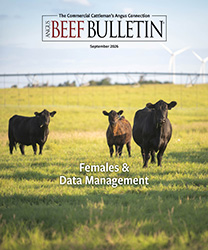
Current Angus Beef Bulletin
Our September issue focuses on the females of the herd and the records that validate them.