



Recovering Feed Intakes in Feedlot Cattle
Tips for getting cattle back on track after a disruption in feed intake.
January 6, 2026

by Logan Thompson, Kansas State University
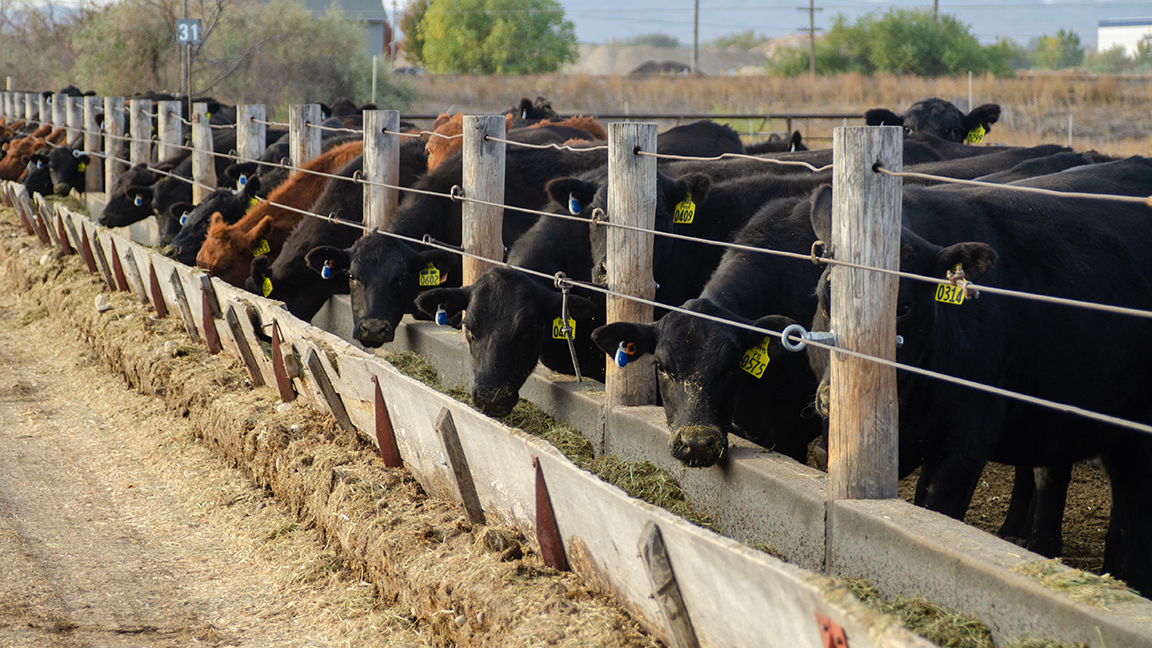
As we move into winter, the likelihood of severe weather events affecting our ability to keep cattle fed on time increases. Mud and variable weather patterns also cause cattle to change their eating behavior, with more erratic consumption occurring around storm events. Simple equipment failure may occur, where feed deliveries may be delayed for a short time until the issue can be resolved.
These feeding interruptions affect all fed cattle, but for cattle on more energy-dense rations, such as finishing animals, it is crucial to manage this period appropriately so long-term effects on performance and health don’t occur.
In previous research on finishing steers looking at fluctuations in timing of feed delivery, daily fluctuations in feed delivery time reduced average daily gain by 6.5% and feed:gain increased by 7% (Galyean et al. 1992). These changes are associated with numerous factors, including a reduction in ruminal pH and competition at the bunk altering feeding behavior.
How we manage our feeding program through this time is critical to get cattle back up on feed and minimize any performance reductions. To do so, we need to be cognizant of a couple important details:
1. When did the event happen that caused cattle to reduce intake?
2. How much were they consuming prior to the reduction in intake?
How we manage our feeding program through this time is critical to get cattle back up on feed and minimize any performance reductions.
The further out we are from the point in which the feeding interruption occurred, the less likely we are going to be able to recover their intake to previous levels, and there will be reductions in performance at pen closeout. Additionally, we want to be very cautious with feed allotment during this process and not push cattle too fast trying to recover intakes.
A good recovery feeding program should be conservatively designed. Table 1 outlines a program we used at the Kansas State University feedlot during the summer of 2025 for pens of 950-pound (lb.) finishing heifers that had been on feed 80 days. We experienced an electrical outage in pens containing Insentec feedbunks, which monitor animal intakes with gates that allow certain animals access to specific bunks.
The outage caused the heifers to be without access to feed for about 16 hours and occurred about eight hours after the morning feeding. This resulted in approximately 30% of that day’s feed allotment of 2,500 lb. not being consumed, meaning 750 lb. of feed remained in the bunks the next morning. Further complicating the recovery, the heifers had recently transitioned rations.
On the day after the event, we reduced the feed allotment by twice the amount of feed that remained in the bunk that morning (2 x 750 = 1,500 lb.). Therefore, the fresh feed delivered was 1,000 lb., resulting in a total of 1,750 lb. of feed in the bunk (1,000 lb. + 750 lb. that had remained from the day before) — the same amount that the heifers ate the day before.
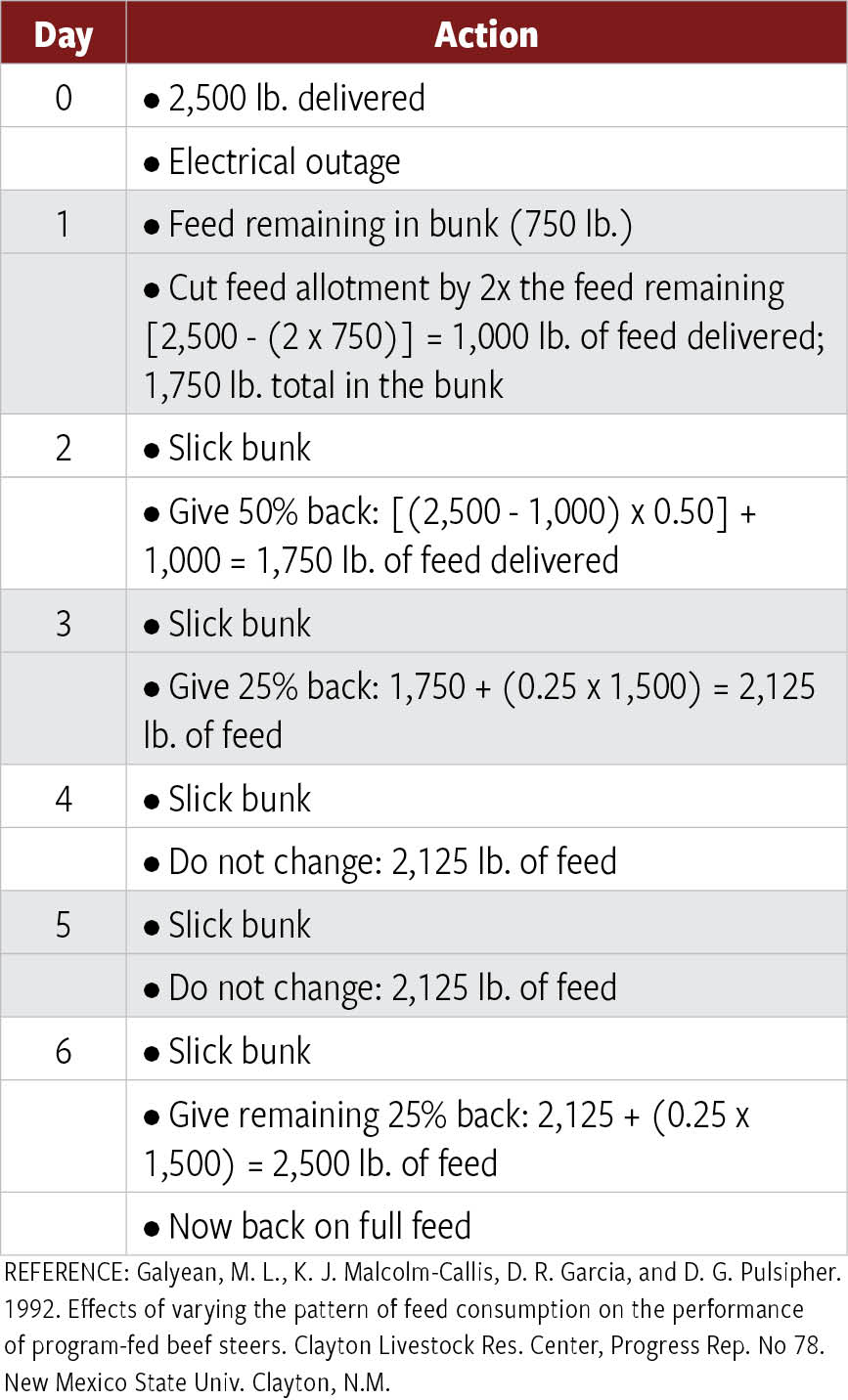
Table 1: Recovery feeding program

The second day, the bunks were slick, and the feed allotment was adjusted that day by adding 50% of the original reduction in feed allotment (1,500 x 0.50 = 750 lb.) to the prior day’s 1,000-lb. feed allotment, resulting in 1,750 lb. of feed delivered that day. With another slick bunk on the third day, the heifers had now consumed 1,750 lb. for three consecutive days. The feed allotment for that day was adjusted again, with 25% of the original reduction (1,500 x 0.25 = 375 lb.) added to the prior day’s 1,750 lb. of feed allotment, resulting in a total of 2,125 lb. of feed delivered that day. We then observed for two consecutive days, as minor bloating had occurred on Day 3, but still recorded slick bunks on both Day 4 and Day 5.
On Day 6, the remaining 25% of the original reduction (1,500 x 0.25 = 375 lb.) was added to the prior day’s 2,125 lb. feed allotment, resulting in 2,500 lb. of feed delivered that day. Cattle were now back to consuming the same amount of feed as they were prior to the feed restriction.
Through this program, we did not observe any long-term morbidity or performance reductions in the affected pens. However, this program is not guaranteed to always recover intakes and is not a rigid guideline. Using experience and understanding of how the cattle are recovering is critical. Good recordkeeping of bunk management and frequent observations of cattle health and eating behavior will aid in determining how and when to step up feed allotment.
Editor’s note: Logan Thompson is a sustainable grazing systems specialist for Kansas State University. [Lead photo by Shauna Hermel.]
Angus Beef Bulletin EXTRA, Vol. 18, No. 1-A
Topics: Feedyard , Health , Management , Nutrition
Publication: Angus Beef Bulletin
Related Content


Current Angus Beef Bulletin
Our September issue focuses on the females of the herd and the records that validate them.