Southern Border Closed Again
Secretary Rollins shuts down U.S. southern border ports to livestock trade due to further northward spread of New World screwworm in Mexico.
July 10, 2025
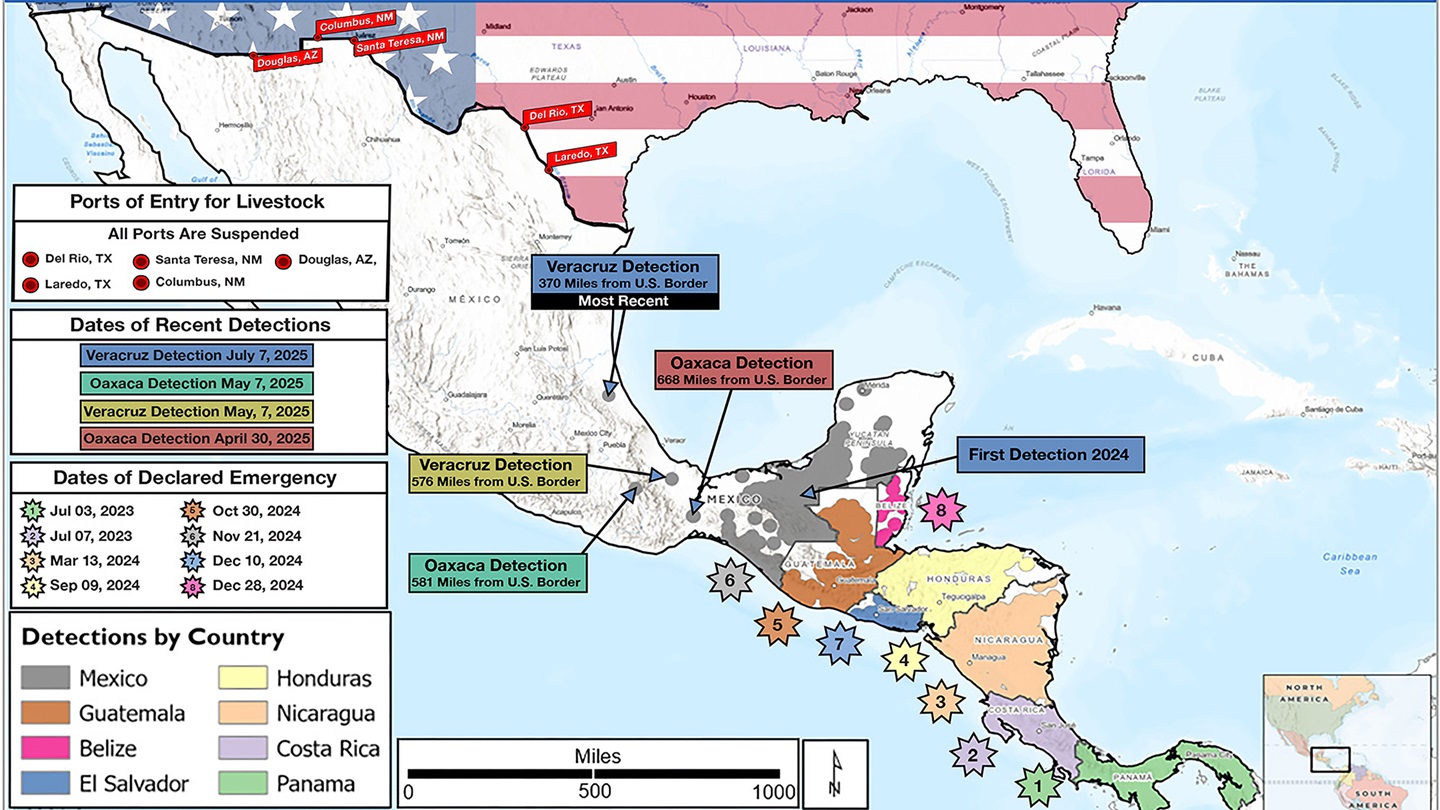
Confirmed detections of New World screwworm in Mexico and Central America
Source: USDA-Animal & Plant Health Inspection Service.
Data source: COPEG epidemiological report week 2025-28; data map created July 9, 2025.

With one port open less than two days in a phased border reopening, U.S. Secretary of Agriculture Brooke Rollins closed the U.S.-Mexico border once again due to detection of New World screwworm (NWS) within 370 miles of the border.
On July 9, Mexico’s National Service of Agro-Alimentary Health, Safety, and Quality (SENASICA) reported a new case of NWS in Ixhuatlan de Madero, Veracruz, which is approximately 160 miles north of the current sterile fly dispersal grid, on the eastern side of the country and 370 miles south of the U.S.-Mexico border.
This new detection comes approximately two months after detections were reported in Oaxaca and Veracruz, less than 700 miles away from the U.S. border, triggering the closure of ports to Mexican cattle, bison and horses on May 11.
While USDA announced a risk-based phased port reopening strategy for cattle, bison and horses from Mexico beginning as early as July 7, this newly reported NWS case raises significant concern about the previously reported information shared by Mexican officials and severely compromises the port reopening schedule previously outlined. To protect American livestock and our nation’s food supply, Secretary Rollins has ordered the closure of livestock trade through southern ports of entry effective immediately.
“A key part of USDA’s strategy for protecting American agriculture is continuously monitoring conditions on the ground,” said Colin Woodall, CEO of the National Cattlemen’s Beef Association (NCBA). “Secretary Rollins has been working to balance the economic needs of U.S. cattle producers who rely on imports while at the same time protecting the overall U.S. cattle herd.”
“With the pest now confirmed just 370 miles south of the U.S.-Mexico border, it is more important than ever to ensure Mexico is held accountable for implementing measures to control New World screwworm.” — Carl Ray Polk Jr., TSCRA president
“The United States has promised to be vigilant — and after detecting this new NWS case, we are pausing the planned port reopenings to further quarantine and target this deadly pest in Mexico,” said Rollins. “We must see additional progress combating NWS in Veracruz and other nearby Mexican states in order to reopen livestock ports along the Southern border.”
To ensure the protection of U.S. livestock herds, USDA is holding Mexico accountable by ensuring proactive measures are being taken to maintain a NWS-free barrier. This barrier is maintained with stringent animal movement controls, surveillance, trapping and following the proven science to push NWS south in phases as quickly as possible.
“With the pest now confirmed just 370 miles south of the U.S.-Mexico border, it is more important than ever to ensure Mexico is held accountable for implementing measures to control New World screwworm,” said Carl Ray Polk Jr., president of the Texas & Southwestern Cattle Raisers Association. “Mexico’s lack of enforcement of protocols leaves us all vulnerable, and Secretary Rollins’ firm stance and commitment to accountability are exactly what is needed at a time like this.”
In June, Secretary Rollins launched a plan to combat New World screwworm by protecting our border at all costs, increasing eradication efforts in Mexico and increasing readiness. USDA also announced the groundbreaking of a sterile fly dispersal facility in South Texas. This facility will provide a critical contingency capability to disperse sterile flies should a NWS detection be made in the southern United States.
Simultaneously, USDA is moving forward with the design process to build a domestic sterile fly production facility to ensure the U.S. has the resources to push NWS back to the Darien Gap. USDA is working on these efforts in lockstep with border states Arizona, New Mexico and Texas, as it will take a coordinated approach with federal, state and local partners to keep this pest at bay and out of the United States.
“While the risk of northward spread is real, we’re grateful for the proactive steps taken by this administration to ensure we are prepared to respond, including the development of a domestic sterile fly dispersal facility. This moment also underscores the urgency of establishing a fully operational sterile fly production facility to support long-term control of New World screwworm.”
Earlier this year, USDA announced that Moore Air Base would be the site of a new sterile fly dispersal facility in South Texas. NCBA is now urging USDA to expedite the development of an additional sterile fly production facility to ensure that we can produce enough flies to safeguard the American cattle industry.
USDA will continue to have personnel perform site visits throughout Mexico to ensure the Mexican government has adequate protocols and surveillance in place to combat this pest effectively and efficiently.
Visit these links to learn more:
- USDA Announces Phased Reopening of Southern Ports (July 2025 article)
- Ag Secretary Brooke Rollins Announces Plan to Combat Spread of New World Screwworm (June 2025 article)
- New World Screwworm Fact Sheet Announced (June 2025 article)
- Cattle and Bison Imports From Mexico Resume (February 2025 article)
- Mexico Notifies United States of New World Screwworm Detection (December 2024 article)
Editor’s note: This article is compiled from news releases distributed by USDA, NCBA and TSCRA.
Angus Beef Bulletin EXTRA, Vol. 17, No. 7-B
Topics: Health , Management , Policy , Industry News , News
Publication: Angus Beef Bulletin
Related Content


Current Angus Beef Bulletin
Our September issue focuses on the females of the herd and the records that validate them.