


Post-storm Strategies for Feedlots
Extension specialist offers strategies to deal with mud, bruising due to hail.
June 6, 2024

Recent weather events have created a new environment for feedlots in northwest Iowa and elsewhere. Torrential rains have turned once-dry feedlots to mud, and accompanying hail may have bruised cattle. Iowa State University Extension Beef Specialist Beth Doran says it’s important to have a strategy in place to deal with the issues.
“Wet, muddy conditions reduce weight gain and can compromise cattle health, so the first thing to tackle is mud,” she says. “While not perfect or easy, there are some emergency strategies for dealing with mud.”
Here are some suggestions:
- Where possible, place whole round bales of cornstalks, straw or hay on areas with less mud. The cattle will tear up the bales and lay on the bedding.
- If you cannot access dirt surfaces of the feedlot, scrape the bunk apron and concrete-surfaced areas to provide a dry, solid surface for cattle to lay down. Scrape the apron regularly to keep it dry and clean.
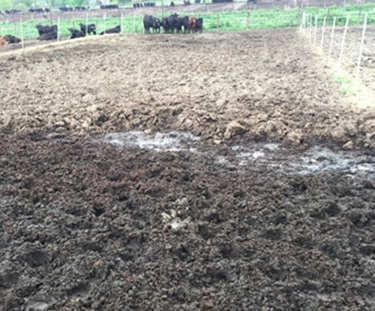
Muddy feedlot conditions common in Nebraska in 2019 lead to poor animal performance, some health issues, and increased odors as temperatures warm. [Photo courtesy of the University of Nebraska-Lincoln.]

- On aprons wider than 20 feet (ft.), place bedding in areas beyond the 20 ft. behind the bunk. Continue to add bedding to form a bed pack and leave the bedding in place until feedlot conditions improve.
“Because hail can cause physical injury to cattle, be aware that marketing may need to be delayed if cattle were hailed upon,” Doran says. “The extent of bruising depends on the size of the hail and how soon the cattle are marketed after experiencing hail.”
Data from a Texas feedyard that experienced hail ranging from 1¾ to 3¾ inches in diameter indicates cattle sold within 15 days of being hailed upon had significant carcass bruising. However, by day 49 the bruising had returned to normal baseline levels.
For more information on dealing with post-storm issues, contact Doran at 712-737-4230 or email doranb@iastate.edu.
Editor’s note: This article is adapted from a news release provided by Iowa State University’s Iowa Beef Center.
Topics: Equipment / Facilities , Management
Publication: Angus Beef Bulletin
Related Content


Current Angus Beef Bulletin
Our September issue focuses on the females of the herd and the records that validate them.