



Blending Stockmanship With Technology
A combination of virtual fencing and cow sense has provided a solution for a Washington state cow-calf producer.
March 20, 2026
Call it luck, fate or the workings of a higher power, but there’s little doubt something bigger was at play when Mike and Joy Wilson met. On a choir trip with her Seattle Pacific University church group, Joy’s youth pastor made a quick stop back home that would change everything.
“We stopped by the ranch. I was so taken by McLaughlin Canyon. I thought, ‘Man, I can’t imagine living like this,’” Joy, a native of Oklahoma, recalls. At the time, she pondered whether the cowboy she really liked only looked at her because the National Finals Rodeo was in Oklahoma City.
“I thought the only reason she looked twice and agreed to marry me was because of where we live,” jokes Mike, the youth pastor’s brother.
Fast-forward a few decades, and the opportunity to lease a new piece of ground arose for the Brewster, Wash., ranchers. While Mike and Joy felt the lease was too good to turn down, even the most fortuitous happenings have their fair share of challenges.
The ground in question included 9,000 acres of range with no existing exterior fence and no way to concentrate cattle into smaller areas for grazing. While beautiful, the area didn’t make the task of checking or gathering cattle easy, either. With roughly two months to install fence and turn cattle out, there was little room for error.
“We told [Vence], ‘We’re only going to do this if you can do it by then,’” says Joy, noting that their virtual fencing partner assured the Wilsons they were up to the challenge. “When we first started all this, we prayed, and we felt like God was leading us forward. We just took it one step at a time.”
The lease with the Confederated Tribes of the Colville Reservation was finalized in February, and cattle needed to be put out on grass in late April. But between Vence and the Wilsons, the process moved forward quickly.
Now several years into using virtual fencing, the Wilsons open their home to anyone looking to experience the beauty of the land or trying to establish whether virtual fencing could be a fit for the unique needs of their own operation.
Seeing the benefits
The Wilsons live and ranch in an area classified as sagebrush steppe. According to the National Audubon Society, sagebrush steppe is the largest ecosystem in the United States, covering 14 states and three Canadian provinces. While beautiful, the area does require producers to make some concessions when it comes to fencing.
“We actually have four-wire barbed-wire fence on half of our ground. As we’ve grown older, I had a friend that would help me build fence. The first year he said, ‘Well, do you want me to cut all the sagebrush off the fence as I go along?’’’
Mike didn’t hesitate with his answer. “I told him, ‘Good lands, no! If you cut all the sagebrush off, the fence will fall down.’ That’s how old some of the fences were.”
When the Wilsons acquired the new lease, effectively managing the land and rotating cows to benefit wildlife and the land would have been impossible without virtual fence.
Making permanent fencing pencil out on owned land would have been borderline, but on leased ground the math was even less helpful.
“I think we were just under $3 a foot when we built [fence] in 2015,” Mike recalls. “With inflation, we’d be over $20,000 a mile. When the contractor rebuilt that fence, he actually took a generator … and drilled holes in the rocks to put the t-posts in.”
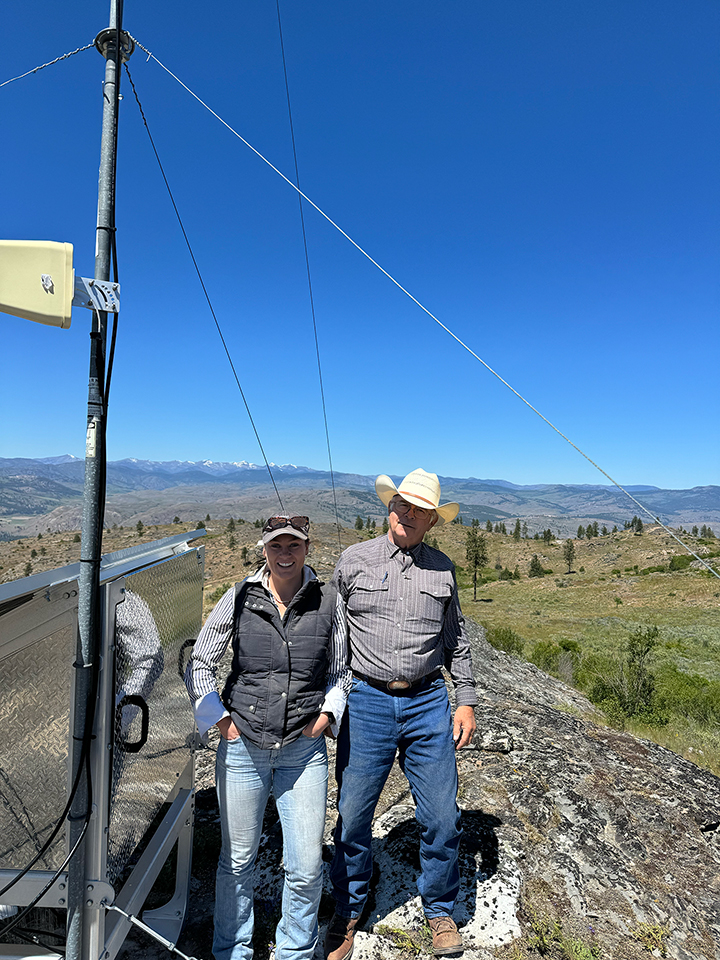
Pictured are (from left) Libby Falkiner, intern from the Angus Australia Program, and Mike Wilson.

With fence prices that high, increased labor demand and the ability for one $12,500 tower (combined with a $40 collar rental per animal) to cover 5,000 to 10,000 acres, virtual fencing worked out on paper quickly.
The other factor that pushed the Wilsons toward virtual fencing was protecting the wildlife corridor.
Considering all those factors, Mike and Joy decided virtual fencing was the best bet. With the financial assistance of Conservation NorthWest, two towers were installed. The Wilson’s experience so far has been positive. After all, Mike says, one thing about virtual fence is nobody ever leaves the gate open.
Historically, says Mike, if cattle are put through a gate and you shut the gate, you know where they’re supposed to be. However, without a collar on each animal, nothing is 100%. Vence offers the Wilsons some peace of mind with the ability to track their animals’ position virtually.
“We kind of have, I say, bigger country … If you’re in the rocks and valleys and ravines, you can pull up on your phone and see where that cow is relative to where you’re actually at,” Mike explains. “When you’re looking for some cows, that’s really nice.”
Last fall, that exact scenario played out. Though not a problem, one group of cows was in an area only accessible by horseback, which meant Mike needed to ride out and bring them back to the corral.
Joy had another thought, and picked up the phone to call their Ranch Success team member at Vence.
The Vence team put a movement on those cattle, but Mike wasn’t sure whether the plan was a success until he arrived on-site.
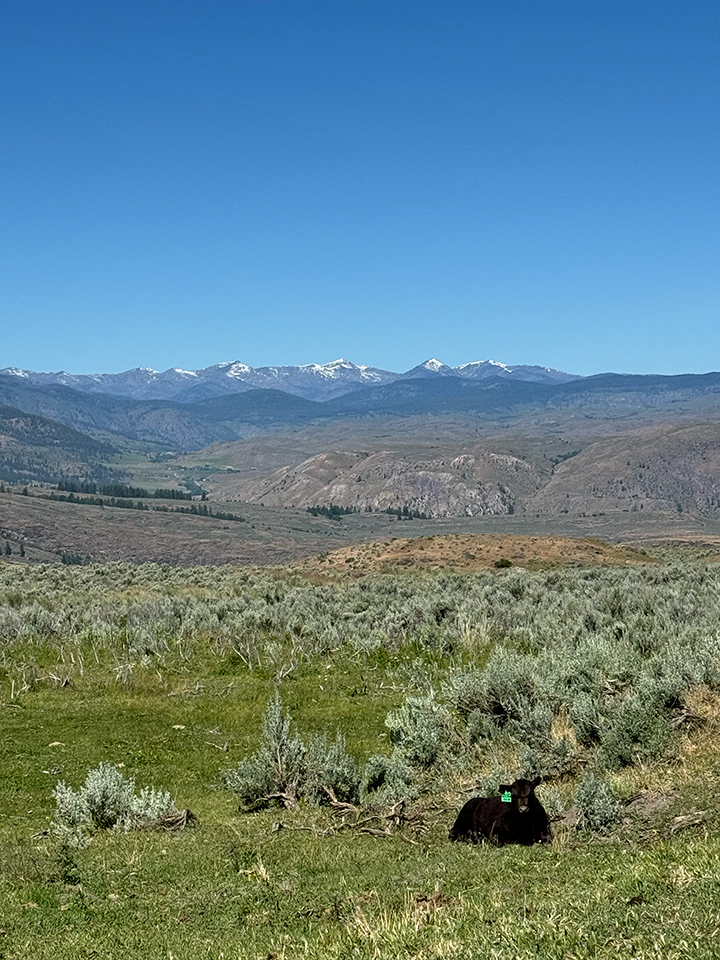

“I go up to where our corral is, and here’s every one of those cows,” he says. Something that simple saved Mike hours of time and effort. While he thought it was going to take him a couple of days to get the cows up, using a Movement Vence nudged the cattle exactly where Mike needed them to be.
Keeping it real
It’s not lost on the Wilsons that they live in one of the most beautiful places on Earth. Protecting that landscape is of great importance; but, to do that, their operation has to stay alive. The Wilsons must be prepared to tackle whatever threat — drought, fire or other — comes their way.
Grazing management is one way to manage for the bad times, and virtual fencing helps make that possible on the Wilsons’ operation. Being good stewards of the land is a core belief for Mike.
“It’s important to us for multiple reasons. One of the biggest things is trying to manage grazing for not only wildlife and water, but also for fire management. We’re a high-risk area for fires,” Mike says. “With virtual fence, you can crowd [cows] into that area a little bit more. You still can’t make them eat that type of grass, but it helps us rotational-graze to better manage fire risk.”
Through the Vence platform, the Wilsons also have a bit more flexibility. If they build a fence and it doesn’t work out, they can make a new fence. That isn’t something easily changed when it comes to permanent fencing.
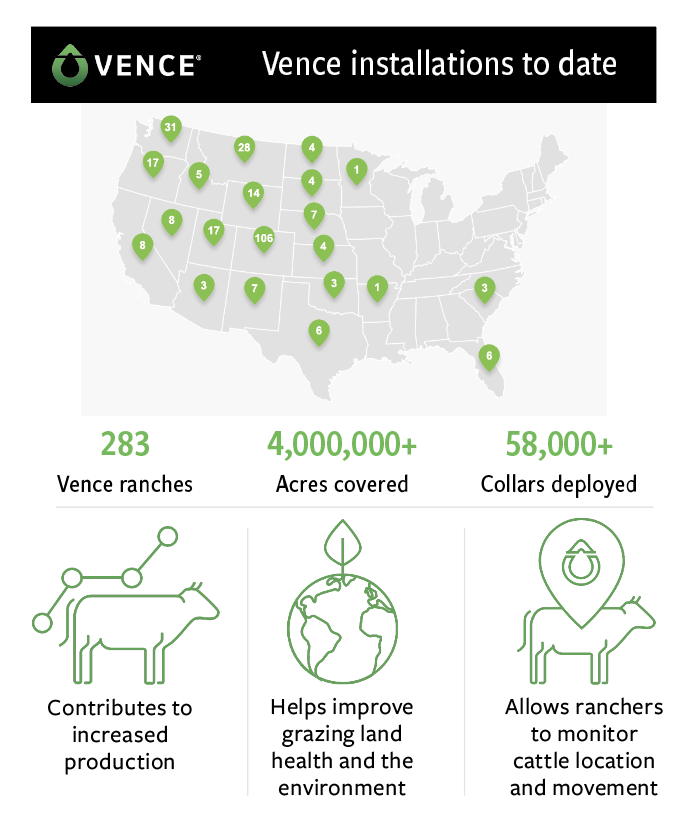

When asked whether anything related to virtual fencing was a surprise, Joy laughs before saying that the couple didn’t know what they didn’t know before installing the virtual fencing system on their leased ground. One thing they’ve learned since is good exterior fence is still a worthwhile safety measure.
“What Vence tells people is that you need an exterior fence and to use virtual fencing for your interior fences,” Joy stresses. Mike adds that he would love to have interior fences but, so far, no one has offered to build those free of charge.
At the end of the day, the Wilsons have had a positive experience when it comes to virtual fencing.
Joy says she believes that is because they’ve approached using the technology with a healthy dose of realism. Virtual fencing has to be seen as a tool and not a miracle, she says.
“A lot of that success comes back to our discipline, knowledge and taking the time to actually understand what’s on the computer. Making sure we’ve got [virtual fences] either turned off or not turned off, giving [the movement Vence] time to get to the collars so we can move [cattle] or hold them there,” says Mike, who believes animal husbandry should stay top of mind. “If you think you need it, it’s worth a try — but you’ve got to commit and work through the problems. The problems aren’t the virtual fence; the problems are usually our willingness to learn.”
GPS collars show ‘virtual fencing’ is next frontier of livestock grazing
For generations, farmers have spent backbreaking hours tearing down and rebuilding fences just to move livestock to fresh grazing fields. Now, thanks to a groundbreaking project at the University of Missouri’s (MU’s) Center for Regenerative Agriculture, that chore is becoming a thing of the past.
With a $900,000 grant from the National Fish and Wildlife Foundation, five Missouri producers are beta-testing a high-tech virtual fencing solution that uses GPS-enabled collars and a simple mobile app to guide animals with sound and mild shock cues. No posts, no wires, no sweat. Just smarter grazing, healthier pastures and more time back in a farmer’s day.
Kaitlyn Dozler, manager of MU’s Virtual Fence Program, is leading the three-year project alongside Rob Myers, a professor with the College of Agriculture, Food and Natural Resources and director of the MU Center for Regenerative Agriculture. The project is specifically designed for Missouri farmers whose animals graze cover crops.
“Farmers might be out multiple times a day moving their physical fences in extreme weather, so using virtual fencing can make their lives so much easier,” Dozler says. “One producer told me she was able to take a vacation for the first time in five years because she knew she could just go online at any time and see exactly where her goats were.”
Four of the five Missouri livestock producers involved in the project — which began last summer — have collared their cattle, while the fifth has collared his sheep. All five producers have enjoyed the convenience of using the new technology so far and, as part of the grant, are sharing their experiences with other Missouri farmers.
“Farmers trust other farmers,” Dozler says. “By hearing about the experiences from those who have tried the new technology, it becomes a smoother process for producers wanting to adopt it on their farms.”
Chris Hudson owns a farm in Middletown, Mo., and collared 50 of his cattle as part of the project. After switching to virtual fencing, he saw much higher utilization of his cover crops, from about 90 grazing days per acre with physical fences to 170 grazing days per acre with virtual fencing.
“I also like how the app allows me to see where each individual cow is at all times,” Hudson says. “When I saw on the app that one of my pregnant cows went off by herself, I knew it was time for her to give birth. I was able to call my dad to go check on the new calf without leaving what I was doing at the time.”
Dozler added the best part of using virtual fencing is the peace of mind it provides.
“Say a producer is at their child’s sporting event and they get the dreaded call that cattle are out,” Dozler says. “Instead of having to leave to go check if it’s their cattle, the producer can just check their phone to ensure the virtual fence is active and see their livestock’s location instantly.”
The project symbolizes MU’s mission as a land-grant university.
“The collaboration with [MU] faculty, MU Extension and the Center for Regenerative Agriculture has helped get innovative technology in the hands of Missouri farmers who can benefit from it,” Dozler says. “While virtual fencing is not meant to be used as a perimeter fence, it can have great benefits as an interior fence for rotational grazing.”
— Adapted from an MU Extension press release
Topics: Management , Equipment / Facilities , Pasture and Forage
Publication: Angus Beef Bulletin
Issue: April 2026
Related Content


Current Angus Beef Bulletin
Our September issue focuses on the females of the herd and the records that validate them.