



Getting ‘In Synch’ With Natural Service
Even when AI isn’t an option for their herd, producers can benefit from using estrous synchronization.
February 21, 2026
‘After years of using AI (artificial insemination), we decided to quit,” says Nancy Peterson, of Gordon, Neb. Up until a few years ago, synchronized AI had been a mainstay at Plum Thicket Farms — the operation managed by Peterson; her husband, Rex; and their son, Patrick.
“Our son was the first to question whether we were getting enough value out of AI, considering the amount of labor it required,” adds Peterson.
Their decision to go back to using bulls for natural service in no way reflects poorly on AI or its results. Application of the technology allowed the Petersons to accelerate genetic improvement in their commercial cow herd through access to proven sires.
However, scheduling administration of synchronization protocols and insemination on an increasingly crowded calendar was challenging, as it is on many operations involving both cattle and crops. Handling the cattle multiple times became more taxing as the operation’s growing use of cover crops led to more diverse cropping systems. Something had to give.
Timing advantage
“But we didn’t want to give up the advantages of estrous synchronization. We still wanted to get females bred early in the breeding season and have them deliver early in the calving season,” explains Peterson, noting that synchronization can be accomplished by handling the cattle only once.
“We put the bulls with the replacement heifers for five days and then give the heifers a shot of (prostaglandin). Leaving the bulls out for another 25 days gives heifers two chances to breed,” Peterson says. “We went into this expecting no more than 75% conception, but we usually end up with 83% to 85%.”
In a situation where estrous synchronization is not used, each individual female will exhibit estrus (come into heat) at a unique time. Since estrus occurs at intervals of 21 days, it could be weeks after bull turnout that a female is bred.
Applying estrous synchronization to a group of females prompts females to exhibit heat within a relatively short period of time. Synchronized females are then receptive to service by a bull at the start of the breeding season. If not bred then, there should be another opportunity 21 days later.
Two breeding opportunities within a 30-day period translate to more calves born early in the subsequent calving season. Calves are then older, heavier and more uniform at weaning time. Whether calves are sold at weaning or after a growing period, uniformity can enhance their marketability.
Eying uniformity
Pete Hayes appreciates a uniform calf crop, seeking it through genetic selection and savvy management. Like the Petersons, he routinely used AI until labor issues prompted a shift to estrous synchronization applied in tandem with natural service. He also chose the synchronization protocol calling for a single injection of prostaglandin administered five days after bulls are turned into breeding pastures.
“I read about it in a magazine and decided to try it,” says Hayes, who headquarters near Redding, Iowa, grazing cattle in the southwest part of the state and across the border into Missouri. “The first time, I kept the cattle close by the road, where I could easily observe breeding activity ... It has worked really well on both cows and heifers. It helps us get more females bred during a short calving season.”
According to Hayes, it’s not unusual for greater than 70% of calves to be born during the first 10 days of the calving season. Typically, 90% of females will have delivered in three weeks.
“I have not been disappointed. It works and, with this protocol, we only handle the cattle one time,” says Hayes. “We put the cows through on the same day we work the calves. One time through, and we’re done.”
Worth a look
The Peterson and Hayes operations rank among a minority — that 7% of U.S. beef cow operations utilizing estrous synchronization, and most of those use it in association with AI. However, according to Texas A&M University animal scientist George Perry, the benefits of synchronization have led to the development of multiple options for coupling that technology with natural service.
“Getting females bred early impacts longevity, impacts calf crop and impacts weaning weights,” states Perry, citing studies showing that replacement heifers that bred early and calved early in the season had greater longevity. They had more time postcalving to recover and be ready to breed back. They stayed in the herd longer, and their calves had heavier weaning weights throughout their productive lives.
“It’s really a snowball effect. As we get more cows bred earlier and they continue to breed early, we keep building on those benefits,” says Perry, noting that there also may be opportunity to move late-calving cows up, depending on the synchronization protocol used. That also can help keep more cows in production longer.
For synchronization used with natural service, the goal is different than with AI. For the latter, protocols are designed to bring a maximum number of females into heat during a very short period of time. To avoid overwhelming the serving capacity of bulls, using protocols that distribute estrus over seven to 14 days is appropriate.
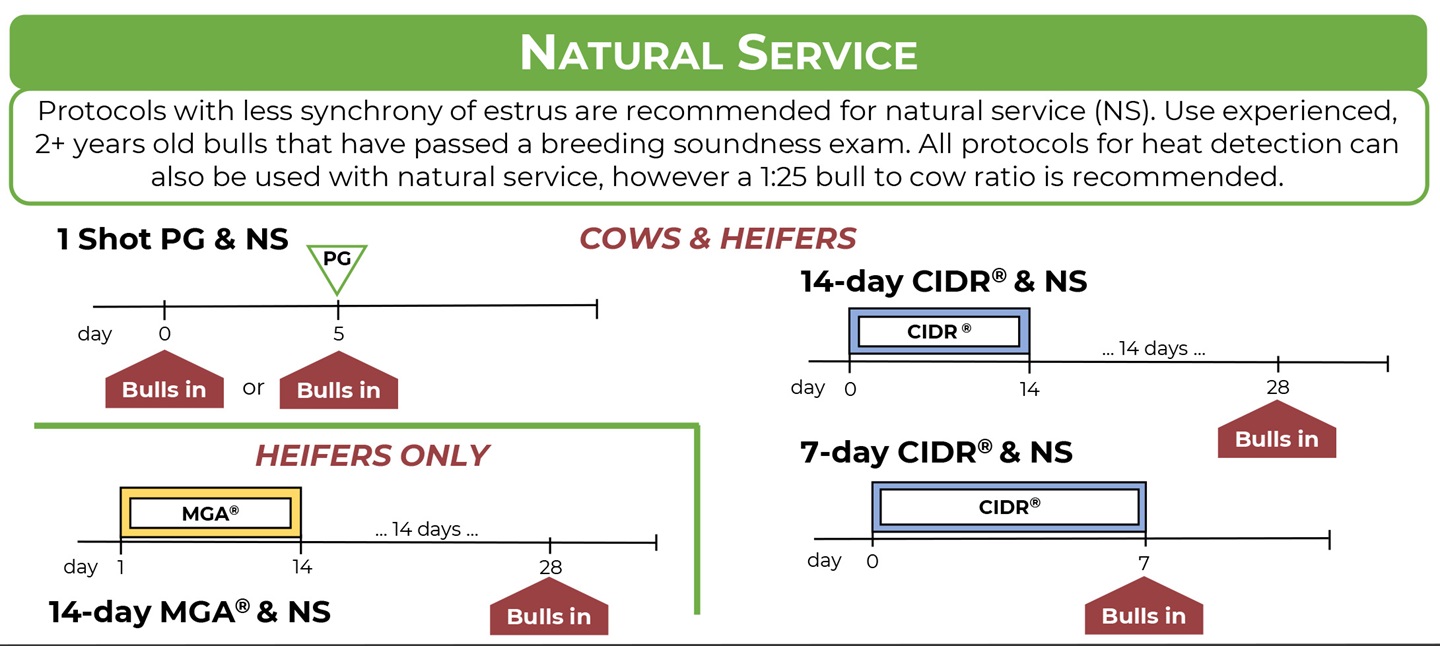
The Beef Reproductive Task Force provides synchronization protocol recommendations for natural service.


Protocol options
Perry says two such protocols are recommended for either cows or heifers. Each involves the use of a different drug with a different schedule and means of administration. Each requires different amounts of time and labor.
“We can turn bulls out and five days later give each female a shot of prostaglandin,” says Perry, explaining the same protocol used by the Peterson and Hayes operations. “It doesn’t matter if that bull has already bred some females during those first five days. After the shot of prostaglandin, the rest of the females should come into heat over the next five to seven days. The downside is that prostaglandin only works if the females are already cycling.”
According to Perry, the second protocol involves no injections, but females must be handled twice. With this protocol, a CIDR® insert is applied to each heifer seven days ahead of the start of breeding season. CIDRs are then removed on the day bulls are turned out with the females.
CIDRs contain a different drug (progestin) that should cause females to show estrus during the next 10-14 days.
Approved for heifers only, a third synchronization protocol involves feeding melengestrol acetate (MGA) for 14 days and then removing it from the diet. Ten days after MGA withdrawal, bulls are turned out with the heifers.
Perry emphasizes that MGA and the 7-day CIDR protocols are progestin-based and capable of prompting females to start cycling. As stated previously, however, females must already be cycling to respond to the one-injection prostaglandin protocol.
Bull power
Perry stresses the need for adequate bull power when using synchronization with natural service. While generally accepted recommendations call for bull-to-cow ratios of one yearling bull per 10-15 cows and one older bull per 25-30 cows, Perry says most bulls are underutilized. He cites studies involving synchronized females suggesting a ratio of one bull per 25 cows is sufficient and most economical.
When using multisire breeding pastures, Perry advises producers to manage bulls appropriately, grouping them by age and size. Be aware of social hierarchy.
Perry suggests bulls destined for the same breeding pasture be grouped together early enough that a pecking order is worked out before breeding season begins. He also reminds producers that a dominant bull with low fertility can have a negative effect on pregnancy rates, even when more fertile subordinate bulls are in the same pasture.
The dominant bull is going to take charge, Perry says. “If your least fertile bull out there is the most dominant, he’s going to hurt pregnancy rates.”
Screening bulls
Bull power is not just about the number used, but whether they are capable of doing the job, adds Perry, emphasizing the necessity of conducting a breeding soundness exam (sometimes referred to as a BSE) for every bull prior to every breeding season. In Perry’s opinion, a proper exam includes a physical examination, measurement of scrotal circumference and the collection of semen for evaluation.
Unfortunately, there is no “test” for libido, so Perry urges producers to make time to observe bull behavior after introduction to the herd. Evaluate each bull’s desire to detect and service females, but also discern how social hierarchy within the bull battery may be affecting the breeding behaviors of its individual members.
These things comprise proper bull management for any operation using natural service, Perry says. With proper management, bulls are quite capable of success in a program utilizing estrous synchronization.
Editor’s note: Troy Smith is a freelance writer and cattleman from Sargent, Neb.
Related Content


Current Angus Beef Bulletin
Our September issue focuses on the females of the herd and the records that validate them.