



Sorting Gate
Building a future: Why bull selection is a strategic investment.
January 6, 2026
If there’s one investment that delivers lasting returns across generations, it’s a high-quality Angus bull. In a business built on decisions with long-term effects, few choices carry more influence than selecting the right herd sire.
This decision isn’t just about the next calf crop; it’s about defining the genetic direction of a herd for years to come.
With every breeding season, a sire affects not only the performance of his immediate progeny, but also the productivity of retained daughters and future generations. His genetic influence compounds over time, shaping the traits that drive profitability.
In today’s market, where genetic tools are more precise than ever and the value of superior genetics is crystal clear, investing in high-merit sires stands as one of the smartest strategic moves a producer can make. It’s not merely a purchase; it’s a long-term investment in genetic progress and herd success.
The bull’s leverage: driving genetic progress
Understanding the sire’s role in herd improvement begins with the Key Equation, which predicts the change in genetic progress per generation. The Key Equation highlights selection intensity as a key driver of genetic gain over time — and bull selection lies at the heart of it.
Selection intensity reflects how far above the population average a selected individual ranks. In practice, this is often expressed through percentile rankings or expected progeny difference (EPD) distributions. For example, an Angus bull in the top 1% for beef value ($B) or combined value ($C) represents high selection intensity and strong genetic merit.
Because bulls can sire dozens of calves each year, they have a disproportionate effect on genetic progress compared to females in the herd. Over time, they contribute a large proportion of the herd’s total genetic gain, even though they contribute only half of the genes to each calf.
This makes it essential to increase selection intensity by choosing bulls that are significantly above average. Doing so accelerates genetic improvement and enhances herd profitability.
At the same time, commercial producers should consider the realities of their own environment and available resources. Genetic selection is most effective when aligned with an individual operation’s context, ensuring chosen sires deliver sustainable gains.
When market conditions, genetic tools, and timing align as they do today, few opportunities offer a better return than investing in the kind of genetics that move your herd, and your business, forward.
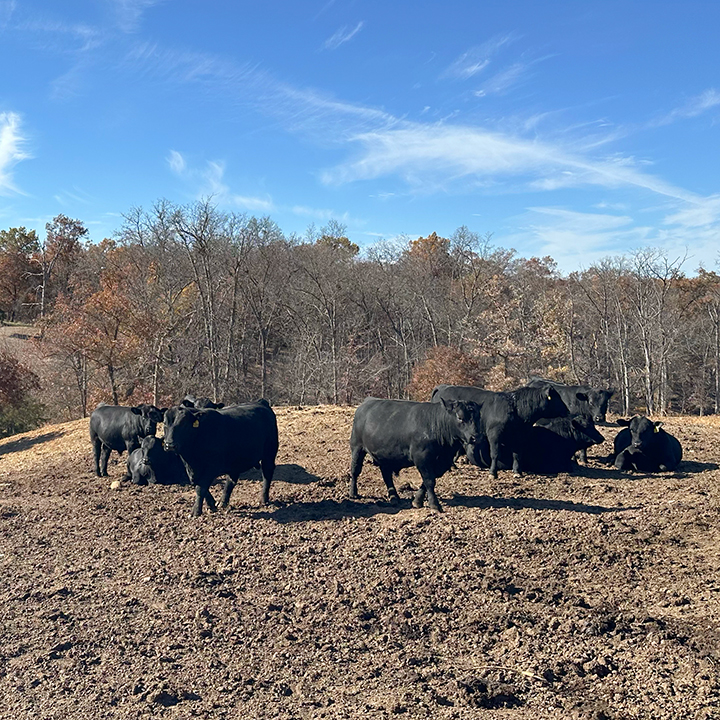
Using young bulls and rotating sires more frequently helps reduce the generation interval and accelerate progress.

Generation interval
Another key factor is generation interval. Practically, we can understand generational interval as the average age of parents when their offspring are born.
Shortening this interval increases the rate of genetic gain. Using young bulls and rotating sires more frequently helps reduce the generation interval and accelerate progress.
In a well-managed genetic selection program, each new generation generally brings better genetics, moving the herd forward. However, how often you replace bulls depends on your herd’s reality. It’s important to strike a balance. Consider your resources and long-term management goals, so your replacement strategy supports both herd improvement and operational stability.
Modern genetic tools support these decisions. Genomically enhanced EPDs and selection indexes allow producers to select with greater confidence, improving accuracy and reducing the risk of underperformance.
Translating genetic merit into economic value
Higher selection intensity reflects greater profit potential. To evaluate genetic decisions economically, performance traits must be linked to measurable outcomes.
Consider a conservative scenario: A bull sires 20 calves per year over three breeding seasons, totaling 60 calves. If he ranks in the top 10% for weaning weight, and his calves average 18 pounds (lb.) more at weaning compared to those from average sires (84 lb. – 66 lb. = 18), the added weight translates directly into revenue. At a market average of $3.90 per lb., that’s an additional $70.20 per calf, or $4,212 in total added revenue from improvement of a single trait.
Of course, beef cattle profitability isn’t driven by weaning weight alone. When other economically relevant traits are factored in — such as maternal performance and longevity, carcass value, and feed efficiency — the sire’s contribution to herd revenue expands even more significantly.
Table 1 compares EPDs for key traits between sires ranked in the top 10% and those at the 50th percentile for the Angus population. It highlights how selecting higher-ranking bulls can meaningfully enhance profitability relative to average sires.
When these traits are combined across multiple generations, the net value of genetic improvement from a single sire can exceed thousands of dollars, especially when daughters are retained and his influence compounds over time.
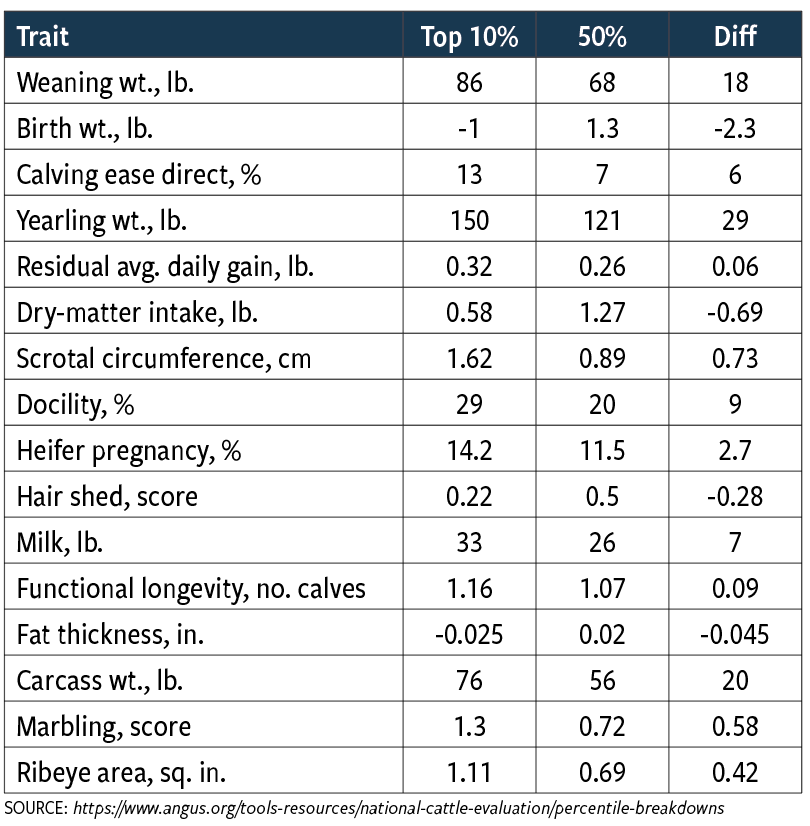
Table 1: EPD difference (DIFF) between top 10% and 50% non-parent bulls in the Angus evaluation

Market timing: opportunity meets genetics
The long-term value of genetic improvement is clear, but timing matters. Economic conditions shape not only the cost of investment, but also the speed and scale of return. Fortunately, current market dynamics strongly favor strategic genetic decisions.
Robust calf prices, steady demand for replacements, and strong consumer demand for high-quality beef have created a favorable environment for producers to invest in herd improvement.
While the current market scenario has led to higher average purchase prices for bulls, their cost relative to calf value is historically low, meaning it takes fewer steers to purchase a bull today than at nearly any point in recent years (see Fig. 1).
This rare alignment of high output value and modest input cost presents a window of opportunity.
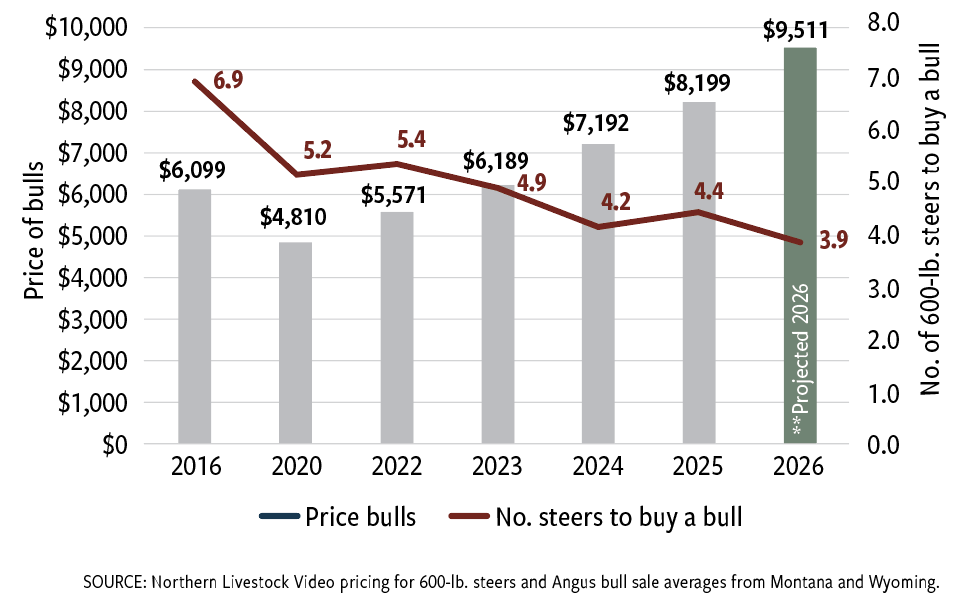
Fig. 1: Bull investment over time: price trends and steer-based valuation No. of 600-lb. steers required to buy a bull, 2016-2025

In practical terms, the cost of genetic improvement, measured against its potential return, has rarely been more attractive. Producers who act now can secure high-merit sires at a relative discount, locking in long-term gains in performance, efficiency and profitability.
Again, when elite genetics are deployed early and consistently, their effects compound across generations. Retaining daughters, accelerating turnover, and aligning selection with market signals all amplify return on investment. In this context, market timing isn’t just about price, it’s about positioning the herd for sustained success.
The bottom line: Invest in genetics that build your future
A good bull does more than sire calves. He builds the foundation for your herd’s future. His genetics have a large influence on genetic progress in traits that determine efficiency and profitability.
As sale season approaches, it’s worth viewing bull selection not as a routine purchase, but as a strategic investment. When market conditions, genetic tools and timing align as they do today, few opportunities offer a better return than investing in the kind of genetics that move your herd, and your business, forward.
Editor’s note: “Sorting Gate” is a regular Angus Beef Bulletin column featuring herd improvement topics for commercial producers using Angus genetics. Pedro Ramos is geneticist for AGI.
Topics: EPDs , Management , Selection , Sire Evaluation
Publication: Angus Beef Bulletin
Issue: January 2026
Related Content



Current Angus Beef Bulletin
Our November issue focuses on the females of the herd and the records that validate them.