



Brandon and Emily Richard, Spencer Smith, and Troy Marshall participated in a panel discussion during the Commercial Pathways Angus University session at the 2025 Angus Convention.
Finding the Path to Marketing Success
Commercial pathways for Angus feeder calves the focus of Angus University sessions at Angus Convention.
February 16, 2026
When it comes to making purchases, relationships and reputation matter. Being able to trust that cattle will not only make it to their end goal, but will exceed expectations for quality and performance along the way is something both cattle feeders and beef consumers can appreciate.
 The Angus breed enjoys a significant market share when it comes to cattle on feed, said Troy Marshall, director of commercial industry relations at the American Angus Association. Making the most of Angus genetics and capitalizing on programs to navigate commercial pathways for Angus feeder cattle was a primary focus of Angus University sessions during Angus Convention hosted in Kansas City, Mo., in November.
“On the feedyard side, [Angus-derived cattle] represented over 50% of the cattle on feed in the country,” Marshall stressed. “When we look at creating more value, using the right tools — like [GeneMax® Advantage™] and AngusLink® — helps tie your cattle into the demand that CAB (Certified Angus Beef) has created. We’ve just got to capture that value by marketing.”
One of the greatest strengths of the Angus breed when it comes to consumers is the demand generated by the Certified Angus Beef ® (CAB®) brand. Even with significant market share captured by black-hided cattle, only 37% of animals identified as black-hided meet the specifications to qualify for CAB. That means there is a lot of opportunity out there for producers looking to capitalize on their investment in Angus genetics, Marshall said.
Unraveling the data
Angus producers have a wealth of genetic knowledge at their fingertips pertaining to the breed, but an investment made into Angus sire verification and genomic testing means commercial producers can now pull aside the curtain on their own genetics. Enrolling in AngusLink value-added programs can help cattlemen capitalize on the competitive edge that using quality Angus genetics provides.
AngusLink allows producers to validate the breed makeup of their cattle and quantify genetic performance potential using the industry’s largest genetic database. Investing in Angus bulls is a great start, but using GeneMax Advantage tests allows producers to place additional scrutiny on the genetic merit of potential replacement females.
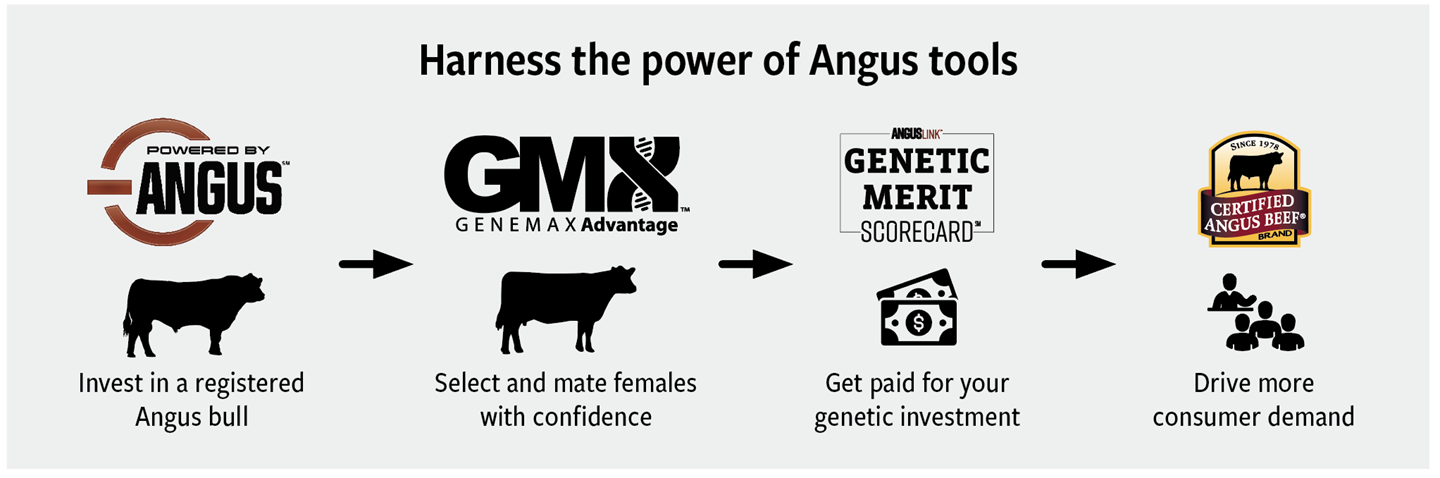

“[Producers] can use [GeneMax] to set their parameters. Users are getting all the dollar value indexes now, including $B (beef value), $C (combined value), $F (feedlot value), $G (grid value) and $M (maternal weaned calf value). They’re getting that on a dollar basis, so it’s directly comparable to the bulls they’re buying,” Marshall explained, noting that commercial cattlemen can use the information on their females to select bulls that can push their herd further in a desired direction.
Another benefit to genetic-testing feeder calves or replacements, verifying sires opens doors to data that could change decisions on the operation, as well as create additional marketing opportunities.
Sire identification is a big plus for producers from a management perspective, Marshall said. GeneMax Advantage results also deliver predictions for 22 individual traits, such as functional longevity (FL) and marbling (MARB).
The proof is in the pudding, Marshall noted. “They can see the progress of their herd and really start to delve into [the data] to make better selection decisions — not only on bulls, but on those replacement females, as well.”
There may be other tests out there for breeders lacking an Angus-based cow herd. However, GeneMax Advantage is far and away the best genomic test for cattlemen with predominantly Angus-based females, Marshall said.
With all the expenses piling up for cattlemen, it’s critical producers consider the opportunity to recoup their investment. With GeneMax Advantage, producers are seeing around $3.00 returned for every dollar invested, which comes out to about $30-$32 per calf, according to Marshall, who noted those numbers don’t even factor in tested females.
“I would say the first year it’s pretty close to a breakeven. But over the course of the lifetime of that female, it becomes a really good investment,” Marshall said.
Turning data into dollars
While the rest of the industry is capitalizing on capturing value, the segment of the industry that makes the most of the genetic investments still sells largely on a commodity basis. The better commercial cattle often subsidize the poorer, Marshall said.
AngusLink allows those producing better cattle to succeed while offering price discovery and transparency. In other words, said Marshall, AngusLink programs highlight the genetic merit of a pen of feeder cattle so the market can differentiate them and reward producers accordingly.
The Angus breed has always had reputation cattle, but one potential issue with marketing by reputation alone is the reliance on buyers knowing who you are and how your cattle will perform on feed. Participating in AngusLink value-added programs allows producers to market reputation cattle, but to a larger audience.
“[AngusLink] helps those producers verify their investment in genetics and management. It helps producers separate those Angus-sired cattle from the sea of black-hided cattle that are out there,” Marshall stressed. “This program helps quantify their calf performance and benchmarks exactly where they stand within the industry.”
Within AngusLink, two programs are available to producers: AngusVerifiedSM and the Genetic Merit Scorecard® (GMS).
“With AngusVerified, producers are able to prove their calves are 100% sired by registered Angus bulls. Buyers know that these calves are truly sired by registered Angus bulls,” Marshall explained. “It creates value on paper that gives those buyers confidence in what they’re buying.”
The second program takes those verified genetics a step further by evaluating the genetic potential of either feeder calves or replacement females via the Genetic Merit Scorecard program. The GMS draws on the industry’s largest database to evaluate calf genetics and projects their performance potential from weaning to the packer, using the breeding history of a herd.
“The other big part of the AngusLink program that I think is really exciting is that it has been able to put more dollars in [producers’] pockets over the last year,” Marshall says. “Last year, we returned almost $30 million in premiums back to those producers who enrolled in AngusLink. The program gives us an opportunity to provide a marketing service to our customers and helps them get rewarded for using Angus genetics.”
Seeing is believing
For Brandon and Emily Richard of Richard Angus Ranch, enrolling in AngusLink® value-added programs isn’t just a theoretical practice. Based in the far southwest corner of North Dakota, the Richards are first-generation registered Angus producers with backgrounds deeply rooted in commercial cow-calf operations.
 “We were both born and raised in the commercial sector. That sets us apart because we are very in tune with what a commercial operation means,” Emily said while addressing the audience attending the Commercial Pathways Angus University track at Angus Convention in November. “We actually have a commercial operation, and we still sell commercial calves every year.”
In a sea of programs purporting to set cattle apart, AngusLink also gives the Richards an edge when it comes to marketing their cattle to their commercial customers. Operating their commercial herd gives the Richards a unique look into the role registered Angus genetics play in making the goals of commercial cattlemen a reality.
“We try our hardest to use our own bulls back in our commercial operations. We don’t sell anything that we wouldn’t use ourselves,” Emily explained. “We know what our commercial operators need because we need it ourselves.”
While the seedstock operation is a newer venture, the commercial herd is a family endeavor. Ranching alongside Brandon’s parents, Emily and Brandon have the opportunity to include their three children in both the commercial and seedstock operations. True to their promise of using their own bulls as sires for commercial calves, the Richards also utilize AngusLink value-added programs to get the most bang for their buck when it comes to marketing their commercial calves.
“Our calves are currently enrolled in AngusLink this year. It is really important that we talk to our commercial producers about investing in AngusLink,” Emily said. “AngusLink provides you with feedlots actively seeking your cattle. So it flips the point around, and instead of you trying to seek out a buyer and trying to place your calves somewhere, it’s the buyer seeking out your [cattle]. It really puts the ball in the commercial cattleman’s court.”
On the flipside, cattle buyers also see the benefit of purchasing animals from operations with a reputation for producing healthy, high-performing animals. Spencer Smith, a partner in western Oklahoma cattle feeder Capstone Beef, said the GMS tells everyone looking at a sale book just how good the cattle selling will perform down the line. One more tell? Producers willing to put in the work for the cattle to sell with the GMS probably have done other things the right way, too.
“If I’m flipping through a [sale book] and I see something that says out of registered Angus bulls and it doesn’t have the Genetic Merit Scorecard? At these price levels, I have to question, ‘What’s their vaccination protocol? Are they giving the shots effectively?’” Smith said. “Even if the average is 88% Choice, I can make a living on average cattle. [The GMS] tells me a lot more about their operations.”
Whether a commercial producer or a cattle feeder, building relationships with those supplying your cattle reaps benefits long past the initial purchase. For the Richards, being involved in their customers’ operations regularly is something they pride themselves on.
After seeing the benefits of enrolling in AngusLink firsthand, the Richards encourage their seedstock and commercial customers to research available value-added programs.
Topics: Management , Feeder-Calf Marketing Guide , Genetics , Marketing
Publication: Angus Beef Bulletin
Issue: January 2026
Related Content


Current Angus Beef Bulletin
Our September issue focuses on the females of the herd and the records that validate them.