



Build From Scratch
Tips for starting a cattle business without any land.
January 6, 2026
It’s hard today for young people to start raising cattle unless they inherit land or can be part of a family ranch. Land in most regions is priced too high to cash flow with cattle.
This is a huge challenge, but we need more young ranchers. Only 1% of the U.S. population is involved in agriculture, and the average age of farmers and ranchers is getting older. According to USDA statistics, most farm and ranch land is owned by people 65 and older. Farmers and ranchers under the age of 35 make up only 12.5% of the ag population.
Rick Machen, executive director of the King Ranch Institute for Ranch Management (KRIRM), says finding operating capital is tough today. If a person has no access to land and minimal ability to secure a loan, they have to work their way into the business.
“There is no substitute for experience — lessons learned in the school of hard knocks,” says Machen. “Often, the most valuable lessons are learned from failure, but that’s not necessarily fatal. Try to fail small. Cultivate and protect your integrity. Plan on hard work, long hours and sweat equity. People who own the resources (land and livestock) still value all three.”
Think creatively
“Find someone successful — spiritually, in family life, as a resource steward, and financially — in that order. Listen to and learn from them. Not every successful rancher is a good mentor,” says Machen. Don’t be afraid to ask someone you admire to mentor you.
Managing risk is essential, he says.
“Don’t bite off more than you can chew; don’t take on more debt or responsibility than you can manage,” Machen advises. “Diversification is key. If a spouse can work (off ranch or remotely) and receive benefits like health insurance, this provides a stable income for family support. Additional enterprises (in addition to cattle) provide opportunity to spread fixed costs and increase revenues. Consider sheep or goats.”
You might create another revenue source if you have a marketable skill like shoeing horses, leatherwork, photography, writing or making furniture. The list is endless. If you have even a small piece of land (and no liability issues that might be a hindrance on leased property) you might add agritourism and recreation (hiking, biking, camping, hunting, fishing, bird-watching, etc.) on the land you have.
“Managing cash flow is essential; having numerous enterprises can translate into more than one or two paydays annually,” Machen says. “Put a pencil to it. Microsoft Excel® is your best ally. If it doesn’t work on paper, refigure it and proceed cautiously.”
Machen suggests knowing your unit cost of production, or UCOP. What is your cost per hundredweight (cwt.) of weaned calf? What is your cost per pound (lb.) gained?
“Without knowing your costs, you cannot determine profitability,” Machen says.
“Plan your entry strategically. In the current cattle market, the downside risk is greater than the potential for upside reward (the market the last two weeks of October 2025 is proof thereof). The amount of capital to enter during this phase of the cattle cycle is intimidating to both a lender and borrower,” he says.
“Without knowing your costs you cannot determine profitability.” — Rick Machen

Stocker cattle typically involve less fixed cost, but effective marketing of both the purchase of cattle and their sale is essential.
“That first cost is often the determinant of profitability,” he says.
Machen says the cow-calf business is a fixed-cost management business, and advises emerging cattlemen to manage fixed costs carefully.
Regarding equipment, he says: “Don’t rent what you can borrow. Don’t buy what you can rent. Don’t buy new if good used is available. If something will sit idle much of the time, you likely don’t need to own it.”
Leasing option
Leasing grazing land and pasturing cattle for someone else is perhaps the lowest fixed cost, low-capital-requirement option; but structure of the lease agreement is critical.
“Without knowledge of the pasture’s potential for supporting growth/gain and knowledge of the cattle’s ability to perform, the beginning stockman must rely on the expertise of a mentor. Weather (soil moisture) is also a huge determinant of success.”
The ever-aging landowners are the people you should make an effort to meet and gain their trust. From personal experience, Machen says that prior to coming to KRIRM, he partnered with a landowner who provided the land, livestock and operating capital.
“I provided expertise and labor for a percentage of the revenue, and that worked for both parties. Sharecropping is another way for a family to keep property while it appreciates in value and enlarges their net worth,” he says.
“Leasing land is the obvious option, but in most regions, leases coming available are a well-kept secret. First-time lessees seldom know they are available until they are not — the lessor has already changed lessees,” says Machen.
Wyoming experience
Sage Askin, Lusk, Wyo., started with a used pickup and trailer and built a multistate livestock operation.
“I couldn’t buy cattle. I talked to a banker, but if you have nothing, they won’t loan money to buy cattle,” he says. “I decided to try to find a ranch to lease, and pay for it by running someone else’s cattle — custom-grazing on rented land.”
His pickup was paid for, so he put it up as collateral for a $17,000 line of credit.
“That loan gave me something to operate on. I hoped to make more money from custom-grazing than my wife and I would pay for pasture. We depended on our stockmanship and grazing management to make it work,” he says.
“I think more ranches are available to lease than 10 years ago,” he observes. “Some people invest in land, but are not actively running it.”
Much of the land available to first-time renters may not be what you want to live on for the rest of your life, and some places take a lot of work to build back up to where they should be. “You’ll have to work harder and do different things to make it work,” Askin says.
“In the Mountain West, if a place was running cow-calf units and you can turn it into a stocker operation, you can generally find stocker-cattle clients and match the animals to the resource better,” he says. You’ll have grass during growing season for stockers and won’t have to buy hay or winter cows.
Relationship skills are important when trying to create a ranching business without land ownership.
“Most of us tend to be introverts and independent and try to go it alone,” Askin says. “The only way to get started is to become good with relationships — which means moving out of our box and becoming comfortable with people. We need the utmost integrity in building relationships and doing what we said we’d do. You’ll have land to operate on if you maintain good relationships.”
Today Askin and his wife operate on a variety of leased and owned properties, and offer custom-grazing services for sheep and goats, as well as cow-calf pairs and stocker cattle. They also develop heifers for other ranchers.
Find a wannabe retiree
Wesley Tucker, field specialist in ag business for the University of Missouri Extension, says leasing ground is one way to start — if a person can find pasture.
“One of the bright spots today is the possibility of finding a rancher who wants to retire,” he says. “I specialize in farm succession and see more and more producers who, even though they have children, don’t have an heir who wants to come back and take over the ranch.”
The older generation doesn’t want their ranch dismantled the day after their funeral, he says. Some are interested in helping a young person get started.
“I’ve had more questions in the past six months, as cattle prices have risen, about cow share agreements — including leasing cows,” Tucker says. “We talk about leasing ground as the entry point for beginning producers, but as more producers get to the age they want to retire, some may be interested in putting cows out on share agreements, if they don’t have an heir who wants to take over.”
Cows can be leased to the younger person, and they share the calf check, he explains. “It takes more communication, however, than just leasing land; you are sharing a living animal that could die. It takes a lot of effort on the part of a young rancher and communication from both parties, but we are seeing more of these situations being able to work.”
“I’ve had more questions in the past six months, as cattle prices have risen, about cow share agreements — including leasing cows.” — Wesley Tucker

Most ranchers want to see their legacy continue — the improvements they’ve made over the years with their land and cattle — whether it’s with their own children or not.
It’s a tough time to try to get started, with high interest rates.
“It’s hard to gain enough capital to buy cows, even if you have access to land,” Tucker acknowledges. “That’s why I like some of the unique arrangements where people can build relationships. Doing things together has a lot of potential. Most ranchers who are looking to retire don’t want to see their cows go to the sale barn, and they face a big income tax bill if they sell them all at once. It’s usually a win-win for both parties spreading it out over time and can really help a young person get started.”
Maybe at first the calf check is split 80-20 between the rancher and the young person leasing the cows, but over time it increases for the young person as they take on more ownership of the cows.
Editor’s note: Heather Smith Thomas is a freelance writer and cattlewoman from Salmon, Idaho. [Lead Photo courtesy of Pixelcatchers/E+ via Getty Images]
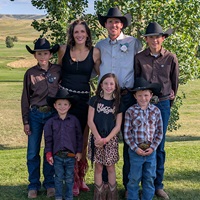 Building a registered Angus business from scratch
J.R. and Katie Lund, young ranchers near Winnett, Mont., established Rockin’ L Genetics in 2008 with the purchase of four Angus cows, starting on leased land.
They met in college, and married soon after. J.R. took a job managing a ranch north of Grass Range, Mont., 30 miles east of Lewistown.
“It was an absentee owner situation, and we were allowed to run a certain number of cows as part of his wage. Those four registered cows were the start of our herd,” Katie says.
They built their herd gradually. Then, in 2012, the ranch owner wanted to sell his cattle. The Lunds bought 130 of his registered cows and leased the ranch until the ranch changed hands.
“We finally found 1,300 acres here at Winnett and were able to start buying it in 2017,” Katie explains. They built a house, and use this as home base for winter feeding and calving. “We are first-generation ranchers. We inherited [J.R.’s] grandparents’ single-iron brand as a family legacy, and it’s nice to see it continue in our generation, knowing what we have done to keep it going.”
Regarding their ranching enterprise, there is no one to fall back on.
With land payments, cow payments and equipment payments, ranching has been challenging and stressful at times for their family, but God has always provided.
Currently they have 250 cows. About 150 are registered.
“We have a bull sale every March in cooperation with another rancher,” Katie says. “We sell about 30 of our own bulls every year, and 2026 will be our 11th sale.”
This has been successful, but they’ve also had some hard knocks. With their very first bull sale taking place the day COVID shut down the country, they’re familiar with tackling a challenge.
It helps that Katie and J.R. both have other jobs, and their operation has multiple enterprises.
“We custom-calve heifers for a rancher from Lewistown, and my husband has an AI (artificial insemination) business, breeding about 1,000 head every spring. I am a fiscal manager for several organizations, with clients around the state and locally,” Katie says, noting that the operation wouldn’t run without the help of their children and working dogs.
Ranchers are at the mercy of the market and nature, but those aren’t the only speed bumps. Finding leases is challenging, too.
“When we do find one, it may be temporary,” she says. “We are constantly moving cattle around. At one point two years ago we were in five different counties. We had heifers on one place, a few cows here, a few cows there, doing anything we could to hold it together. We were too scattered out, chasing water and cows all summer.”
They were able to keep the business going, however, because they are not afraid to work.
“You learn to rely on your faith, but you have to take chances, and there are risks, so you have to be super smart with your finances,” Katie says. “I am currently opening a coffee/ice cream shop in Winnett. Together with friends (also first-generation ranchers), J.R. and I sell our beef direct to consumers. You have to find ways to generate more revenue. The biggest thing with being your own boss is that you have to stay self-motivated, and get the job done. It can be easy to get distracted.”
Katie’s advice to young people trying to get started is to never give up.
“When my husband and I were trying to buy land, we were told by multiple bankers to just sell our cows because we were never going to make it,” she says. “Not many people believed in us. Bankers have to be conservative, but at some point it’s important to look at the next generation and this way of life. We have worked hard to build our reputation.”
Katie says the Farm Service Agency (FSA) was instrumental in helping them buy land.
“We could not have done it without them,” she concludes. “They have a lot of programs and options to help with the startup.”
Related Content


Current Angus Beef Bulletin
Our November issue focuses on the females of the herd and the records that validate them.