




Research Roundup
Insights for improving finishing performance.
November 3, 2025
Soybeans in finishing cattle diets
University of Nebraska researchers conducted a feedlot study to compare the effect of using whole or roasted soybeans at two inclusion rates (12% and 16% of diet dry matter), soybean meal, distillers’ grains, or a dry-rolled corn with urea control in finishing cattle diets.
Steers fed the diet with the 16% inclusion of roasted soybeans had better average daily gain (ADG), feed conversion (F:G) and hot carcass weight (HCW). All other diets resulted in similar performance to the dry-rolled corn and distillers’ treatments. Roasted soybeans fed at a 16% inclusion improved F:G over the 12% roasted soybeans as compared to the whole soybeans, which were better at the 12% inclusion.
These data suggest soybeans can be fed to finishing cattle to provide fat and protein, but roasting enhances the response in performance.
In the study, the greatest inclusion of roasted soybeans resulted in the greatest performance. Soybean meal, whole soybeans and the 12% inclusion of roasted soybeans provided performance and carcass traits that did not significantly differ from the control and distillers’ grains diets.
The results suggest soybeans may be an option to displace corn or distillers’ grains in finishing diets where the product is readily available or economical without reducing cattle performance, with a 16% roasted soybean inclusion outperforming corn.
Funding for this research project was provided by the Nebraska Soybean Board. Products were provided by Elanco Animal Health and Merck Animal Health.
Source: 2025 Nebraska Beef Cattle Research Report. Researchers were Melissa Bausch, graduate assistant and clinical veterinarian, office of research and economic development, Lincoln; James MacDonald, and Galen Erickson, professors, animal science, Lincoln; and Pablo Loza, assistant professor, animal science, Panhandle Research Extension and Education Center, Scottsbluff.
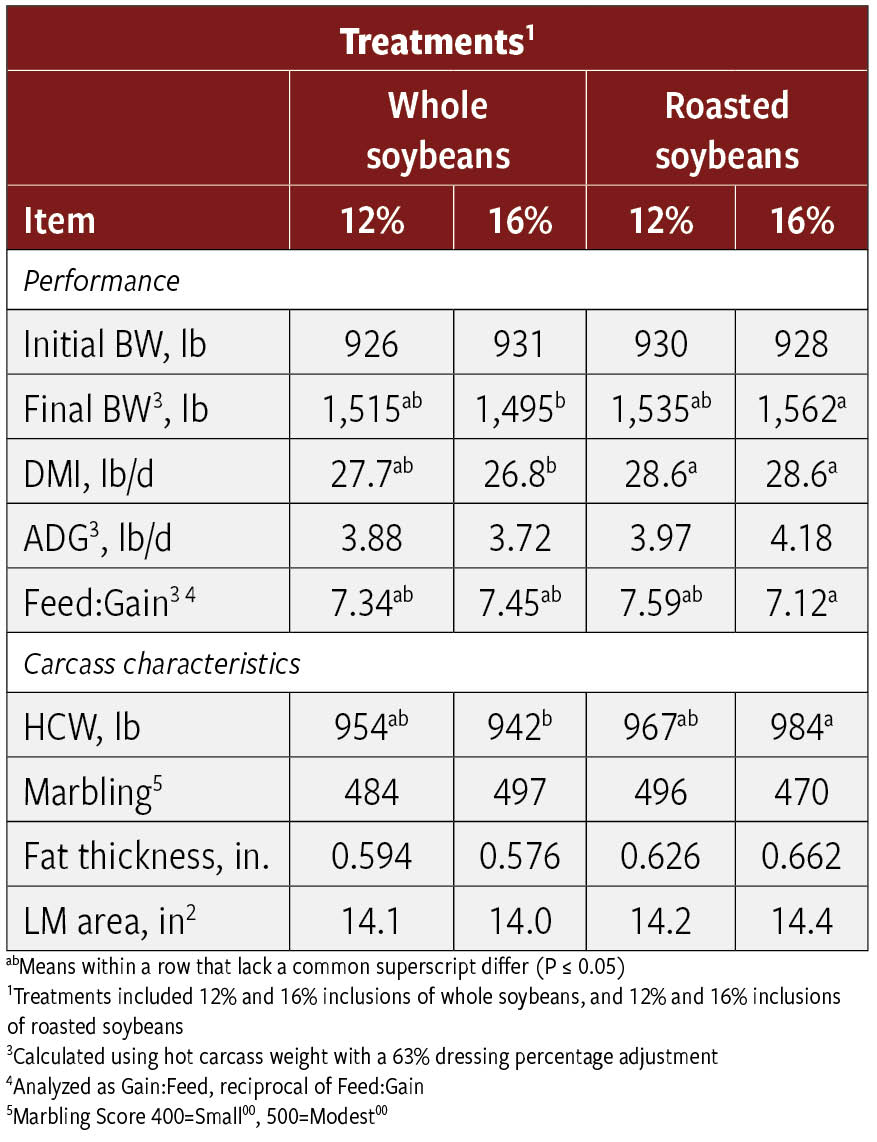
Effects of roasting and soybean inclusion on feedlot performance and carcass characteristics.

greatOplus improves finishing performance and carcass characteristics
Researchers at Kansas State University investigated feeding greatOplus (GOP), an extruded mixture of flaxseed and Nannochloropsis oculata microalgae biomass, on feedlot cattle performance and carcass characteristics.
Seven hundred yearling steers weighing approximately 825 pounds (lb.) were blocked by initial body weight (BW) and assigned randomly, within block, to 28 feedlot pens containing 25 animals per pen. Cattle were vaccinated against viral and clostridial pathogens, treated for internal and external parasites, and implanted with a combination implant.
The control diet (CON) consisted of 58.3% steam-flaked corn, 20% wet corn gluten feed, 2.56% soybean meal, and 4.17% vitamin-mineral-feed additive premix.
For the greatOplus (GOP) diet, a portion of the corn and all the soybean meal were replaced with 10% GOP (dry basis) to create isonitrogenous diets. Cattle were fed once daily, ad libitum.
After 175 days on feed, animals were weighed and transported to a commercial abattoir for harvest. Animal performance measurements included ADG, dry-matter intake (DMI) and gain:feed (G:F). HCW and incidence of abscessed livers were assessed on the day of harvest. Marbling score, 12th-rib fat thickness, longissimus muscle area, and USDA yield and quality grades were determined following 48 hours of refrigeration.
Cattle fed GOP had greater DMI and ADG (P < 0.05) compared to cattle fed CON, but G:F was not affected by treatment. Cattle fed GOP had greater HCW compared to those fed CON (932.11 vs. 902.79 lb.; P < 0.01) and tended to produce more Prime and Choice carcasses (87.4% vs. 83.0%; P = 0.11) with greater 12th-rib backfat (0.61 in. vs. 0.59 in.; P < 0.02) and greater yield grades (2.91 vs. 2.75; P < 0.01).
Marbling score (488 vs. 491), longissimus muscle area (14.6 in.2 vs. 14.5 in.2) and incidence of liver abscess (12% vs. 16% for CON and GOP, respectively) were unaffected by treatment.
Carcass values were calculated using base prices, premiums and discounts published by the USDA and were greater for cattle fed GOP compared to cattle fed the CON diet ($2,122 vs. $2,059; P < 0.01). Bottom line, including greatOPlus at 10% of the diet dry matter improved cattle performance, largely as the result of its effect on DMI and ADG.
Source: Adapted from summary by Firman Nasiu, Cattlemen’s Day 2025, Kansas State University, February 2025. Contribution no. 25-158-S from the Kansas Agricultural Experiment Station. Full reports are available at newprairiepress.org/kaesrr. For more information, contact James Drouillard, ruminant nutrition, at 785-532-1204; or Dale Blasi, beef cattle nutrition and management extension specialist at 785-532-5427.

Topics: Feedyard , Management , News , Nutrition
Publication: Angus Beef Bulletin
Issue: November 2025
Related Content


Current Angus Beef Bulletin
Our November issue focuses on the females of the herd and the records that validate them.