

Common Ground
Beyond the black hide.
November 3, 2025
In today’s historic cattle market, one trend remains consistent: Angus-sired feeder cattle continue to command premiums. Whether you’re selling at the auction barn or marketing load lots through video sales, buyers are willing to pay more for cattle backed by Angus genetics. This summer we have consistently seen a premium of $15-$20 per hundredweight (cwt.) on black-hided feeder cattle when compared to non-black cattle of the same weight.
What’s driving this demand, and what misconceptions still linger?
Let’s start with the obvious
Yes, black-hided cattle frequently bring more money. But, it’s not just about color. Black-hided cattle have been topping the market for decades. With limited breed information typically available for buyers, color can sort out the cattle influenced by black Angus genetics.
Angus cattle have earned a reputation for quality, consistency and performance. Decades of genetic selection have led to cattle that grade higher, convert feed more efficiently and produce heavier carcasses.
Feeders know Angus-sired cattle can be taken to heavier finish weights and more consistently hit the high-quality grid targets, driving profitability.
Packer buyers seek out those black-hided cattle as they more frequently have higher quality grades and qualify for the Certified Angus Beef ® (CAB®) brand.
Some myths need busting
Not all black-hided cattle are created equal, and not all qualify for CAB.
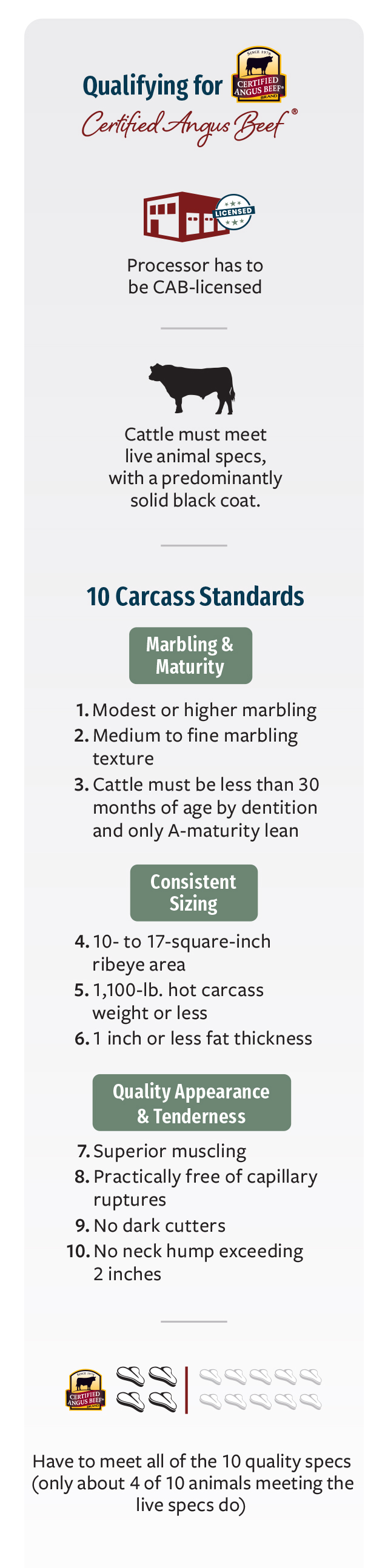
To qualify for CAB, cattle must first be harvested at a CAB-licensed packing plant. Today, about 85% of the packing capacity in North America has a license to produce CAB.
Then, cattle must meet the American Angus Association Live Animal Specification to carry an Angus label. That requirement is “predominantly solid black with no other color behind the shoulder, above the flanks or breaking the midline.”
The Red Angus Association of America has a different live animal requirement that includes non-black cattle. Those cattle do not qualify for CAB, but they can qualify for other Angus branded programs if the packer chooses.
After meeting the American Angus Association Live Animal Specification, carcasses must meet CAB’s 10 strict carcass specifications for marbling, maturity, weight, ribeye area, fat thickness and consistency. The black hide is just the first gate. From there, it’s all about consistent quality — and that is what delivers value for chefs, retailers and consumers.
Only four of 10
The national average CAB acceptance rate is about 40% — meaning about four out of 10 black-hided cattle qualify for CAB. However, we frequently see producers who are focusing on carcass quality (marbling) ringing that bell at rates double the national average.
While cattle failing to meet CAB’s specifications may likely go into another Angus-branded USDA certified program, it is uncommon for these programs to pay producers any grid premium. That’s why qualifying for CAB matters; it’s where the dollars are.

With more than 70% of the fed cattle in the United States now being black-hided, buyers are looking for other ways to sort out genetic merit. That’s why the AngusLinkSM program continues to gain significant traction. The market this summer showed substantial premiums for all black-hided feeder calves, but those enrolled in the AngusLink program consistently brought additional premiums. Buyers see the value in the AngusVerifiedSM designation and also understand how important the Genetic Merit ScorecardSM is for predicting the performance and carcass quality of those cattle.
As we look ahead, the opportunity for commercial producers is clear: Have an Angus cow that fits your environment and brings in a big Angus calf that is in high demand with the feeder and packer. The market is telling us what it values — and it’s not just a black hide. It’s the Angus advantage.

Topics: Association News , Marketing , Feeder-Calf Marketing Guide
Publication: Angus Beef Bulletin
Issue: November 2025
Related Content


Current Angus Beef Bulletin
Our November issue focuses on the females of the herd and the records that validate them.