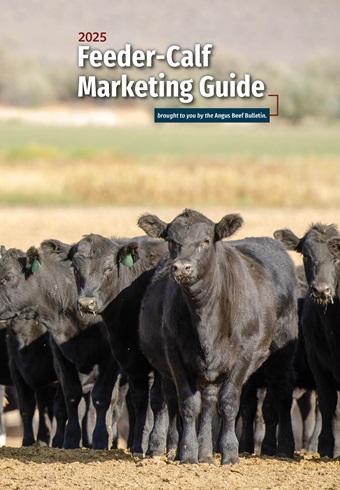
Feeder-Calf Marketing Guide
Stockyards Savvy
Nine ways to increase your take-home check.
July 25, 2025
Right now, even the most pessimistic producers have a hard time not smiling when they pick up their check from the stockyard. Still, with a bit of tweaking, the prices you get for your calves can be even higher. Here are nine ways to increase your paycheck.


1. Nutrition first
In a year’s time, Robby Stephens, owner-operator of Turner County Stockyard in Ashburn, Ga., sees 70,000-plus head of cattle go through the ring and weekly video sales.
“Nutrition is the most important thing because nutrition is the key to a healthy, strong, big calf,” he says, adding a caution: “We don’t want any fat calves because they’ll shrink out too much. You don’t want a thin calf, either, that can’t make the ride.”
At Wil-Mil Farms, a purebred Angus and commercial operation in Leesburg, Ga., manager Bill Holton is also a firm believer in top-quality nutrition.

“Nutrition is the most important thing because nutrition is the key to a healthy, strong, big calf,” says Robby Stephens of Turner County Stockyard, Ashburn, Ga.

“That adds value,” he says. “We graze our cows and calves on Bermuda and Bahia grass in the summer and make sure to rotate them through the pastures. In the winter they graze oats or triticale.”
2. Invest in bull power
Stephens puts genetics right up there with nutrition.
“I always tell people a cow is 50% of a calf, and a bull is 50% of your calf crop. A good bull can make up for a lesser cow,” he says.
And yes, breed matters.
“Angus is used a lot. Buyers want black calves in a moderate frame,” he explains.
A lot of Charolais-cross and Hereford-cross calves come through the ring, but not many with Brahman blood, Stephens says. “The buyers will dock you a little bit for ear. A half-blood Brahman isn’t [going to] bring near what an Angus or English-sired calf will bring. That’s just because it won’t grade as good or feed as good on the other end.”
“Superior genetics help us when we sell,” Holton says. “We use AI-sired (sired by artificial insemination) Angus bulls.”
3. Numbers matter
Yes, even when you sell calves through the ring at the sale barn, numbers matter.
“Going from a lot size of one up to a lot size of 15 to 20 head makes a really big difference,” Josh Maples, Mississippi State University (MSU) ag economist, says, citing a University of Kentucky study. “Once you get up into that 40- to 50-head range, the difference is smaller, but certainly still increases as you get higher. But those really small lot sizes, selling one at a time, two at a time or three at a time, is detrimental to the price you get as compared to selling more calves together.”
If you have a smaller herd, you can help yourself by having a controlled breeding season, Stephens advises. “The tighter the calving season, the better off you are — one, just for the ease of working your cattle; and two, the bigger the groups we can make with your calves, the better off you’ll be.”
At Wil-Mil, Holton starts calving the first of October and finishes by Dec. 10. That gives him a uniform load lot of steers averaging around 590 pounds (lb.) that he sells through Turner County Stockyard’s weekly video sale.
There aren’t as many heifer mates to market.
“By the time we take our replacement heifers out, we only have around 50 head, so we don’t have enough for a truckload lot,” he explains. “But, they group them at the stockyard.”

“Superior genetics help us when we sell,” says Bill Holton of Wil-Mil Farms, Leesburg, Ga.

If you have neighbors with cattle, Stephens adds, you can help each other by using similar genetics and the same calving season. Then you can make your own groups and possibly reach that uniform truckload lot buyers love.
Stephens says a truckload, sold through their video sale, will typically bring 20¢-25¢ per lb. more than similar cattle sold one at a time through the ring.
Maples agrees.
“Time after time, study after study has shown that 50,000 pounds, where you can do a lot of the work for the buyers by putting the load together for them, typically pays in terms of the price,” he says. However, if the cattle in a load are from a number of different operations, the buyers will take that into account because of the risk of commingling on health.
4. Cut to the chase
“With castration, the smaller the animal, the easier it is on you and the calf,” says Stephens. However, when the calf is smaller, 300 lb. or less, he says, there isn’t much price difference between a bull and steer calf. Watch out later, though.
“When you get over 400 pounds, there is 20¢ to 30¢ between a steer and a bull calf,” he says. “The buyers really start looking to make sure every single one’s a steer. When you get over 600 pounds, castration really starts paying.”
5. Healthy is as healthy does
Stephens recommends giving calves respiratory vaccinations, preferably a modified-live virus (MLV) and blackleg. “They need to give them at least three weeks before they sell them.”
At Wil-Mil, they give two rounds of vaccinations, a respiratory MLV and blackleg, as well as a dose of Synanthic® dewormer. They give the first round the first week of April when they also castrate the bull calves not being saved for seedstock. They give the second round the first week of May before the calves are sold in June or July.

Robby Stephens, owner-operator of Turner County Stockyard, recommends producers pen, sort and load their calves during the early morning hours to reduce heat stress.

6. Preconditioning pays
“A weaned preconditioned calf will still bring you 20¢-30¢ more — even through the ring — plus, you’re getting paid for the weight gained,” says Stephens. “If it costs you $1 to put a pound on, and you’re selling those pounds for over $3, you’re making money.”
7. Temper, temper
While it is awfully tough to find the time to just walk through your calves and get them used to humans, it can pay.
In a Mississippi study, researchers sat ringside and rated calves on a scale of 1 to 5, with 1 being the most calm while a 5 was extremely aggressive.
“Overall, an animal brought 3¢ to 4¢ less per pound if it was determined to be either a 4 or 5 on the aggression scale,” says Maples.
8. Travel counts
“If we have cattle coming 100 miles or 150 miles, we let our buyers know,” says Stephens. “They’re figuring the shrink in their head. That calf is not gonna shrink as bad so he can pay more for it. He’s already shrunk out on the trip and the buyer is getting a better weigh up.”
No matter how long or short a trip, Stephens urges producers to pen and haul early in the morning during hot months. “Try to do it during the cool of the day.
“In the summertime, at 7 o’clock in the afternoon, it’s still 90°.” He adds, “Be as low-stress as possible.”
Stephens also encourages producers to bring their calves to the sale early. If you can’t bring them the night before, get them to the barn first thing the next morning.
“That’ll give them a chance to fill back up on hay and water and will help them sell earlier in the sale,” he explains.
Stephens urges producers to make sure their trailer is clean before they load their calves.
“You want a clean environment,” he says. “You don’t want them to get on a nasty trailer. That’s why the people who haul for us wash their trailers out every week. You want a healthy calf when it gets here. We wash the barn out every week, too. We want the calves to be as healthy as they can [be] for the folks that are next in line.”
9. Bragging rights
Whether the calves have had vaccinations, have been preconditioned, or are sired by bulls from well-known purebred herds, tell your stockyard manager and, if possible, potential buyers.
“We announce it as the calves come in the ring,” says Stephens. “That’s what keeps buyers coming back.”
Editor’s note: Becky Mills is a freelance writer and a cattlewoman from Cuthbert, Ga.
 Hand-picked
Sometimes the answer is family, maybe just not your family.
Allen Wiggins had a dilemma familiar to more than a few cattle producers. He was ready to retire, but didn’t have anyone to take over the family business. In his case, it was Turner County Stockyard.
Wiggins was privileged to work with both his grandfather, H.R. Wiggins, and his father, Roy Wiggins, at the stockyard, which has been in business since 1960. However, both the older Wigginses passed away.
Allen’s sons grew up helping in the stockyard, but his oldest, Austin, is taking after his mother, Sonia, a nurse practitioner. Fresh out of med school, the young doctor started his residency in Tallahassee, Fla., this summer. Dallas, the youngest, is a talented musician, a drummer for three different north Georgia-based bands and works for the University of Georgia in Athens.
The real wakeup call came in 2020 when COVID hit.
Says Wiggins: “We lost Jim Freeman, our longtime bookkeeper. The last day he worked was his 49th anniversary. He got sick that night, and 17 days later he was gone. The day before his funeral, I came down with it and was sick for three weeks.”
Enter second-generation stockyard kid Robby Stephens. Son of Todd Stephens, owner of Northeast Georgia Livestock LLC in Athens, Robby worked for Wiggins while he was at Abraham Baldwin Agricultural College (ABAC) in nearby Tifton. He continued to help him part-time while he worked his grandparents’ farm.
Wiggins and Stephens talked about the young cattleman buying the stockyard, but still in his 20s, he didn’t think he could swing it. After his grandparents passed away, the farm was sold, and Stephens moved back to Athens to work for his dad.
“When I moved back to Athens, he missed me, and I missed being down here,” says Stephens.
In December of 2022, Wiggins was in Athens for a beef commodity meeting and went by the stockyard to talk to Stephens again. This time they made it work. On the last weekly sale day of May 2023, Stephens took over.
Wiggins is still a familiar face at the stockyard and helps out on Wednesday sale days, as well as Tuesdays, getting ready for sales. Still, he says the pressure is off and adds, “It’s not very often you get to handpick somebody you want to sell your business to. I wouldn’t have left my employees and customers with just anybody. We’re on our fourth generation with some of our customers.”
Stephens, now 29 and the owner-manager of the wide-open, nonstop auction market, says, “It’s working good. At the start, you have to earn everybody’s trust, but I think we’ve even drawn more customers.”
Currently, he’s planning on adding more pens on the outside of the barn to have more turnout space for cattle. Plus, even with the 3 a.m. postsale nights, he says, “I love it. I love what I do.”


Topics: Feeder-Calf Marketing Guide , Marketing
Publication: Angus Beef Bulletin
Related Content



Current Angus Beef Bulletin
Our November issue focuses on the females of the herd and the records that validate them.