



Angus Stakes
We’ve come a long way since barbed wire.
July 31, 2025
Innovation.
What’s it mean to you? Invention? Advancement? Technology? Expense? Mindset? Change? Improvement?
In my mind innovation encompasses the inventions and the advancements — in both tools and mindsets — that propel an industry forward. The beef industry has certainly witnessed a lot of innovation through the years.
Historically, barbed wire would be heralded as one of the most impactful innovations of the beef industry. Patented by Joseph Glidden in 1874, barbed wire allowed cattle to be raised in a more controlled environment, ushering in opportunities to innovate in areas of grazing, feeding, genetic selection and breeding, as well as biosecurity and health.
The ability to transport cattle via railroad would rate, as well. Railroads provided greater market access, opening up access to population centers in the East and the Midwest and allowing creation of marketing hubs.
The meatpacking industry has certainly had its share of innovations over the years — innovations that have led to greater productivity, improved animal welfare, improved food safety and improved worker safety.
Innovation often meets resistance. Some is due to fear of change, while some is justifiable critique that can improve the innovation. Glidden’s patented wire was not the first wire to fence cattle in.
Certainly, barbed wire had its share of detractors. But true innovations are more than inventions. They are the necessities we didn’t know we needed. They have logic. They have a practicality. They promise a return on investment, and they lay the groundwork for further innovation.
Angus innovation
When George Grant brought the first Angus bulls in America to Kansas in 1873, they were considered freaks because they were polled and solid black, a sharp contrast to the longhorn cattle prevalent at the time. But, when those Angus bulls were bred to the longhorn cows, their polled, black calves weighed up heavier the next spring. As beef, they provided a better eating experience.
Success of the breed led to formation of the American Angus Association. Organization led to internal discussion, research and collaboration, which eventually led to performance programs, breeding values, expected progeny differences (EPDs), the Certified Angus Beef ® (CAB®) brand, ultrasound, dollar value indexes ($Values), genomic testing and genomic-enhanced EPDs.
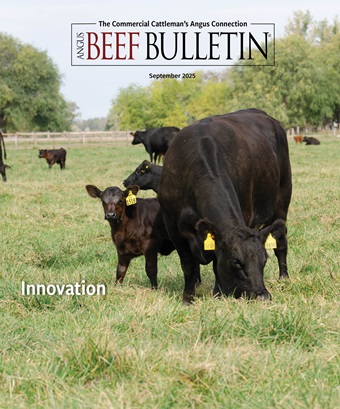
Today, 152 years after those bulls first stepped onto the Kansas prairie, the Angus breed influences 80% of the nation’s cow herds. The innovations of the past have led to the innovations that we feature in this issue today — the newly launched maternal EPDs for functional longevity (FL), teat score (Teat) and udder suspension (UDDR); the GeneMax® Advantage™ heifer selection and herd benchmarking tool, SireMatch™, and the Genetic Merit ScorecardSM.
Beyond the breed and its toolbox, the industry continues to advance with new equipment, new pasture management, new handling practices and new products.
We’ve come a long way since barbed wire. Today’s virtual fencing innovations promise to reduce our reliance on permanent fence altogether.
When we fail to innovate — such as failing to address the change in cattle type with the formula for red meat yield (see story in the Feeder-Calf Marketing Guide inserted in this issue), economic signals can become warped. That can slow progress at the very least.
When we see the gap in what could be, it incentivizes more aggressive innovation. I look forward to the next era of innovation. It’s sure to advance techniques and tools to address feed costs through enhanced feed efficiency, ways to enhance immunity and protect herds from disease, and ways to reduce labor and enhance our time spent with the cattle.
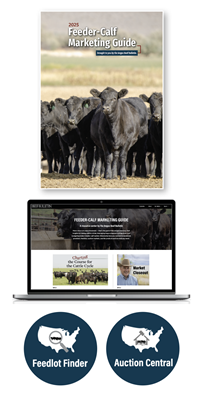 Feeder-Calf Marketing Guide
With its own homepage on the redesigned www.Angus.org website, we’ve modified our timing and presentation of the Feeder-Calf Marketing Guide. We’ve moved the “Feedlot Finder” and “Auction Central” listings online, where we can take advantage of the ability to keep listings more current.
Now presented in September, we focus the content of the Guide (see insert in this issue) on the feature stories to help you make the greatest return possible on your investment in Angus genetics.
See the Feeder-Calf Marketing Guide for more about the switch.
Topics: Business , News , Management , Sustainability
Publication: Angus Beef Bulletin
Issue: September 2025
Related Content


Current Angus Beef Bulletin
Our November issue focuses on the females of the herd and the records that validate them.